Interview with Daniel Wedi Korbaria, Author of the book- "Mother Eritrea".
Januari 6, 2020
https://www.blascodamompracem.it/home/i ... r-eritrea/
Interview with Daniel Wedi Korbaria, Author of the book- "Mother Eritrea".
Januari 6, 2020
https://www.blascodamompracem.it/home/i ... r-eritrea/
 (Software translation from italian)
Eritrean writer born in 1970,
Daniel Wedi Korbaria has lived in Italy since the mid-nineties. He has been involved in theater for a long time and in recent years he has collaborated with many magazines writing articles, essays and surveys with a focus mainly on immigration. Pan-Africanist and not aligned with the dominant ideology, highly critical of NGOs and a great lover of his culture, Daniel is an erudite and out of the choir voice, which deserves to be listened to carefully for the depth of his speeches and for his testimony of a great man of African culture. 'Mother Eritrea' is her first book, written in 2019 and published by the Tuscan publishing house:
La Vela. A novel that is a journey into the Asmara of the seventies, still under the occupation of Ethiopia, to relive the everyday life of a very poor family, their places, their hopes, their humanity, their faith. A novel that is pure micro-history, a reading to understand dynamics that too often we tend to approve, out of laziness or necessity, behind the word Africa alone. But the black continent is immense and each place has its peculiarity, its history, its language, its religion, its people. An extraordinary, moving book that leads to reflection on the value of life, on the value of every life. A work that highlights, once again, how it is not the wealth of a nation that determines the happiness of a people, but the relationships between its people and the power of its traditions, which are transformed from generation to generation, to create life and give light to hope. Between anthropology and neorealism, definitely one of the best readings on Africa ever faced.
We interviewed the author, while if you want to buy the book go here..
https://www.edizionilavela.it/prodotto/mother-eritrea/
Q: Asmara in the seventies, the torrserawit (Ethiopian soldiers) impose a curfew on the local population. The occupation of Eritrea, in a few decades, has gone from Italian to Ethiopian. How did your people go on in a grueling war, which lasted more than thirty years, and achieve independence in 1991? What kept you together?
A: In the 1950s many colonies were recognized as independent nations, the only one not having had this opportunity was Eritrea. This was an injustice inflicted on us by the United Nations because, on the other hand, the Ethiopian
Negus Haile Sellassie enjoyed the iron alliance with Washington and London. To us Eritreans, to conquer our Independence, there was nothing left but armed struggle. Thus, in every Eritrean family there was someone who fought at the front: fathers, mothers, brothers, sisters, uncles, men and women, young and old, Christians and Muslims, a struggle where about 60,000 young people lost their lives, and all with one goal: free Eritrea from
torrserawit. What united us, was this very strong desire for self-determination for the birth of a nation called Eritrea.
 Q: Asmara's meticulous description, is enchanting for the reader. A total immersion in the everyday life. Yet a rare humanity emerges, to be found in rich and westernized places. How much does spirituality and faith affect, the bonds of the Eritrean people?
A
Q: Asmara's meticulous description, is enchanting for the reader. A total immersion in the everyday life. Yet a rare humanity emerges, to be found in rich and westernized places. How much does spirituality and faith affect, the bonds of the Eritrean people?
A: Christians and Muslims who have fought for independence together, have always lived together peacefully and in harmony. In Asmara, my city, every day at dawn you can hear the songs from the Coptic churches, at sunset the call of the
muezzin merges with the sound of the bells of the Cathedral for the evening mass. During holidays such as Christmas or Ramadan, Eritreans wish each other good wishes by visiting their respective houses with a cake in hand.
Certainly we must always ensure that no type of religious extremism infiltrates to threaten this harmony, especially those who preach ethnic-religious divisions. In much of the African continent, there is in fact a worrying spread of new pseudo-religions of very social preachers who put more wood on the fire of the perennial inter-ethnic conflicts and tribal divisions causing them often to lead to real massacres. I remain skeptical about the usefulness of importing these "religions" since they will only create, as is already happening, other useless and dramatic divisions. But I fear that these divisions are part of the weapons of neo colonialism.
 Q: Mother Eritrea, is the mother of the two young characters of the novel. Her figure touches the mythological and amalgamated drama, love and religion. A figure that radiates eternity and alternates the deeper moods of the condition, of both mother and woman. Forty years later, the era in which the novel is set, how is the condition of women in Eritrea?
A
Q: Mother Eritrea, is the mother of the two young characters of the novel. Her figure touches the mythological and amalgamated drama, love and religion. A figure that radiates eternity and alternates the deeper moods of the condition, of both mother and woman. Forty years later, the era in which the novel is set, how is the condition of women in Eritrea?
A: At the time when Mother Eritrea was a child, the living conditions of women in Eritrea was that of working animals, divided between home walls and fields, to collect lumber and provide the water of daily needs. Heavy work, on the verge of slavery. They were illiterate and without rights, not even that of owning their land. To worsen the conditions of women came brutal and violent Ethiopian
torrserawit, as it is widely described in history. And it was precisely to rebel against this violence, that many girls chose to join the armed liberation struggle. They wanted a country founded on egalitarianism, between men and women.
Those women fought and gave their lives to build Eritrea and today, after just a quarter of a century, there are women ministers and ambassadors, teachers, doctors, engineers, others who drive taxis, buses or construction machinery, airplane pilots and all, like men, do military service. In Eritrea there is no feminicide or gender violence. Eritrean women can stroll peacefully in the evening.
In the novel, I describe a dramatic scene on FGM. Here, this barbaric practice that for decades was practiced throughout the Horn of Africa became outlawed in Eritrea in 2007 and, I would add, anyone who stands up for human rights on women should bow to that result.
 Q: How autobiographical is your book and what has prompted you to leave us, this splendid testimony of your country?
A
Q: How autobiographical is your book and what has prompted you to leave us, this splendid testimony of your country?
A: This is not an autobiographical novel but like so many stories, it is inspired by personal experiences. Many characters are invented, and others are inspired by people I have known in the past. I did nothing but lay a sheet and project, as in a documentary, the whole history of the Liberation struggle and the years of the rise and flight of the infamous Colonel
Menghistu Hailemariam. And since it is a novel, the whole story is narrated through the voice of a child,
Yonas the protagonist, an African
Tom Sawyer but with an empty belly, who together with his little brother is constantly hunting for food. I chose to tell the vicissitudes of a "particular" family, that of an Eritrean woman who alone raises two mulatto children, a misfit, poor family, apparently with no hope of coming out of the war unscathed.
But in addition to wanting to tell this story that can be considered "universal", I wanted to give an answer to those who often ask me "But why do young people flee Eritrea?". After reading the novel, anyone can understand the suffering endured by an entire people under the bombs. But to the Eritrean who fled the war at the time, Italy would never have given any political asylum, to any of the characters described in my novel, not even to the
Yoni brothers and Sami! Today, however, it grants it with great magnanimity.
Have Eritreans changed, or has Italy changed? Or, do they want us to believe that today's Eritreans are worse off than those who suffered napalm bombs? I don't believe so and I don't believe, that Italy has become more good and "human" than in the past. Instead, I believe that Italy is involved in the "project" that is moving entire populations from the South to the North of the world, making them land in its ports, and in fact, managing the lucrative "hospitality business" that employs thousands of Italians. Otherwise, why welcome so generously an Eritrean or pseudo-eritrean, such even at "prima facie", without documents and assigning everyone the same date of birth: January 1st?
Q: In many articles signed by you, which can be easily found on the web, you are very critical of the role of NGOs in the Mediterranean which, in your opinion, represent an element of pull factor that pushes many Africans to leave their land & move to live on the edge of poverty in Europe. Could you tell us more about this, please?
A: For a long time I have stopped believing the goodness of the NGOs, with many of them I have had some bickering and I have talked about many others in my articles. From my experience on the migration phenomenon of the last decade, I can say that many of them have slingshot, metaphorically speaking, like dogs on the bone to be stripped, to have greater visibility. I invite anyone wishing to know a little more on the subject to read the article "
Rescue at sea or shipwreck announced?"
https://www.lucadonadel.it/salvataggio- ... nnunciato/ I personally do not believe in the goodness of them, and wonder who could be behind it. Who are the owners, of those "save migrants" ships? What if they were characters related to intelligence, lobbies, ex-soldiers and people related to particular interests? But did they really redeem themselves, on the road to Damascus?
 Q: What is the pan-Africanist movement and what are its objectives?
A
Q: What is the pan-Africanist movement and what are its objectives?
A: Pan-Africanism means, finding solutions by reasoning in terms that are no longer national but continental and taking to heart the idea of African revival. But despite the good intentions in Italy, there is no real movement out there capable of involving everyone. There have been attempts to bring together the various African diasporas in a "pan-Africanist" movement but so far with little positive development, since the Africans residing here are fragmented into small groups and it will take a lot of effort to succeed in the endeavor.
Q: What is the socio-political situation today in Eritrea and how, after almost thirty years since Independence, have relations with Ethiopia been restored?
A: Unlike the previous Ethiopian government of the TPLF, the new Premier
Abiy Ahmed, a young but enlightened leader, has finally accepted the border verdict established in 2002 by a UN Commission by ending the war that started in 1998/2000. Thus, peace between the two countries has been progressing for a year. In mid-December 19, President
Isaias Afewerki went for the second time to Addis Ababa where together with the new Nobel Peace Prize he laid the foundation stone of the future headquarters of the Eritrean Embassy, to be built in the center of the city on a plot donated to the Eritrean people as a Christmas present.
However, the TPLFs ousted by Abiy barricaded themselves in their region of Tigray and row against peace by not evacuating their army from Eritrean territories. To avoid attacks, the Eritrean border with the Tigray is currently closed. The next elections in May 2020, will be very important for the continuation of the path of this peace. This is why Ethiopia needs to heal its ailments, which are the inter-ethnic conflicts it currently suffers from and thus be able to gain some political stability.
 D: On Christmas day, I saw children go crazy for the gifts they were gaven. They had become aggressive and overexcited and, I don't hide you, they scared me. At that moment I was thinking of the little brothers/characters in your book when they find a tennis ball, and the joy they felt for an unexpected gift so simple that a child here would throw it in the trash with contempt. We live in a violent and frenetic system of values, ordered by the most bitter consumerism that wants to make every man a nihilist without spirituality and an amorphous being in feelings. How much can we learn about it from Africa?
A
D: On Christmas day, I saw children go crazy for the gifts they were gaven. They had become aggressive and overexcited and, I don't hide you, they scared me. At that moment I was thinking of the little brothers/characters in your book when they find a tennis ball, and the joy they felt for an unexpected gift so simple that a child here would throw it in the trash with contempt. We live in a violent and frenetic system of values, ordered by the most bitter consumerism that wants to make every man a nihilist without spirituality and an amorphous being in feelings. How much can we learn about it from Africa?
A: In my book, the tennis ball has a symbolic value. It is an ephemeral object, which however has a great emotional value. Today, in the West, no gift can ever match that tennis ball received so unexpectedly, not even a smartphone gift would make children so happy. Abundance and consumerism, can kill not only creativity but also childhood. But in Africa, where consumerism is virtual, it is still possible to see the authentic joy that a very small gift can give a child, for example a colored pencil or a candy. And seeing those smiles, makes you feel like a tiny little being.
Q: In your opinion, is it easier to draw from your book a trip to the places you describe or a film/TV series?
A: In the past, I wanted to be a film writer and I have also participated in numerous competitions by presenting some screenplays written by me. Today, to tell Mother Eritrea I chose to create a cinematographic narrative structure, almost to tell in images, and so, with plot weaves and twists, I hope I have given birth to a work not without moments of climax at high voltage. I wanted to create a novel, that was full of images printed on film and therefore indelible. But my hope is also to be able to intrigue the reader just enough, to convince him to take a trip to my country. An experience, that could turn into the journey of life. Go and see for yourself and discover the real Eritrea, to get to know its people, its history, its culture and its determination to resist neo colonialism.
 The author: Daniel Wedi Korbaria



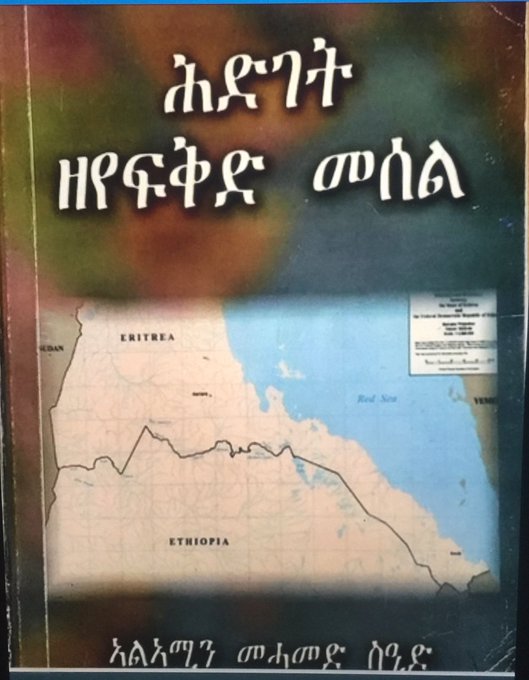
 partly tells Somalia & Eritrea solidarity in the aftermath of WWII & Ethiopia's attempt to annex both Eritrea & Somalia by cajoling the figureheads of the time, to withdraw their support for independence.