Some notes on change
Wednesday, 18 December 2019
By Simon Weldemichael
http://shabait.com/categoryblog/29806-s ... on-change-
Some notes on change
Wednesday, 18 December 2019
By Simon Weldemichael
http://shabait.com/categoryblog/29806-s ... on-change-
Change is the law of nature. Under the sun, nothing is permanent except change itself. Change is an inherent characteristic of an individual, organization, society and country.
Change can be an opportunity or a threat. Change does not take place in strictly defined models. People may resist or make change.
Marx has pointed out that the job of philosophers is not to interpret but to change the world. However, we should not forget that the quality of change is always determined by how we define and interpret the reality. For this reason, before rushing into change, individuals, organizations and countries are advised to define their reality objectively and then accept it courageously.
We have reached a time to say good-bye to 2019 and welcome a New Year. In 2019, Eritrea played a proactive role in consolidating the hard founded peace, sustaining regional cooperation and materializing the aspiration of the people. The Eritrean people are hopeful, looking optimistically to the future with every passing year of peace.
Human beings have been striving for change while simultaneously resisting it. We have certain things that need to be changed and others that need to be retained. To know what to change and what to preserve is important for success. Many people have a simple or imprecise notion about change and blindly want to introduce change. But change at all levels requires utmost prudence, practicality and responsibility.
When some significant threat or opportunity arises, change becomes inevitable. Change takes place both in response to internal developments and actions that happen in the external environment. When the time is ripe, the signal that tells the need for change appears. Premature change and overdue change are not likely to bring about the desired result. At individual level, change may include alteration and modification of once behavior, style and attitude. At organizational level, it may mean changing the organizational structure, introducing new technology, reshuffling personnel and re-shaping the organizational culture. This means that change demands individuals and organizations to alter their old thinking styles and behavior patterns to establish innovative, progressive and advanced styles and behavior.
We crave for change based on the assumption that it will improve our conditions. However, improvement lays not in the change itself but in the quality and management of change. Any change has to pass through some stages in order to bear beneficial fruit. Before rushing into change individuals and organizations are advised to make intensive preparation and evaluation. They must first recognize the necessity and urgency of change. We crave for change to overcome existential or potential problem. However, before addressing the problem we have to understand and agree on the root cause of the problem. We have to improve the quality of change and reduce the change-induced incidents by critical and scientific handling and management of change. History teaches us that many individuals and societies that show laxity have been wrecked by the winds of changes.
It is important for individuals and organizations to constantly monitor their performance and what is happening around them. This helps them realize the need to change. In this fast moving world, to survive as well as to thrive, we need to develop a means of managing change and then introduce timely, essential and controlled change. It is necessary to consider the causes of change and what actually needs changing.
The national charter of Eritrea states that,
an organizational structure is not something that is designed once to serve forever. It must change with new developments and changes in conditions.
Structures are like soil and policy is a seed that grows on it. A good policy can only be productive when promising and fitting environment is in place. The placid and carefully observed changes that have been introduced by the government so far constitute a giant step. The Peoples Front has effectively created a stable political system, societal harmony and functioning economic system. The rich experience of conflict resolution and change management of the leadership gives advantage and confidence to experiment change. The empowerment and adjustment of the Peoples Front to meet the demands of ‘the new era’ of peace would determine the course of events and the fate of the country.
Change emerges as a result of simultaneous domestic and external factors. Multiple political, cultural, social, technological, economic as well as natural forces contribute, with varying degree and speed. Change at national level is a complex and nonlinear process. We have to understand the interaction of domestic actions with those of others. Change is not a matter of proclamation and decision. It is a slow and gradual process and moves through a series of stages. In the first instance, the need for change must be recognized. Above all, it is important to bear in mind that not all changes are necessarily improvements. We shall not be tempted to make changes for change’s sake. What we need is a deliberate change that passes through conscious reasoning.
Change is not a guaranteed and secured journey toward a better life. Change is rather an uncertain process of moving from one challenge to the next. The new era of peace in our region is both an opportunity and a challenge to Eritrea. Eritrea is playing a proactive role in consolidating and expanding the peace. The pace with which Eritrea adjusted herself to the emergent situation attracts appreciation from different directions. The rapid transformation and harmonization have helped the country to adapt to the new changes without disruption. At this critical point in time, Eritrea is fortunate to have a mature and skilled leadership that has accumulated a rich experience of coping with and managing change.
Eritrea is one of the few countries in the region that has effectively maintained a sound social harmony. We must recognize and strengthen the different institutions that have developed over time and protected the harmony and security of the society. The Peoples Front as a political institution guarantees the unity, harmony and security of the country.
_________
___________________
MoE: striving to Achieve SDG4
By Milka Teklom
http://shabait.com/articles/nation-buil ... ieve-sdg4-
Articles
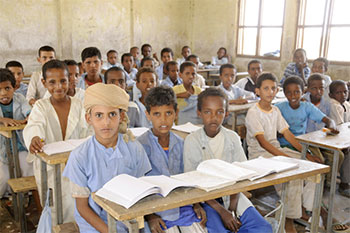
Pre-schools or kindergartens were originally created in the late 18th century in Bavaria and Alsace to serve children whose parents both worked outside home. Preschools today are formal educational institutions that provide learning space for children aged two to seven years. They serve as a bridge for children as they make a transition from home to school life.
The government of Eritrea has been working vigorously to achieve the
Sustainable Development Goal number four (SDG 4), which requires every state to ensure inclusive and equitable quality education and promote lifelong learning opportunities for all. Especially since the formation of the macro-policy in 1994, the government has been investing on the expansion of pre-school education. In order to address the Education Sector Plan (2020- 2022), the Ministry of Education (MoE) held a national workshop, under the theme “
laying the foundation for lifelong learning,” from 4 to 5 December, with a view to reaching a consensus and finalizing the documents on the
Education Sector Communication Strategy (ESCS) and
Early Childhood Care and Education (ECCE) Strategy.
In his address at the workshop held at the National Confederation of Eritrean Workers, Mr.
Petros Hailemariam, representative of the minister of Education, said finalizing the two documents (ESCS and ECCE) is part of the government’s policies and efforts. Director General of the Department of General Education at the MoE, Mr.
Mussa Husien Naib, briefed the participants on the backgrounds of
Early Childhood Development (ECD) programs, global commitment and the role of an integrated ECD programs in promoting social justice.
Mrs.
Abeba Habtom, Head of the ECCE panel, took over the platform to introduce the ECCE strategies and objectives and the benefits of the investment for the ECD. She noted that in the last two decades the government, with the help of parents, has been investing in the expansion of early childhood education (ECCE) programs. As a result, the ECCE centers increased from 90 in 2001 to 524 in 2017. The ECCE curriculum is based on a thematic approach to guarantee incorporated planning, teaching and learning that empower children to achieve dynamic knowledge, skills, and attitudes.
Mrs. Abeba also talked about the strategies implemented by the MoE to improve the quality of pre-school education, including the procedural guideline in 2001 and an integrated ECD policy in 2004. Various manuals, guidelines, syllabus, early learning development standards and supportive learning materials have been prepared, updated and translated into eight local languages. Mrs. Abeba outlines the five objectives of the program, which are, proposing strategies to meet the 30% net enrolment rate for pre-school children by 2020; providing strategies to improve the quality of the existing and future learning environment; recommending an implementation plan for the proposed strategies targeting remote and disadvantaged areas; proposing ECCE budget allocation and future coverage of ECCE services; and suggesting a monitoring and evaluation framework for the ECCE sub-sector.
Mrs. Abeba concluded her speech saying that in Eritrea there is no school-feeding program for children aged five and under-five, which is negatively affecting 50% of under-five children in their cognitive development.
The third speaker on the occasion, Mr.
Abraham Russom, director of curriculum, addressed the issue of finance, budget implementation plans, research, and monitoring and evaluation system. He said the government funds the ECCE program’s operational costs, but to complement the government’s efforts, advocacy work needs to be done to increase financial support and commitment and a resource mobilization strategy needs to be developed to improve financing of the sector.
After thanking the MoE for creating a forum for discussion, Ms.
Shaheen Nilofer, UNICEF’s country representative, said that globally 175 million boys and girls are not enrolled in pre-school education. Especially in low-income countries, nearly 8 in 10 children (78%) are missing this opportunity. She noted,
As a global community, we face a shared challenge to ensure that the graduating class of 2030 starts school at the right time.
She assured everyone that UNICEF would continue to advocate and support Eritrea towards providing children with the opportunities they deserve and towards shaping a better future for children and their societies in the decades to come. She wished the participants a successful and fruitful outcome from the consultation workshop.
I expect outline directions and implementation of the two strategies, which will guide interventions at community level,
she said.
According to a study in 2016 on “
out of school children”, despite progress in the last two decades in Eritrea, access to pre-school education is still low; the net enrolment ratio for 4 to 5 year-old children is 17.1%, and 73% of age 5 children are out of school. In an interview, both Mr. Mussa and Mrs. Abeba said that the main aim of the MoE is to raise coverage of pre-school education to 30% by 2020.