 Opinion
Eritrea Built Its Sovereignty on Land. Now It Needs It Online.
By Ternafi
https://mesobjournal.com/post/eritrea-d ... et-gateway
Aug 10, 2026
Opinion
Eritrea Built Its Sovereignty on Land. Now It Needs It Online.
By Ternafi
https://mesobjournal.com/post/eritrea-d ... et-gateway
Aug 10, 2026
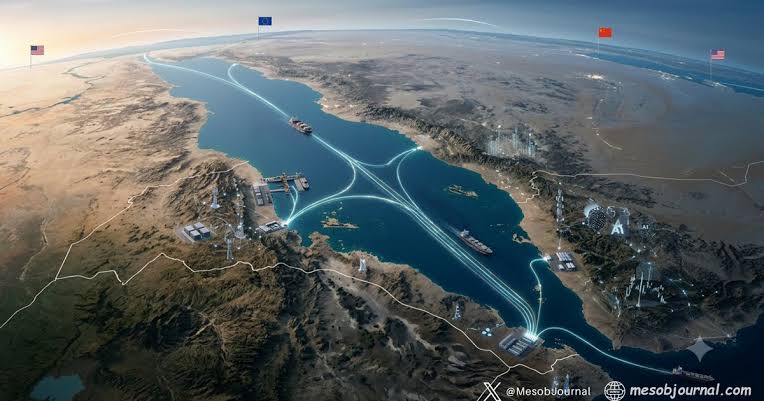 Eritrea at the center of the Red Sea’s emerging digital gateway.
For Eritrea, sovereignty has never been an abstract idea.
It was fought for on the ground, defended along a contested border, carried through years of sanctions and diplomatic isolation, and built into an economic philosophy that remains deeply suspicious of dependency. Few African states have placed greater emphasis on the ability to make national decisions, without asking permission from outside.
There is now another frontier where that principle has to be applied.
The internet.
Not
Facebook. Not entertainment. Not whether people can watch videos faster.
The issue is whether Eritrea can build an economy, educate a new generation, run modern hospitals, connect businesses to markets, digitize government, attract investment, modernize banking and participate meaningfully in the artificial-intelligence revolution without possessing the digital infrastructure on which all of those things increasingly depend.
On that measure, Eritrea has fallen too far behind.
Industry infrastructure directories continue to identify Eritrea, as the only coastal African state without an operational submarine telecommunications cable landing station. At the same time, some of the world's most important fiber routes run through the Red Sea corridor immediately beside it.
There is a strange contradiction here.
Eritrea possesses one of Africa's most strategically valuable coastlines, overlooking a maritime passage connecting Europe, Asia, the Gulf and Africa. Ships, energy and information move through this corridor every day.
Yet, much of the digital economy moving underneath those same waters effectively passes Eritrea by.
That should no longer be treated as an ordinary telecommunications problem.
It is a strategic development problem.
The next infrastructure is invisible
There was a time when development could be measured largely through things people could see: roads, dams, ports, factories, schools, clinics, electricity lines.
Those still matter.
But fiber has joined that list.
A modern economy increasingly runs through infrastructure buried underground or laid across the seabed. A farmer checking agricultural information, a doctor consulting medical databases, a student taking an online engineering course, a hotel receiving an international booking, a bank clearing transactions, a mining company transferring geological data and a government digitizing customs are all drawing on the same underlying resource: reliable connectivity.
The World Bank describes digital connectivity as an enabler of productivity, innovation, trade and job creation. Across Africa, its digital-development programs increasingly treat broadband not as a consumer luxury but as basic economic infrastructure.
Artificial intelligence makes the gap more consequential.
AI systems depend on connectivity to reach cloud computing, datasets, software repositories, research, models and digital services. The International Telecommunication Union puts it plainly: widespread AI use requires strong, modern digital infrastructure.
A country can arrive late to social media and lose little of strategic importance.
Arriving late to AI is different.
AI is beginning to affect software development, translation, medicine, logistics, agriculture, education, mineral exploration, manufacturing, administration and scientific research. The distance between countries that can use these tools productively and countries that cannot, may widen remarkably quickly.
For Eritrea, the danger is not merely slower internet.
It is slower accumulation of knowledge.
Eritrea's past cannot simply be removed from the equation
Any serious discussion of Eritrean infrastructure has to acknowledge the environment in which the country developed.
Eritrea spent years under UN sanctions, before the Security Council unanimously lifted them in November 2018. European restrictive measures implementing the UN regime, were subsequently repealed.
That was not the end of external financial pressure.
In November 2021, the United States imposed sanctions on the Eritrean Defense Force, the PFDJ, the Hidri Trust, Red Sea Trading Corporation and individuals under an executive order related to the conflict in northern Ethiopia. Washington moved in 2026 toward removing those particular measures as its strategic calculations in the Red Sea changed, although other U.S. restrictions and individual designations have existed under separate legal authorities.
The significance extends beyond the legal language of sanctions.
Small states that become politically toxic in major financial centers can encounter a second layer of isolation: banks reluctant to process transactions, vendors worried about compliance, investors demanding higher risk premiums, insurers hesitating and companies deciding that a small market is not worth the paperwork.
That environment can make infrastructure procurement harder, even where no blanket prohibition exists.
For Eritrea, which already chose a cautious model of external borrowing and investment, such pressures reinforced a longstanding instinct: minimize exposure.
One can understand why.
But understanding the origins of caution is different from arguing that caution should govern every future decision.
At some point, a defensive strategy that successfully protects sovereignty can begin to constrain the economic capacity needed to sustain sovereignty.
Digital connectivity may be, where Eritrea is approaching that line.
External hostility is part of the explanation. It cannot become the explanation for everything.
This is the uncomfortable part of the argument.
Eritrea has legitimate reasons to remember what happened when international institutions, powerful states and financial systems were used to pressure it. Its skepticism did not emerge in a vacuum.
But there is no contradiction between acknowledging that history and expecting the Eritrean state to move faster today.
The UN sanctions disappeared almost eight years ago.
The geopolitical environment is changing.
Eritrea now conducts expanding diplomatic engagement across Africa, the Gulf, China, Russia, Europe and the wider international system. Even Washington's recent reassessment of relations has been influenced by something Eritrea has possessed all along: its strategic position on the Red Sea.
The country therefore has more diplomatic space with which to negotiate than it did during its most isolated years.
That space should be used.
Self-reliance cannot mean technological delay.
In fact, the logic should run in the opposite direction.
A state serious about self-reliance should want its own fiber backbone, domestic data capacity, cybersecurity expertise, national digital platforms and diversified international connections precisely because dependence on weak infrastructure leaves it vulnerable to others.
What “sovereign internet” should actually mean
There is a danger in the phrase sovereign internet.
It can be misunderstood as closing a country off from the global network or building a national intranet behind digital walls.
That would miss the point.
For Eritrea, digital sovereignty should mean connection without strategic dependency.
The country should be connected to the global internet through infrastructure whose critical decisions cannot be monopolized by one foreign government, one technology supplier, one cable operator or one geopolitical bloc.
That suggests several principles.
Eritrea should physically host international gateway infrastructure on its territory.
It should have more than one international route.
Critical state information and nationally important services should be capable of being hosted domestically.
Domestic traffic should not needlessly leave the country and travel thousands of kilometres before returning.
Network equipment should be interoperable rather than locked permanently into one supplier.
Cybersecurity competence should reside increasingly inside Eritrea.
And the state should know where its data goes, who operates critical infrastructure and what happens if one external connection fails.
That is sovereignty in digital form.
Start with the Red Sea
The obvious physical starting point is a submarine cable landing station.
Eritrea does not need to build an entirely new intercontinental cable from scratch. It needs to negotiate participation in the network already being constructed around it.
The Red Sea is one of the world's great digital corridors as well as a maritime one. International cable systems connect Europe with Asia and Africa through the region, while TeleGeography's global mapping shows a dense concentration of active and planned infrastructure running through the corridor.
This geography gives Eritrea leverage.
Massawa is the obvious candidate for serious technical study because of its proximity to Asmara, port infrastructure and position on the Red Sea. Assab should also be studied, particularly from the perspective of redundancy and future economic development.
Engineering, seabed conditions, security, power supply, route economics and cable-operator interest should determine the final configuration rather than politics alone.
But one principle should be decided before any feasibility study begins:
Eritrea should not build a single digital lifeline.
The Red Sea itself has demonstrated why. Cable disruptions in the region have affected connectivity far beyond the location of the physical damage, reminding governments that subsea infrastructure is both extraordinarily powerful and inherently vulnerable.
One landing is progress.
Two independent routes are strategy.
A future Eritrean system could combine submarine capacity, with a geographically separate terrestrial or second subsea route. Satellite should remain part of the resilience architecture, particularly for remote sites and emergencies, rather than serving as a substitute for the country's primary high-capacity backbone.
EriTel itself advertises VSAT satellite connectivity alongside xDSL, point-to-point wireless and leased-line services.
Satellite has its place.
A national digital economy should not be built around its limitations.
The cable alone will solve surprisingly little
There is another trap.
Governments sometimes celebrate the arrival of a submarine cable as though broadband has arrived everywhere with it.
It has not.
The cable merely brings enormous capacity to the beach.
The real development project begins there.
That capacity needs redundant fiber from the coast to Asmara. From the capital, a national backbone should reach Keren, Mendefera, Dekemhare, Barentu, Tesseney, Massawa, Assab and other population and production centers. Ports, schools, hospitals, universities, banks, mining operations and industrial sites should be treated as anchor customers around which wider networks can grow.
The ITU's 2025 assessment of African connectivity describes fixed fiber infrastructure, as a cornerstone of digital transformation. Its mapping also places Eritrea among the African countries, where relatively few people live close to core fiber nodes.
Then comes mobile broadband.
For most Eritreans, the digital revolution will not arrive through a fiber socket in the living room. It will arrive through a phone.
That means upgrading radio networks, spectrum use, towers and backhaul alongside the national fiber program.
Fiber without modern mobile distribution gives a state capacity without mass access.
Mobile access without fiber gives millions of users a narrow pipe.
Eritrea needs both.
Build an Eritrean Internet Exchange before waiting for everything else
Some improvements do not require waiting for a submarine cable.
An Internet Exchange Point in Asmara should be among the fastest achievable interventions.
An IXP allows networks inside a country to exchange traffic locally, rather than sending it through international transit infrastructure and back again. The Internet Society says this reduces cost and latency, while increasing resilience.
The African experience is worth studying.
In Kenya and Nigeria, early IXP development reduced local latency dramatically and saved operators substantial international transit costs. Kenya later increased the share of traffic being localized, as more networks and content providers interconnected domestically.
Eritrea's scale is smaller.
The principle is identical.
A message between two institutions in Asmara should not need to make an international journey.
Government portals, university resources, Eritrean media, educational material, software repositories and frequently accessed content can increasingly be hosted or cached locally.
The result is not only speed.
It is resilience.
If an international route fails, nationally hosted services can continue operating.
That is another form of sovereignty.
Data centers are the next strategic infrastructure
Once dependable fiber, electricity and domestic routing exist, Eritrea should begin thinking about national data-center capacity.
Not an extravagant hyperscale facility.
Start sensibly.
Government systems, national records, education platforms, health infrastructure, banking services and Eritrean digital businesses need secure domestic hosting options.
Over time, this can develop into sovereign cloud capacity.
Here the country's renewable-energy ambitions may become relevant. Data infrastructure needs dependable electricity and cooling. Eritrea's solar potential, combined with a carefully planned grid and storage strategy, could eventually support a modest domestic computing sector.
AI makes this increasingly important.
No small African state is going to reproduce the computing infrastructure of the United States or China. Nor does it need to.
Eritrea can use foreign cloud services while retaining sensitive national workloads, domestically. It can run smaller open-source AI models, locally. Universities can build computing laboratories. Ministries can deploy AI-assisted translation and administrative systems. Health researchers can analyze data under national rules. Software engineers can participate in global development, without leaving the country.
Digital sovereignty is not autarky.
It is having options.
And this is where Eritrea should avoid an old trap in a new form
China would be an obvious potential partner.
So could Gulf investors, Asian equipment manufacturers, African development institutions, European companies and other cable consortia.
Eritrea should speak with all of them.
But the country should resist the temptation to replace one dependency with another.
If a single foreign vendor supplies the cable connection, national backbone, switching equipment, cloud layer, cybersecurity tooling and maintenance, the flag over the supplier's headquarters matters less than the dependency itself.
The same principle Eritrea applies in diplomacy can be applied to technology:
diversify.
Use Chinese financing where the terms make sense.
Use European technology where it is competitive.
Engage Gulf capital where interests overlap.
Seek African institutional financing where available.
Build Eritrean technical competence throughout.
Require interoperable standards.
Retain the ability to replace components.
Own the architecture even when others supply the equipment.
That would be a genuinely multipolar digital strategy.
The diaspora is an underused digital asset
Eritrea possesses something many infrastructure plans overlook: a technically educated diaspora spread across Europe, North America, the Middle East and elsewhere.
Software engineers, network specialists, cybersecurity professionals, data scientists, medical researchers and entrepreneurs with Eritrean roots already work inside some of the world's most advanced economies.
They should not merely be asked for money.
Ask for knowledge.
A national digital program could create structured temporary-return fellowships, remote engineering groups, university partnerships, cybersecurity advisory networks and startup mentorship programs.
Ten experienced Eritrean network engineers contributing architecture and training may sometimes be more strategically useful than another equipment donation.
Infrastructure depreciates.
Knowledge reproduces itself.
The government should also accept that openness creates capacity
Infrastructure alone will not produce a digital economy.
People need room to use it.
Students need affordable access.
Businesses need predictable rules.
Developers need software tools, cloud services and online payment mechanisms.
Universities need international research access.
Entrepreneurs need the ability to experiment.
Government agencies need to digitize services in ways that reduce bureaucracy rather than simply moving bureaucracy onto a screen.
Cybersecurity concerns are real. Foreign surveillance is real. Disinformation is real. Digital dependency is real.
But restricting technological adoption cannot be the long-term answer to technological risk.
The stronger response is competence.
Train cybersecurity professionals.
Build laws.
Protect critical infrastructure.
Develop national identity systems carefully.
Create privacy standards.
Teach media literacy.
Secure networks.
Maintain backups.
Diversify suppliers.
A society becomes digitally resilient by learning to operate technology, not by remaining outside it.
A five-year national mission
Eritrea has experience organizing national development around long-term objectives.
Connectivity deserves that level of seriousness.
The first year should be about decisions: establish a national digital infrastructure authority or task force, map existing telecom assets, commission cable-landing studies for Massawa and Assab, establish the Asmara IXP, identify spectrum requirements and prepare the legal architecture for wholesale access, cybersecurity and data protection.
Years two and three should be construction years: secure at least one submarine connection, build redundant fiber toward Asmara, modernize core network equipment, extend backbone capacity toward major towns and prioritize hospitals, universities, ports, banks, mines and schools.
Years three through five should turn infrastructure into an economy: wider mobile broadband, local data hosting, digital public services, university computing facilities, electronic payments, technology training and incentives for Eritrean software and service companies.
The state does not have to privatize the entire telecommunications sector to do this.
Nor does it have to copy another country's model.
But monopoly cannot be allowed to become synonymous with stagnation.
Even where the government retains strategic ownership, operators can be subjected to performance targets, transparent wholesale arrangements and technical benchmarks. Infrastructure sharing and carefully managed competition at the service layer can lower costs without surrendering strategic assets.
Eritrea can design its own model.
What it cannot do is pretend time has stopped.
Self-reliance must evolve
Eritrea's doctrine of self-reliance emerged from experience.
A liberation movement learned that promised help might not arrive. A young state discovered that international guarantees could be selective. Sanctions reinforced the belief that dependence could become political leverage.
There is wisdom in that history.
But every doctrine has to respond to the technology of its age.
In the twentieth century, strategic independence meant controlling land, ports, food production, military capacity and political decision-making.
In the twenty-first, it also means fiber, data, computing power, software skills and secure access to global information networks.
A country that does not control enough of its digital infrastructure does not become more sovereign by remaining disconnected.
It becomes dependent in a different way: dependent on scarce satellite bandwidth, outside hosting, foreign technical capability and whatever limited gateways remain available.
Eritrea has spent decades refusing to let others determine its political direction.
It should bring that same instinct to the digital sphere.
Not by closing the door.
By building its own door.
The fiber highways of the twenty-first century already run through the Red Sea. Eritrea does not need permission to recognize what that geography offers. It needs engineering, investment, negotiation, institutional courage and speed.
There will always be risks.
There were risks when roads were built, when ports were expanded, when power networks were constructed and when industries were established.
The larger risk now is watching another technological generation pass.
In the AI era, connectivity is no longer simply communications policy.
It is education policy. Industrial policy. Health policy. Trade policy. Security policy. Youth policy.
And increasingly, sovereignty policy.
Eritrea fought hard to secure its place on the map.
The next task is making sure it has a place on the network.

