 Egypt’s President El Sisi plans Washington visit this month for talks with Trump, Ethiopia’s GERD expected on agenda
https://addisstandard.com/egypts-presid ... nda/?amp=1
December 13, 2025
Egypt’s President El Sisi plans Washington visit this month for talks with Trump, Ethiopia’s GERD expected on agenda
https://addisstandard.com/egypts-presid ... nda/?amp=1
December 13, 2025
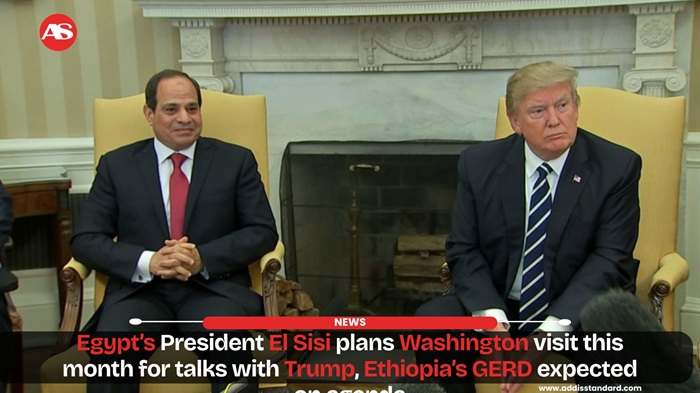 President Donald Trump and Abdel Fattah al-Sisi in the White House (Photo: CNN)
Addis Abeba
President Donald Trump and Abdel Fattah al-Sisi in the White House (Photo: CNN)
Addis Abeba — Egypt’s President Abdel Fattah El Sisi is planning a visit to Washington later this month for talks with U.S. President Donald Trump, with discussions expected to include Ethiopia’s Grand Ethiopian Renaissance Dam (GERD) on the Nile, The National reports, citing sources familiar with the preparations.
https://www.thenationalnews.com/news/me ... ith-trump/
According to the report, Cairo intends to seek direct U.S. engagement in its long-running dispute with Ethiopia over the Nile dam, which Egypt views as a threat to its share of the river’s waters. The sources said President El Sisi is expected to ask President Trump to press Ethiopia toward a framework under which the dam would be operated jointly by experts from Nile Basin countries, alongside representatives of the African Union.
The National further reported that Egypt is also seeking U.S. backing for a new regional agreement that would require Nile Basin states to consult one another before constructing dams on the river.
The Nile dam dispute has remained unresolved despite years of negotiations between Ethiopia, Egypt, and Sudan. During President Trump’s first term, the United States mediated talks that produced a draft agreement, but Ethiopia declined to sign it at the time. Subsequent negotiations under African Union auspices have also failed to yield a binding deal.
While the Washington visit is expected to cover a range of regional issues, including Gaza and Egypt’s relations with Israel, the Nile dam is anticipated to feature prominently on the agenda, reflecting Cairo’s continued efforts to internationalize the issue and revive U.S. involvement,
The National reported, citing its sources.
The planned visit comes amid a shift in U.S. policy toward Africa, after Washington unveiled a new National Security Strategy
https://addisstandard.com/?p=53982&=1 that signals a recalibration of its engagement on the continent, with particular attention to the conflict-prone Horn of Africa.
Released by the White House, the strategy outlines a move away from what it describes as past approaches shaped by “
liberal ideological” priorities and heavy reliance on foreign aid. Instead, it emphasizes trade, investment, and targeted diplomatic engagement, focusing on partnerships with what it terms
capable, reliable states
willing to open their markets to U.S. goods and services.
Conflict prevention and resolution form a central pillar of the strategy, with the Horn of Africa identified as a priority region. The document highlights persistent tensions involving Ethiopia, Eritrea, and Somalia, warning that emerging flashpoints could escalate in the absence of preventive diplomacy. It also points to U.S. interest in contributing to negotiations in other crisis-affected contexts, including the Democratic Republic of Congo–Rwanda tensions and the ongoing war in Sudan. While noting concerns over a resurgence of Islamist militant activity in parts of Africa, the strategy underscores that the United States intends to avoid long-term military deployments or enduring security commitments on the continent.
Against this backdrop, Ethiopia–Egypt relations over the Nile waters and the Grand Ethiopian Renaissance Dam (GERD) have remained strained. In a recent report, Addis Standard noted that Ethiopia’s Ministry of Foreign Affairs (MoFA) issued a strongly worded statement
https://addisstandard.com/?p=53931&=1 on 3 December 2025 accusing senior Egyptian officials of escalating hostile rhetoric and of
categorically rejecting dialogue
on the Nile and GERD.
MoFA described recent comments from Cairo as
manifestations of the failure of the Egyptian government to come to terms with the realities of the 21st century,
adding that some Egyptian officials remain
steeped in a colonial-era mentality
and act as though they
have a monopoly over the waters of the Nile.
The ministry also criticized Egypt’s repeated invocation of colonial-era treaties, stating that Addis Abeba
has no room to accommodate the vestiges of colonialism that Cairo is finding difficult to eschew.
