Ethiopian News, Current Affairs and Opinion Forum
Zmeselo
Senior Member+
Posts: 36769
Joined: 30 Jul 2010, 20:43

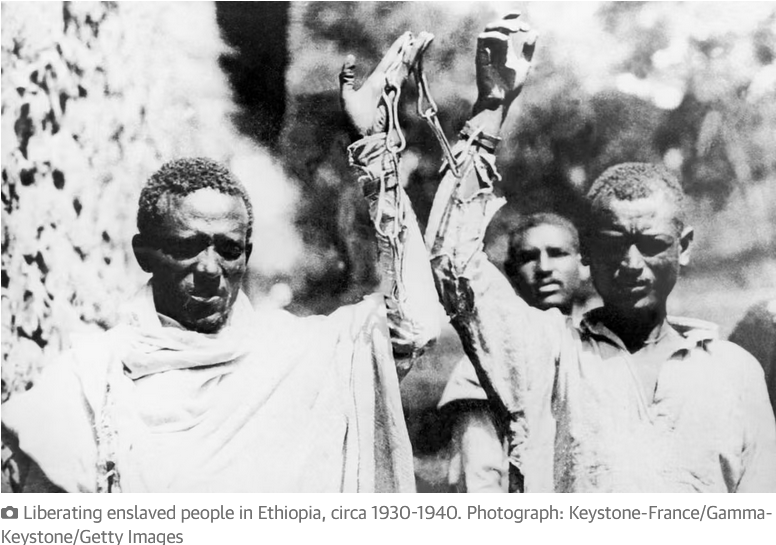
Slavery in Ethiopian history.

Post by Zmeselo » 04 Dec 2025, 22:04


When some Ethiopians use derogatory terms about Eritreans or other Africans —such as “Askaris” or “Italian construct”—it is worth looking honestly at their own history.

Historical records show that until the Italian invasion of 1935, slavery and the slave trade remained deeply embedded in the Ethiopian/Abyssinian culture and economy, with estimates suggesting that up to a quarter of the population lived in slavery. It was, in fact, Fascist Italy that finally abolished the practice during its occupation—an uncomfortable but well-documented historical reality that is often overlooked when mentioning

3,000 years of uninterrupted history.


Although Menelik II and Haile Selassie issued proclamations against slavery, these were never genuinely enforced. When Ethiopia joined the League of Nations in 1922, it was required to abolish slavery within ten years, yet slavery continued. In 1932, the League formally reprimanded Haile Selassie for failing to carry out this obligation. Both Menelik and Haile Selassie were themselves slave owners, as widely reported by contemporary observers and historians.

Today, public discourse in Ethiopia rarely confronts this part of its past, nor the long-term social consequences it created—issues that still affect the country’s stability and cohesion. Below are several historical quotations, that shed light on Ethiopia’s history with slavery.

Harold G. Marcus:

Menelik’s palace was staffed with many hundreds of slaves… captured during the southern campaigns.

The Life and Times of Menelik II

Harold G. Marcus:

Haile Selassie, like all Ethiopian nobles of his era, possessed slaves in his household until the 1930s.

By 1935, despite proclamations, slavery remained widespread. Perhaps two million Ethiopians lived in some form of bondage.


A History of Ethiopia

Richard Pankhurst:

Slave-taking was intrinsic to the expansion of Menelik’s empire. Tens of thousands of Oromo, Sidama, and other southerners were taken as slaves, many of whom entered the imperial household.

Most slaves were obtained from the southern and southwestern regions… including the Oromo, Sidama, Gurage, Kafa, and various Nilotic groups.


Economic History of Ethiopia, Vol. I

British Foreign Office Report (1934):

Even in the household of the Emperor, slaves continue to serve despite proclamations declaring abolition.


Christopher Clapham:

Domestic slavery persisted in the imperial family well into Haile Selassie’s reign.


Transformation and Continuity in Revolutionary Ethiopia
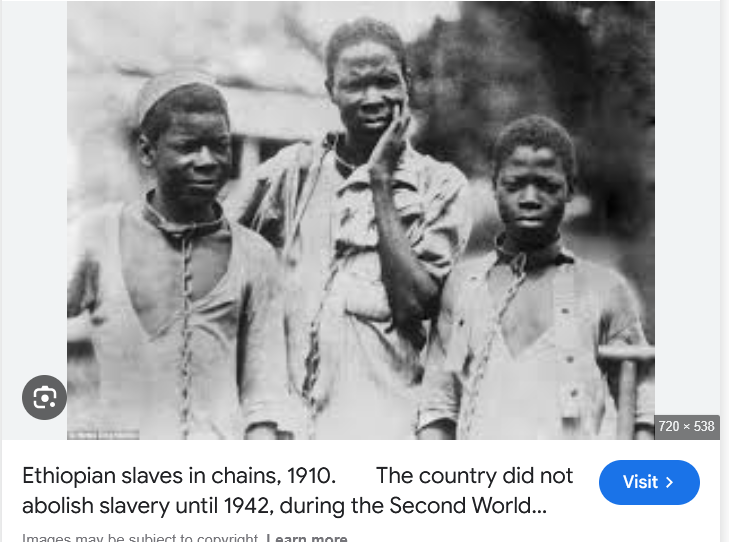


League of Nations evidence:

In 1932–1935, the League of Nations repeatedly criticized Haile Selassie for:

- failing to suppress slave trading
- keeping domestic slaves at the imperial palace
- allowing nobles to continue owning slaves

The League’s 1935 report states:

Slavery exists even in the household of the Emperor.


Haile Selassie formally abolished slavery again in 1942 (under British pressure). By the mid-1940s, domestic slavery in the palace had largely ended, though forced labor persisted under other names.
Fiyameta
Senior Member
Posts: 19773
Joined: 02 Aug 2018, 22:59

Re: Slavery in Ethiopian history.

Post by Fiyameta » 05 Dec 2025, 00:49


The Failure of Emperor Haile Selassie

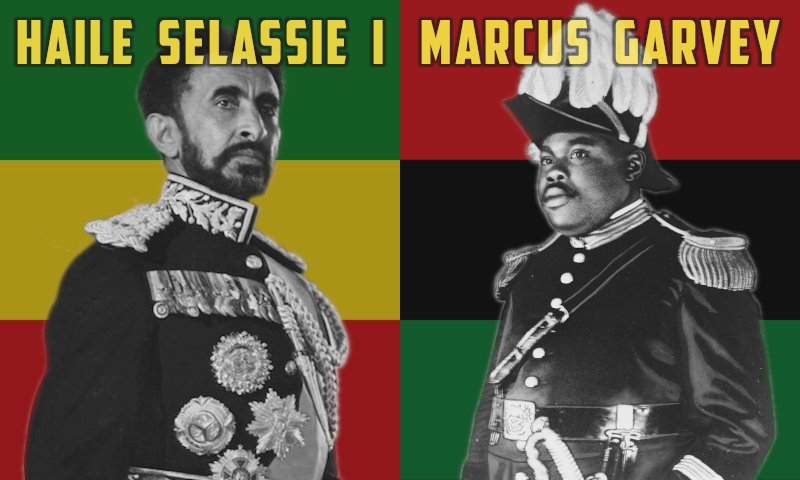
By Marcus Garvey

It is a pity that a man of the limited intellectual calibre and weak political character like Haile Selassie became Emperor of Abyssinia at so crucial a time in the political history of the world. A cringing, white slave hero worshipper, visionless and disloyal to his country, this is the impression the serious minded political student forms of the conduct of the ex-Emperor of Abyssinia.

We must admit that we glorified Haile Selassie when the war started, fought his battles to win international support, but we ever felt deep down in our hearts that he was a slave master. We had hoped that if Abyssinia had won that we would have forced the Government of Abyssinia to free the black whom they held as slaves. We would have preferred this than seeing the country taken by Mussolini or any European power; but now that the country is temporarily lost and the Emperor has cowardly exiled himself, the truth must be told.

In truth, the Emperor is out of place in democratic England. He wants to be once more in the environment of the feudal Monarch who looks down upon his slaves and serfs with contempt.

The Africans who are free can also appreciate the position of slaves in Abyssinia. What right has the Emperor to keep slaves when all the democratic sections of the world were free, when men had the right to live, to develop, to expand, to enjoy all the benefits of human liberty?

After all, Haile Selassie is just an ordinary man like any other human being. What right has he to hold men as slaves? It is only the misfortune of the slaves that causes him to be a slave master. Negroes who have the dignity of their race at heart resent the impertinence of anyone holding the blacks as slaves.

Haile Selassie ought to realize this and abolish his foolish dream of being an Emperor of slaves and serfs and try to be an Emperor of noble men, and for him to be that he must himself be the noblest of them all.

When the war started in Abyssinia all Negro nationalists looked with hope to Haile Selassie. They spoke for him, they prayed for him, they sung for him, they did everything to hold up his hands, as Aaron did for Moses; but whilst the Negro peoples of the world were praying for the success of Abyssinia this little Emperor was undermining the fabric of his own kingdom by playing the fool with white men, having them advising him; having them telling him what to do, how to surrender, how to call off the successful thrusts of his Rases against the Italian invaders.

Yes, they were telling him how to prepare his flight, and like an imbecilic child he followed every advice and then ultimately ran away from his country to England, leaving his people to be massacred by the Italians, and leaving the serious white world to laugh at every Negro and repeat the charge and snare – “he is incompetent,” “we told you so.” Indeed Haile Selassie has proved the incompetence of the Negro for political authority, but thank God there are Negroes who realize that Haile Selassie did not represent the truest qualities of the Negro race. How could he, when he wanted to play white? How could he, when he surrounded himself with white influence? How could he, when in a modem world, and in a progressive civilization, he preferred a slave State of black men than a free democratic country where the black citizens could rise to the same opportunities as white citizens in their democracies?

https://www.africaresource.com/rasta/se ... nt-page-1/

Zmeselo
Senior Member+
Posts: 36769
Joined: 30 Jul 2010, 20:43

Re: Slavery in Ethiopian history.

Post by Zmeselo » 05 Dec 2025, 16:12

I understand this may upset some Ethiopians, but I sincerely believe that examining how the real modern Ethiopian state was formed and developing a shared understanding of the history of the Horn of Africa can provide a foundation for building modern, integrated and cooperative states in our region. This approach could help break the cycle of endless war, poverty, and intra- and inter-state conflict.

Ethiopia Today


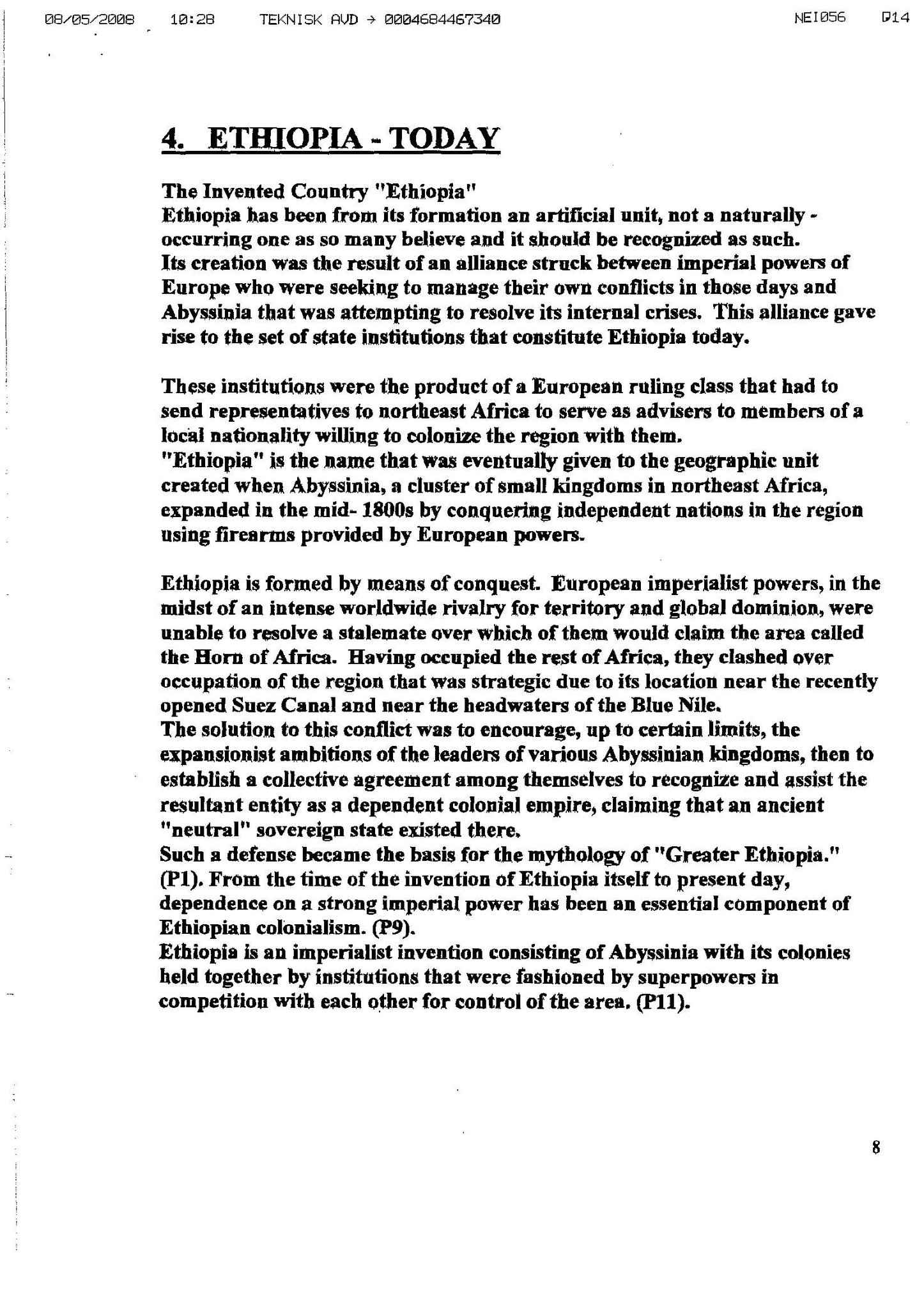
The Invented Country “Ethiopia

Ethiopia has, from its formation, been an artificial political unit rather than a naturally occurring one, as many people believe. It should be recognized as such.

Its creation was the result of an alliance between European imperial powers—who were trying to manage their own rivalries at the time—and Abyssinia, which was attempting to resolve its internal crises. This alliance gave rise to the set of state institutions that constitute Ethiopia today.

These institutions emerged from a European ruling class, that sent representatives to northeast Africa to serve as advisers to a local nationality willing to colonize the region in partnership with them.

Ethiopia” is the name eventually applied to the geographic unit created when Abyssinia, then a cluster of small kingdoms in northeast Africa, expanded in the mid-1800s by conquering independent nations in the region using firearms supplied by European powers.

Ethiopia was formed through conquest. European imperial powers—locked in an intense global rivalry for territory and dominance—were unable to resolve a stalemate over who would claim the area known as the Horn of Africa. Having already divided most of the continent among themselves, they clashed over this strategically important region near the recently opened Suez Canal and the headwaters of the Blue Nile.

Their solution was to encourage, within limits, the expansionist ambitions of various Abyssinian leaders and later establish a collective agreement among themselves to recognize and assist the resulting entity as a dependent colonial empire, all while claiming that an ancient and “neutral” sovereign state already existed there.

This justification became the foundation for the mythology of “Greater Ethiopia(p.1). From the time Ethiopia itself was invented to the present day, dependence on a powerful external patron has remained a defining feature of Ethiopian colonialism (p.9).

Ethiopia is thus an imperial invention, consisting of Abyssinia and the territories it colonized, held together by institutions shaped by competing global powers seeking control over the region (p.11).


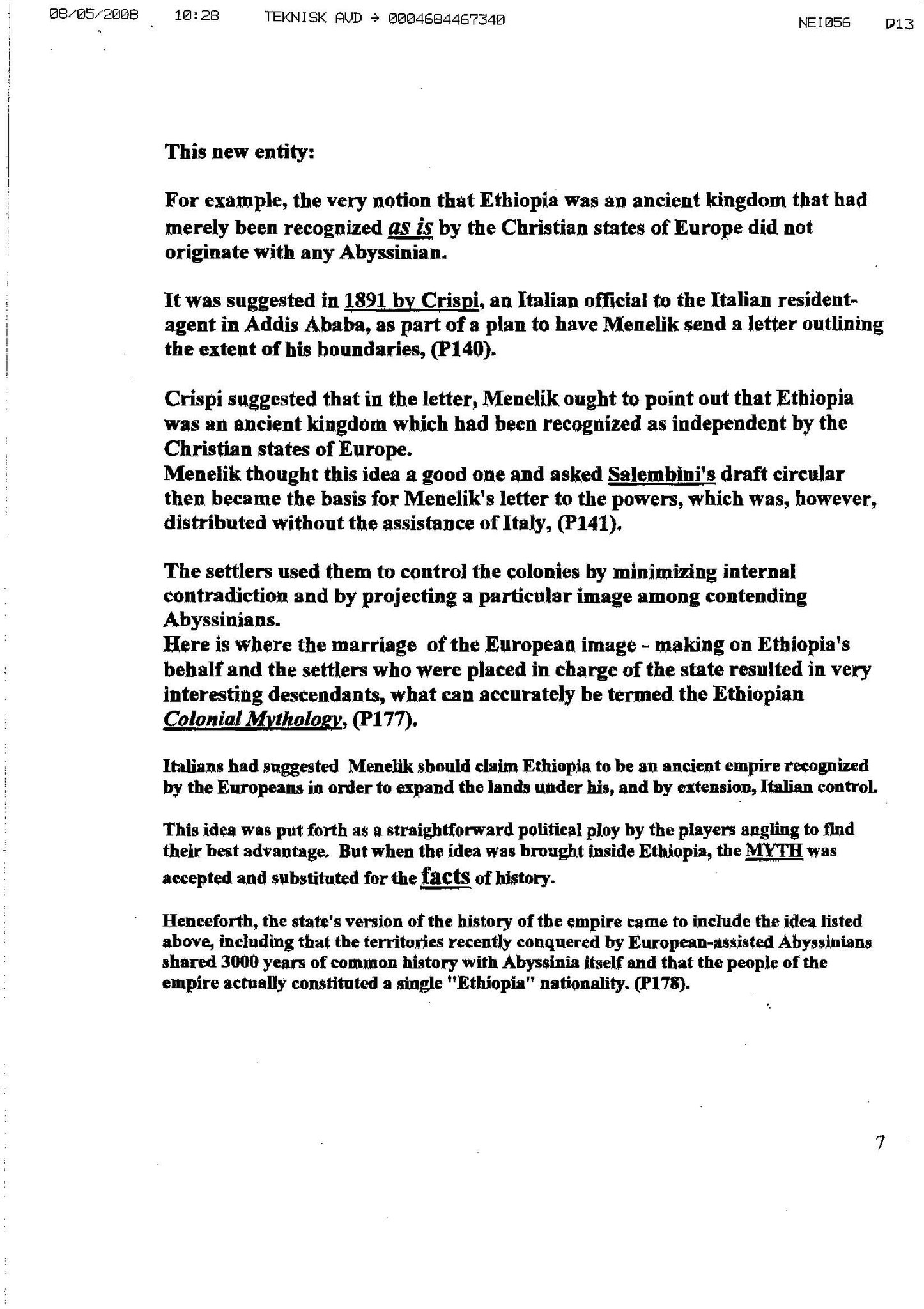
For example, the very notion that Ethiopia was an ancient kingdom that had merely been recognized as is by the Christian states of Europe did not originate with any Abyssinian. It was first suggested in 1891 by Crispi, an Italian official, to the Italian resident-agent in Addis Ababa as part of a plan to have Menelik send a letter outlining the extent of his boundaries (p.140).

Crispi proposed that, in the letter, Menelik ought to point out that Ethiopia was an ancient kingdom which had been recognized as independent by the Christian states of Europe. Menelik thought this idea a good one and asked Salembini to draft a circular. That draft then became the basis for Menelik’s letter to the powers, which was, however, distributed without the assistance of Italy (p.141).

The settlers used these narratives to control the colonies by minimizing internal contradictions and by projecting a particular image among contending Abyssinians. This is where the marriage between European image-making on Ethiopia’s behalf and the settlers who were placed in charge of the state produced very interesting descendants—what can accurately be termed the Ethiopian Colonial Mythology (p.177).

The Italians had suggested that Menelik should claim Ethiopia to be an ancient empire recognized by the Europeans in order to expand the lands under his, and by extension, Italian control. This idea was put forward as a straightforward political ploy by actors seeking their best advantage. But when the idea was brought inside Ethiopia, the myth was accepted and substituted for the actual facts of history.

Henceforth, the state’s version of the history of the empire came to include the idea described above, including the claim that the territories recently conquered by European-assisted Abyssinians shared 3,000 years of common history with Abyssinia itself, and that the people of the empire constituted a single “Ethiopian” nationality (p.178).

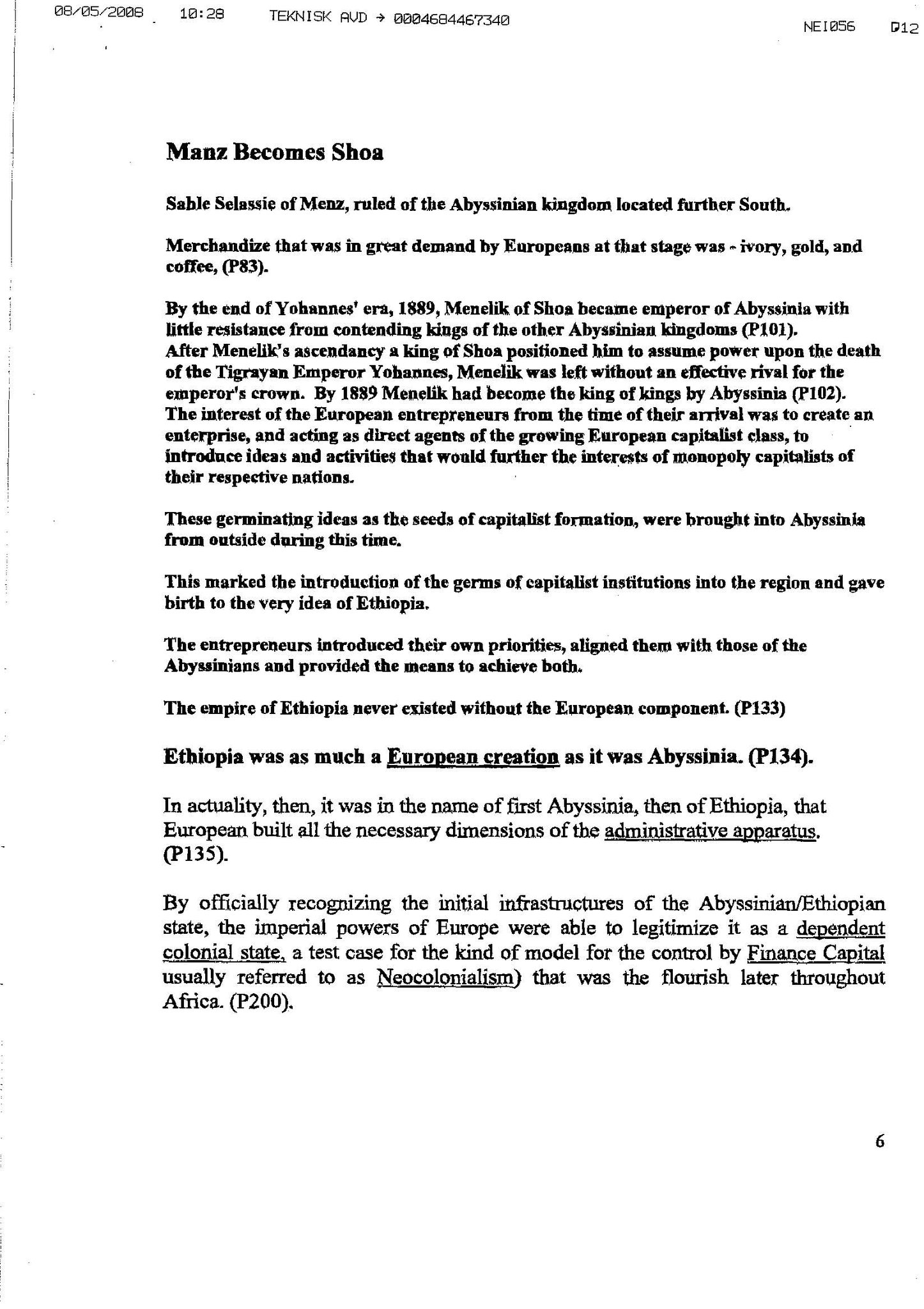
Menz Becomes Shoa


Sahle Selassie of Menz, ruled over the Abyssinian kingdom located farther south. Merchandise that was in great demand by Europeans at that stage included ivory, gold, and coffee (p.83).

By the end of Yohannes’ era, in 1889, Menelik of Shoa became emperor of Abyssinia with little resistance from the contending kings of the other Abyssinian kingdoms (p.101). After Menelik’s ascendance, the position of king of Shoa allowed him to assume power upon the death of the Tigrayan Emperor Yohannes. Menelik was left without an effective rival for the emperor’s crown. By 1889, Menelik had become the king of kings of Abyssinia (p.102).

The interest of European entrepreneurs from the time of their arrival was to create an enterprise and, acting as direct agents of the growing European capitalist class, to introduce ideas and activities that would further the interests of monopoly capitalists in their respective nations.

These germinating ideas—the seeds of capitalist formation—were brought into Abyssinia from the outside during this period. This marked the introduction of the germs of capitalist institutions into the region and gave birth to the very idea of Ethiopia.

The entrepreneurs introduced their own priorities, aligned them with those of the Abyssinians, and provided the means to achieve both. The empire of Ethiopia never existed without the European component (p.133). Ethiopia was as much a European creation, as it was Abyssinia (p.134).

In actuality, it was in the name of first Abyssinia and then Ethiopia that Europeans built all the necessary dimensions of the administrative apparatus (p.135).

By officially recognizing the initial infrastructures of the Abyssinian/Ethiopian state, the imperial powers of Europe were able to legitimize it as a dependent colonial state—a test case for the kind of model for control by finance capital, usually referred to as neocolonialism, that would later flourish throughout Africa (p.200).

Horus
Senior Member+
Posts: 39848
Joined: 19 Oct 2013, 19:34

Re: Slavery in Ethiopian history.

Post by Horus » 05 Dec 2025, 16:17

So, this is to justify the present day slavery prevailing in Eritrea?!!!! :lol: :lol: :lol: :lol: :lol: :lol:

Zmeselo
Senior Member+
Posts: 36769
Joined: 30 Jul 2010, 20:43

Re: Slavery in Ethiopian history.

Post by Zmeselo » 05 Dec 2025, 18:49


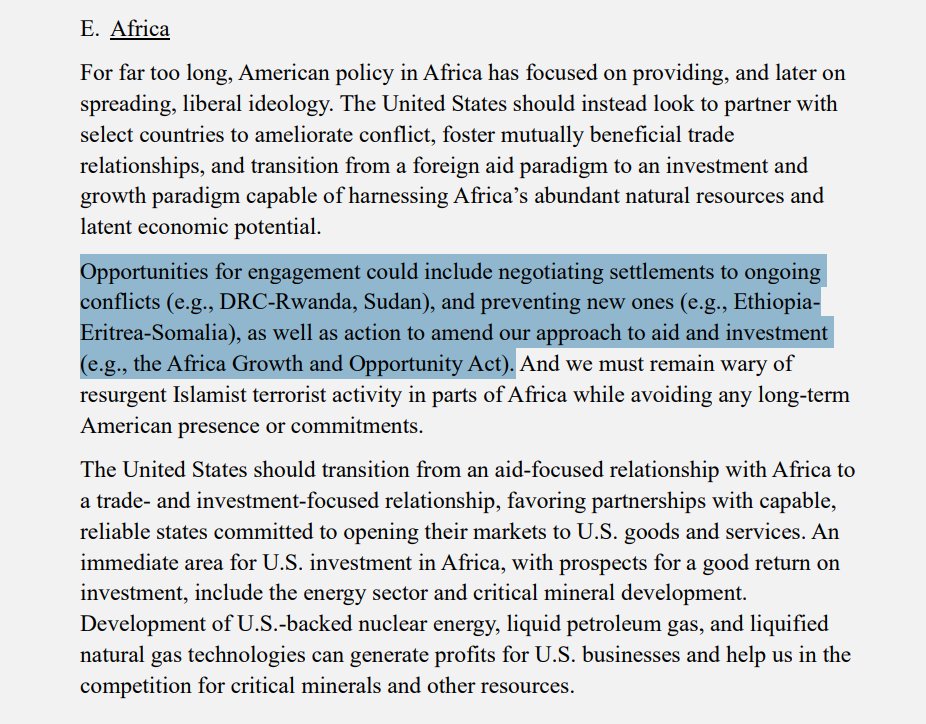
STATE DEPARTMENT — The 2025 US National Security Strategy, identifies Africa as a region where diplomatic engagement can help resolve active conflicts and prevent new ones.

One of the most urgent concerns is the growing risk of confrontation between Ethiopia and Eritrea, driven in part by Ethiopia’s renewed ambitions for

Sovereign Red Sea access.


The document notes that this dispute, along with instability involving Somalia, could escalate into a broader regional crisis if not managed early.

The strategy calls for proactive US involvement in conflict prevention, including support for negotiations and regional diplomacy.

It also stresses the need to modernize American aid and investment tools, such as the Africa Growth and Opportunity Act (AGOA), while staying alert to the resurgence of Islamist militant groups.

At the same time, it emphasizes avoiding long-term US military commitments on the continent.


https://whitehouse.gov/wp-content/uploa ... rategy.pdf


(Page 29) - Africa


For far too long, American policy in Africa has focused on providing, and later on spreading, liberal ideology. The United States should instead look to partner with select countries to ameliorate conflict, foster mutually beneficial trade relationships, and transition from a foreign aid paradigm to an investment and growth paradigm capable of harnessing Africa’s abundant natural resources and latent economic potential.

Opportunities for engagement could include negotiating settlements to ongoing conflicts (e.g., DRC-Rwanda, Sudan), and preventing new ones (e.g., Ethiopia - Eritrea - Somalia), as well as action to amend our approach to aid and investment (e.g., the Africa Growth and Opportunity Act). And we must remain wary of resurgent Islamist terrorist activity in parts of Africa while avoiding any long-term American presence or commitments.

The United States should transition from an aid-focused relationship with Africa to a trade- and investment-focused relationship, favoring partnerships with capable, reliable states committed to opening their markets to U.S. goods and services. An immediate area for U.S. investment in Africa, with prospects for a good return on investment, include the energy sector and critical mineral development. Development of U.S.-backed nuclear energy, liquid petroleum gas, and liquified natural gas technologies can generate profits for U.S. businesses and help us in the competition for critical minerals and other resources.

Mesob
Member
Posts: 2596
Joined: 23 Dec 2013, 21:03

Re: Slavery in Ethiopian history.

Post by Mesob » Yesterday, 16:21

Why are our Ethiopian friends afraid to talk and hiding this recent historical facts from history books and from university students. Ethiopia may have been one of the last African nations to forbid the institutionalized Ethiopian Slavery legally.
Records show that by the end of the second world war, 25% of the population of Addis Ababa was in slavery. The irony is that Ethiopian upper classes or the upper caste were owning other Ethiopians.
Mengistu Haile Mariam's mother herself was born in slavery, in the household of Deja. Kebede Tesema. The people of Ethiopia will learn more about Ethiopia, by studying the history of slavery more than by studying about dead dukes.


Naga Tuma
Member+
Posts: 6762
Joined: 24 Apr 2007, 00:27

Re: Slavery in Ethiopian history.

Post by Naga Tuma » Yesterday, 20:48

Your tenacious presence on this forum made me pretend that you are a better literate than this.

Your deficit in enlightenment is dismal.

I gave the following badge of honor to Abere before I read your post here. Be invited to it.

Enlightenment for eternity and a badge of honor for Zmeselo for the rest of his life in three words:

1. Gofta/Goita/Gheta/god/Gott/goth/guth/God
2. አባ/ኣብ/አባት/ኣቡ/ዓብ (ዓብ ራምን ጨምሮ)
3. ሙጫ/ሙጬ/ሙሴ/ሙሳ/ሞሰስ/ምክ(Mc)/ማክ(Mac) (በበርገሩ የሚታወቀዉ ማክዶናልድ ሙጫ ዶናልድ ማለት ነዉ)

No one can erode the history of these introductory words for the second Renaissance.

The most surprising thing to me in your piece here is when a ገብረ ክርስቶስ from Eritrea discusses about slavery in Ethiopia.

ገብረ Is an organic word in both Ethiopia and Eritrea. It is older than the introduction of Christianity at Axum.

Presumably, the name was taken in dear of Jesus Christ like a Muslim submits to Prophet Mohammed.

In short, it is evident and conclusive that the word ገብረ existed in Ethiopia and Eritrea before Christianity.

Is it the same as slavery or in between slavery and India’s caste system?

Every society in the world has a history that can’t be erased in hindsight. Both Ethiopia and Eritrea can own up the word ገብረ and move forward instead of such cheap politics and politically correct pretense.

The beginning of owning up the word should start with which group of people in both Ethiopia and Eritrea said ገብረ and those who were called ገብረ starting before the birth of Christianity.

If it is unclear, we can go to languages that also existed before the birth of Christianity.

Isaias Afwerki is aged enough to have the wisdom of age to ask how people say God in different languages in the region. Yohannes Leta may be able to help him how it is said in Borana and Agua languages.

You can also pull one out of your badge of honor to help.

It may also help deciphering the difference between a political community and an economic community.

What a waste of time. What a wasted time.
Zmeselo wrote:
04 Dec 2025, 22:04


When some Ethiopians use derogatory terms about Eritreans or other Africans —such as “Askaris” or “Italian construct”—it is worth looking honestly at their own history.

Historical records show that until the Italian invasion of 1935, slavery and the slave trade remained deeply embedded in the Ethiopian/Abyssinian culture and economy, with estimates suggesting that up to a quarter of the population lived in slavery. It was, in fact, Fascist Italy that finally abolished the practice during its occupation—an uncomfortable but well-documented historical reality that is often overlooked when mentioning

3,000 years of uninterrupted history.


Although Menelik II and Haile Selassie issued proclamations against slavery, these were never genuinely enforced. When Ethiopia joined the League of Nations in 1922, it was required to abolish slavery within ten years, yet slavery continued. In 1932, the League formally reprimanded Haile Selassie for failing to carry out this obligation. Both Menelik and Haile Selassie were themselves slave owners, as widely reported by contemporary observers and historians.

Today, public discourse in Ethiopia rarely confronts this part of its past, nor the long-term social consequences it created—issues that still affect the country’s stability and cohesion. Below are several historical quotations, that shed light on Ethiopia’s history with slavery.

Harold G. Marcus:

Menelik’s palace was staffed with many hundreds of slaves… captured during the southern campaigns.

The Life and Times of Menelik II

Harold G. Marcus:

Haile Selassie, like all Ethiopian nobles of his era, possessed slaves in his household until the 1930s.

By 1935, despite proclamations, slavery remained widespread. Perhaps two million Ethiopians lived in some form of bondage.


A History of Ethiopia

Richard Pankhurst:

Slave-taking was intrinsic to the expansion of Menelik’s empire. Tens of thousands of Oromo, Sidama, and other southerners were taken as slaves, many of whom entered the imperial household.

Most slaves were obtained from the southern and southwestern regions… including the Oromo, Sidama, Gurage, Kafa, and various Nilotic groups.


Economic History of Ethiopia, Vol. I

British Foreign Office Report (1934):

Even in the household of the Emperor, slaves continue to serve despite proclamations declaring abolition.


Christopher Clapham:

Domestic slavery persisted in the imperial family well into Haile Selassie’s reign.


Transformation and Continuity in Revolutionary Ethiopia


League of Nations evidence:

In 1932–1935, the League of Nations repeatedly criticized Haile Selassie for:

- failing to suppress slave trading
- keeping domestic slaves at the imperial palace
- allowing nobles to continue owning slaves

The League’s 1935 report states:

Slavery exists even in the household of the Emperor.


Haile Selassie formally abolished slavery again in 1942 (under British pressure). By the mid-1940s, domestic slavery in the palace had largely ended, though forced labor persisted under other names.
Post Reply