Ethiopian News, Current Affairs and Opinion Forum
Zmeselo
Senior Member+
Posts: 36770
Joined: 30 Jul 2010, 20:43

How the UAE keeps the US close while hedging against it

Post by Zmeselo » 06 Dec 2025, 08:53


News | Inside UAE
How the UAE keeps the US close while hedging against it

The UAE's ties to China and approach to Sudan and Yemen have not upset relations with the US, experts say


UAE President Sheikh Mohamed bin Zayed Al Nahyan (R) welcomes his US counterpart Donald Trump upon arrival at the presidential terminal in Abu Dhabi, on 15 May 2025 (Giuseppe Cacace/AFP)

By Sean Mathews

https://www.middleeasteye.net/news/how- ... against-it

5 December 2025

The United Arab Emirates https://www.middleeasteye.net/countries/uae has struck a sweet spot. It is hedging against the US https://www.middleeasteye.net/countries/us even as it leverages good ties in Washington to load up on AI chips and assert itself in hotspots from Yemen https://www.middleeasteye.net/countries/yemen to Sudan https://www.middleeasteye.net/countries/sudan that put it in conflict with the rest of the US’s Arab partners.

The UAE is pushing ahead with sensitive projects linked to China, https://www.middleeasteye.net/countries/china the US’s top rival, but US and Arab officials tell Middle East Eye it is enduring little cost for doing so.

MEE revealed https://www.middleeasteye.net/news/us-i ... d-base-uae recently that US intelligence assessed members of China’s People’s Liberation Army (PLA) were deployed at a key military base in Abu Dhabi.

After publication of that report, one US official and one person briefed on the matter told MEE that China watchers posted to the US embassy in Abu Dhabi were still suspicious of Beijing’s activities at Khalifa Port, where China’s state-owned Cosco operates a terminal and US intelligence has suggested the PLA was active.
The UAE has taken a few steps back, but not completely written off their cooperation with China. What that tells you is that the Emiratis feel they can withstand any US pressure,
Cinzia Bianco, a Gulf expert at the European Council on Foreign Relations, told MEE.

During the Biden administration, some senior officials became so alarmed about the UAE’s growing independence from Washington that they wanted to pursue a wide review of the relationship with the Gulf state. The effort was led by Barbara Leaf, the top State Department official in the Middle East. In the end, the report fizzled out, a former senior US official told MEE.
It ended up very condensed, looking at the UAE’s role in Libya, but sidestepped all the really sensitive stuff about China,
the former official said, speaking on condition of anonymity.


The UAE has been able to hedge with China but insulate itself from the pushback in Washington


- Anna Jacobs, International Crisis Group


When President Donald Trump returned to office this year, he made his first foreign visit to the Gulf region. Some Middle East watchers took note of the fact that Trump enjoyed full state dinners in Saudi Arabia and Qatar but a truncated trip in the UAE in May.

Several US officials attributed that to tensions over the UAE’s tech ties to China.

But last month, the UAE’s state-owned AI tech titan, G42, was given the go-ahead in Washington to purchase tens of thousands of Nvidia’s advanced AI chips, along with its state-owned Saudi rival, Humain.

The fact that both Saudi Arabia and the UAE were given equal weighting caught the attention of some analysts.
The UAE has been able to hedge with China but insulate itself from the pushback in Washington in ways other countries could not imagine,
Anna Jacobs, at the International Crisis Group, told MEE.

Too good for Nato and the F-35

The contrast between the UAE’s approach to Washington and that of its Gulf neighbours and rivals, Qatar and Saudi Arabia, has been brought into stark relief this year.

After Israel bombed Hamas negotiators in Doha in September, Qatari officials sought to move closer to the US and downplay any murmurs of tensions, including over the US’s advanced knowledge of the Israeli attack. Already designated a major non-Nato ally, Qatar upped its military cooperation with Washington and elicited an executive order from Trump pledging to defend it against future attacks.

Not to be outdone, when Crown Prince Mohammed bin Salman visited Washington, DC, last month, his kingdom was named a major non-Nato ally. Perhaps more importantly, Saudi Arabia hashed out a defence cooperation agreement with the US that current and former US officials told MEE will speed up arms sales.

Qatar and Saudi Arabia’s designations as major non-Nato allies mean the Arabian Gulf is now blanketed with states carrying that placard of cosiness to Washington. The three exceptions are: war-torn Yemen, Oman, which prides itself as a nimble mediator, and the UAE.
The UAE thinks it is above things like major non-Nato ally,
a western official in the Gulf told MEE.
It doesn’t sink to that game.
The UAE, Saudi Arabia and Qatar are all home to US military bases, but for years, the Emiratis have placed the most stringent conditions on how the US uses that access, the former US official told MEE.

The Al Dhafra Air Base near Abu Dhabi hosts the US’s 380th Air Expeditionary Force.

The UAE’s go-it-alone approach is evident when you compare its stalled bid to acquire F-35 warplanes from the US and Saudi Arabia. Riyadh secured Trump’s approval to purchase the advanced jet fighters last month, even though it refused to normalise ties with Israel, at least for now.

The UAE was promised the F-35 in return for establishing diplomatic ties with Israel in 2020, but the deal stalled over US concerns about its military ties to China. Last year, the UAE said it was not interested in acquiring F-35s, in part because of the restrictions the US placed on the sale.
Of all the Gulf countries, the UAE is most serious about its strategic hedging,
Jacobs said.
Saudi Arabia and Qatar are investing long-term in the relationship with the US, whereas the UAE has been hedging more, but that doesn’t seem to bother Washington.
Going it alone

On some files, the Trump administration appears to be much closer to Doha, Ankara and Riyadh. For example, Trump has credited Crown Prince Mohammed bin Salman and Turkish President Recep Tayyip Erdogan with convincing him to lift sanctions on Syria and bring its new president, Ahmed al-Sharaa, into the US fold. The UAE is one of the countries most sceptical of Sharaa’s Islamist roots.

After the Arab Spring, Washington became accustomed to looking at the Middle East through the prism of two blocs, a Saudi and Emirati one opposed to the toppling of old regimes like Hosni Mubarak’s in Egypt, and a Turkish and Qatari one that was more comfortable angling for influence in the wake of popular protests.

The UAE and Saudi Arabia engineered a blockade of Qatar and intervened in Yemen's https://www.middleeasteye.net/countries/yemen civil war together. But now, those old battle lines have broken down.

This week, a separatist armed group in southern Yemen backed by the UAE went on the offensive against forces backed by Saudi Arabia in Hadramout, a resource-rich province in eastern Yemen that Riyadh has long considered its sphere of influence and vital outlet to the Indian Ocean.

In Sudan, the region’s other simmering proxy war, MEE was the first to reveal that Crown Prince Mohammed bin Salman planned to lobby against the UAE at the White House in November, a sharp escalation that surprised many Gulf watchers who say the region’s monarchs are sensitive about airing their dirty laundry in Washington.

Saudi Arabia, Turkey and Qatar back the Sudanese Armed Forces against the Emirati-backed Rapid Support Forces. The UAE has backed the RSF throughout the war using supply lines that run through southeastern Libya, https://www.middleeasteye.net/countries/libya Chad and, increasingly, the port of Bosaso, on Somalia's Puntland coast. Abu Dhabi continues to deny the allegations.

The UAE’s balancing act, analysts and current and former diplomats say, can be attributed to its slick diplomacy and deep pockets. For almost twenty years, the UAE’s ambassador to Washington, Yousef al-Otaiba, has doled out funds to think-tanks and parties while hobnobbing with Washington powerbrokers.

Qatar and Saudi Arabia play the same game, analysts say, but the UAE’s relationship with Israel has endeared it to politicians and US officials on both sides of the political aisle.
The UAE does get more leeway than Saudi Arabia and Qatar because it is Israel’s golden boy,
a current US official told MEE.

Fiyameta
Senior Member
Posts: 19773
Joined: 02 Aug 2018, 22:59

Re: How the UAE keeps the US close while hedging against it

Post by Fiyameta » 06 Dec 2025, 09:19

The UAE took over Ethiopia without any resistance. It didn't even ask "May I please colonize you?" It just did. :P

Zmeselo
Senior Member+
Posts: 36770
Joined: 30 Jul 2010, 20:43

Re: How the UAE keeps the US close while hedging against it

Post by Zmeselo » 06 Dec 2025, 22:04


Global development
RSF massacres left Sudanese city ‘a slaughterhouse’, satellite images show

Up to 150,000 residents of El Fasher are missing since North Darfur capital fell to paramilitary Rapid Support Forces

Mark Townsend

https://www.theguardian.com/global-deve ... mages?s=09

Fri 5 Dec 2025

The Sudanese city of El Fasher resembles a “massive crime scene”, with large piles of bodies heaped throughout its streets as the paramilitary Rapid Support Forces (RSF) work to destroy evidence of the scale of their massacre.

Six weeks after the RSF seized the city, https://www.theguardian.com/world/2025/ ... -el-fasher corpses have been gathered together in scores of piles to await burial in mass graves or cremated in huge pits, analysis indicates.

With the capital of North Darfur https://www.theguardian.com/world/darfur state still sealed off to outsiders, including UN war crimes investigators, satellite evidence has revealed a network of newly dug incineration and burial pits thought to be for the disposal of large numbers of bodies.

While the final death toll of the massacre remains unclear, British MPs have been briefed that at least 60,000 have been murdered https://uk-crime.co.uk/sarah-champion-2 ... and-sudan/ in El Fasher.

Sarah Champion, chair of the Commons international development select committee, said:
Members received a private briefing on Sudan, at which one of the academics stated: ‘Our low estimate is 60,000 people have been killed there in the last three weeks.’
As many as 150,000 residents of El Fasher remain unaccounted for since the city fell to the RSF. They are not thought to have left the city, and this grisly development comes amid increasingly gloomy speculation about their fate.

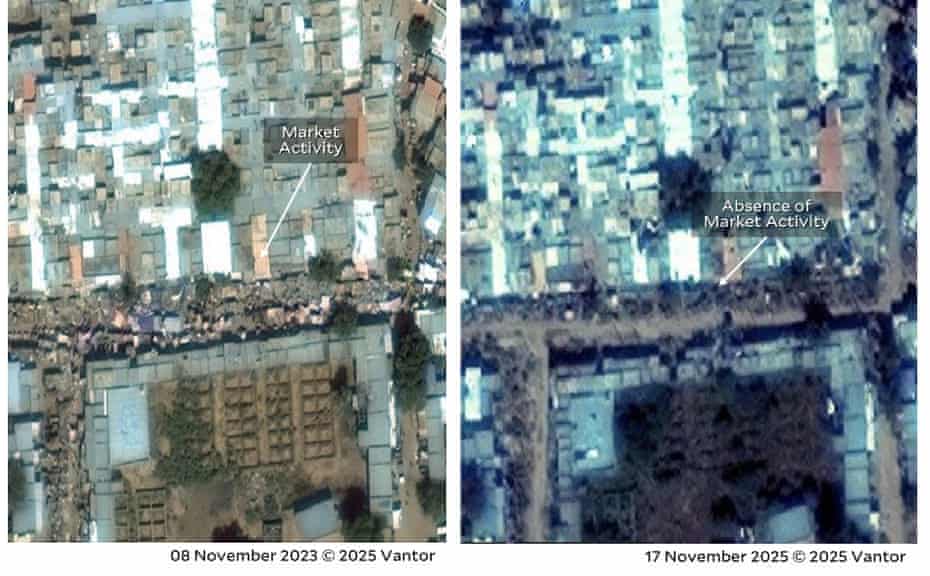
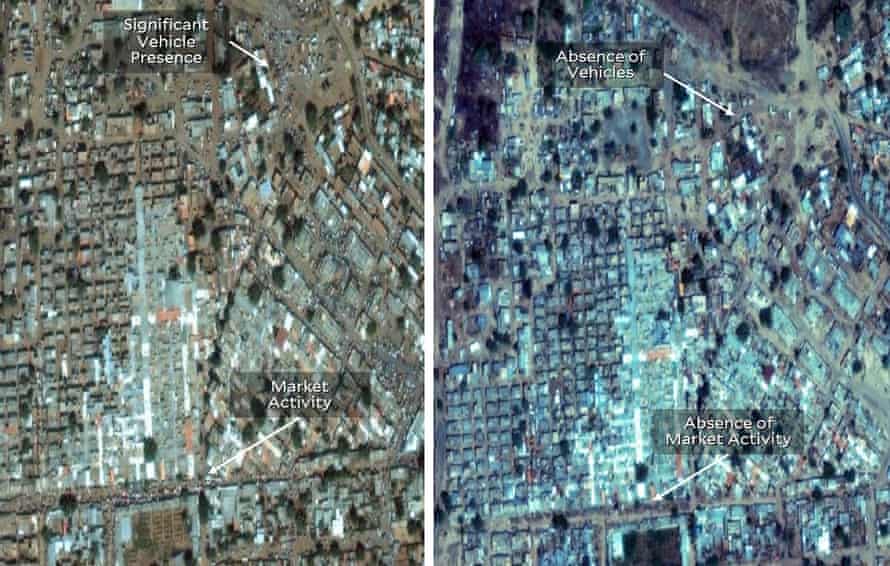
Nathaniel Raymond, director of the Yale Humanitarian Research Lab, https://medicine.yale.edu/lab/khoshnood ... s/reports/ which has been closely analysing satellite images of El Fasher, said the city was eerily empty, with once-bustling markets now desolate.

Yale’s latest analysis suggests marketplaces are now so unused https://files-profile.medicine.yale.edu ... c88149a388 that they are becoming overgrown and that all the livestock appears to have been moved out of the city,which had 1.5 million inhabitants before the war began in April 2023.
It’s beginning to look a lot like a slaughterhouse,
said Raymond.

No expert or agency has been able to explain the whereabouts of the tens of thousands of residents who have been missing since El Fasher – the army’s last major stronghold in the region – was overrun on 26 October after the RSF’s brutal 500-day starvation siege. https://www.theguardian.com/global-deve ... fasher-rsf

The Guardian has spoken to sources who describe El Fasher residents being held in detention centres in the city, though the numbers still detained are small.


Satellite imagery from August 2025, left, shows evidence of market activity and vehicles around El Fasher, while an image taken on 17 November 2025, right, shows no signs of life in the city. Photograph: Courtesy of Humanitarian Research Lab/Yale School of Public Health

RSF officials had pledged to allow the UN into El Fasher to deliver aid and investigate atrocities, but to date the city remains out of bounds for humanitarian organisations as well as UN officials.

Aid convoys are understood to be on standby in nearby towns and cities as negotiations for the RSF to give safety guarantees continue. So far the paramilitary group, now in its third year of civil war with Sudan’s armed forces, has refused.

A UN source said:
There needs to be a security assessment before we can plan on sending assistance. Right now, there is no guarantee of safe passage or protection of civilians, aid workers or humanitarian assets.
Despite the uncertainty over how many residents might be alive inside El Fasher, the need for help to reach the city is deemed critical, with “staggering” levels of malnutrition https://www.theguardian.com/world/2025/ ... her-tawila reported among those who had escaped. International experts have declared the city to be in famine. https://www.ipcinfo.org/ipcinfo-website ... ue-137/en/

Raymond said some residents, with whom his team had now lost touch, had contacted them within the first two days of the attack alleging that up to 10,000 people had been killed.

Human rights experts now believe El Fasher is likely to be the worst war crime of the Sudanese civil war, which is already characterised by mass atrocities https://www.theguardian.com/global-deve ... ort-forces and ethnic cleansing. https://www.theguardian.com/world/artic ... -rsf-sudan

Over 32 months of ruinous war, the country has been torn apart, with as many as 400,000 people killed and almost 13 million displaced. The conflict has caused the world’s biggest humanitarian crisis. https://lordslibrary.parliament.uk/huma ... mber-2025/

Meanwhile, there have been renewed calls for a thorough investigation into an RSF attack on the Zamzam displacement camp https://www.theguardian.com/global-deve ... p-timeline seven miles (12km) south of El Fasher six months earlier.

A new report by Amnesty International https://www.amnesty.org/en/ documents how the RSF targeted civilians, took hostages, and destroyed mosques and schools during a large-scale attack on Zamzam camp. It has called for the RSF to be
investigated for war crimes.

Zmeselo
Senior Member+
Posts: 36770
Joined: 30 Jul 2010, 20:43

Re: How the UAE keeps the US close while hedging against it

Post by Zmeselo » Yesterday, 15:43


US Senator Links the Kalogi Massacre to Foreign Support and Holds the UAE Responsible for Enabling the Militia

US Senator Chris Van Hollen posted a tweet commenting on the massacre committed by the Rapid Support Militia in Kalogi. In his tweet, he stated:

The RSF just attacked a kindergarten, killing at least 33 children in Sudan.

Meanwhile, the Trump Admin. continues to sell arms to the UAE, who are aiding these atrocities.

Imagine if Trump spent as much time trying to stop the killing, as he did getting the UAE to invest in his crypto coin.


While Senator Van Hollen referred to the initial reported death toll, the Sudan Doctors Network later confirmed that the massacre was far more devastating. Updated reports revealed that 116 civilians were killed in Kalogi, including 46 children, after deliberate suicide drone attacks targeted a kindergarten and several civilian facilities. A second strike killed medics who had rushed to the scene to rescue the injured.

Senator Van Hollen’s statement reignited the debate over the UAE’s role in enabling the Rapid Support Militia. References to the UAE’s military, financial, and logistical support have become central topics in congressional hearings and in international media investigations. This support, which includes weapons transfers, funding pathways, transportation networks, and political shielding, has allowed the militia to sustain its military operations and expand its reach across conflict areas. It is the same enabling structure that made a complex attack like the Kalogi kindergarten strike possible.

The danger of such support is that it allows the militia to continue the war, while much of the international community remains silent or avoids naming the party responsible for empowering the violence. This silence creates conditions in which atrocities escalate, because the militia understands that it has an external sponsor that provides it with resources and protection, and that global actors have not yet confronted or even clearly acknowledged that sponsor.

What happened in Kalogi is not an isolated tragedy. It is a new alarm for the world. As calls grow inside and outside Sudan demanding accountability for the militia, the international community must also confront the role of foreign supporters, particularly the UAE, whose enabling of the Rapid Support Militia has been repeatedly documented.

Without addressing these external networks, the cycle of atrocities will continue unchecked.
@SudaneseEcho


________________


Post Reply