Ethiopian News, Current Affairs and Opinion Forum
Zmeselo
Senior Member+
Posts: 37345
Joined: 30 Jul 2010, 20:43

Tribute To Hamid Idris Awate

Post by Zmeselo » 31 Aug 2023, 01:47

Please wait, video is loading...


Tribute To Hamid Idris Awate

https://tesfanews.net/tribute-to-hamid-idris-awate/

August 30, 2015

Hamid Idris Awate, who fired the first shot against Ethiopian government forces on 1 September 1961 at Mount Adal, was a leader in early movements for Eritrean independence. That first shot, indeed sparked the armed struggle for independence of Eritrea.

Hamid Idris Awate (1910-1962) was a leader in the early movements for Eritrean independence. Hamid fired the first shot against Ethiopian government forces on 1 September 1961 at Mount Adal. He went on to create the Eritrean Liberation Army (the armed wing of the Eritrean Liberation Front). He died on May 28, 1962. He was wounded in the last battle he fought against the occupation forces, and it seems his death was due to battle wounds, though some claim it was from natural causes. He was buried near Haykota, Gash Barka, and a statue was erected by the Government of Eritrea on 1 September 1994 at his gravesite.

Hamid Idris Awate was born at Gerset, located between Tessenei and Omhajer in southwestern Eritrea in the year 1910. His father was a peasant and was known to own a rifle. Awate, was trained by his father on how to use that gun. At an early age, he was a very skillful fighter who achieved great superiority in the usage of arms and developed a high knighthood skill that gained him the respect of his generation. Growing up in a locality that appreciates and values ethical principles based on honesty and faithfulness, Awate was known to be a man of moral values and a good example for them to follow, and trust and was a great leader to be obeyed. Besides his fluency in Arabic, Tigre, Tigrina, Nara, Hedareb, and Kunama, Awate also spoke fluent Italian language.

In 1935, he was conscripted by the Italians to serve in the colonial army of the Eritrean Ascari. Besides his fluency in Arabic, Tigre, Tigrina, Nara, Hedareb, and Kunama, Awate learned the Italian language within a short period of time and was sent to Rome for a course in military intelligence.

After returning from Italy, he was appointed as a security officer in western Eritrea. Shortly after that, he served as deputy chief of the city of Kassala, Sudan, and its surroundings during the brief Italian occupation of that city in 1940/1941. He fought as an Ascari in the Battle of Keren and participated in the Italian guerrilla in Eritrea against the British and Ethiopians in WWII, with the cavalrymen of Ali Gabre.

At an early age, Awate was known among his friends and localities for his leadership capabilities and that was enhanced by his daily experience through the posts he held coupled with his national consciousness and awareness of his people’s problems and concerns. He was the most respected individual, in the GashSetit and Barka areas. Many instances are told about his courage and how he was able to fight back, when attacked by colonial police and assassins.

At the end of World War II, the British soldiers who were searching for arms in western Eritrea have, in the process, confiscated properties and killed cattle of the localities in the GashSetit and Barka areas. In a self-defense reaction, Awate killed one of the soldiers. The British authorities accused Awate of a “crime” and forced him to live as a fugitive, for some time. In the meantime, he was defending his people against the British plunders and other bandits who crossed the border from the Sudan, shifta from other parts of Eritrea and Ethiopia who used to raid and loot the properties of people of the GashSetit and Barka areas as well.

Awate commanded a group of 40 gunmen, who Actively operated against the British forces causing heavy losses among them. Aware of his great influence and role, the British colonial authorities decided to negotiate with Awate in order to avoid regrettable developments. A peace deal was reached and the violent clashes came to a stop.

When the Ethiopian government broke the terms of the UN Resolution of the federation of Ethiopia and Eritrea, reducing Eritrea to the status of an occupied country, the Eritrean people rose against it, showing their objections to that action by the Emperor’s government who adopted all means and ways of torture, intimidations, imprisonments, and killings. In the face of that, the Eritreans did not yield or surrender to the Ethiopians unilaterally annulling the federation agreement.

Being a man of initiative and combat, he didn’t leave events to take course according to the aggressor’s wish. He decided to take action that would set history straight and restore stolen rights, but he was waiting for the right time to take the most important decision of his life.

Armed Struggle

In July 1960, in the city of Cairo, a group of young Eritrean students and intellectuals held a meeting and formed the Eritrean Liberation Front (ELF). The group consisted of the following names:

Idris Mohammed Adem (the president of the National Assembly of Eritrea)
Idris Osman Galaydos (a graduate of law school of Cairo University)
Mohammed Saleh Hummed (a graduate of law school of Cairo University)
Said Hussein (a student of Al-Az’har University in Cairo)
Adem Mohammed Akte (a graduate of the University of Cairo)
Taha Mohammed Noor (a graduate from Italy)

Back home, the Ethiopian authorities were suspicious of Awate’s movements and activities and were watching him closely.

In his book, “Eritrea: Destiny Challenges“, Hamid Saleh Turkey wrote about Awate’s beginnings and how the Ethiopian police forces planned to arrest Awate in his village in August 1961. Turkey explains that the Ethiopians deployed a large amount of police forces, but their plans were foiled by an Eritrean nationalist within the Ethiopian police who informed Awate earlier of that plan. Awate then fled to Mount Adal, located to the west of Agordet.

Awate’s decision to begin armed resistance was reached, after a period of long deliberations with other nationalists. In an interview with Eritrea Al-haditha, issue #75, second year, pioneer Mohammed Al-Hassan Dohen, a long-time friend of Awate and Awate’s assistant when he was district chief, says:

In the year 1960, Idris Mohammed Adem sent a letter to Awate, the letter was written in Arabic… Hamid Awate told me that Idris Mohammed Adem was asking him to declare the armed struggle, but he was not ready for it at that time. After four months, Mohammed Al-Shiekh Daood came and asked Awate to declare the revolution. Awate agreed to lead the armed struggle and declare the revolution, but asked for support. Mohammed Al-Shiekh Daood provided Awate with old arms, three five-bullet rifles “abu khamsa” and gave him 300 Birr with sugar and tea. In addition, Ibrahim Mohammed Ali brought two rifles and myself owned a rifle. At the beginning we were only seven, then shortly our number had grown to be 13 fighters.


The Ethiopian authorities, immediately responded to Awate’s declaration. According to Awate’s contemporaries, a military unit in six trucks was sent to apprehend Hamid Awate but failed. The Ethiopians resorted to using different tactics to deal with Awate. Mohammed Al-Hassan Dohen, indicates in his interview that Omer Hassano and Ejiel Abdulrahman made a last-minute appeal to end Awate’s rebellion on August 1961. Awate responded saying:
If you want us to end our armed struggle, then you better lower the Ethiopian flag and raise up the Eritrean flag.
On September 1st, 1961, Mount Adal witnessed the birth of the long-awaited event, the declaration of the Eritrean revolution. Armed with a strong belief in a just cause, Awate and the pioneers made history in Adal with very poor preparations in terms of arms, men, equipment, and provisions. Nevertheless, they waged their first fierce battle against the Ethiopian occupation in Mount Adal. The freedom fighters, the “RA’EEL” or pioneers, who accompanied Awate, were the following:

• Abdu Mohammed Faid
• Ibrahim Mohammed Ali
• Hummed Gadef
• Awate Mohammed Faid
• Mohammed Beareg
• Mohammed Adem Hassan
• Saleh Giroog
• Ahmed Fekak
• Mohammed Al-hassan Dohen
• Adem Fegoorai
• Ali Bekhit
• Idris Mohmoud
• Omer Kerai

According to Awate’s contemporaries, the battle of Adal lasted for seven hours from (6 a.m. to 1 p.m). Failing to crash the newly formed Eritrean Liberation Army (ELA), the Ethiopian forces retreated back and Awate ordered ELA fighters to withdraw first to Obel, then to Omer Siggo. The reaction to the battle of Mount Adal was great, among Eritreans. The Eritrean people showed their support and solidarity, with their revolution. The ELA pioneers, received a warm welcome wherever they went. On his side, Mohammed Al-Shiekh Daood sold 30 camels to raise the needed amount of funds to supply the revolution and submitted that money to Awate.

Having received a stunning defeat in the battle of Adal, the Ethiopians were alarmed by Awate’s performance. They started massing their forces to carry out a large-scale attack. The Ethiopians were able to encircle ELA in the area of Omal, where another fierce battle took place and resulted in the death of the first member of the ELA, Abdu Mohammed Faid.

However, the ELA was getting stronger as new well-trained fighters who served in the Sudanese military forces began to join the armed struggle. Kiboop Hejaj and Adem Gasear joined Awate and at a later time, on February 17, 1962, another group consisting of 11 joined as well. They were:

• Mohammed Idris Haj
• Omer Hamid Ezaz
• Taher Salem
• Osman Mohammed Idris (abu shenap)
• Ibrahim Mohammed Behdouri
• Mohammed Omer Abdella (abu tyara)
• Omer Mohammed Ali (Da’mer)
• Kisha Mohammed Kisha
• Mohammed Ibrahim
• Abdalla Idirs Adem
• Adem Gendifel

Awate, led all the battles fought during his lifetime. Pioneer Abu Rigella reported that after the battle of Amnait, leader Awate, and Mohammed Ibrahim Shandi got wounded. He says at the time, there were 11 military and civilian individuals who joined Awate, they swore in front of him, and declared their commitment to fight with him.

Abu Rigella attended the meeting, when Awate was elected as a leader unanimously and Mohammed Idris Haj as his deputy. He said, Awate addressed the meeting saying:

We are all Eritreans, we have to serve our country with honesty and sincerity, we are here to achieve a goal, and if there is anybody who may have individual ambitions other than the declared objective, then, he must leave now. We all have to show extreme commitment and dedication and carry out the commands and instructions of the leader, no matter how hard they are, for the cause of our country.


On May 27, 1962, Awate drank milk for dinner, then soon told his unit that he was not feeling good. His condition began to deteriorate, quickly. It is said, that Awate called pioneer Kiboob Hajaj and gave him his gun to emphasize that the struggle should continue. On the morning of the next day, Awate died from his battle wounds. His companions buried him secretly and did not reveal his death, until four years later.


___________


HISTORY & CULTURE
The Spark that Ignited the Blazing Flames of Independence

Dr. Fikrejesus Amahazion

https://shabait.com/2023/08/30/the-spar ... ependence/

Aug 30, 2023

Certain days, stand out as particularly important on the Eritrean calendar. 24 May, celebrating Eritrea’s hard-earned independence, of course, is one. 20 June, reserved to remember the monumental sacrifices of those who fell to win and defend the country’s independence and sovereignty, is definitely another. 8 March and 1 May, which are set aside to observe the huge contributions and importance of women and workers, respectively, are also special days for Eritreans.

Joining these distinguished days is 1 September, locally referred to as Bahti Meskerem, which represents the anniversary of the beginning of Eritrea’s long and bitter armed struggle for independence. The occasion, a national holiday filled with deep patriotism and utmost pride, offers an important opportunity to reflect upon and remember the immense sacrifices and brave, heroic exploits of so many who fought to turn into reality what to many for so long seemed an impossibility: the defeat of Africa’s largest, best-equipped army and the achievement of independence.

On 1 September 1961, now 62 years ago, the Eritrean independence movement transitioned from street demonstrations, non-violence, and peaceful protest, to active, armed resistance. Years before, on 20 September 1949, the United Nations General Assembly (UNGA) decided to send a second commission of inquiry into Eritrea to explore a potential
solution [to] the problem of Eritrea.
In the delegation’s subsequent report about their visit to the country, Sir Zafrulla, the Pakistani representative, presciently observed,
An independent Eritrea would obviously be better able to contribute to the maintenance of peace (and security) than an Eritrea federated with Ethiopia against the true wishes of the people. To deny the people of Eritrea their elementary right to independence would be to sow the seeds of discord and create a threat in that sensitive area of the Middle East.


After a lengthy international process seeking to develop a solution to the Eritrea question, on 2 December 1950, United Nations Resolution 390 (V), was passed by the UNGA. Resolution 390(V), which was backed and sponsored by the United States, extinguished Eritreans’ hopes for independence, federating Eritrea with Ethiopia as
an autonomous unit … under the sovereignty of the Ethiopian Crown.
Seemingly echoing Sir Zafrulla’s prophetic statement, G.K.N. Trevaskis, a former British official in Eritrea, ended his book, Eritrea: A Colony in Transition, by warning Ethiopia that it would be in its (and Eritrea’s) interest for the federal arrangement to survive in accordance with Resolution 390 (V). Yet he acknowledged:
[For Ethiopia], the temptation to subject Eritrea firmly under her own control will always be great. Should she try to do so, she will risk Eritrean discontent and eventual revolt, which, with foreign sympathy and support, might well disrupt both Eritrea and Ethiopia herself.
Although the Eritrean people’s inviolable and inalienable right to self-determination was denied, contrary to principles recognized by the United Nations, and unlike the other Italian colonies that received independence at the end of World War II, Eritreans were nevertheless relieved that the country was not dismembered. The terms of the international resolution stipulating that Eritrea was to be autonomous unit meant that Eritrea was to possess legislative, executive, and judicial powers in the field of domestic affairs, while the jurisdiction of Ethiopia was to extend to defense, foreign affairs, and international trade.

However, Ethiopia, an absolute monarchy ruled by Emperor Haile Selassie, viewed the federal structure with disdain and contempt. Almost immediately, the Emperor began to violate the terms of the federal arrangement; just nineteen days after the federal arrangement was officially ratified and came into force, the imperial regime committed its first violation, through Proclamation 130. The Emperor’s views of the arrangement calling for Eritrea’s autonomy were made unmistakably clear in a speech delivered to the Eritrean Assembly on 22 March 1955:
There are no internal or external affairs as far as the office of his Imperial Majesty’s representative is concerned, and there will be none in the future. The affairs of Eritrea concern Ethiopia as a whole and the Emperor.
The Assembly quickly descended into little more than a rubber stamp for imperial demands and it rapidly lost any credibility among Eritreans. Eventually, the entire Eritrean constitution would be replaced, while the Eritrean flag was replaced by that of Ethiopia. Eritreans were also banned from using indigenous languages in education as well as all official functions, with Amharic, the dominant language of Ethiopia, being made the official language. Furthermore, Eritreans were forced to dissolve their political parties and trade unions, and whole industries were relocated from Asmara to Addis Ababa. The economic basis of autonomy was also eroded, as Eritrea’s highly lucrative shares of customs and excise were expropriated by the Ethiopian government, while foreign investors were pressured to invest in Ethiopia rather than Eritrea. Furthermore, tax funds from Eritrea were used for imperial rather than local interests.

Eritreans were also subjected to state repression, severe violence, and persecution, while all forms of civil disobedience, opposition, dissent, and resistance, which had largely been peaceful and involved broad segments of the Eritrean population, were forcefully crushed. On 10 March 1958, the trade unions launched a general strike in Asmara and other major centers, lasting for four days. In response, Ethiopian troops fired on unarmed protestors killing and wounding many. Assassination attempts against nationalists also became common and routine, forcing some of the most prominent targets, such as Woldeab Woldemariam, Ibrahim Sultan, and Idris Mohammed Adem, into exile. From abroad, they continued their opposition to Ethiopia’s expansionism and helped establish resistance groups.


It is worth noting that Eritrea had been guaranteed a review of its case by the United Nations, if Ethiopia violated the international resolution. Despite the guarantee, and even though many Eritrean political leaders and activists, on numerous occasions, appealed and petitioned to the United Nations in protest of Ethiopia’s steady dismantling of the federal arrangement, the United Nations and the international community remained silent and failed to muster a response. Finally, in November 1962, the imperial regime dissolved the Eritrean parliament under force of arms and annexed Eritrea, proclaiming it as the empire’s fourteenth province. Again, the United Nations and the international community voiced no objections and failed to act in response to this flagrant breach of international law.

It was within this historical context that on 1 September 1961, harbenya (patriot) Hamid Idris Awate, a daring soldier regarded as a renegade by the Italians, British, and Ethiopians, and a small band of fighters, armed with only a handful of old rifles, fired the first shots of the armed struggle in the Gash Barka region of Eritrea. Awate was a talented marksman, who had earlier served as a soldier in the colonial army. There, his military bravery and skills earned him the respect of his superiors and a variety of medals. A few months following Awate’s launch of the armed struggle, Abdu Mohamed Fayed became its first martyr when he was killed at Adal, near Sawa. (Abdu Mohamed Fayed’s grave is now located in Sawa, while Hamid Idris Awate himself passed away about 10 months after the beginning of the armed struggle due to illness.)

For the peace-loving Eritrean people, the launch of the armed revolution was
the expression of the indignation of a people whose rights [were] flagrantly and ruthlessly suppressed.
From those first shots fired by Awate and subsequent hit-and-run skirmishes, Eritrea’s independence struggle grew into a wide-scale war of liberation encompassing the entire population – much like a small spark that ignites a blazing wildfire engulfing everything before it.

During the decades-long independence struggle, Eritrea received no substantive international economic, political, or military support, and it was confronted by one of the continent’s largest and best-equipped militaries. Throughout the duration of the protracted conflict, Ethiopia was heavily backed by the Cold War superpowers, the US and USSR (sometimes simultaneously); as well as many other countries, including, among others, Israel, East Germany, Cuba, and Yemen. Eventually, in 1991, after one of the longest national wars for liberation in modern African history and following tens of thousands of deaths, numerous more injuries, and much devastation and destruction, Eritrea finally won its independence.


________


Sept. 01- commemoration of Eritrea Armed struggle. Tribute to Awate.

1951, Eritrea chief of police (BMA), David Cracknell, went to Barka to plead Awate's surrender. Awate replied:

I will not surrender! I will defend my people, together with the local leaders.


__________


Last edited by Zmeselo on 31 Aug 2023, 13:27, edited 4 times in total.

Zmeselo
Senior Member+
Posts: 37345
Joined: 30 Jul 2010, 20:43

Re: Tribute To Hamid Idris Awate

Post by Zmeselo » 31 Aug 2023, 04:31

Check out the trailer for the new documentary Breaking Through: The Rise of African Cycling and be sure to subscribe to GCN+ to watch a deep archive of bespoke cycling documentaries, as well as live racing from across the calendar and around the world.


_____________


____________


Club DENDEN (Minstry of Defense), with outstanding performances , dominated both the men & woman’s football teams and to become CHAMPIONS of Zoba Maekel League. ⚽️ 🏆 🍾 🎈
Last edited by Zmeselo on 31 Aug 2023, 13:28, edited 2 times in total.

Zmeselo
Senior Member+
Posts: 37345
Joined: 30 Jul 2010, 20:43

Re: Tribute To Hamid Idris Awate

Post by Zmeselo » 31 Aug 2023, 04:44

Every day, hundreds of these trucks make their way to the Port City of Massawa carrying tons of copper, zinc, and soon potash.

Mining, contributes significantly to the GDP of the country after agriculture and trading.


_______________


_______________


ኣስመራን ብሽግለታን፣ መናብርቲ። 🤳Wedi Feday


______________


1960s vintage Volkswagen Karmann Ghia, owned by Kenan Tecle and Rahel Tecle @GhideonMusa

Zmeselo
Senior Member+
Posts: 37345
Joined: 30 Jul 2010, 20:43

Re: Tribute To Hamid Idris Awate

Post by Zmeselo » 31 Aug 2023, 05:05


Around 30 people, from different government institutions, started today the II module of the online training on national development planning & inclusive growth. Today's session, focused on Future thinking and strategic planning.


Great day for us here at UNDP, as we partner with the Min. of Finance National Dev & Lee Kuan Yew School of Public Policy to roll out an online training on national developing planning & inclusive growth. A first of its kind in Eritrea & an important step towards achieving the SDG's.
@UNDPEritrea


Zmeselo
Senior Member+
Posts: 37345
Joined: 30 Jul 2010, 20:43

Re: Tribute To Hamid Idris Awate

Post by Zmeselo » 31 Aug 2023, 05:12


____________


____________


A team from "Unisa" Africa’s premier distance learning institution led by vice principal Prof. Khehla Ndlovu and acting deputy executive dean, college of Law, Prof. M. Budeli made a one week visit to Asmara last week. During their stay, they met with Minister Fawzia Hashim and discussed, inter alia, progress of MoJ-Unisa's program.

The team also met with the students and conducted various lectures and meetings to further illustrate, among other things, research methodologies. @MoJ_Eritrea

Deqi-Arawit
Senior Member
Posts: 16032
Joined: 29 Mar 2009, 11:10
Location: Bujumbura Brundi

Re: Tribute To Hamid Idris Awate

Post by Deqi-Arawit » 31 Aug 2023, 05:24

Zmeselo wrote:
31 Aug 2023, 01:47


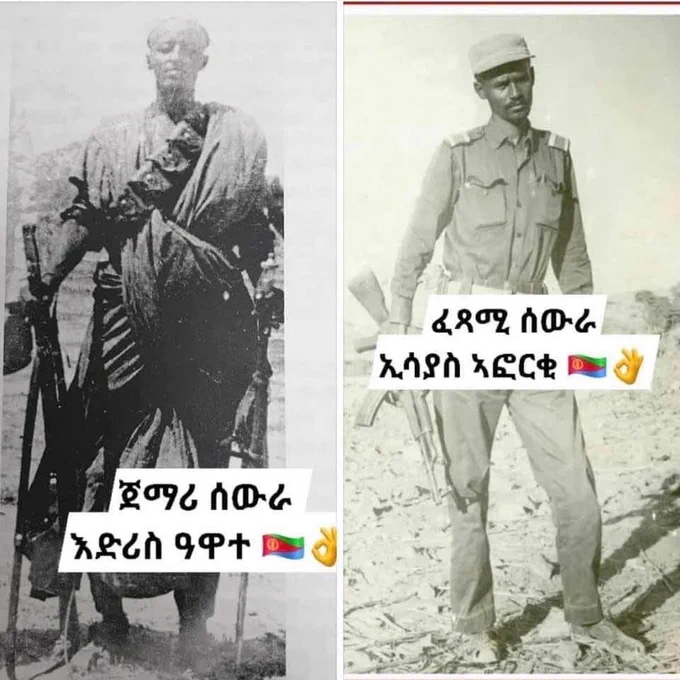
Dumb arse, this is not Awate, one fella who lives in London United Kingdom claimed the man in the picture is his maternal uncle but since the statue is already constructed, wedi medhin berad officials gave the man a deaf ear and instead, they are trying to convince us that the man is indeed aware. :mrgreen:

awate is fictional character who has different faces :lol: :lol: :lol: :lol:


Deqi-Arawit
Senior Member
Posts: 16032
Joined: 29 Mar 2009, 11:10
Location: Bujumbura Brundi

Re: Tribute To Hamid Idris Awate

Post by Deqi-Arawit » 31 Aug 2023, 05:48

Here is Awate. :mrgreen:


Zmeselo
Senior Member+
Posts: 37345
Joined: 30 Jul 2010, 20:43

Re: Tribute To Hamid Idris Awate

Post by Zmeselo » 31 Aug 2023, 06:44


Greetings from Eritrea where HCP #Cureblindness will join in local teams to conduct a high-volume cataract surgical outreach, at Berhan Ayny Hospital. Previously shipped supplies, are already in the hospital store and ready to be used to restore sights to so many patients. @DrMenghisB

Temt
Member+
Posts: 5480
Joined: 04 Jun 2013, 22:23

Re: Tribute To Hamid Idris Awate

Post by Temt » 31 Aug 2023, 12:06


Zmeselo
Senior Member+
Posts: 37345
Joined: 30 Jul 2010, 20:43

Re: Tribute To Hamid Idris Awate

Post by Zmeselo » 31 Aug 2023, 13:40

Temt wrote:
31 Aug 2023, 12:06

Thanx for this, brother temt. :lol:

The 1 day old lie about our Ambassador, was hilarious.


The RC Chuma met today, with the VP of AfDB Dr. Kariuki. On the colorful relationship of the bank with the government and potential for further endeavors the VP said,
If we have a country in the region, where we can have transformational impact, it is Eritrea.


#happeningnow Quarterly meeting of the Eritrea Development Partners' Forum taking place this morning, with Ambassadors and Heads of Mission and members of the UN Country Team. The meeting is taking stock of Global & Regional developments. @AeneasChumaUN

Hazega/Tsazega.
Member
Posts: 1601
Joined: 12 Jun 2007, 20:55

Re: Tribute To Hamid Idris Awate

Post by Hazega/Tsazega. » 31 Aug 2023, 16:50

Zmeselo wrote:
31 Aug 2023, 01:47
Please wait, video is loading...


Tribute To Hamid Idris Awate

https://tesfanews.net/tribute-to-hamid-idris-awate/

August 30, 2015

Hamid Idris Awate, who fired the first shot against Ethiopian government forces on 1 September 1961 at Mount Adal, was a leader in early movements for Eritrean independence. That first shot, indeed sparked the armed struggle for independence of Eritrea.

Hamid Idris Awate (1910-1962) was a leader in the early movements for Eritrean independence. Hamid fired the first shot against Ethiopian government forces on 1 September 1961 at Mount Adal. He went on to create the Eritrean Liberation Army (the armed wing of the Eritrean Liberation Front). He died on May 28, 1962. He was wounded in the last battle he fought against the occupation forces, and it seems his death was due to battle wounds, though some claim it was from natural causes. He was buried near Haykota, Gash Barka, and a statue was erected by the Government of Eritrea on 1 September 1994 at his gravesite.

Hamid Idris Awate was born at Gerset, located between Tessenei and Omhajer in southwestern Eritrea in the year 1910. His father was a peasant and was known to own a rifle. Awate, was trained by his father on how to use that gun. At an early age, he was a very skillful fighter who achieved great superiority in the usage of arms and developed a high knighthood skill that gained him the respect of his generation. Growing up in a locality that appreciates and values ethical principles based on honesty and faithfulness, Awate was known to be a man of moral values and a good example for them to follow, and trust and was a great leader to be obeyed. Besides his fluency in Arabic, Tigre, Tigrina, Nara, Hedareb, and Kunama, Awate also spoke fluent Italian language.

In 1935, he was conscripted by the Italians to serve in the colonial army of the Eritrean Ascari. Besides his fluency in Arabic, Tigre, Tigrina, Nara, Hedareb, and Kunama, Awate learned the Italian language within a short period of time and was sent to Rome for a course in military intelligence.

After returning from Italy, he was appointed as a security officer in western Eritrea. Shortly after that, he served as deputy chief of the city of Kassala, Sudan, and its surroundings during the brief Italian occupation of that city in 1940/1941. He fought as an Ascari in the Battle of Keren and participated in the Italian guerrilla in Eritrea against the British and Ethiopians in WWII, with the cavalrymen of Ali Gabre.

At an early age, Awate was known among his friends and localities for his leadership capabilities and that was enhanced by his daily experience through the posts he held coupled with his national consciousness and awareness of his people’s problems and concerns. He was the most respected individual, in the GashSetit and Barka areas. Many instances are told about his courage and how he was able to fight back, when attacked by colonial police and assassins.

At the end of World War II, the British soldiers who were searching for arms in western Eritrea have, in the process, confiscated properties and killed cattle of the localities in the GashSetit and Barka areas. In a self-defense reaction, Awate killed one of the soldiers. The British authorities accused Awate of a “crime” and forced him to live as a fugitive, for some time. In the meantime, he was defending his people against the British plunders and other bandits who crossed the border from the Sudan, shifta from other parts of Eritrea and Ethiopia who used to raid and loot the properties of people of the GashSetit and Barka areas as well.

Awate commanded a group of 40 gunmen, who Actively operated against the British forces causing heavy losses among them. Aware of his great influence and role, the British colonial authorities decided to negotiate with Awate in order to avoid regrettable developments. A peace deal was reached and the violent clashes came to a stop.

When the Ethiopian government broke the terms of the UN Resolution of the federation of Ethiopia and Eritrea, reducing Eritrea to the status of an occupied country, the Eritrean people rose against it, showing their objections to that action by the Emperor’s government who adopted all means and ways of torture, intimidations, imprisonments, and killings. In the face of that, the Eritreans did not yield or surrender to the Ethiopians unilaterally annulling the federation agreement.

Being a man of initiative and combat, he didn’t leave events to take course according to the aggressor’s wish. He decided to take action that would set history straight and restore stolen rights, but he was waiting for the right time to take the most important decision of his life.

Armed Struggle

In July 1960, in the city of Cairo, a group of young Eritrean students and intellectuals held a meeting and formed the Eritrean Liberation Front (ELF). The group consisted of the following names:

Idris Mohammed Adem (the president of the National Assembly of Eritrea)
Idris Osman Galaydos (a graduate of law school of Cairo University)
Mohammed Saleh Hummed (a graduate of law school of Cairo University)
Said Hussein (a student of Al-Az’har University in Cairo)
Adem Mohammed Akte (a graduate of the University of Cairo)
Taha Mohammed Noor (a graduate from Italy)

Back home, the Ethiopian authorities were suspicious of Awate’s movements and activities and were watching him closely.

In his book, “Eritrea: Destiny Challenges“, Hamid Saleh Turkey wrote about Awate’s beginnings and how the Ethiopian police forces planned to arrest Awate in his village in August 1961. Turkey explains that the Ethiopians deployed a large amount of police forces, but their plans were foiled by an Eritrean nationalist within the Ethiopian police who informed Awate earlier of that plan. Awate then fled to Mount Adal, located to the west of Agordet.

Awate’s decision to begin armed resistance was reached, after a period of long deliberations with other nationalists. In an interview with Eritrea Al-haditha, issue #75, second year, pioneer Mohammed Al-Hassan Dohen, a long-time friend of Awate and Awate’s assistant when he was district chief, says:

In the year 1960, Idris Mohammed Adem sent a letter to Awate, the letter was written in Arabic… Hamid Awate told me that Idris Mohammed Adem was asking him to declare the armed struggle, but he was not ready for it at that time. After four months, Mohammed Al-Shiekh Daood came and asked Awate to declare the revolution. Awate agreed to lead the armed struggle and declare the revolution, but asked for support. Mohammed Al-Shiekh Daood provided Awate with old arms, three five-bullet rifles “abu khamsa” and gave him 300 Birr with sugar and tea. In addition, Ibrahim Mohammed Ali brought two rifles and myself owned a rifle. At the beginning we were only seven, then shortly our number had grown to be 13 fighters.


The Ethiopian authorities, immediately responded to Awate’s declaration. According to Awate’s contemporaries, a military unit in six trucks was sent to apprehend Hamid Awate but failed. The Ethiopians resorted to using different tactics to deal with Awate. Mohammed Al-Hassan Dohen, indicates in his interview that Omer Hassano and Ejiel Abdulrahman made a last-minute appeal to end Awate’s rebellion on August 1961. Awate responded saying:
If you want us to end our armed struggle, then you better lower the Ethiopian flag and raise up the Eritrean flag.
On September 1st, 1961, Mount Adal witnessed the birth of the long-awaited event, the declaration of the Eritrean revolution. Armed with a strong belief in a just cause, Awate and the pioneers made history in Adal with very poor preparations in terms of arms, men, equipment, and provisions. Nevertheless, they waged their first fierce battle against the Ethiopian occupation in Mount Adal. The freedom fighters, the “RA’EEL” or pioneers, who accompanied Awate, were the following:

• Abdu Mohammed Faid
• Ibrahim Mohammed Ali
• Hummed Gadef
• Awate Mohammed Faid
• Mohammed Beareg
• Mohammed Adem Hassan
• Saleh Giroog
• Ahmed Fekak
• Mohammed Al-hassan Dohen
• Adem Fegoorai
• Ali Bekhit
• Idris Mohmoud
• Omer Kerai

According to Awate’s contemporaries, the battle of Adal lasted for seven hours from (6 a.m. to 1 p.m). Failing to crash the newly formed Eritrean Liberation Army (ELA), the Ethiopian forces retreated back and Awate ordered ELA fighters to withdraw first to Obel, then to Omer Siggo. The reaction to the battle of Mount Adal was great, among Eritreans. The Eritrean people showed their support and solidarity, with their revolution. The ELA pioneers, received a warm welcome wherever they went. On his side, Mohammed Al-Shiekh Daood sold 30 camels to raise the needed amount of funds to supply the revolution and submitted that money to Awate.

Having received a stunning defeat in the battle of Adal, the Ethiopians were alarmed by Awate’s performance. They started massing their forces to carry out a large-scale attack. The Ethiopians were able to encircle ELA in the area of Omal, where another fierce battle took place and resulted in the death of the first member of the ELA, Abdu Mohammed Faid.

However, the ELA was getting stronger as new well-trained fighters who served in the Sudanese military forces began to join the armed struggle. Kiboop Hejaj and Adem Gasear joined Awate and at a later time, on February 17, 1962, another group consisting of 11 joined as well. They were:

• Mohammed Idris Haj
• Omer Hamid Ezaz
• Taher Salem
• Osman Mohammed Idris (abu shenap)
• Ibrahim Mohammed Behdouri
• Mohammed Omer Abdella (abu tyara)
• Omer Mohammed Ali (Da’mer)
• Kisha Mohammed Kisha
• Mohammed Ibrahim
• Abdalla Idirs Adem
• Adem Gendifel

Awate, led all the battles fought during his lifetime. Pioneer Abu Rigella reported that after the battle of Amnait, leader Awate, and Mohammed Ibrahim Shandi got wounded. He says at the time, there were 11 military and civilian individuals who joined Awate, they swore in front of him, and declared their commitment to fight with him.

Abu Rigella attended the meeting, when Awate was elected as a leader unanimously and Mohammed Idris Haj as his deputy. He said, Awate addressed the meeting saying:

We are all Eritreans, we have to serve our country with honesty and sincerity, we are here to achieve a goal, and if there is anybody who may have individual ambitions other than the declared objective, then, he must leave now. We all have to show extreme commitment and dedication and carry out the commands and instructions of the leader, no matter how hard they are, for the cause of our country.


On May 27, 1962, Awate drank milk for dinner, then soon told his unit that he was not feeling good. His condition began to deteriorate, quickly. It is said, that Awate called pioneer Kiboob Hajaj and gave him his gun to emphasize that the struggle should continue. On the morning of the next day, Awate died from his battle wounds. His companions buried him secretly and did not reveal his death, until four years later.


___________


HISTORY & CULTURE
The Spark that Ignited the Blazing Flames of Independence

Dr. Fikrejesus Amahazion

https://shabait.com/2023/08/30/the-spar ... ependence/

Aug 30, 2023

Certain days, stand out as particularly important on the Eritrean calendar. 24 May, celebrating Eritrea’s hard-earned independence, of course, is one. 20 June, reserved to remember the monumental sacrifices of those who fell to win and defend the country’s independence and sovereignty, is definitely another. 8 March and 1 May, which are set aside to observe the huge contributions and importance of women and workers, respectively, are also special days for Eritreans.

Joining these distinguished days is 1 September, locally referred to as Bahti Meskerem, which represents the anniversary of the beginning of Eritrea’s long and bitter armed struggle for independence. The occasion, a national holiday filled with deep patriotism and utmost pride, offers an important opportunity to reflect upon and remember the immense sacrifices and brave, heroic exploits of so many who fought to turn into reality what to many for so long seemed an impossibility: the defeat of Africa’s largest, best-equipped army and the achievement of independence.

On 1 September 1961, now 62 years ago, the Eritrean independence movement transitioned from street demonstrations, non-violence, and peaceful protest, to active, armed resistance. Years before, on 20 September 1949, the United Nations General Assembly (UNGA) decided to send a second commission of inquiry into Eritrea to explore a potential
solution [to] the problem of Eritrea.
In the delegation’s subsequent report about their visit to the country, Sir Zafrulla, the Pakistani representative, presciently observed,
An independent Eritrea would obviously be better able to contribute to the maintenance of peace (and security) than an Eritrea federated with Ethiopia against the true wishes of the people. To deny the people of Eritrea their elementary right to independence would be to sow the seeds of discord and create a threat in that sensitive area of the Middle East.


After a lengthy international process seeking to develop a solution to the Eritrea question, on 2 December 1950, United Nations Resolution 390 (V), was passed by the UNGA. Resolution 390(V), which was backed and sponsored by the United States, extinguished Eritreans’ hopes for independence, federating Eritrea with Ethiopia as
an autonomous unit … under the sovereignty of the Ethiopian Crown.
Seemingly echoing Sir Zafrulla’s prophetic statement, G.K.N. Trevaskis, a former British official in Eritrea, ended his book, Eritrea: A Colony in Transition, by warning Ethiopia that it would be in its (and Eritrea’s) interest for the federal arrangement to survive in accordance with Resolution 390 (V). Yet he acknowledged:
[For Ethiopia], the temptation to subject Eritrea firmly under her own control will always be great. Should she try to do so, she will risk Eritrean discontent and eventual revolt, which, with foreign sympathy and support, might well disrupt both Eritrea and Ethiopia herself.
Although the Eritrean people’s inviolable and inalienable right to self-determination was denied, contrary to principles recognized by the United Nations, and unlike the other Italian colonies that received independence at the end of World War II, Eritreans were nevertheless relieved that the country was not dismembered. The terms of the international resolution stipulating that Eritrea was to be autonomous unit meant that Eritrea was to possess legislative, executive, and judicial powers in the field of domestic affairs, while the jurisdiction of Ethiopia was to extend to defense, foreign affairs, and international trade.

However, Ethiopia, an absolute monarchy ruled by Emperor Haile Selassie, viewed the federal structure with disdain and contempt. Almost immediately, the Emperor began to violate the terms of the federal arrangement; just nineteen days after the federal arrangement was officially ratified and came into force, the imperial regime committed its first violation, through Proclamation 130. The Emperor’s views of the arrangement calling for Eritrea’s autonomy were made unmistakably clear in a speech delivered to the Eritrean Assembly on 22 March 1955:
There are no internal or external affairs as far as the office of his Imperial Majesty’s representative is concerned, and there will be none in the future. The affairs of Eritrea concern Ethiopia as a whole and the Emperor.
The Assembly quickly descended into little more than a rubber stamp for imperial demands and it rapidly lost any credibility among Eritreans. Eventually, the entire Eritrean constitution would be replaced, while the Eritrean flag was replaced by that of Ethiopia. Eritreans were also banned from using indigenous languages in education as well as all official functions, with Amharic, the dominant language of Ethiopia, being made the official language. Furthermore, Eritreans were forced to dissolve their political parties and trade unions, and whole industries were relocated from Asmara to Addis Ababa. The economic basis of autonomy was also eroded, as Eritrea’s highly lucrative shares of customs and excise were expropriated by the Ethiopian government, while foreign investors were pressured to invest in Ethiopia rather than Eritrea. Furthermore, tax funds from Eritrea were used for imperial rather than local interests.

Eritreans were also subjected to state repression, severe violence, and persecution, while all forms of civil disobedience, opposition, dissent, and resistance, which had largely been peaceful and involved broad segments of the Eritrean population, were forcefully crushed. On 10 March 1958, the trade unions launched a general strike in Asmara and other major centers, lasting for four days. In response, Ethiopian troops fired on unarmed protestors killing and wounding many. Assassination attempts against nationalists also became common and routine, forcing some of the most prominent targets, such as Woldeab Woldemariam, Ibrahim Sultan, and Idris Mohammed Adem, into exile. From abroad, they continued their opposition to Ethiopia’s expansionism and helped establish resistance groups.


It is worth noting that Eritrea had been guaranteed a review of its case by the United Nations, if Ethiopia violated the international resolution. Despite the guarantee, and even though many Eritrean political leaders and activists, on numerous occasions, appealed and petitioned to the United Nations in protest of Ethiopia’s steady dismantling of the federal arrangement, the United Nations and the international community remained silent and failed to muster a response. Finally, in November 1962, the imperial regime dissolved the Eritrean parliament under force of arms and annexed Eritrea, proclaiming it as the empire’s fourteenth province. Again, the United Nations and the international community voiced no objections and failed to act in response to this flagrant breach of international law.

It was within this historical context that on 1 September 1961, harbenya (patriot) Hamid Idris Awate, a daring soldier regarded as a renegade by the Italians, British, and Ethiopians, and a small band of fighters, armed with only a handful of old rifles, fired the first shots of the armed struggle in the Gash Barka region of Eritrea. Awate was a talented marksman, who had earlier served as a soldier in the colonial army. There, his military bravery and skills earned him the respect of his superiors and a variety of medals. A few months following Awate’s launch of the armed struggle, Abdu Mohamed Fayed became its first martyr when he was killed at Adal, near Sawa. (Abdu Mohamed Fayed’s grave is now located in Sawa, while Hamid Idris Awate himself passed away about 10 months after the beginning of the armed struggle due to illness.)

For the peace-loving Eritrean people, the launch of the armed revolution was
the expression of the indignation of a people whose rights [were] flagrantly and ruthlessly suppressed.
From those first shots fired by Awate and subsequent hit-and-run skirmishes, Eritrea’s independence struggle grew into a wide-scale war of liberation encompassing the entire population – much like a small spark that ignites a blazing wildfire engulfing everything before it.

During the decades-long independence struggle, Eritrea received no substantive international economic, political, or military support, and it was confronted by one of the continent’s largest and best-equipped militaries. Throughout the duration of the protracted conflict, Ethiopia was heavily backed by the Cold War superpowers, the US and USSR (sometimes simultaneously); as well as many other countries, including, among others, Israel, East Germany, Cuba, and Yemen. Eventually, in 1991, after one of the longest national wars for liberation in modern African history and following tens of thousands of deaths, numerous more injuries, and much devastation and destruction, Eritrea finally won its independence.


________


Sept. 01- commemoration of Eritrea Armed struggle. Tribute to Awate.

1951, Eritrea chief of police (BMA), David Cracknell, went to Barka to plead Awate's surrender. Awate replied:

I will not surrender! I will defend my people, together with the local leaders.


__________


(One of the best cd bought so many years ago)

Post Reply