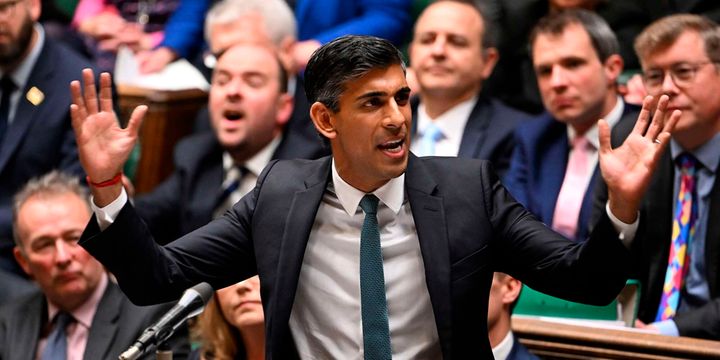
British Prime Minister Rishi Sunak speaks during his first Prime Minister's Questions in the House of Commons in London on October 26. Photo credit: Jessica Taylor | AFP
How Rishi Sunak’s family ended up in the UK from Kenya
By John Kamau
https://www.thecitizen.co.tz/tanzania/n ... ya-4002560
Sunday, October 30, 2022
Summary
• British PM’s parents were part of the ‘stateless’ Indians who had found themselves characterised as the ‘undesirables’ of the British Empire and struggled to reach London – where a quota system on British Asian migrants was in place
When new British Prime Minister Rishi Sunak’s parents left Kenya in the 1960s, it was not of their own volition. The promise made by ruling party Kanu slightly before Independence that there would be
was only for those who took Kenyan citizenship.space for everyone
In Kenya, British Asians were regarded as middle-class, but once in London, they were only allowed to take up low-income employment and were categorised as “coloured”.
That move was supposed to deter those willing to relocate.
Rishi Sunak’s parents were part of the “stateless” Indians who had found themselves characterised as the “undesirables” of the British Empire and struggled to reach London, where a quota system on British Asian migrants was in place.
Britain only allowed a limited number of arrivals yearly, and they had agreed with Jomo Kenyatta on the numbers allowed to leave Kenya, which had refused to allow dual nationality.
During the Lancaster conferences on Kenya’s Constitution, Kanu opposed Kadu’s proposal for dual citizenship. And therefore, after Independence, non-Africans in Kenya were given two years to make up their minds.
After that, Asians found themselves in a dilemma. They could neither return to India – which had closed doors on them – nor take up British citizenship easily after London came up with strict policies and a quota system.
As a medical practitioner, Sunak’s father, Yashivir, who was born in Kenya, and his pharmacist mother, Usha, born in Tanzania, had careers in an area that had been targeted for Kenyanisation.
Though Kenya had only 38 African doctors at Independence, eight of whom were interns, the fate of foreign doctors was raised in Parliament in 1963 when MPs pressured the government to start Kenyanising the health sector. By then, the Ministry of Health had employed 218 medical doctors.
To frustrate non-Kenyan Asians still in the country, the Kenyatta government confronted them with new laws that forced them to apply for work permits, as if they were fresh immigrant, and they were restricted in the nature of business they could undertake.
The government wanted companies to incorporate local directors to escape the purge, but most Asian-owned businesses were family enterprises and could not accommodate outsiders.
Ironically, those Indians who were pushed out of the retail trade went into industrial production, which informed the community’s domination of the sector.
Initially, the setting up of an African commercial class to replace the Indians who dominated the distribution sector faced some teething problems; it hurt most of those who were ordinary shopkeepers and they had to leave the retail sector.
This political tempo had been set in May 1960 by Tom Mboya, who told the Legislative Council that people seeking
Thus, at Independence, the Jomo Kenyatta government gave all businessmen and settlers in Kenya an ultimatum: to either take on Kenyan citizenship or leave with their families.double loyalties have a lot to fear because they are not Kenyans at heart.
They want to exploit that position...If he wants to be an African, and there is room for Asian and Europeans to become Africans, then let him become African without qualification.
Kenya was copying from India, which had in 1955 passed the Citizenship Act that abolished double nationality.
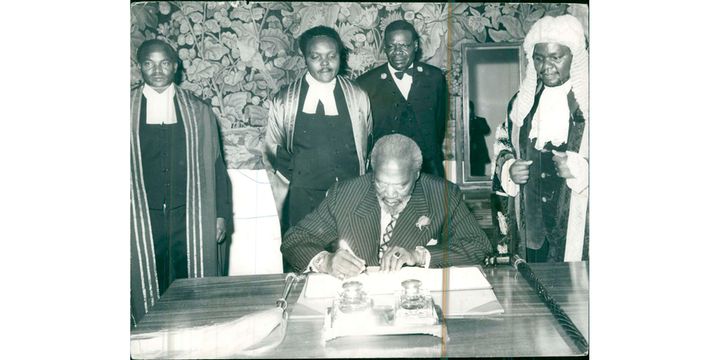
Kenya's first President, Jomo Kenyatta, signs the visitors' book at Parliament Buildings in February 1975. His government gave all businessmen and settlers in Kenya an ultimatum: to take up Kenyan citizenship or leave with their families. Photo credit: Nation Media Group
One had to either become an Indian subject or a British subject. Kenya then adopted an open anti-Asian policy on United Kingdom passport holders (it was only in July 2017 that they were finally gazetted as a new Kenyan tribe, ending 54 years of discrimination).
For Kenyatta, in order to implement the new policy, his government had set up the Kenyanisation of Personnel Bureau, whose purpose was to oversee the removal of various employees within the public and private sector of either British or Asian origin and recommend renewal of work permits.
Commercial and settler farmers were also given “quit notices” to give room for the Africanisation of the businesses and take-over of the settler farms, put in a Land Bank under the resettlement programme.
While the work permits and the Land Bank became avenues of corruption in the 1960s and 70s, the migration policy threw thousands of families out of the country, creating a new generation of Kenyan-born diasporic communities.
Most of these were astute investors and traders, and some today are at the core of industry in the UK and Canada, where they settled. The move caused a lot of panic in the UK, leading the Labour Government to enact the Commonwealth Immigrants Bill to limit such entries.
The idea was to restrict the inflow of Asians from East Africa and other holders of British passports in foreign countries.
Home Secretary James Callaghan told the House of Commons that the measures were necessary
He proposed a special allocation of 1,500 employment vouchers a year for those holding British passports who had no substantial connection with Britain either by birth or paternal parentage.in fairness to the people of this country and in the interests of equitable treatment for the citizens of the Commonwealth as a whole.
The problem was what to do with 35,000 Indians in Kenya holding British passports and another 105,000 Asians who could turn stateless.
With Kenyatta moving on with the Africanisation programme, Britain was always afraid that he might throw the Indians out rather than follow the quota system.
Many Indian families lost their properties and businesses to the political elite through the programme. Others who had not denounced British citizenship after Independence, were squeezed out via rules that made it hard for them to get employment or do business.
Even as locals took over these Asian-owned businesses, there was entrepreneurial confusion since most of the locals had yet to make up their minds on what they wanted from all the opportunities on offer.
Francis Macharia, the National Chamber of Commerce chairman, put it aptly in the 1960s:
The rise of Rishi Sunak as British Prime Minister ends as a beautiful story that started with lots of political rejection in East Africa.Many Africans are completely confused. They don’t know whether they want to do business or farming or something else – and there is a tendency to look at business as a hobby.
[email protected]