Scholz says top priority is avoiding NATO confrontation with Russia
https://www.reuters.com/world/europe/sc ... ce=twitter
Scholz says top priority is avoiding NATO confrontation with Russia
https://www.reuters.com/world/europe/sc ... ce=twitter
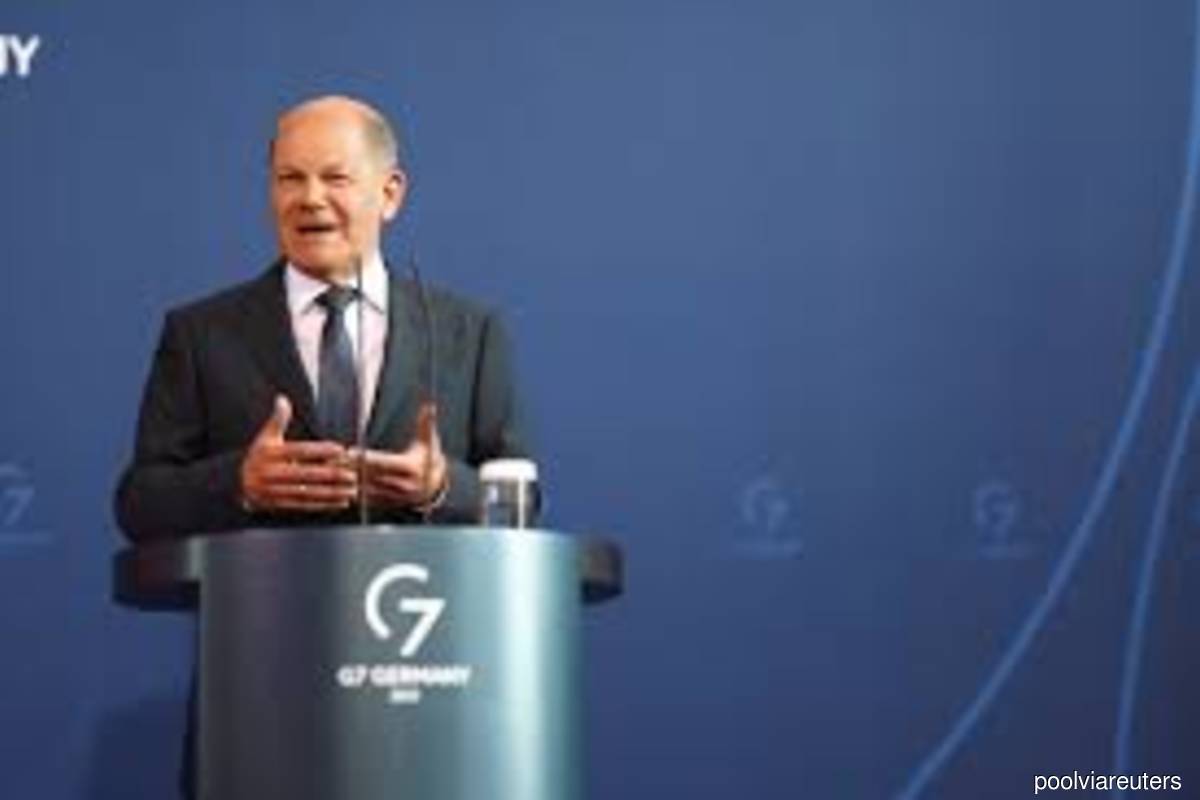 German Chancellor Olaf Scholz makes a statement after talks with European leaders and U.S. President Joe Biden, in Berlin, Germany, April 19, 2022. REUTERS/Lisi Niesner/Pool
Summary
German Chancellor Olaf Scholz makes a statement after talks with European leaders and U.S. President Joe Biden, in Berlin, Germany, April 19, 2022. REUTERS/Lisi Niesner/Pool
Summary
•
Scholz warns Germany may be considered war party if it sends tanks
•
Says top priority is avoiding nuclear war
•
Does not believe banning Russian gas would end war
BERLIN, April 22 (Reuters) - NATO must avoid a direct military confrontation with Russia that could lead to a third world war, German Chancellor
Olaf Scholz said in an interview with
Der Spiegel when asked about Germany's failure to deliver heavy weapons to Ukraine.
Scholz is facing growing criticism at home and abroad for his government's apparent reluctance to deliver heavy battlefield weapons, such as tanks and howitzers, to Ukraine to help it fend off Russian attacks, even as other Western allies step up shipments.
Asked in an extensive interview published on Friday why he thought delivering tanks could lead to nuclear war, he said there was no rule book that stated when Germany could be considered a party to the war in Ukraine.
That's why it is all the more important that we consider each step very carefully and coordinate closely with one another,
he was quoted as saying.
To avoid an escalation towards NATO is a top priority for me.
That's why I don't focus on polls or let myself be irritated by shrill calls. The consequences of an error would be dramatic.
This was a departure from his previous statements on the topic, focusing on the fact that Germany's own military's stocks were too depleted to send any heavy battlefield weapons while those the German industry has said it could supply could not easily be put into use.
Asked why he would not explain his government's reluctance with the threat of nuclear war, he said such "
simplifications" were not helpful.
Separately, Scholz defended his decision not to immediately end German imports of Russian gas in response to what Russia calls a
special military operation
in Ukraine.
I absolutely do not see how a gas embargo would end the war. If (Russian President Vladimir) Putin were open to economic arguments, he would never have begun this crazy war,
he said.
Secondly, you act as if this was about money. But it's about avoiding a dramatic economic crisis and the loss of millions of jobs and factories that would never again open their doors.
Scholz said this would have considerable consequences not just for Germany but also for Europe and the future financing of the reconstruction of Ukraine.
Reporting by Riham Alkousaa and Kirsti Knolle; Writing by Sarah Marsh Editing by Tomasz Janowski
______________________
 COMMENTARY
Pimps of war: Neocons who fueled 20 years of carnage in the Middle East are back for more
The warmongering buffoons who drove the U.S. to disaster in Iraq and Afghanistan are now eager for war with Russia
By CHRIS HEDGES
https://www.salon.com/2022/04/12/pimps- ... -for-more/
APRIL 12, 2022
COMMENTARY
Pimps of war: Neocons who fueled 20 years of carnage in the Middle East are back for more
The warmongering buffoons who drove the U.S. to disaster in Iraq and Afghanistan are now eager for war with Russia
By CHRIS HEDGES
https://www.salon.com/2022/04/12/pimps- ... -for-more/
APRIL 12, 2022
 Men In Military Uniforms Standing (Getty Images / Michael Davis / EyeEm)
This article originally appeared at ScheerPost. https://scheerpost.com/2022/04/11/hedge ... ps-of-war/ Used by permission.
T
Men In Military Uniforms Standing (Getty Images / Michael Davis / EyeEm)
This article originally appeared at ScheerPost. https://scheerpost.com/2022/04/11/hedge ... ps-of-war/ Used by permission.
The same cabal of warmongering pundits, foreign policy specialists and government officials, year after year, debacle after debacle, smugly dodge responsibility for the military fiascos they orchestrate. They are protean, shifting adroitly with the political winds, moving from the Republican Party to the Democratic Party and then back again, mutating from cold warriors to neocons to liberal interventionists. Pseudo-intellectuals, they exude a cloying Ivy League snobbery as they sell perpetual fear, perpetual war and a racist worldview, where the lesser breeds of the earth only understand violence.
They are pimps of war, puppets of the Pentagon, a state within a state, and the defense contractors who lavishly fund their think tanks — Project for the New American Century, American Enterprise Institute, Foreign Policy Initiative, Institute for the Study of War, the Atlantic Council and the Brookings Institution. Like some mutant strain of an antibiotic-resistant bacteria, they cannot be vanquished. It does not matter how wrong they are, how absurd their theories, how many times they lie or denigrate other cultures and societies as uncivilized or how many murderous military interventions go bad. They are immovable props, the parasitic mandarins of power vomited up in the dying days of any empire, including ours, leaping from one self-defeating catastrophe to the next.
I spent 20 years as a foreign correspondent reporting on the suffering, misery and murderous rampages these shills for war engineered and funded. My first encounter with them was in Central America. Elliot Abrams — convicted of providing misleading testimony to Congress on the Iran-Contra Affair and later pardoned by President
George H.W. Bush so he could return to government to sell us the Iraq war — and
Robert Kagan, director of the State Department's public diplomacy office for Latin America — were propagandists for the brutal military regimes in El Salvador and Guatemala, as well as the rapists and homicidal thugs who made up the rogue Contra forces fighting the Sandinista government in Nicaragua, which they illegally funded. Their job was to discredit our reporting.
_____________
RELATED:
The dangerous myth of American innocence: Only our enemies commit "war crimes" https://www.salon.com/2022/03/24/the-my ... ar-crimes/
_____________
They, and their coterie of fellow war lovers, went on to push for the expansion of NATO in Central and Eastern Europe after the fall of the Berlin Wall, violating an agreement not to extend NATO beyond the borders of a unified Germany and recklessly antagonizing Russia. They were and are cheerleaders for the apartheid state of Israel, justifying its war crimes against Palestinians and myopically conflating Israel's interests with our own. They advocated for air strikes in Serbia, calling for the U.S. to "
take out"
Slobodan Milosevic. They were the authors of the policy to invade Afghanistan, Iraq, Syria and Libya. Robert Kagan and
William Kristol, with their typical cluelessness, wrote in April 2002 that
the road that leads to real security and peace is the road that runs through Baghdad.
http://www.weeklystandard.com/Content/P ... 6zzete.asp
We saw how that worked out. That road led to the dissolution of Iraq, the destruction of its civilian infrastructure, including the obliteration of 18 of 20 electricity-generating plants and nearly all the water-pumping and sanitation systems during a 43-day period when 90,000 tons of bombs were rained down on the country, the rise of radical jihadist groups throughout the region, and failed states. The war in Iraq, along with the humiliating defeat in Afghanistan, shredded the illusion of U.S. military and global hegemony. It also inflicted on Iraqis, who had nothing to do with the attacks of 9/11, the widespread killing of civilians, the torture and sexual humiliation of Iraqi prisoners, and the ascendancy of Iran as the preeminent power in the region. They continue to call for a war with Iran, with Fred Kagan stating that
there is nothing we can do short of attacking to force Iran to give up its nuclear weapons.
They pushed for the overthrow of President
Nicolás Maduro, after trying to do the same to
Hugo Chávez, in Venezuela. They have targeted
Daniel Ortega, their old nemesis in Nicaragua.
They embrace a purblind nationalism that prohibits them from seeing the world from any perspective other than their own. They know nothing about the machinery of war, its consequences or its inevitable blowback. They know nothing about the peoples and cultures they target for violent regeneration. They believe in their divine right to impose their "
values" on others by force. Fiasco after fiasco. Now they are stoking a war with Russia.
The nationalist is by definition an ignoramus,
Yugoslav writer
Danilo Kiš https://en.wikipedia.org/wiki/Danilo_Ki%C5%A1 observed.
Nationalism is the line of least resistance, the easy way. The nationalist is untroubled, he knows or thinks he knows what his values are, his, that's to say national, that's to say the values of the nation he belongs to, ethical and political; he is not interested in others, they are no concern of his, hell — it's other people (other nations, another tribe). They don't even need investigating. The nationalist sees other people in his own images — as nationalists.
The Biden administration is filled with these ignoramuses, including
Joe Biden.
Victoria Nuland, the wife of Robert Kagan, serves as Biden's undersecretary of state for political affairs.
Antony Blinken is secretary of state.
Jake Sullivan is national security adviser. They come from this cabal of moral and intellectual trolls that includes
Kimberly Kagan, the wife of
Fred Kagan, who founded the Institute for the Study of War,
William Kristol,
Max Boot, John Podhoretz, Gary Schmitt, Richard Perle, Douglas Feith, David Frum and others. Many were once staunch Republicans or, like Nuland, served in Republican and Democratic administrations. Nuland was the principal deputy foreign policy adviser to Vice President
[deleted] Cheney.
They are united by the demand for larger and larger defense budgets and an ever-expanding military.
Julian Benda called these courtiers to power
the self-made barbarians of the intelligentsia.
_____________
The ideologues who demand ever-larger defense budgets and an ever-expanding military don't see the corpses of their victims. I did, in Guatemala, El Salvador, Nicaragua, Gaza, Iraq, Sudan, Yemen and Kosovo.
_____________
They once railed against liberal weakness and appeasement. But they swiftly migrated to the Democratic Party rather than support
Donald Trump, who showed no desire to start a conflict with Russia and who called the invasion of Iraq a
big, fat mistake.
Besides, as they correctly pointed out,
Hillary Clinton was a fellow neocon. And liberals wonder why nearly half the electorate, who revile these arrogant unelected power brokers, as they should, voted for Trump.
These ideologues did not see the corpses of their victims. I did. Including children. Every dead body I stood over in Guatemala, El Salvador, Nicaragua, Gaza, Iraq, Sudan, Yemen or Kosovo, month after month, year after year, exposed their moral bankruptcy, their intellectual dishonesty and their sick bloodlust. They did not serve in the military. Their children do not serve in the military. But they eagerly ship young American men and women off to fight and die for their self-delusional dreams of empire and American hegemony. Or, as in Ukraine, they provide hundreds of millions of dollars in weaponry and logistical support to sustain long and bloody proxy wars.
Historical time stopped for them with the end of World War II. The overthrow of democratically elected governments by the U.S. during the Cold War in Indonesia, Guatemala, the Congo, Iran and Chile (where the CIA oversaw the assassination of the commander-in-chief of the army, Gen.
René Schneider, and President
Salvador Allende), the Bay of Pigs, the atrocities and war crimes that defined the wars in Vietnam, Cambodia and Laos, even the disasters they manufactured in the Middle East, have disappeared into the black hole of their collective historical amnesia. American global domination, they claim, is benign, a force for good, "
benevolent hegemony." The world,
Charles Krauthammer insisted, welcomes "
our power." All enemies, from
Saddam Hussein to
Vladimir Putin, are the new
Hitler. All U.S. interventions are a fight for freedom that make the world a safer place. All refusals to bomb and occupy another country are a 1938 Munich moment, a pathetic retreat from confronting evil by the new
Neville Chamberlain. We do have enemies abroad. But our most dangerous enemy is within.
The warmongers build a campaign against a country such as Iraq or Russia and then wait for a crisis — they call it the next Pearl Harbor — to justify the unjustifiable. In 1998, Kristol and Robert Kagan, along with a dozen other prominent neoconservatives, wrote an open letter to President
Bill Clinton denouncing his policy of containment of Iraq as a failure and demanding that he go to war to overthrow Saddam Hussein. To continue the
course of weakness and drift,
they warned, was to
put our interests and our future at risk.
Huge majorities in Congress, Republican and Democrat, rushed to pass the Iraq Liberation Act. Few Democrats or Republicans dared be seen as soft on national security. The act stated that the United States government would work to
remove the regime headed by Saddam Hussein
and authorized $99 million towards that goal, some of it being used to fund
Ahmed Chalabi's Iraqi National Congress, which would become instrumental in disseminating the fabrications and lies used to justify the Iraq war during the administration of
George W. Bush.
______________
Warmongers build a campaign against a country such as Iraq and Russia and then wait for a crisis — they always call it the next Pearl Harbor — to justify the unjustifiable.
______________
The attacks of 9/11 gave the war party its opening, first with Afghanistan, then Iraq. Krauthammer, who knew nothing about the Muslim world, wrote that
the way to tame the Arab street is not with appeasement and sweet sensitivity but with raw power and victory. …The elementary truth that seems to elude the experts again and again … is that power is its own reward. Victory changes everything, psychologically above all. The psychology in the [Middle East] is now one of fear and deep respect for American power. Now is the time to use it.
Removing Saddam Hussein from power, Kristol crowed, would
transform the political landscape of the Middle East.
It did, of course, but not in ways that benefited the U.S.
They lust for apocalyptic global war. Fred Kagan, the brother of Robert, a military historian, wrote in 1999 that
America must be able to fight Iraq and North Korea, and also be able to fight genocide in the Balkans and elsewhere without compromising its ability to fight two major regional conflicts. And it must be able to contemplate war with China or Russia some considerable (but not infinite) time from now.
(Emphasis mine.)
They believe violence magically solves all disputes, even the Israeli-Palestinian morass. In a bizarre interview immediately after 9/11,
Donald Kagan, the Yale classicist and right-wing ideologue who was the father of Robert and Fred, called, along with his son Fred, for the deployment of U.S. troops in Gaza so we could
take the war to these people.
They have long demanded the stationing of NATO troops in Ukraine, with Robert Kagan saying that
we need to not worry that the problem is our encirclement rather than Russian ambitions.
His wife, Victoria Nuland, was outed in a leaked phone conversation in 2014 with the U.S. ambassador to Ukraine,
Geoffrey Pyatt, disparaging the EU and plotting to remove lawfully elected President
Viktor Yanukovych and install compliant Ukrainian politicians in power, most of whom did eventually take power. They lobbied for U.S. troops to be sent to Syria to assist "
moderate" rebels seeking to overthrow
Bashar al-Assad. Instead, the intervention spawned the Caliphate. The U.S. ended up bombing the very forces they had armed, becoming Assad's de facto air force.
The Russian invasion of Ukraine, like the attacks of 9/11, is a self-fulfilling prophecy. Putin, like everyone else they target, only understands force. We can, they assure us, militarily bend Russia to our will.
It is true that acting firmly in 2008 or 2014 would have meant risking conflict,
Robert Kagan wrote in the latest issue of
Foreign Affairs of Ukraine, lamenting our refusal to militarily confront Russia earlier.
But Washington is risking conflict
https://www.foreignaffairs.com/articles ... worth-risk now; Russia's ambitions have created an inherently dangerous situation. It is better for the United States to risk confrontation with belligerent powers when they are in the early stages of ambition and expansion, not after they have already consolidated substantial gains. Russia may possess a fearful nuclear arsenal, but the risk of Moscow using it is not higher now than it would have been in 2008 or 2014, if the West had intervened then. And it has always been extraordinarily small: Putin was never going to obtain his objectives by destroying himself and his country, along with much of the rest of the world.
In short, don't worry about going to war with Russia, Putin won't use the bomb.
I do not know if these people are stupid or cynical or both. They are lavishly funded by the war industry. They are never dropped from the networks for their repeated idiocy. They rotate in and out of power, parked in places like the Council on Foreign Relations or the Brookings Institution, before being called back into government. They are as welcome in the Obama or Biden White House as the Bush White House. The Cold War, for them, never ended. The world remains binary, us and them, good and evil. They are never held accountable. When one military intervention goes up in flames, they are ready to promote the next. These
Dr. Strangeloves, if we don't stop them, will terminate life as we know it on the planet.
______________
Chris Hedges is the former Middle East bureau chief of the New York Times, a Pulitzer Prize winner and a columnist at ScheerPost. He is the author of several books, including "America: The Farewell Tour," https://bookshop.org/a/2464/9781501152689 "American Fascists: The Christian Right and the War on America" https://bookshop.org/a/2464/9780743284462 and "War Is a Force That Gives Us Meaning." https://bookshop.org/a/2464/9781610393591 He previously worked overseas for the Dallas Morning News, the Christian Science Monitor and NPR, and hosts the Emmy-nominated RT America show "On Contact."