#PIA interviews Part I and Part II - English translation
Part I: https://shabait.com/2023/02/15/intervie ... -part-i-2/
Part 2: https://shabait.com/2023/02/21/intervie ... part-ii-2/
Re: President Isaias Afewerki interview Part I & II English translation
እንግዲህ ከይዘቱ በተጨማሪ በ 8ቱ ጥያቄዎች መልስ ውስጥ እንደ ቅደም ተከተላቸው ይህን ታዝበናል 
1) Eritrea 9 ግዜ፣ TPLF 38 ግዜ፣ Washington 8 ግዜ፣ Ethiopia 7 ግዜ፣ Tigray 8 ግዜ ተጠቅሰዋል።
2) Eritrea 0 ግዜ፣ TPLF 3 ግዜ፣ Washington 0 ግዜ፣ Ethiopia 1 ግዜ፣ Tigray 0 ግዜ ተጠቅሰዋል።
3) Eritrea 3 ግዜ፣ TPLF 0 ግዜ፣ Washington 0 ግዜ፣ Ethiopia 0 ግዜ፣ Tigray 0 ግዜ ተጠቅሰዋል።
4) Eritrea 0 ግዜ፣ China 2 ግዜ፣ Russia 2 ግዜ፣ Washington 3 ግዜ ተጠቅሰዋል።
5) Eritrea 12 ግዜ፣ TPLF 27 ግዜ፣ Washington 2 ግዜ፣ Ethiopia 25 ግዜ፣ Tigray 26 ግዜ ተጠቅሰዋል።
6) Eritrea 5 ግዜ፣ TPLF 2 ግዜ፣ Washington 3 ግዜ፣ Ethiopia 6 ግዜ፣ Somalia 34 ግዜ ተጠቅሰዋል።
7) Eritrea 5 ግዜ፣ TPLF 2 ግዜ፣ Washington 0 ግዜ፣ Ethiopia 1 ግዜ፣ Somalia 2 ግዜ ፣ Kenya 11 ግዜ ፣ Sudan 4 ግዜ ተጠቅሰዋል።
8] Eritrea 1 ግዜ፣ TPLF 0 ግዜ፣ Washington 1 ግዜ፣ Ethiopia 0 ግዜ፣ Tigray 0 ግዜ ተጠቅሰዋል።
1) Eritrea 9 ግዜ፣ TPLF 38 ግዜ፣ Washington 8 ግዜ፣ Ethiopia 7 ግዜ፣ Tigray 8 ግዜ ተጠቅሰዋል።
2) Eritrea 0 ግዜ፣ TPLF 3 ግዜ፣ Washington 0 ግዜ፣ Ethiopia 1 ግዜ፣ Tigray 0 ግዜ ተጠቅሰዋል።
3) Eritrea 3 ግዜ፣ TPLF 0 ግዜ፣ Washington 0 ግዜ፣ Ethiopia 0 ግዜ፣ Tigray 0 ግዜ ተጠቅሰዋል።
4) Eritrea 0 ግዜ፣ China 2 ግዜ፣ Russia 2 ግዜ፣ Washington 3 ግዜ ተጠቅሰዋል።
5) Eritrea 12 ግዜ፣ TPLF 27 ግዜ፣ Washington 2 ግዜ፣ Ethiopia 25 ግዜ፣ Tigray 26 ግዜ ተጠቅሰዋል።
6) Eritrea 5 ግዜ፣ TPLF 2 ግዜ፣ Washington 3 ግዜ፣ Ethiopia 6 ግዜ፣ Somalia 34 ግዜ ተጠቅሰዋል።
7) Eritrea 5 ግዜ፣ TPLF 2 ግዜ፣ Washington 0 ግዜ፣ Ethiopia 1 ግዜ፣ Somalia 2 ግዜ ፣ Kenya 11 ግዜ ፣ Sudan 4 ግዜ ተጠቅሰዋል።
8] Eritrea 1 ግዜ፣ TPLF 0 ግዜ፣ Washington 1 ግዜ፣ Ethiopia 0 ግዜ፣ Tigray 0 ግዜ ተጠቅሰዋል።
Hillal wrote: ↑23 Feb 2023, 17:33#PIA interviews Part I and Part II - English translation
Part I: https://shabait.com/2023/02/15/intervie ... -part-i-2/
Part 2: https://shabait.com/2023/02/21/intervie ... part-ii-2/
Re: President Isaias Afewerki interview Part I & II English translation
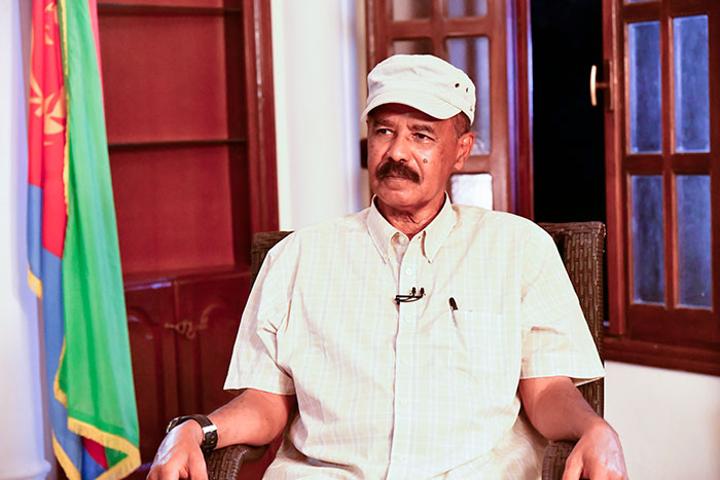
Q1. In your interview last year, you had indicated that the TPLF’s reckless adventures had been foiled, even if its Enablers continued to dwell on their subversive campaigns. As you had predicted, the TPLF unleashed its third offensive (in August last year) during the critical harvest season as it was invariably the case with the two previous offensives. The TPLF was subsequently compelled to sign the Cessation of Hostilities Agreement. What were the political and military developments that underpinned this event? What is its likely trajectory in the period ahead?
A. When broaching this subject, the first question that comes to mind is why was war necessary in the first place? And, what was the rationale for launching the third adventurist offensive? It is imperative to examine the dynamics of the preceding reckless offensives in order to properly gauge and understand the third and final gambit.
As I stressed earlier, the crucial question is why this war was launched in the first place at a time when a Peace Agreement was signed. In our view, this was not really a TPLF agenda; but essentially the agenda of Washington. The sad fact is, perturbed and anxious as they were by the advent of peace between Eritrea and Ethiopia, impeding and scuttling it became their dogged obsession. The vehicle of choice to implement this wicked agenda was their subordinate – the TPLF clique. The TPLF was subservient to their agenda for almost thirty years thereby plunging Ethiopia into a quagmire. The TPLF had done its part as a loyal surrogate in those decades. Finally, it was utterly incapacitated and became a spent force. Nonetheless, its Enablers did not abandon their agendas. When it was said GAME OVER, the thrust of their actions focused on resuscitating the TPLF and their agenda. The schemes that were being concocted were transparent to us.
As I explained on previous occasions, I was not keen to meet the Chief of the TPLF clique during the celebratory occasion in Omhager. But eventually, I decided to meet him briefly – for a couple of seconds at most – to ask him why they were making preparations for war. I told him, “I am baffled; What are your intentions in going to war? His response was “this is not going to happen…it will not happen”. This was not, really, an honest response.
Soon after, the reckless adventures ensued including missile attacks on Asmara. They had mapped out 72 targets for missile attacks against the country. The full details will be divulged at the appropriate time. In a nutshell, it can be summed up as the reckless gamble of a bankrupt merchant. Of course, they had made necessary preparations. The end game was to disrupt the conducive climate of peace and impose a new reality of chaos and instability. The military offensives stemmed – as it was graphically depicted in the play during the Fenkil celebrations yesterday – from miscalculation. The presumptuous assessment by Washington further amplified and multiplied the TPLF clique’s erroneous perspectives. They unleashed the offensive expecting huge results. Bombing Asmara with missiles cannot have substantive military impact. Yet the US Embassy in Asmara amplified it with its megaphones in a celebratory tone.
There is nothing new or novel to us in TPLF’s unbridled conduct which is akin to a bankrupt merchant who wallows in yet more gambles. Furthermore, the TPLF has external Enablers and masters. Its main task is to do their bidding; to implement their express instructions.
The first phase of the TPLF’s initial offensive ended in a debacle. I will not delve into greater details on the dynamics and specifics of how the first offensive was foiled. They should have drawn appropriate lessons from this utter failure. But its Enablers concocted various subterfuges to salvage the TPLF clique.
The second option that was developed subsequently was to attack Wollo and Combolcha and enter Addis Abeba. All the accompanying themes and dramas were meticulously prepared. The propaganda that was floating was that this was indeed a second chance. What could the TPLF achieve by spreading itself in a vast area, in a huge morass? In retrospect it is clear that this was a disastrous folly. Only a fool will keep playing when the game is finished. The sheer size of the army they had amassed through extensive and forced conscription might have been a factor that misled them. They pinned their hopes on outnumbering the Federal Army. These were the calculations that they reached in their closed circle. But the outcome was predictable. The outcome that would accrue when operating in unfamiliar and expansive terrain extending to Addis Abeba cannot be lost to a sober mind. This was utter insanity. As it happened, the offensive met utter failure.
And yet, TPLF’s Enablers concocted another ploy. They pressed for the termination of the counter-offensive campaign and to hinder its advance to the Tigray Region. This was inexplicable by any standards. But it was evident that this would lead to the launching of the third offensive. Indeed, old habits die hard and the pattern or playbook was in any case the same.
Frantic preparations for the third round of the military adventure, which was dubbed “final and decisive,” continued in full swing. A large army was amassed through coercion, deceit and intimidation. The preparations, including the propaganda, were reminiscent of the fanfare during the Dergue’s regime. The pomp and insanity was hard to fathom. They had sustained major defeats in the two previous rounds. Their desire was now not to miss the opportunity in the third round. I attribute this agenda to the clique in Washington and its ilk elsewhere. The only vehicle of implementation was of course the TPLF clique. The TPLF had no problem to advance external agendas by agitating the people of Tigray through deceitful promises and dreams.
In the last military adventure, the plan was to open new fronts in the eastern and western flanks in addition to the northern and southern fronts. The preparations that were made on Sudanese territory were enormous both in terms of magnitude and capacity. The intention and strategy was to open a corridor through this western front. An additional army was thus created through recruitment in the refugee camps in Sudan and from the contingents that were deployed in Darfur on a peacekeeping mission. Similarly, attempts were made to secure a corridor to Djibouti on the eastern front by inciting ethnic conflicts in the border areas. All-round preparations were thus made for over six months. Weapons and other equipment were smuggled [into Tigray] by airplanes under the cover of darkness to augment the TPLF’s military capability.
In the meantime, the Federal Army, which had gleaned vital lessons from the previous two rounds, had undertaken substantive preparations. The fact was the preparations were not adequate during the first two offensives that were unleashed by the TPLF. One element that contributed to the miscalculation of the TPLF clique and its Enablers was the notion that the Federal Army was virtually impotent. The TPLF had of course an inside track as it had incessantly worked, for almost thirty years, to weaken and fragment it. The Northern Command was an army of 30,000-32,000. Over 10,000 of these soldiers were TPLF loyalists or soldiers. To infiltrate and disarm this force in the first offensive was thus deemed as relatively easy. In retrospect, it is clear that TPLF strategy consisted of weakening and fragmenting the national army to advance its overarching objective of controlling and ultimately balkanizing the country along ethnic lines. The TPLF’s modus operandi for maintaining power rested on inciting interminable ethnic divisions and planting time bombs here and there. As a result, robust and sovereign federal institutions, including security and defense organs, were not developed. TPLF’s reckless first offensive was, no doubt, prompted by these considerations. The shallow strategy was to overrun and route these “nominal institutions” and subsequently funnel the military assault towards the North (i.e. Eritrea).
But the plan did not materialize. Although we may not quantify it at this stage, there were many who refused to surrender when the TPLF unleashed the first assaults. What transpired thereafter is of course well-known.
As I stated earlier, the Federal Army had drawn appropriate lessons from the two offensives to undertake requisite preparations for the third offensive. Still, all the variables in war cannot be foreseen in advance as they are determined by the side starts the war.
In our case, in the past eighty years of our history, waging war has never been our choice. If we went into war it has always been reactive and in self-defense.
In the first round, we cannot talk about adequate preparation to counter TPLF’s adventures. But the ensuing months provided opportunities for requisite preparations. In Ethiopia, in particular, it afforded opportunities for greater popular awareness as well as more effective operational capacity. Based on the lessons learned from the two previous rounds, we were able to synchronize our operations.
War has never been our choice. Accordingly, we need to work together to deny the capability to those who continue to disturb peace in the region by unleashing incessant wars against us. Deterrent action was thus imperative to ascertain peace and stability in the region
The operational changes made had tangible contributions. In addition, we possessed detailed information of what they envisaged. This was critical to our preparations. The task consisted of collecting vital information and meticulous monitoring of their movements and force- deployments until they initiate the military assault. This state of affairs continued for almost six months. The third round was dubbed by them as “final and decisive”. Likewise, this was also our position. The view was that this round should be consummated, and not be halted in mid-stream in order to avert another disastrous adventure.
The problem is they don’t know their capability. They live in a fantasy world. Their advisers and masters are even worse. The clique in Washington are clueless about the reality on the ground. Their situational analysis is flawed. They dubbed the third round “final and decisive”, because deep down, they believed in it. So, to make it a lesson for everyone, to bring the war to an end and for genuine peace to prevail, adequate preparations were made to foil their schemes.
Developments on the ground were really dramatic. The preparations of the counter-offensive were substantial. When the war began, it did not take much time. The losses inculcated on the TPLF within a short period of time was colossal. Within three weeks, TPLF’s leadership began to wail and make preparations to flee from the country. The developments on the ground were swift and forceful. This caused panic not just within the TPLF camp but more so in its Enablers. They began crying out for help and asked to be rescued. A meeting was arranged to be held in Pretoria on 24 October. The US military base in Djibouti sent an aircraft to Mekele to pick up TPLF’s negotiators who were taken to Djibouti and then to Pretoria on another flight.
There, they were presented with a document and asked to sign it. It was all arranged by the clique in Washington. The AU envoys – Obasanjo, Uhuru – were there for cosmetic purposes. The whole scheme revolved around halting the military progress and advances of the counter-offensive in the field in Shire, Aksum, Adwa, Adi-grat,… Mekelle etc. TPLF was severely downgraded and reduced to seeking rescue from its Enablers who obliged accordingly.
One can ask why the meeting was held in Pretoria and not in some other place; and why the subsequent meeting was held in Nairobi. Anyway, through the Djibouti operation, some members of the TPLF clique were taken to Kampala while others were taken to Pretoria to sign.
In short, the plan for halting the counter-offensive was implemented. But so long as they are fully disarmed and put in camps, there’s no need for continued war. The implementation process must be monitored fully. Washington’s principal preoccupation was to rescue the TPLF from the abyss and create a new condition for them to survive and gradually look for other potential options. But there is no need to be alarmed by this. It is good that an agreement has been made, and it should be implemented. Until the agreement is implemented, we cannot comment further. We will not prematurely say that it is all done as we know TPLF’s track-record and its propensity to revert to its old tricks.
The new tactics we now see is bidding for time using lame excuses. To this end, they are peddling new claims alleging that “’Eritrea hasn’t pulled out [its forces… it’s killing people and looting property … there is the issue of Welkait…etc.’’.
The ploy, until yesterday, is to use flimsy pretexts to delay the implementation of the Agreement, and, to exploit the resultant uncertainty to concoct a new scheme. This is Washington’s normative way of thinking, which is applied in other global affairs too. If you encounter an unfamiliar situation, you create chaos to buy time and then to refine and chart out new plans. This is conceivable only if there is going to be a fourth round. In reality, though, the situation will not deteriorate to that level; even if we assume that old habits die hard. The possibilities for reorganization (for TPLF) are indeed very slim. However, we will not make a premature judgement at this juncture; but we will talk about it at the right time.
We are going to closely monitor the implementation of the agreement. But generally, we can say that we are in a better position because of our endurance and the counteroffensive measures that were taken. We cannot say they will change their behavior; but the third round might have taught them a lesson. How many hundreds of thousands have died? How many have been injured? Where are they? This kind of disaster is not seen in any war. It is difficult to imagine the magnitude of the losses caused by the military adventure. It is a crime. After declaring an aimless war; plunging innocent people into a quagmire; causing huge loss of life and property; squandering much opportunity; should not there be due accountability? What does this mean? (Instead of admitting their guilt), they are looking for cover and shifting the blame to others. This is not admissible. There has to be a day when this question has to be raised. Those that are responsible have to be held accountable. It is not just about the three rounds of TPLF’s military adventures. The destruction and loss of opportunity meted out to the Eritrean people for 30 long years without accountability cannot be downplayed or shrugged off.
At the end of the day, it all boils down to the question I raised at the beginning. Why war? How can it be justified politically; even from their own perspective? Why are they conducting this war? What is the real rationale? What are the objectives that the implementers and their Enablers want to achieve? What could be its regional or global benefits? It is mind-boggling.
They have been operating through proxies to-date. The agenda and approach has not changed. The clique in Washington is not happy about the prevailing situation. So, it has to constantly create problems. If it can find an obedient servant like the TPLF clique, well and good. Otherwise, it has to look for an alternative. That has been their modus operandi. And as the global situation compounds their worries, will they ever be relieved from anguish?
A sane person would not accommodate the latest, third adventure, of the TPLF and its Enablers. It is possible for anyone to miscalculate. One may exaggerate his capacity and opportunities while undermining those of his opponent. But when you sustain very heavy losses, you have to stop. The three rounds of military adventures should be seen within the context of the past thirty years as well as the future. The question is, will they change their behavior? Will they embrace peace following the implementation of the Pretoria and Nairobi agreements? We shall see. May be some will flee. After what has happened, there is no space in Tigray where they can play the same game. And there has not been any in the first place. They might have instilled a false sense of invincibility or some other reasons to galvanize support. The last episode provides, however, a big lesson to the people of Tigray who were forced into a costly war they did not need.
The destruction caused by the war cannot be compared to any event. That is why we are insisting on accountability. Also, in order to deter similar adventures from recurring in the future. We should see the events within a broader context; and not in isolation. When we look at the events, we wonder why they are not tired of doing it; they should not have transpired in the first place.
For eighty years, they have harassed and declared wars on us that we never wanted. Can we not be allowed to live in peace as a people? Of course, there is no reason for us to ask for their permission. But as a people, we have the right to live in peace. What is the argument for the successive wars they have been declaring against us ever since they made the statement that Eritrea wouldn’t serve their strategic interests? Don’t they learn from their incessant failures? Couldn’t they change when the Cold War ended, and a unipolar world was created?
In our perspective, the game that went on for a long time came to an end with the demise of TPLF. The phrase “Game over” was not uttered casually. But like a bankrupt gambler who does not give up irrespective of his growing losses and even incurs more debt in the hope of some gains, they launched the three disastrous offensives. And we took, with patience, the required counteroffensive measures. We cannot say similar attempts will not be made in the future because we cannot speak for them. But a big lesson has been learned from the disaster. Above all, we have gained a big experience as a result of working together with the Federal Forces as one team. We can say we have shared experiences that will be helpful in building regional peace. This is a big headache for them. They do not want to see peace between Eritrea and Ethiopia. They will not stay idle. They may try to trigger a conflict between Eritrea and Ethiopia and use the resultant instability to foment other problems in the region. Somalia, Sudan, South Sudan would be potential targets in this destabilizing scheme. The current situation poses a big challenge to them. I call it a “historic challenge”. For the past eighty years, they have exploited the war between Eritrea and Ethiopia under various ruses and arrangements. The war between Eritrea and Ethiopia has served them beyond measure. The habit that they have nurtured for eighty years cannot be expected to change overnight. The loss incurred because of this is unbelievable. And if you go back in time and look at the loss, it is unimaginable. That is why it is important to assess the cumulative damage inculcated in the three rounds of military adventures within the larger context. It is a big experience; and a big lesson has been learned.
Q2. Still on the topic you have raised, there is no doubt that the situation in Ethiopia and the policies of the US and its allies, which have been affecting negatively the international and regional situation in general, have played a devastating role for the past half century. Today, in a critical transition period, the Washington administration has developed a new National Security Strategy that it says will determine the course of events for the next ten years. What can we expect from this new strategy? What might be its global and regional implications?
A. One has to always return to the source of the issue and answer key questions – who is responsible for global insecurity dating back to the pre–Cold War era and up to this day? For what purposes? These recurring questions can help one decipher the recently published national security strategy document. Superficial changes in language aside, which make it seem as if they have corrected their ways, the core attitude has not changed. In fact, a careful reading reveals hidden messages buried between the lines, all serving a specific purpose. This begs the question whether they are even willing to change; whether their culture even allows them to change.
No matter what one thinks of the Cold War era, it was a time of contentious competition between the Soviet bloc and one ruled by them, and it carried with it specific characteristics. Why did this competition need to change? Why did this change then give rise to a hostile and reckless unipolar world? What global challenges did this in turn cause over the past 30 years? What are their plans for the future? The same questions apply to the current situation with Russia.
To answer all of these questions and to understand the core characteristics that underpin this attitude one must examine their [American] history. It can all be traced back to the same mentality that saw no issue with settling in a foreign land after having wiped out an entire native population. In fact, if you look at the geographical makeup of the Americas, you cannot help but wonder about the native populations. We hear of “discoveries” in Canada and other places. You then ask, what happened to the population that was there before? You find that they were wiped out. The few that were left were then controlled. This is documented history. That is what they did everywhere they went during that time. It is the source of their supremacy.
They then resorted to importing enslaved people from Africa to develop the land. If you subtract the enormous number that drowned in the Atlantic and those that perished due to illnesses, you find that the remaining Black people living in the US today are the offspring of enslaved Africans. That is how they developed the country. The actual number of slave owners was relatively small compared to those that they enslaved but that is how they ruled the country, and all of this was considered absolutely normal to them.
Whether one is looking at the 21st, the 20th, or the 19th century, slavery, indentured labor, greed, and hegemony is at the core of the mentality that has ruled and continues to rule that system. It is, however, important to differentiate between the handful in power that have denied the world peace and stability and America as a whole, which includes the American population that bears no responsibility for these actions.
The events surrounding the end of the Cold War and the issues on the Soviet bloc’s side, which eventually led to the fragmentation of the Soviet Union, unfolded in a way that gave one side a false sense of triumph. Instead of ceasing the opportunity to work for global peace and security, however, this “triumph” led them to design a unipolar world and proclaim that the world was now under their full control; that there would be no contest in any sector (economically, technologically, militarily, etc); and that anyone who dared to rise or challenge this view, this “might”, would be dealt with and contained. In effect, all of this was a continuation of the same political culture that they used for centuries, leading one to conclude that they have always remained at the root of all global upheaval and instability.
Nothing has changed with the new strategy – whether viewed in relation to the Cold War or the outlook that gave rise to a unipolar world, the pillars remain the same. Of course, misleading words such as “competition” may have been added but the fact remains that fair competition remains an alien concept to them as they have always aimed at a zero-sum outcome. This new document simply aims to revive a unipolar world that they spent 30 years perfecting and that is now slowly but surely crumbling.
In reality, one cannot speak of the European Union at this time. Ukraine is used as a means to revive this idea. Similarly, NATO is a very weak entity that they are trying to revive using this manufactured situation. Blocking Russia from growth in key areas, especially technologically and militarily, was viewed as a mechanism to ensure global hegemony. As such, using and propping up Crimea, Ukraine, and other areas as pretext, Russia remained their key target for containment over the past 30 years in the post-Cold War era.
Ironically, and what can only be referred to as a blundered gamble, they assumed that China could be used to their advantage as the country offered a cheap source of energy, labor, and basic key industries. They swiftly moved their industries to China with the singular aim of global hegemony. What they could not foresee was China’s confident rise over the past 30 years and overtaking them in many key sectors.
Any observer can predict the next 20 years for China in relation to America and America’s partners. This in turn is giving rise to a change in tune declaring China as the new “threat” and calling to contain China. Of course, none of this is revealed in the new strategy document – a document that highlights “competition” as a key pillar when in reality, as mentioned above, fair competition remains alien to them.
Whether by design or default, this unprovoked hostility aimed at both – Russia and China – has moved these two countries closer to each other. We remain aware of this reality.
Of course, Ukraine remains a pretext with which to revive a unipolar world and eliminating any chance of other powers challenging that hegemony. The “global order” that they seek to uphold is one where they have no competition and one where they control all resources and countries.
The question then becomes will this attempt succeed? Does the current global trend allow a regression back to a unipolar world?
In my opinion, this remains a dream. In fact, the new strategy document, although it reveals their inner whims and desires, proves that they are unable to properly read global events. It is a reflection of yet another blundered gamble. Unfortunately, this has resulted in further misadventures and the resulting chaos we continue to witness at this time. This also proves that they are not interested in calmly analyzing global trends or contributing to global peace and stability. At the core of their political culture is the rule of the jungle where force is used regardless of the cost paid by humanity.
We can also point to the fact that the situation created in our region closely relates to these global developments. Recall that our Independence coincided with the end of the Cold War and the hope at the time was that perhaps the world would be in a better position to support change. Alas, the past 30 years proved the opposite. They continued to use proxies, such as the TPLF clique and others, to create chaos everywhere. Of course, proxies never take the time to think twice and always obey commands in exchange for a few pennies – this is something previously admitted by TPLF cadres. As such, one can easily conclude, whether in our region or other parts of the world, the source of instability and chaos is one and the same.
As their unipolar strategy of the past 30 years slowly crumbles, the next consideration is to try and understand what effects will the current developments have on our region. Some claim that Ukraine will once again lead to triumph, and that Russia will be defeated – this of course is illogical. Then comes the containment of China – one has to ask if that is at all feasible or logical? They are of course trying different angles to fuel chaos in the Pacific by pitting one country against the other, but this too is doomed to fail and can only be viewed as the work of a losing gambler. One must also wonder about the direction America is heading, amassing a massive debt in the ballpark of 32 trillion, printing dollars to keep its economy afloat. What of the military exhibition in Ukraine and the enormous cost that it is entailing?
As it relates to our region, the end of TPLF’s war, for example, does not mean that they will not try to find other ways to create conflict. The trend of the past proves that this mentality that thrives on global chaos will never rest. In the end, however, all we can do is remain aware of all of these developments and remain cognizant of the possible challenges they may pose and prepare for any eventuality.
As is listed in the new strategy document, there are many manufactured reasons that they will use to target other countries for “containment”. Whether Iran or North Korea or others, they will continue to make up the necessary pretext to push through their agenda. This unfortunately will never change.
The use of proxies, the desire to dominate the world and its resources, the strategy of divide and rule – one cannot expect any change as long as these remain the pillars underpinning their interaction with the world.
As a society that has borne the brunt of their hostility for 80 years, our desire for peace and stability remains unmatched in this region. We want to live in a time when war is a thing of the past. We want to achieve our development goals. We are aware that none of the plans we have come through desire alone. We have always committed to work hard. But how do we do this while facing forces that trip us at every corner and how do we do this while facing proxies that are all too willing to serve external agendas? All of these challenges require careful considerations. This also requires us to work in solidarity within our region and with other regions that promote peace and stability. This of course does not mean that we can ignore them and their ways. We cannot afford to. In fact, we need to fully understand what it is that they are planning and how it affects us all. The peace and stability that we want to promote and build between us and Ethiopia and our region in general must take this context into consideration. As such, the events of the past two years should not be viewed in a vacuum but as part of global trends and within the larger global context.
Q3. Your Excellency, you have already mentioned hostilities that have been waged against Eritrea by the US administration for the last 80 years. Is there any hope for substantial changes in rectifying misguided US policies toward Eritrea in light of the so-called New Foreign Security Strategy?
A. A thorough reflection of history leads one to conclude that there would be no change in their policy. In fact, it is striking to witness such repeated futile ploys that in the end do not benefit anyone. It is really difficult to understand why they would continue to engage in juvenile acts that do not reflect their global status and the expectation that comes with their strength.
During Trump’s administration, we chose to engage believing that perhaps there was room to clarify our historical position and the unprovoked hostility and aggression against Eritrea lasting 80 years. We sent a factual memorandum detailing every wrongdoing since 1941 and up to this day. This initiative was anchored on the belief that perhaps they could learn from repeated misguided policies. Trump responded by saying “I may not agree with everything you have said but I willing to work with you in the future”. Again, we did not do this expecting change but to have our version of history recorded in their files.
It is worth noting that some powers did reflect on their past misdeeds and have shown interest in adjusting their ways. Unfortunately, at the time of decision making, these powers take a back seat and the ones that dominate the mediums are the same powers that have repeatedly been on the wrong side of history, caring only about their own fantasies and agendas.
It is also worth noting that when we speak of unprovoked hostilities and wrongdoing, we do so not only in our name because this is not unique to us alone. We always recognize that others in Africa and other parts of the world have also been victims of these misadventures. In fact, we recognize that we may be at the very end of their list of targeted countries. Having understood all of this, it becomes difficult to expect major change in their policy or that they would ever shift from this dangerous track record.
Nevertheless, we must commit to sustainable peace and stability – and we must commit to do so in spite of their aggressions. This is something that requires relentless work and cannot be achieved simply by wishing for it or by trying to work with and correct them.
The challenges experienced in different regions of West, South and North Africa, in our region, as well as in the Middle East, are all similar. To understand the whole jigsaw, one must put all the individual pieces together after studying each piece separately. This would help explained that all the issues in our region – in the Red Sea, in the Horn of Africa, the Nile basin, and in the Gulf region – are the result of interference and manipulative exploits. As such, the situation in the entire region affects us all, collectively.
The different blocs within this region are all interdependent and the economic, development, and security sectors in each all complement and affect one another. One cannot analyze issues in one area separately and if one makes an effort to understand the situation as a whole, one finds that all challenges lead straight back to powers that have an interest in sowing conflict. They may do this directly or indirectly through small or large proxies.
Having said this, we must remain alert at all times, continuously analyze the situation unfolding around us, prioritize our efforts based on the reality, and in the end, we must commit to not only withstand these challenges but to move past them and march forward.
The experience of Eritreans and this society’s ability to withstand all challenges over the past 80 years is worth studying. Eritreans were able to achieve all that they have relying on their own resources and through peerless martyrdom and perseverance. These past 80 years are characterized by a unique sense of resilience – something left for history to bare witness. We need to maintain this history of resistance and resilience, which is why it is important for us to remain alert to their conspiracies and strategies.
This of course leads to a new set of questions – what will be the end of the situation that has been witnessed in Ukraine? What would be the fate of fronts they have been creating in other locations? How are they planning to manage? How will their plans against rising powers pan out? What would they gain from such acts? All of this is assuming there would be no change in their strategic plans and ideologies.
NATO was haphazardly revived and restructured. It is important to note that this was not the result of a planned or orderly decision but rather in reaction to new and unforeseen events that they deemed as threats. Ukraine was used as the necessary pretext for this and is providing an excuse for their objectives. The issue of Sweden and Finland joining or not joining NATO is just part and parcel of the disorderly attempt to expand NATO’s size and to give life to the already dead organization. NATO’s existence is now being questioned. The European Union itself does not exist and it is no longer functional. What is being disseminated through media outlets is repeated ad nauseam with no new agenda.
The silver lining in all of this is that the unipolar world order that they have been preaching about and protecting for the past 30 years has been dismantled and this has paved the way for a better global situation. Of course, it would not be realistic to imagine drastic change overnight or even within a year or two but the trend is leading towards a better future.
This will cause spasms on their end, especially when they realize that the powers that they have tried to control and contain are now out of their reach. They may then try to design new plans but it would be too late. The path they are currently on is literally driving them to the edge of the cliff.
The ideology that kept the Cold War afloat has expired. They then spent the next 30 years destabilizing the world. These efforts may continue in the future. What matters at this point is what will we do in such circumstances? What will other partners who have also suffered from such hostilities do? What can we do collectively to deter such scenarios? Because, again, we cannot expect them to change their ways as it unfortunately seems to be a chronic illness that has no remedy.
Q4. Mr. President, you have repeatedly mentioned that the global order has been subjugated by powers guided by greed and dominance. But there has been a growing awareness in the countries of the Global South and demands for a new and balanced international order. What are the prospects of such developments and what is Eritrea’s stance toward such a scenario?
A. As mentioned earlier, the hostility and efforts to control, stifle and contain both Russia and China have resulted in these two powers moving towards one another and working closely together. This has not crystallized to assume meaningful institutional form, but still remains a reactive and natural response or trend than can grow with time. We then need to examine what the overall developments in China, Russia, India and other small countries of the world would look like. What is yet not clear, for example, is whether Japan is content or not with the policies of the clique in Washington. Would it benefit from continuous confrontation within that neighborhood? Would the confrontation between South and North Korea continue with the same momentum? The alliance that has been attempted to be fostered among Japan, South Korea, and India with Australia’s backing is not accepted by the region.
It is important to note that the demands for peace and stability among the people of the Global South is growing. It would be wrong to assume that ordinary people cannot read global trends and cannot understand larger geostrategic maneuverings. Unfortunately, the powers engaged in manufacturing chaos are not interested in paying attention to these demands and the fact that these developments have generated wider and increased awareness and people from all corners of the world are saying enough is enough.
After the end of the Cold War, the powers that promoted containment were actively engaged in promoting terrorism and supporting terrorist organizations. In fact, terrorist organizations that rose in the past 30 years are directly and indirectly linked to these powers of dominance and the proponents of the unipolar world order. The crisis and destruction that has been witnessed everywhere, including in our region, is the result of these antics. The so-called fight against terrorism was insincere and a tool for deception. Terrorism was created by them. Apart from the terrorist attack of 9/11, the Global South has been the victim of such intimidations. Hunger was another tool worsened by endless crises created by such malicious policies. This part of the world has been greatly affected by the global strategy of the clique in Washington.
Africa has a population of 1.2 billion and the situation may become even more complicated with an increase in population and with ever intensifying interventions and turbulences created by these external forces. The situation in Latin America is similar.
In short, the Global South has been marginalized and the challenges made more complicated by interference and misguided policies.
As a result of and in reaction to these developments, awareness is increasing and populations in the Global South are continuously questioning the reasons for their underdevelopment, worsening living standards and the numerous other challenges they have been facing. They have been demanding a new global order. It is a natural outcome of years of suffering. It is also expected that this awareness will give rise to growing resistance in the Global South in the coming decade or two. We are literally left with no other choice but to resist and to find ways and mechanisms of eliminating the obstacles that stand in our way to our development, peace and stability.
It therefore comes as no surprise to now see last ditch efforts aimed at attracting Africa. Summits have been organized in Europe and America. Africa-America summits have been organized by the clique in Washington. All of this is a reaction to the rising levels of awareness and resistance. It is a last ditch effort to try and undo the tide of resistance. Such attempts have also been exercises to gain the hearts and minds of the people in the Gulf region. But this too is to no avail. Even parties that were previously allies during the Cold War have become increasingly fed up by such acts, saying enough is enough. Countries in the Global South will once and for all say “no hegemony.” Ironically, the powers of domination have begun to understand the trends, which is why they have been looking for alternatives and thus sending delegations to Africa. They are doing all this to appease people and to try and register some gains. But it is too late. No one is fooled by their ploys any more. No one is fooled by these attempts while people’s lives have been destroyed by these same powers.
==================================================================================================================
Interview with President Isaias Afwerki – Part II
GENERAL
On Feb 21, 2023

Q1. As you mentioned in part one of the interview, the people of Tigray have paid a very heavy price for TPLF’s reckless adventures. Having gone through this horrific experience, what developments can we now expect from the people of Tigray? Recalling TPLF’s myriad and willful campaigns to foment hate and internecine conflict between the people of Tigray and other peoples in Ethiopia (as well as its Eritrean neighbor), what message do you have to the people of Tigray?
A. This must be viewed in its wider and cumulative context as the malaise was spawned over a long period of time. Its genesis must, thus, be properly analyzed and understood. The question that always comes to mind is why did we find ourselves in this situation in the first place? Why did the TPLF get embroiled in this malaise?
The struggle was arguably just when it was first launched as it was against the domination or hegemony of one specific nationality or ethnic group. This was within the context of the political reality of Ethiopia at the time. The basic question is how marginalization and its ramifications – how the right of nationalities – should be addressed.
Our collaboration begun in the early 1970s. But this had to undergo tugs of ideological battles for many years, extending to the second-half of the 1970s, owing to the erroneous political objectives laid out in TPLF’s Manifesto, which included Tigray’s secession from Ethiopia and the declaration of independence.
Considering the sanctity of colonial borders and the role this in turn played in the formation of African nations through various processes, including the countries of the Horn of Africa, the consensual position was that struggles for self-determination cannot exist outside this framework. As such, the demand for secession was completely indefensible, especially when viewed in relation to the formation of other countries in this region including Djibouti, Eritrea, Ethiopia, Sudan; the process that led to the drawing of borders in Africa; and the struggle for rights within these set boundaries.
This stark difference in interpretation and objectives between us resulted in extensive consultations that took several years. Our argument was that the struggle ought to be aimed at, and confined to, bringing about change in Ethiopia. It also needed to be inclusive; to bring about fundamental change in the whole country; to redress and rectify issues of injustice, inequity, ethnic bigotry, and marginalization.
This was ultimately rectified – after having agreed upon clear and shared objectives – and we were subsequently able to cultivate ties of cooperation. The political pronouncements of the time, the organizational structures, and the public awareness campaigns taking place in Tigray reflected these common understandings. As such, our cooperation continued.
External interference was rampant during the whole period. First, there were interventions from the US and Israel to prop up the Haile Selassie regime. Then, in the mid-1970s, the Dergue took power and with it came the involvement of the USSR. This continued for 17 years after which the Dergue regime fell and justice was achieved.
The fall of the Dergue regime in 1991, which coincided with the end of the Cold War, led to a new epoch in our region’s history, ushering in the envisioned just changes in Ethiopia, as well as the termination of the historical injustices perpetrated against Eritrea. The new epoch was characterized by the absence of external meddling in the region’s affairs.
The end of the Cold War entailed changes at the global as well as the regional levels. In the context of Ethiopia, the fundamental issues under consideration revolved on how to handle the future political dynamics in the country and effect a just transformation anchored on inclusiveness and solidarity – taking into account that this was a struggle waged not only by the people of Tigray but numerous other oppressed nationalities.
A Conference on Peace and Democracy was accordingly held in Addis Ababa in 1991. Various arguments were raised, before and during this conference, that highlighted the need to take into consideration the just struggles of all nationalities – the Oromo, the Amhara, the Somali, the Afar, and other groups – when formulating the transition to a new political dispensation.
The TPLF however embarked on misguided political and organizational trajectory. It is within this context that TPLF perverted the process and created the EPRDF. The idea was to form a “coalition” of individuals that ostensibly represent different ethnicities but that the TPLF would manage and/or micromanage. In the first place, the EPRDF organizational structure was subordinated and supplanted by the TPLF’s Marxist-Leninist League of Tigray. The TPLF was, in effect, betraying the ethos of the struggle against marginalization to create a new alliance in which it was the new hegemon. In the process, it marginalized the other political groups in the coalition. This could not be viable. As it happened, the OLA eventually pulled out. This derailment eventually percolated to affect others in the whole country.
Eritrea’s approach has always been to urge for composed consultations. This was the case during the consultations that took place in the 1970s as mentioned earlier or the ones that took place in this context, in 1991. Our view, as presented at the time, was that whatever political system is created ought to be inclusive; reflect the historical, decades-long, struggle against oppression and marginalization; and not leave room for division and fragmentation.
The centrifugal trend begun to emerge soon after the convention of the Conference on Peace and Democracy. It was not addressed promptly. We continued to observe the situation with reservations as we were firmly convinced that the path chosen would ultimately imperil the cultivation of participatory and inclusive political dispensation in Ethiopia. The drafting of the new Constitution of the Federal Democratic Republic of Ethiopia occurred against this backdrop.
Owing to our cordial working relationship at the time and having been in constant communication about these developments during and after the 1991 Conference, Melles paid an unplanned visit to Asmara at the end of 1994 and gave me for comments, the first draft of the Constitution. He stated it had not been shared with anyone at the time.
Immediately after the first glance, I recognized that I would need a couple of days for a more comprehensive appraisal and accordingly asked him to give me more time.
In my view and setting aside the irrationality of Article 39 on the right to secession, the entire document was not amenable for possible amendments here and there. In those times, Melles and myself had nurtured a habit of communicating our views to each other candidly on all the issues on which we maintained periodic consultations. So I told Melles (bluntly) that the draft Constitution was not fit for any people, let alone for the people of Ethiopia.
African countries have emerged from colonial rule. The primary task, the overarching project, remained nation-building in a forward-looking mode. Fragmented and dispersed constituencies; disparate communities some of which were privileged while most were deprived and marginalized; must be galvanized together in the common task of cohesive nation-building. In my view, the proposed Draft Constitution would not solve Ethiopia’s challenges and would only lead to further polarization. The people of Ethiopia deserve better.
Melles quipped: “I knew you would say this”. I told him fine and went on to add: “your proposal is idealistic and cannot be applied in practical terms… What if it leads to fragmentation tomorrow?”. Melles retorted: “we have no other choice… this is the only way we can control Ethiopia”.
EPRDF, of course, was concocted as a convenient “umbrella coalition”, as a tool of political charade to give the superficial impression of equal participation by all. But how would this be managed and what are the conceivable benefits of a system that incubates polarization?
But for Melles, the strategy was clear. In his words: “For us, this is the only viable strategy. We plant time bombs here and there. If all is smooth, well and good. If not, we will detonate all the bombs”.
Needless to say, this strategy was not constructive. One cannot build a nation through this path. Indeed, nation-building requires one to enact a deliberate process that builds bridges, erases fault lines, brings people together, and sustainably consolidates integration over time.
Any political structure or system that leads to further disunity and polarization is doomed to fail. This is true for Ethiopia as a whole, including the people of Tigray.
One could rightly argue prior to the launching of the struggle, the people of Tigray were marginalized, discriminated against, and wronged, and as such had every right to struggle and bring about a system that would rectify these offenses. Nevertheless, the path chosen or options taken thereafter were erroneous.
In any case and as I mentioned earlier, Melles’ response was: “I knew you would say this… I just wanted to hear your views and let you know what we are planning…”.
In response, I thanked him sincerely for giving me the chance to provide comments on the Draft Constitution and reiterated that the system envisaged is not fit for Ethiopia. But sadly, the tone had begun to change: the side that waged a struggle against marginalization was now marginalizing all the others, in an ironic role-reversal, as it climbed on the ladders of power.
Unfortunately, this was the reality that transpired after 1995 – and the developments of the past two years are a direct result of, and can be traced back, to the flawed policy choices articulated then. This mind-set also provides a clear answer to my first question of “why was war necessary?’’
The TPLF believed that it can achieve its distorted policy objectives only by allying with, and becoming subservient to, a major power. Oddly, this was openly rationalized by a morally reprehensible saying: “if the person who has an illicit affair with your mother is powerful, you have to embrace or mollify him”.
The idea that one can align with external powers to solve domestic issues is unconscionable. Domestic challenges ought to be solved through just and honorable procedures and all other external partnerships have to be based on this. Not the other way round. As it happened, the TPLF enlisted the full support of Washington as well as many others in Europe.
So over the past 25 years, the TPLF became the errand boy and surrogate of foreign agendas. In as far as domestic policy is concerned, the situation degenerated to incubate spiraling conflicts and polarization rather than cohesion and harmony.
In this respect, the “border” war that the TPLF unleashed against Eritrea in 1998 under the pretext of a “dispute” over Badme was not the agenda of the people of Tigray by any stretch of imagination. Various drastic and irrational policy changes were enacted haphazardly in and around the border areas that hampered normative and informal trade hitherto enjoyed by communities on both sides. Instead of focusing on larger trade issues that would benefit everyone, why was it necessary to nitpick on minute issues; such as regulating petty and informal trade to be conducted by opening Bank accounts etc.? Why were senseless issues all of a sudden blown out of proportion with the aim of creating divergence?
Our approach was solution-oriented.
To address these vexing problems, we proposed for harmonization of policies – economic, trade, investment, etc. The assumption was that practical implementation would be carried out with flexibility and in a manner that would allay unnecessary misunderstanding and friction. We also believed that, given the historical ties of the people on both sides of the border, trying to impose physical checkpoints would only lead to unnecessary complications.
Unfortunately, our proposals were shunned.
Any sober mind would be hard-pressed to understand why Badme became an issue. Indeed, there was no good-faith dispute; nor was it the agenda of the TPLF clique. This was an agenda of external powers. A simple issue was deliberately compounded to provide the pretext for conflict. We appealed for calm explaining that the international border was not drawn by us and there was no need for new inventions.
But, this was invariably the pattern with all the other problems that unfolded thereafter – raise senseless issues out of thin air and deliberately complicate them to instigate hostilities.
Eventually, the border war was unleashed on us, causing the unnecessary spilling of blood, and leading to further deterioration in our relations. The putative “border dispute” was ultimately settled by an international Arbitral Court. Yet the TPLF blocked its implementation by raising another spurious argument on physical demarcation even when the Arbitral Court had accomplished the task with detailed precision – metre by metre – through virtual demarcation.
It must be emphasized that this was not really the choice of the TPLF but a deliberate act of interference by the Administration in Washington at the time in order to keep this issue unsettled. It cajoled the TPLF leadership to shift goalposts – to keep refusing to abide by the decision, to call for “negotiations”, etc. Jendayi Frazier (Assistant Secretary for African Affairs at the time) and other US officials kept making public pronouncements to that effect.
How can one negotiate on a matter that was resolved by the Court? This is not tenable by any standards. Still it was frantically pursued in order to exacerbate the tension and conflict that had caused so much human loss and devastation.
It is within this context that the struggle for justice waged by the people of Tigray began to incrementally take a different form.
Indeed, once the fundamental rights of the people of Tigray were ascertained, the policy objective should have focused on creating a conducive climate for harmonious relationship with other peoples in Ethiopia. But over the past thirty years, a perverted mentality was deliberately fomented that agitated for Tigrayan “supremacy” in all sectors – in the political, military, economic etc. domains. This was anathema to the nurturing of harmony among the peoples; to bolstering national unity. The party that fought ethnic oppression and marginalization cannot morph into the oppressor by any logic. But this was the tone and political theme that the TPLF leadership embarked on and that did not represent the interests of the people of Tigray. Its inevitable byproduct was increased polarization.
This was the framework within which all conflicts were situated, including the “border” conflict with Eritrea, the invasion of Somalia in 2006, etc. It is also the framework within which the people of Tigray were deliberately isolated to be at loggerheads with all their neighbours. Their relationship with the people of Eritrea soured further, and so did their relationships with virtually all the nationalities within Ethiopia.
In a nutshell, TPLF’s folly, which lasted 30 years and claimed an entire generation, failed miserably within Ethiopia and derailed the quest for legitimate rights of the people of Tigray leading to the most recent catastrophe.
One would have expected the TPLF to recognize the disastrous consequences of its policies and take appropriate measures of rectification. On the contrary, it resorted to fleeing ahead; a pre-emptive tactic so to speak; to wage a new round of war and conflict to cover-up its past misdeeds.
As it happened, the TPLF was the biggest hindrance to the consolidation of the very positive and welcomed reforms that took place in Ethiopia. By the same token, it worked feverishly to scuttle the peace agreement between Eritrea and Ethiopia. These developments were seen as the biggest threat to the TPLF and their “reversal” became its primary preoccupation. To this end, it declared a war (of Insurrection) and went on committing one reckless invasion after another in the three rounds of offensives that it unleashed.
How can one perceive these disastrous blunders as promoting the interests of the people of Tigray? Considering the fact that the people of Tigray had fought against marginalization since the 1970s, and even before, and fully ascertained their fundamental ties, why would they be plunged into such a quagmire when they could have lived in peace and harmony with the other nationalities in Ethiopia as well as with the people of Eritrea with whom they could have nurtured warm ties as a geographically closer neighbor? Whose interests do the misguided adventures of the past 30-years as well as the most recent war really serve? In effect, these reckless adventures are the desperate, last-ditch, acts of a failed clique that craved to regain its lost power.
It has to be reiterated – no matter which way and from which angle one tries to rationalize it – that none of TPLF’s misguided adventures were aimed to serve, or were ever in the interests of, the people of Tigray. They cannot be explained in terms of cogent political, security and economic calculus. One cannot find a plausible explanation for the incessant and deliberate fomenting of animosity, antagonism, resentment, fear, etc.
The third and last war, dubbed as the “decisive battle” by the TPLF, will undoubtedly have its repercussions. The enormous amount of young people forced to die in vain; the vast and critical resources wasted; the irrational and nonstop fear-mongering campaigns organized to instill a sense of “siege mentality”, of keeping them hostage; the intense and deceitful political campaigns; may have contributed to initially lead many astray. But on the other hand and in retrospect, this is the time for sober minds to say “enough is enough!”
True to form, the TPLF continues to wallow on falsehoods and deceit. In the latest episode, it is posing as a “peacemaker”, which to any observer is absolutely absurd and laughable. Does this faction have no shame? Obviously, this is done to try and silence and/or usurp the growing popular calls and trend for peace within Tigray as people have really had enough with war. As if the people can forget the arrogant and very recent calls for endless wars, the TPLF is now trying to claim a narrative of peace and appear as peaceful. This is truly shameless and does not, in any way, represent the people of Tigray.
The people of Tigray, without any doubt, have at this time learned a very valuable and critical lesson. They know, more than any other people, what has transpired. The central message is: it is not only the people of Tigray but we have all gleaned an important lesson. The people of Tigray must extricate themselves from this quagmire. There is no reason for a conflict with Eritrea or with other nationalities within Ethiopia.
This is a time for introspection; a time to look back and draw appropriate lessons, both for the people of Tigray and other peoples in Ethiopia, from the mentality and perspectives on a Federal system that prevailed in the 1990s; and, from what subsequently transpired in the 30 years thereafter.
It is imperative to create a new platform now. The opportunity lost is not small to the people of Ethiopia; including to Eritrea The foundations that should have been laid in the 1990s and that could have been bolstered incrementally were not embarked on at that time. The wall that should have been built was not built. The TPLF leadership derailed the whole process to inculcate the malaise that we are grappling with.
At this juncture, what is imperative is to recoup lost opportunities for the people of Ethiopia and bring about a conducive platform for social cohesion and unity; that eradicates toxic climate of ethnic polarization, animosity and bloodletting. A platform that enhances more robust ties with the people of Eritrea.
Deceitful acts intended to revive the defunct policies and toxic mindset will not serve the interests of the people of Tigray. In effect, the people of Tigray will not need advice or sensitization campaigns from others. They have suffered from the excruciating ordeal for almost a generation now. The people of Tigray can make a decisive and constructive contribution. Its neighbourly ties with the people of Eritrea must be consolidated. It has vast interests with the other peoples of Ethiopia which must be nurtured for the common good. The agonizing lessons gleaned from TPLF’s three offensives are too fresh to require delving into past history to underscore the pitfalls of TPLF’s toxic policies. The policy choice that the people of Tigray have to make is indeed starkly clear. And they have no need for external advice or sermonizing.
Q2. The new President of the Federal Republic of Somalia conducted two official visits to Eritrea. Subsequently, the Somali forces trained in Eritrea have returned to their country. In this context, what is the overall development in Somalia, and how is its relationship with Eritrea, and the neighboring countries, in general?
A. In many respect, the reality in Somalia can provide an instructive image of the overall situation in our region. The end of Cold War coincided with the profound changes that unfolded in Ethiopia. This provided a momentous opportunity for the Horn of Africa; and most especially for the people of Somalia.
Somalia’s formative statehood that culminated in the 1960s through the unity of the two sides – one colonized by the British, the other by Italy – had ushered-in a great hope for the people of Somalia. In this context, one must highlight the significant role played by, and the immense contributions of the people of Somalia, towards the overall developments in the Horn of Africa region. This is particularly true between 1960s-1990s. It is also relevant to mention the relationship that the country enjoyed with the former USSR and the ensuing political dynamics and swift changes that occurred. The political changes that swept Ethiopia in 1974, however, led to a shift in global alliances, which in turn negatively affected Somalia. And for the subsequent 17 years (1974-1991), Siad Barre’s Government had to grapple with myriad complications.
Somalia’s borders that were naturally determined – as it is universally the case in the African continent as a whole – by colonialism, does not incorporate all the people of Somali origin in the Horn of Africa. As such, and within this complex geographical reality, Somali interpretation of nationalism in the 60s, 70s, and 80s – with its ebbs and flows – was quite wide and included the 5 regions – British Somaliland, Italian Somaliland, the North-Western District in Kenya, a Somali Region in Djibouti, and the Ogaden in Ethiopia. It is within this context that Somali iss (irredentism) was viewed as a “national security threat” by the three neigbouring countries – Djibouti, Ethiopia, and Kenya. This also led to manipulations within various Somali forces vying for control. This was further exacerbated by the changing global climate.
I recall a story of Somalis, in the 1960s, burying a coffin labeled “clannism”, to signify the absolute rejection of division based on this superficial difference. Somalis were quite conscious of the need to move away from myopic and shortsighted calculations towards a broad-based, inclusive nation-building process.
Unfortunately, this path did not materialize. And in 1991, after the fall of the Siad Barre Government, Somalia became mired in endless internal conflicts and turmoil. Somalia’s ethnic and religious uniqueness notwithstanding, myriad external interventions coupled with internal weaknesses led to clan politics, debilitating instability, and chronic corruption. Narrow clan politics and nepotism became rampant. This was in a country that is unique in Africa in terms of ethnic and religious [deleted].
As a combined result of all these problems, the country was dubbed a “failed state”. Clan politics and the resultant chaos gave rise to the Union of Islamic Courts. This was prior to the emergence of what is termed Al-Shebaab.
At this point, it is important to highlight Somalia’s highly significant geostrategic position – in the Indian Ocean, the Gulf of Aden, Bab al Mandeb, and the Red Sea. In the same breath, owing to the resourcefulness of Somalis – no matter where they are located within the borders of these neighboring countries – one could imagine, in an ideal situation, their contribution to the development and growth of this region, and the enhancement of people-to-people harmonious ties. Unfortunately, the internal divisions led to this being a lost opportunity. In addition to internal schisms, foreign interference played a significant role in weakening the Somali State. As it will be recalled, the United States intervened militarily in Somalia during Aideed’s Presidency whose nadir point was the Black Hawk down incident.
What were the consequences of US, and other external, military intervention at that time? And why was the region incapable of contributing to a solution to the Somali conundrum? Unfortunately, the governments in Ethiopia and Kenya at the time, having declared Somalia a “national security threat”, had their own reasons to hamper any positive efforts towards a lasting solution.
All of this is relevant to underline that the situation in Somalia has a significant effect on the region at large. The country, with its 3,300 kms long coastline, immense agricultural potential, mining and other natural resources, and perhaps most importantly the geographical spread of the population over a significantly wide area, grants it a very unique position in the Horn of Africa, with the ability to contribute to regional prosperity, complementarity, and development.
Within this framework, Somalia’s relationship with Eritrea is based on historical ties that date back prior to, and during, the Siad Barre Administration. These historical bonds manifested themselves in various ways over time, including solidarity and assistance, a shared vision and complementarity in the region. Our desire to bring forth and convert these historical ties to tangible actions that contribute to regional cohesion and unity is too palpable to merit emphasis. These are not choices that depend on the whims of one political party, individual or specific government. Finding avenues through which we can all benefit from the immense potential of our region, assist and complement one another’s efforts, and contribute to our shared development and growth is not a choice but a matter of duty.
Somalia, with all of the challenges that it had to face over the past one or two epochs, has lost many opportunities. Adding fuel to fire, its neighboring countries did not make an effort to play a constructive role.
Oddly enough, one of the key points consistently raised and discussed with Meles – and on which we thought we could cultivate consensus – in the immediate aftermath of the new changes in the region in 1991 was the need to support Somalia constructively while primarily focusing on our respective domestic agendas. We in Eritrea pledged to expand our relationship and contribute to the best of our capacity, but, as this was more directly related to Ethiopia, we urged the TPLF to take leadership in this task and contribute positively to Somalia’s needs.
Sadly, instead of contributing with earnestness to the implementation of common regional programmes, the TPLF chose to do the bidding of its external sponsors. It is within this context that it sent its forces to invade Mogadishu in 2006. This was clearly not a regional agenda or IGAD’s agenda. It was a task given to it by Washington.
This was utterly perplexing to us as we had hoped, and had agreed, that neighboring countries ought to have a constructive role in pushing Somalia forward into a better position, not drag the country backwards in fulfilment of Washington’s agenda.
It is within this context that we chose to withdraw from IGAD for the next 16 years – protesting the failure of a regional bloc to find regional solutions to regional challenges and its inability to put an end to such collusions.
Eritrea’s consistent views with regards to Somalia – and this must be coordinated with our neighbours in the region – is that the country needs to extricate itself from the quagmire. At the outset, it needs to consolidate its unity and put an end to destructive clan-based politics that does not serve the interests of the vast majority of Somalis. In some ways, there are analogies with other political configurations in the region. The Federal structure appears to exacerbate further polarization along clan and other divisive lines.
The overarching objective is to ensure that Somalia is out of the woods to assume its rightful place and invaluable contributions to the region. This will require concerted regional support. In any case, we have to shoulder our modest part.
At the outset, this requires an unequivocal commitment to unity and national cohesion that discards clan allegiances and cleavages. Secondly, the rifts between the north and south is providing ample maneuvering space for external meddling who seem bent on driving a wedge between the two Somalias. As such, this must be resolved with utmost urgency. Unilateral Declaration of Independence will not be useful to the proclaiming party and the region as a whole. Thirdly, regional and neighboring countries ought to make adjustments in their perspectives on Somalia in a constructive spirit. And above all, Somalia needs to bolster its institutions as an independent and sovereign nation; beginning with the consolidation of a credible defense force. The country simply cannot afford to function with various militia groups – UIC or various externally sponsored terrorist groups such as Al-Shebaab, etc. A stable Somali government is naturally predicated on robust institutions, including a credible armed forces.
Eritrea is committed to play its modest part in this endeavor. 5000 soldiers were indeed trained here but this is far from covering the needs of the country considering its relatively large landmass and long coastline. These are matters for the decision of the Somali government and they will obviously require meticulous planning. The ultimate aim is consolidation of robust institutions – including armed forces – that promote the interests of, and are loyal to, the people of Somalia, its national unity and development agendas. This will preclude insidious external interventions under the pretext of fighting terrorism etc.
The commitment that Eritrea undertook bore positive fruit and was widely accepted by the Somali population; not just the Farmajo Administration. As expected, the mudslinging and pathetic defamation that followed, essentially by Washington and others in the league, were incredible. Despicable innuendos were peddled to sully the project including false accusations of killings, deploying them in the conflict areas in Tigray, and other ludicrous lies. The preposterous efforts to derail this project from achieving its objectives have not stopped even when they have all returned home. Various subterfuges have been put in place to disperse them.
The very obvious reason behind all of this scheming is the desire to perpetuate the “failed state” narrative; providing the necessary context and pretext for continued interference and control; and, blocking any chance of Somalia achieving sustainable peace and development.
The challenges are of course enormous and cannot be downplayed. Various forces who are meddling in Somalia’s internal affairs are working feverishly to roll-back the positive progress and future plans of the restitution of a sovereign Somalia. They are arming militias; fomenting clan divisions through bribes and other corrupt means; and instigating conflict between the two Somali entities.
On the other hand, Somalia’s endowments are also huge. Its maritime resources and agricultural potential are substantial. Potential oil and gas discoveries can augment its endowments.
Taking into account these complex realities, the urgent task at hand is the restitution of a sovereign Somalia that can stand on its own two feet; a Somalia that can move away from being the poster country for hunger and drought; a Somalia that can sustainably make use of its vast natural resources for the benefit of its own people; a Somalia that can achieve its security and development needs and priorities; and a Somalia that can claim its rightful place on the regional and global stage.
These are essentially and primarily the task and responsibility of Somalis. Partners must commit to making enabling contributions. But they can never act as a substitute to the central endeavors of Somalia itself.
Q3. Various official visits took place in recent months, including by the new President of Kenya as well as high-level officials from the Sudan. As is known, Eritrea’s articulated and cherished vision is peace and stability to prevail in the region that would enhance economic cooperation and partnership also with Kenya, Somalia, Djibouti and the two Sudan. Are these aspirations shared by these countries at this point in time? What would be the potential prospects and challenges?
A. Eritrea’s relationship with Kenya must be gauged within the wider regional agenda and strategy. Our two countries had embarked on nurturing close bilateral ties in the early 1990s, during President Arap Moi’s tenure. This was closely related to the developments in South Sudan and the majority of consultations and meetings were held in Kenya at the time as it supported a very conducive environment and platform.
Unfortunately, the relationship became strained afterwards, during both Kibaki’s and Uhuru’s tenures, for a variety of reasons. One recalls the deplorable episodes when our citizens – who were journalists – were kidnapped in the streets of Kenya and handed over to our enemies. This was not, really, Kenya’s agenda. It was done under the bidding of foreign intelligence agencies. The complications that certain intelligence agencies which used Nairobi as operational base has its own history and can be divulged in greater detail. This is a very wide-ranging topic that would be best discussed separately. Suffice it to say that this period had a very negative effect on the region at large – especially as it related to developments in the Sudan, South Sudan, and Somalia. This also negatively affected regional cooperation at large, especially in the post-2006 period after the TPLF’s invasion of Somalia. And as a consequence of, and related to the latter episode, it was the same foreign intelligence agencies that took the role of coordination between the TPLF regime and the Kibaki and later Uhuru governments on Somali/regional matters.
All of this is stressed to say that Kenya, up until that point, was unable to have the envisioned positive contribution in the region. This especially applied to its dealings in the southern Somali context, southern Ethiopia, as well as South Sudan due to its geographic proximity. In is also within this context that Kenya’s relationship with Eritrea suffered – owing to external pressures and meddling.
Nevertheless, President William Ruto’s initiative and his recent visit to Asmara has contributed to revive the relationship. It was a very welcomed initiative as we chose not to dwell on problems of the strained relationship and lost opportunities but on broader issues in a normalized setting. Our discussions during his visit to Asmara were quite comprehensive and were anchored not only on enhancing bilateral ties but also on alignment of perspectives and views of bolstering regional cooperation that forestalls unhelpful external meddling.
This, of course is not a novel idea. Rather, it can be traced back to the road-map charted out in the early post-colonial years and the pronounced objectives of the Founding Fathers in establishing the Organization of African Union (OAU). This was not a matter of re-inventing the wheel. Instead, recognizing that we have lost significant opportunity over the past few decades, we resolved to accelerate the process of achieving these sweeping objectives in an effort to make up for lost times.
President Ruto’s positive outlook and initiative was indeed a very welcome change and enabled us to have frank and comprehensive discussions. The subsequent visit to Nairobi further solidified the initiative, enabling us to envision and outline tangible plans.
Kenya’s participation at the US-Africa Summit; bilateral meetings they carried out with others at the margins of the Summit; and various other concurrent developments, further impelled them to reinforce their call for regional integration and cooperation. This was partly in reaction to unconstructive external meddling lurking in the background and various attempts to block regional initiatives.
President Ruto’s initiative resulted in Eritrea’s decision to resume its membership in IGAD. Indeed, Eritrea would not have had any reason to suspend its membership from IGAD under a climate that was conducive for working together. Suspension of our membership occurred because, in our view, the organization could not implement the regional objectives, goals and charted out strategies as it became increasingly instrumentalized by external forces. If these anomalies are rectified – which would imply improvement in its organizational and operational modalities – resumption of our membership becomes automatic.
As such, the desire at this time is to revitalize IGAD as an effective regional institution for promoting peace and stability as well as economic cooperation among the Member States on the basis of synergy and complementarity. This is especially urgent during this context of rapid global shifts as well as less than ideal scenarios in several countries within our region. We must work to support where needed and positively contribute to resolving regional issues in a way that complements the priorities and needs of sovereign regional governments. The approach and pace must be vigorous to recoup the opportunities lost in the past 20 or so years.
Furthermore, Eritrea and Kenya – recognizing the lost opportunities in the past but without being held hostage by it – have also agreed to work out concrete mechanisms and institutions of coordination to facilitate their bilateral cooperation on a variety of sectors. Same as above, Ruto’s commitment in this area and outlook is truly laudable.
The external chorus fuming by this renewed commitment further demonstrates the need to accelerate this process. One may ask what is there to gain from wanting to throw a wrench at this initiative? The answer, as stated earlier in a different context, is the same – regional cohesion and unity in this strategic area does not serve external interests. This is to be expected and is not a new phenomenon. It should not derail us from our vision. On the contrary, it should provide further impetus to rapidly work towards achieving our shared vision of peaceful coexistence, shared development, and sustainable peace.
We discussed bilateral areas for cooperation in great detail – touching on sectors such as energy, water, agriculture, and other areas, including social sectors. We also discussed trade and investment, recognizing that this has to be situated in practical sense – what can we buy from Kenya and what can Kenya buy from us? Do we have the required transport infrastructure in place? Do we have complementing policies? As such, taking into account the huge task ahead, we have committed to address these challenges, put the necessary mechanisms and structures in place, so as to move from good wishes to actually creating an enabling and practical environment in this field.
We have also resolved to firmly situate our bilateral agreements within the broader regional context. We have agreed that the Kenyan Government will initiate platforms for all of us within the IGAD community to come to a common understanding of our goals, to set out regional objectives and priorities, etc. This will go a long way in making up for lost time and moving forward towards our shared goals. We must also be cognizant of impending challenges and be equipped to resolve and move past them.
Having said all of this, it is obvious that we are committed to a monumental task. Still, the newly established environment is one of immense hope and optimism and has the potential for equally monumental benefits for all of us in this region.
Q4. There appears to be a gradual shift on global issues in the Middle East, especially in the Gulf countries – from their traditionally Western-leaning outlook towards a more balanced stance. In this respect, their ties with Asia are growing. What are the future prospects of these shifting perspectives? How is it viewed by the West? In the same context, what is the current relationship with Eritrea?
A. The four regions that make up what we term as our neighborhood are the Nile Basin, the Horn of Africa, the Red Sea, and the Gulf. From our perspective, these four regions have complementarity in many respects. In addition to interactions within the neighbourhood, these regions have their own specific ties with other parts of the globe, including the dominant forces in the West. This complex matrix of relations adds to complications in the whole neighborhood.
In the context of the post-Cold War, the Gulf region was seen as the “sphere of influence” of Western powers in the context of the “policy of containment”. The countries slated for candidacy within the “sphere of influence” essentially provided the material inputs for hegemony and the looting of resources to mollify the predators’ insatiable greed.
This was especially true in countries that were rich in oil as they were quite literally considered as their exclusive enclaves; enabling the Western powers to significantly boost their economies at the expense of looted resources from these regions. When seen historically from the beginning of the 19th century, the pillage of resources has continued for almost 100 years.
This pillage was justified by the “security guarantees’’ that they ostensibly were providing to these countries. Unfortunately, this rationale of “vital protection and security” was broadly accepted, in terms of pliable mind-sets, by the countries at the receiving end of the pillage. This state of affairs gave the predators the opportunity to exacerbate divisions within the region and thereby [deleted] their exploitative practices.
This is a very summarized version of a truly gloomy reality that had gone on for decades.
This reality must also be seen in the context of the dominant outlook in the heydays of the unipolar world order. The uni-polar world order was predicated on premises of full supremacy – with no power that could ever compete with them – in the military, technological and economic domains.
In the neighbourhood in question, this strategy was translated through the establishment of a constellation of foreign military bases – whether it was in Somalia, the Red Sea, the Gulf countries – and the attendant subordination of the national armies through bilateral security and defense agreements. These skewed arrangements allowed for the deployment of foreign naval and air forces.
Sadly, and as I stated earlier, the old guards within the region’s countries accepted this reality as a matter of fact and rationalized the pillage and looting as a corollary of the support provided to guarantee their “security” and “protection”.
The current changing global dynamics and the gradual rejection of, and moving away, from a unipolar global order has given rise to gradual shift in outlook within the Middle East and the Gulf as well. As such, and within the past 30 years, the Gulf countries begun to slowly diversify and cultivate solid economic ties with Asia, and in particular China, and other parts of the world.
This shift has been influence by many factors. In the first place, the “containment policy” has floundered with time. Initially the focus was on Russia – as they also have hierarchies in their perceived threats and resultant policy of containment. But now, it is shifting towards China even if this is not spelled out explicitly. Their assumption in earlier times was that China will remain a power house for their investment with its cheap labour and resources. But China is in a position now, especially in terms of the projections in the coming five to ten years, to effectively frustrate the dreams and fantasies of the uni-polar world order.
Of course, this has resulted in significant anxiety within the countries hitherto enjoying unrestrained access to looted resources. In an effort to block the process of multipolarity and an effort to “contain” China, they have effected various strategies one of which is creating the “debt trap” narrative specially to curb China’s growing ties with Africa. In addition to this, they began effecting covert and overt harassment of countries that choose to diversify and create new links.
In the Gulf countries, there are economic consideration, growing markets for their oil etc., that impels them to diversify their ties in global terms. So the changes are correlated with ongoing global dynamics and trends.
There is an interesting parable recited by King Abdallah to Madeline Albright when she claimed that the US was providing his country “protection” – the story tells of a herder who got a dog in an effort to scare off a hyena that was stealing about one goat per week. Ironically, the herder was forced to feed the dog about one goat per day. The moral of the story was that sometimes, the one tasked with “protecting” (i.e. the US) would cost ten folds the price paid for diversifying.
The trend is positive as these countries have seemingly shaken off the erroneous mentality that the West has their best interest at heart. In the same vein, consciousness against hegemony is slowly rising and they are gradually choosing to base their ties on relationships that provide mutual benefits and are not based on “with us or against us” sort of harassments.
Eritrea’s ties with the Gulf States were hampered from developing within a framework that was free of influence, meddling, and disinformation. At this time, however, we are seeing some positive and reassuring trends that are related to the gradual shifts in alliances mentioned above as well as the Gulf countries renewed sense of sovereignty. The Gulf countries are fostering new economic ties with Asia, Latin America and other powers besides their traditional domains. This trend is also entailing more profound ties between the Gulf States and other countries of the Horn of Africa.
As expected, and quite unfortunately, some quarters continue to go along with directives received from Washington and Europe, but this is something that we hope can be rectified and remedied over time as the global trend continues shifting and our region grows stronger and more confident in its dealings. We remain committed to, and genuinely believe that, we can positively work towards mending and strengthening of these relationships.
Re: President Isaias Afewerki interview Part I & II English translation
Meleket wrote: ↑24 Feb 2023, 05:59እንግዲህ ከይዘቱ በተጨማሪ በ 8ቱ ጥያቄዎች መልስ ውስጥ እንደ ቅደም ተከተላቸው ይህን ታዝበናል
1) Eritrea 9 ግዜ፣ TPLF 38 ግዜ፣ Washington 8 ግዜ፣ Ethiopia 7 ግዜ፣ Tigray 8 ግዜ ተጠቅሰዋል።
2) Eritrea 0 ግዜ፣ TPLF 3 ግዜ፣ Washington 0 ግዜ፣ Ethiopia 1 ግዜ፣ Tigray 0 ግዜ ተጠቅሰዋል።
3) Eritrea 3 ግዜ፣ TPLF 0 ግዜ፣ Washington 0 ግዜ፣ Ethiopia 0 ግዜ፣ Tigray 0 ግዜ ተጠቅሰዋል።
4) Eritrea 0 ግዜ፣ China 2 ግዜ፣ Russia 2 ግዜ፣ Washington 3 ግዜ ተጠቅሰዋል።
5) Eritrea 12 ግዜ፣ TPLF 27 ግዜ፣ Washington 2 ግዜ፣ Ethiopia 25 ግዜ፣ Tigray 26 ግዜ ተጠቅሰዋል።
6) Eritrea 5 ግዜ፣ TPLF 2 ግዜ፣ Washington 3 ግዜ፣ Ethiopia 6 ግዜ፣ Somalia 34 ግዜ ተጠቅሰዋል።
7) Eritrea 5 ግዜ፣ TPLF 2 ግዜ፣ Washington 0 ግዜ፣ Ethiopia 1 ግዜ፣ Somalia 2 ግዜ ፣ Kenya 11 ግዜ ፣ Sudan 4 ግዜ ተጠቅሰዋል።
8] Eritrea 1 ግዜ፣ TPLF 0 ግዜ፣ Washington 1 ግዜ፣ Ethiopia 0 ግዜ፣ Tigray 0 ግዜ ተጠቅሰዋል።
Hillal wrote: ↑23 Feb 2023, 17:33#PIA interviews Part I and Part II - English translation
Part I: https://shabait.com/2023/02/15/intervie ... -part-i-2/
Part 2: https://shabait.com/2023/02/21/intervie ... part-ii-2/
ብረዚደንታችን ለበርካታ ዓመታት ስለ 'ቨርቺዋል ዲማርኬሽን' ተንትነዋል። ኣሁንስ ከ"ቨርቺዋል ዲማርኬሽን' ትንተና ወጥተው "ድንበር ኣያስፈልገንም" ከሚለው ትንተናቸውም ወጥተው ስለ "ፊዚካል ዲማርኬሽን" ምን ይላሉ? ሰፊው የኤርትራ ህዝብ በተለዪም ጉዳዩ በቀጥታ የሚመለከተው በኤርትራና በኢትዮጵያ ድንበር ኣካባቢ ያለው ኤርትራዊ በቀጣዩ ቃለምልልሳቸው የሚጠብቀው ምላሽ ነው! ጀሮ ዳባ ልበስ ካልተባለ።
'ቨርቺዋል ዲማርኬሽን' የዓለም ታዛቢዎች ባሉበት መልኩ በ'ፊዚካል ዲማርኬሽን' ስጋ ካልለበሰ፡ የሰማእታቶቻችን ደም ለከንቱ ፈሷል፡ የህግ የበላይነትም ኣልተተገበረም፡ ለቀጣዪ ትውልድም ዳሩ ላይ ያልደረሰና ያልተቋጨ ችግርን ትቶ እንደማለፍ ይቆጠራል። [አራት ሚልየን ነጥቦች]
Re: President Isaias Afewerki interview Part I & II English translation
Meleket wrote: ↑24 Feb 2023, 09:34Meleket wrote: ↑24 Feb 2023, 05:59እንግዲህ ከይዘቱ በተጨማሪ በ 8ቱ ጥያቄዎች መልስ ውስጥ እንደ ቅደም ተከተላቸው ይህን ታዝበናል
1) Eritrea 9 ግዜ፣ TPLF 38 ግዜ፣ Washington 8 ግዜ፣ Ethiopia 7 ግዜ፣ Tigray 8 ግዜ ተጠቅሰዋል።
2) Eritrea 0 ግዜ፣ TPLF 3 ግዜ፣ Washington 0 ግዜ፣ Ethiopia 1 ግዜ፣ Tigray 0 ግዜ ተጠቅሰዋል።
3) Eritrea 3 ግዜ፣ TPLF 0 ግዜ፣ Washington 0 ግዜ፣ Ethiopia 0 ግዜ፣ Tigray 0 ግዜ ተጠቅሰዋል።
4) Eritrea 0 ግዜ፣ China 2 ግዜ፣ Russia 2 ግዜ፣ Washington 3 ግዜ ተጠቅሰዋል።
5) Eritrea 12 ግዜ፣ TPLF 27 ግዜ፣ Washington 2 ግዜ፣ Ethiopia 25 ግዜ፣ Tigray 26 ግዜ ተጠቅሰዋል።
6) Eritrea 5 ግዜ፣ TPLF 2 ግዜ፣ Washington 3 ግዜ፣ Ethiopia 6 ግዜ፣ Somalia 34 ግዜ ተጠቅሰዋል።
7) Eritrea 5 ግዜ፣ TPLF 2 ግዜ፣ Washington 0 ግዜ፣ Ethiopia 1 ግዜ፣ Somalia 2 ግዜ ፣ Kenya 11 ግዜ ፣ Sudan 4 ግዜ ተጠቅሰዋል።
8] Eritrea 1 ግዜ፣ TPLF 0 ግዜ፣ Washington 1 ግዜ፣ Ethiopia 0 ግዜ፣ Tigray 0 ግዜ ተጠቅሰዋል።
Hillal wrote: ↑23 Feb 2023, 17:33#PIA interviews Part I and Part II - English translation
Part I: https://shabait.com/2023/02/15/intervie ... -part-i-2/
Part 2: https://shabait.com/2023/02/21/intervie ... part-ii-2/
ብረዚደንታችን ለበርካታ ዓመታት ስለ 'ቨርቺዋል ዲማርኬሽን' ተንትነዋል። ኣሁንስ ከ"ቨርቺዋል ዲማርኬሽን' ትንተና ወጥተው "ድንበር ኣያስፈልገንም" ከሚለው ትንተናቸውም ወጥተው ስለ "ፊዚካል ዲማርኬሽን" ምን ይላሉ? ሰፊው የኤርትራ ህዝብ በተለዪም ጉዳዩ በቀጥታ የሚመለከተው በኤርትራና በኢትዮጵያ ድንበር ኣካባቢ ያለው ኤርትራዊ በቀጣዩ ቃለምልልሳቸው የሚጠብቀው ምላሽ ነው! ጀሮ ዳባ ልበስ ካልተባለ።
'ቨርቺዋል ዲማርኬሽን' የዓለም ታዛቢዎች ባሉበት መልኩ በ'ፊዚካል ዲማርኬሽን' ስጋ ካልለበሰ፡ የሰማእታቶቻችን ደም ለከንቱ ፈሷል፡ የህግ የበላይነትም ኣልተተገበረም፡ ለቀጣዪ ትውልድም ዳሩ ላይ ያልደረሰና ያልተቋጨ ችግርን ትቶ እንደማለፍ ይቆጠራል። [አራት ሚልየን ነጥቦች]
Re: President Isaias Afewerki interview Part I & II English translation
Meleket wrote: ↑24 Feb 2023, 09:34Meleket wrote: ↑24 Feb 2023, 05:59እንግዲህ ከይዘቱ በተጨማሪ በ 8ቱ ጥያቄዎች መልስ ውስጥ እንደ ቅደም ተከተላቸው ይህን ታዝበናል
1) Eritrea 9 ግዜ፣ TPLF 38 ግዜ፣ Washington 8 ግዜ፣ Ethiopia 7 ግዜ፣ Tigray 8 ግዜ ተጠቅሰዋል።
2) Eritrea 0 ግዜ፣ TPLF 3 ግዜ፣ Washington 0 ግዜ፣ Ethiopia 1 ግዜ፣ Tigray 0 ግዜ ተጠቅሰዋል።
3) Eritrea 3 ግዜ፣ TPLF 0 ግዜ፣ Washington 0 ግዜ፣ Ethiopia 0 ግዜ፣ Tigray 0 ግዜ ተጠቅሰዋል።
4) Eritrea 0 ግዜ፣ China 2 ግዜ፣ Russia 2 ግዜ፣ Washington 3 ግዜ ተጠቅሰዋል።
5) Eritrea 12 ግዜ፣ TPLF 27 ግዜ፣ Washington 2 ግዜ፣ Ethiopia 25 ግዜ፣ Tigray 26 ግዜ ተጠቅሰዋል።
6) Eritrea 5 ግዜ፣ TPLF 2 ግዜ፣ Washington 3 ግዜ፣ Ethiopia 6 ግዜ፣ Somalia 34 ግዜ ተጠቅሰዋል።
7) Eritrea 5 ግዜ፣ TPLF 2 ግዜ፣ Washington 0 ግዜ፣ Ethiopia 1 ግዜ፣ Somalia 2 ግዜ ፣ Kenya 11 ግዜ ፣ Sudan 4 ግዜ ተጠቅሰዋል።
8] Eritrea 1 ግዜ፣ TPLF 0 ግዜ፣ Washington 1 ግዜ፣ Ethiopia 0 ግዜ፣ Tigray 0 ግዜ ተጠቅሰዋል።
Hillal wrote: ↑23 Feb 2023, 17:33#PIA interviews Part I and Part II - English translation
Part I: https://shabait.com/2023/02/15/intervie ... -part-i-2/
Part 2: https://shabait.com/2023/02/21/intervie ... part-ii-2/
ብረዚደንታችን ለበርካታ ዓመታት ስለ 'ቨርቺዋል ዲማርኬሽን' ተንትነዋል። ኣሁንስ ከ"ቨርቺዋል ዲማርኬሽን' ትንተና ወጥተው "ድንበር ኣያስፈልገንም" ከሚለው ትንተናቸውም ወጥተው ስለ "ፊዚካል ዲማርኬሽን" ምን ይላሉ? ሰፊው የኤርትራ ህዝብ በተለዪም ጉዳዩ በቀጥታ የሚመለከተው በኤርትራና በኢትዮጵያ ድንበር ኣካባቢ ያለው ኤርትራዊ በቀጣዩ ቃለምልልሳቸው የሚጠብቀው ምላሽ ነው! ጀሮ ዳባ ልበስ ካልተባለ።
'ቨርቺዋል ዲማርኬሽን' የዓለም ታዛቢዎች ባሉበት መልኩ በ'ፊዚካል ዲማርኬሽን' ስጋ ካልለበሰ፡ የሰማእታቶቻችን ደም ለከንቱ ፈሷል፡ የህግ የበላይነትም ኣልተተገበረም፡ ለቀጣዪ ትውልድም ዳሩ ላይ ያልደረሰና ያልተቋጨ ችግርን ትቶ እንደማለፍ ይቆጠራል። [አራት ሚልየን ነጥቦች]