https://foreignpolicy.com/2021/11/09/in ... ore-teeth/In Ethiopia and Sudan, U.S. Policy Needs Less Talk and More Teeth
The Biden administration’s tough rhetoric is not enough to avoid a disastrous outcome in the Horn of Africa.
By Cameron Hudson, a senior fellow at the Atlantic Council’s Africa Center. Previously, he served as the chief of staff to the U.S. special envoy to Sudan and as director of African affairs at the National Security Council.
Sudanese youths protest in the streets of the capital Khartoumon Nov. 4. AFP VIA GETTY IMAGES
NOVEMBER 9, 2021, 3:09 AM
In his first weeks in office, U.S. President Joe Biden declared that “America is back. Diplomacy is back at the center of our foreign policy,” as part of an overall strategy to advance an agenda focused on human rights and democracy, where Americans would stand “shoulder to shoulder with our allies and key partners once again.”
But nearly one year into his administration, it has become clear that all carrot and no stick is not sufficient when hoping to dissuade forces seeking to maintain their grip on power.
Nowhere has this been clearer than in the Horn of Africa, where rulers are proving more responsive to the gun than to the street. In such an environment, to be feared is to be respected.
But in a year of sustained high-level diplomacy to support a democratic transition in Sudan and to avoid a civil war in neighboring Ethiopia, U.S. rhetoric has not inspired enough fear or respect from those countries’ respective leaders to avoid a potentially catastrophic outcome for U.S. interests in the region.
Biden’s message has been delivered by the first special envoy for the Horn of Africa, Jeffrey Feltman, but he has done little to achieve these objectives. Now, the risk of collapse in this strategically vital region, occupying more than 1,000 miles of Red Sea coastline, could not be greater and the consequences more dire.
Before Biden even took office, his foreign-policy team had staked out a hard line in Ethiopia, and it has since been firm in calling for a cease-fire, accountability, and broad-based political dialogue in the government’s increasingly brutal campaign against Tigrayan rebels. And while the administration has been remarkably consistent in its messaging, it’s done surprisingly little to add teeth to its demands, despite growing concerns of state-sponsored famine and even genocide. Nor has it succeeded in forcing the full withdrawal of neighboring Eritrea from the Tigray region or deterring the Tigrayan army from expanding its counterassault into the neighboring Amhara and Afar regions.
U.S. rhetoric has not inspired enough fear or respect from key countries’ leaders to avoid a potentially catastrophic outcome for U.S. interests in the region.
As Tigray People’s Liberation Front forces now seek to push south toward the capital and international diplomats prepare to evacuate the city, Washington’s diplomacy is failing to make an impact.
Visa restrictions on unnamed Ethiopian and Eritrean officials and the suspension of bilateral development assistance, begun under the Trump administration, are the only real punitive measures that have been imposed after a full year of war. A wide-ranging sanctions
program, threatened since April, was rolled out in September but surprisingly did not actually sanction officials or entities as promised, suggesting the mere threat of sanctions is perhaps more impactful than their imposition. And the more recent announcement, brought about by a congressionally imposed deadline, that Ethiopia would lose over $200 million in U.S. trade preferences under the African Growth and Opportunity Act does not take effect until January.
As the United States continues to hold out misplaced hope that its diplomacy alone will work, the parties to the conflict have continued to use that time to press their fight beyond the point where Washington’s words will be able to draw them back, raising the specter of an even wider regional conflagration. With Egypt anxious for a conclusion to negotiations over the Grand Ethiopian Renaissance Dam and Sudan’s military seeking to retake large portions of its disputed border with Ethiopia, continued deterioration in Ethiopia is in no one’s interest.
In Sudan, which once held out the promise of undertaking a successful democratic transition, U.S. diplomacy has been focused on incentivizing the right kinds of behavior; more than $1 billion has been promised so far in support of debt relief, investment guarantees, governance reform, and direct financial support. However, no serious effort has ever been made to protect these investments by preparing policies to weaken those elements of the still-ruling military council who from the start have barely hidden their disdain for the notion of civilian rule.
That massive U.S. investment was thrown into doubt on Oct. 25 when Sudan’s military suspended the transitional constitution, arrested the U.S.-backed civilian prime minister, and began a campaign of mass arrests, torture, and killing of the political opposition and pro-democracy street protesters. With international assistance now suspended and the United States calling for a return to the pre-coup political status quo, Sudan’s military head of state has declared that he won’t back down and is instead preparing to install his own compliant government. And though Washington succeeded in coaxing a strong consensus from the United Nations Security Council to “restore the civilian-led transitional government,” fears remain that outside actors are all likely working behind the scenes to undermine that consensus and encourage the military’s hard line.
Here again, Washington has the tools needed to bolster its diplomacy but has refused to use them. Targeted human rights sanctions against the military and its corporations; designations of the Rapid Support Forces and military intelligence, the principal perpetrators of abuses around the coup, as foreign terrorist organizations; and better use of sanctions structures still on the books from Sudan’s previous 1989 coup and the Darfur conflict would add muscle to U.S. diplomacy and would be understood beyond Khartoum in places like Cairo and Moscow, which are extending a lifeline to the military through their ongoing political and military support. Even calling the events of last month a “coup”—something State Department statements have assiduously avoided—would begin to push back against the military’s incomprehensible narrative that it acted to save the transition.
As the crises in Sudan and Ethiopia begin to spiral out of control, U.S. officials must acknowledge where diplomacy has come up short and apply pressure.
But as Sudan’s pro-democracy activists are now arrested simply for meeting with U.N. envoys, the lack of U.S. punitive measures against the coup leaders has only weakened the strength of U.S. diplomacy and has put at real risk the pro-democracy allies Washington said it would stand shoulder to shoulder with.
As the crises in Sudan and Ethiopia begin to spiral out of control, U.S. officials must acknowledge where diplomacy has come up short and apply pressure to not only influence but also actively shape the peaceful and democratic outcomes the Biden administration has been calling for. Imposing a regional arms embargo, suspending debt financing, and issuing targeted sanctions on government-owned entities and military leaders in both countries would be an overdue start. So would offering more direct support to democracy activists and peacemakers on the ground who are struggling to have their voices heard among internet blackouts and government misinformation.
As they do so, U.S. policymakers would also do well to heed the call of one of Sudan’s beleaguered politicians whose pleas for tangible assistance have thus far gone unanswered:
“This pressure has to be more than just tweets. This pressure needs to have mechanisms that could create real pressure on the military.”
Cameron Hudson is a senior fellow at the Atlantic Council’s Africa Center. Previously, he served as the chief of staff to the U.S. special envoy to Sudan and as director of African affairs at the National Security Council. Twitter: @_hudsonc
In Ethiopia and Sudan, U.S. Policy Needs Less Talk and More Teeth

Last edited by Aba on 09 Nov 2021, 08:51, edited 1 time in total.
Re: In Ethiopia and Sudan, U.S. Policy Needs Less Talk and More Teeth

Opinion
New American bill threatens to exacerbate Ethiopia's crisis
Andrew Korybko
https://news.cgtn.com/news/2021-11-09/A ... index.html
09-Nov-2021
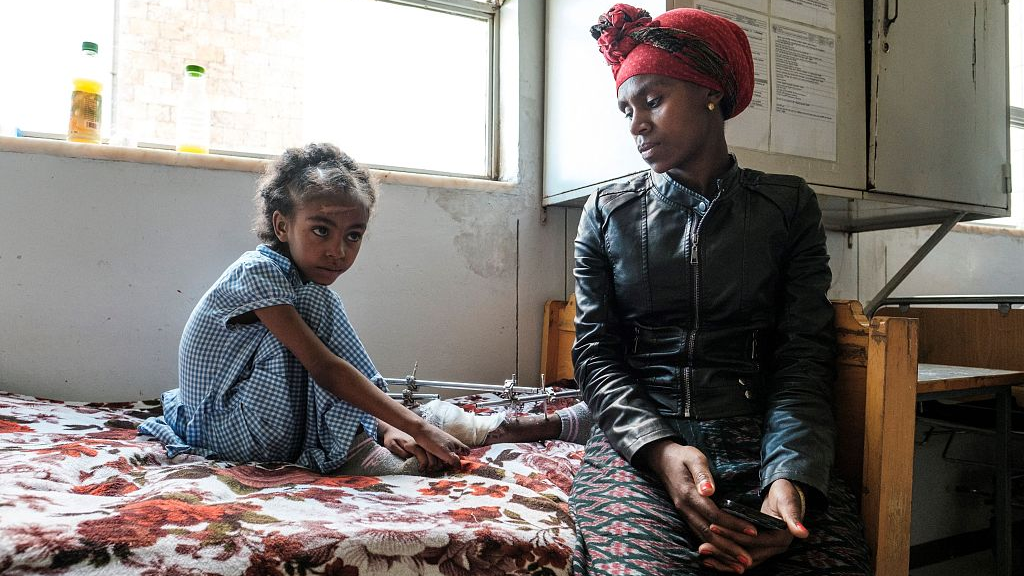
Ethiopian girl Arsema Berha, injured during fighting between the Tigray People's Liberation Front (TPLF) and Ethiopia's government forces, is receiving treatment in Ayder Referral Hospital in Mekele, Ethiopia, February 25, 2021. /CFP
Editor's note: Andrew Korybko is a Moscow-based American political analyst. The article reflects the author's views and not necessarily those of CGTN.
Ethiopia is in the midst of its worst crisis in decades after the terrorist-designated Tigray People's Liberation Front (TPLF), which used to be the most influential faction of the former ruling party prior to falling out with Prime Minister Abiy Ahmed, threatened to take over the capital of Africa's second most populous country. The war started a year ago, after the TPLF killed members of the Ethiopian National Defense Force (ENDF) in a series of surprise attacks in the northern Tigray Region.
It continues to this day despite the ENDF withdrawing from the region over the summer as part of its unilateral ceasefire, aimed at relieving the local population's humanitarian challenges. Instead of peacefully reciprocating, the TPLF immediately invaded the neighboring Afar and Amhara regions. Its open calls for regime change contradict its previous claims that it was fighting a "defensive war", aimed solely at breaking the federal government's alleged blockade against their region.
The U.S. is threatening to exacerbate this crisis through its newly introduced
This bipartisan legislation makes America an indirect party to the ongoing hostilities and lends credence to popular claims in the country, that Ethiopia's former ally is at the very least biased in support of the TPLF. It comes shortly after the U.S. announced that it'll revoke Ethiopia's free access to the American market, due to its alleged human rights abuses.Ethiopia Peace and Democracy Promotion Act of 2021 (EPDPA).
The EPDPA contains a number of disturbing provisions. One part mandates support for "civil society," which in the context of the country's current crisis could be interpreted as intent to foment Color Revolution unrest, especially when remembering the U.S. history in doing so in other countries. Another aims to
which is a euphemism for pressuring the authorities to rescind the TPLF's terrorist designation and subsequently treat it as a political equal.support all-inclusive national dialogue,
The U.S.'s planned meddling is made even more explicit through the EPDPA's threats to sanction anyone who it accuses of
which could be exploited to essentially encompass the entire government.undermining efforts with respect to a peaceful negotiated settlement to end hostilities in northern Ethiopia,
It also makes similar threats against anyone who sells arms to the country, which could lead to secondary sanctions against Russia and Ethiopia's other arms partners.
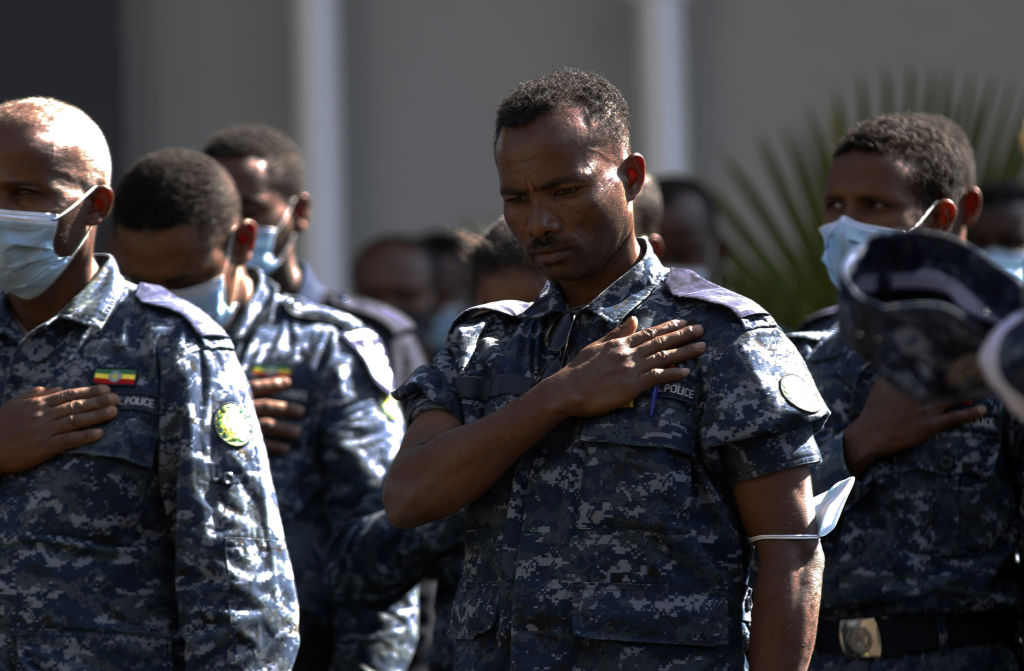
A commemoration ceremony is held by Ethiopian Federal Police in honor of the soldiers, who died during the military operation launched against the rebel Tigray People's Liberation Front (TPLF) in Ethiopia, in front of Federal Police Station in Addis Ababa, Ethiopia, November 3, 2021. /Getty
Observers shouldn't be deceived into thinking that those sanctions threats are sincerely meant to promote "peace and democracy", in Ethiopia. After all, the country's internationally recognized government that recently received a parliamentary supermajority has the legal right to manage its internal affairs however it wants, which includes refusing to lift the TPLF's terrorist designation. It can also buy arms from whichever of its partners that it wants too, as all countries do.
America's planned meddling, goes even further than potentially fomenting Color Revolution unrest and sanctioning Ethiopia. The EPDPA proposes that
the latter of which was invited to assist the ENDF in Tigray.the Secretary of the Treasury shall instruct the United States Executive Directors of the international financial institutions to use the voice and vote of the United States in those institutions to oppose any loan or extension of financial or technical assistance to the governments of Ethiopia and Eritrea,
In other words, the U.S. plans to collectively punish the entire population of Ethiopia by pressuring the International Monetary Fund and the World Bank to politicize their lending to the country exactly as it punished the Afghan people after the Taliban swept to power in August. The end effect will be to worsen socioeconomic conditions there and risk triggering a humanitarian crisis, all for the purpose of hoping that this will pressure the authorities to submit to the U.S. political demands regarding the TPLF.
The EPDPA's likely passing will therefore undoubtedly exacerbate, Ethiopia's crisis across multiple dimensions. It'll also make the U.S. an indirect party to the conflict, by tacitly placing it on the side of the terrorist-designated TPLF.
This bill is the embodiment of America's neo-imperialist meddling and should therefore be opposed by all those who sincerely respect the sovereign right of Ethiopia's internationally recognized democracy to bring peace to the country, through whichever means it regards as necessary.
____________

Ambassador @TayeAtske reminded the UNSC,
#NoMorewe reiterate our plea for the supporters of TPLF, that have been providing it with communication equipment, satellite information, weapons & even fighters to desist from this, not only illegal but also immoral act.