Viagra may stop cancer spread : Israeli scientists find active ingredient
Posted: 06 Aug 2026, 22:38
In world first, Israeli scientists find active ingredient in Viagra may stop cancer spread
Researchers say mouse models and data from 5 million health fund members show erectile dysfunction drug and statins may improve outcomes by blocking cholesterol needed for cells to metastasize

From left to right: Prof. Ayelet Erez of Weizmann Institute of Science, Dr. Yarden Ariav, a researcher in Erez’s lab, and Dr. Samah Hayek, senior epidemiologist at Clalit Health Services and a senior lecturer in Tel Aviv University's Department of Epidemiology and Preventive Medicine, School of Public Health. (Courtesy/Weizmann Institute of Science and Clalit Innovation)
In a surprising discovery, Israeli researchers say they have uncovered the biological mechanism in which Viagra, a drug best known for treating male erectile dysfunction, helps stop the spread of cancer.
In peer-reviewed research, scientists at Weizmann Institute of Science showed that sildenafil, the active ingredient in Viagra, disrupts cancer cells’ cholesterol supply, a crucial material they need to metastasize to other organs.
Dr. Yarden Ariav led the research in Prof. Ayelet Erez’s lab at Weizmann, along with researchers in Prof. Eytan Ruppin’s lab at the US National Cancer Institute, the Innovation Division at Israel’s national health provider Clalit Health Services, and physicians and scientists from Clalit-Beilinson Hospital.
The scientists’ findings, which appeared in July in Cancer Research, were based on mouse cancer models, cultures of cancer cells from human patients, and data collected over 20 years from some 5 million Clalit members.
Survival rates were highest among the patients who had taken both sildenafil and statins, a common class of cholesterol-lowering drugs, six months before their diagnosis, the data showed.
The laboratory tests focused mostly on cancers such as triple-negative breast cancer, melanoma, and lung cancer.
The real-world patient data “confirmed our findings in male mice for lung, colon and prostate cancer,” Erez told The Times of Israel by telephone.
She emphasized that the next step is to “push medicine” by giving women a drug traditionally associated with men’s health.
“The uniqueness and the most important thing that we now need to do is a clinical trial to give Viagra to women with triple-negative breast cancer,” Erez said.
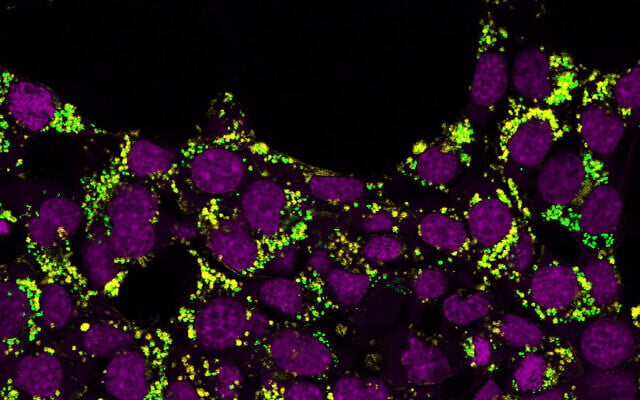
Weizmann Institute of Science research shows breast cancer tissue after treatment with Sildenafil. Cholesterol (green) is trapped within tiny sac-like organelles called lysosomes, making it unavailable to the cancer cells. Cell nuclei are shown in purple. (Courtesy/Weizmann Institute of Science)
Halting cancer’s spread by stopping cholesterol
Sildenafil was initially developed to treat heart conditions because it opened blood vessels. Then, doctors realized it could also effectively treat male erectile dysfunction, and was approved for that use in 1998.
Now, the research team gave the drug to both male and female mouse models and human cancer cells. Using high-resolution cellular imaging to observe and track the changes in real time, the scientists saw how the drug acted quickly, immediately obstructing an enzyme known as phosphodiesterase type 5 (PDE5). This triggered a spike in the key chemical messenger, cyclic GMP (cGMP).
Next, the scientists saw that cGMP targeted and then trapped a protein responsible for transporting cholesterol, the essential fuel that cancer cells rely on to invade other organs. Deprived of this cholesterol, the cancer cells lost their ability to spread, resulting in significantly fewer metastases.

Illustrative image: a doctor holds up a pink ribbon for breast cancer awareness. (dragana991 via iStock by Getty Images)
“We uncovered a new biological pathway and showed how this pathway can be harnessed,” said Erez, who is also a practicing physician and serves as a senior researcher and dean of Weizmann’s Miriam and Aaron Gutwirth Medical School.
However, in the next part of the experiment, the researchers saw that the cancer cells weren’t ready to give up the fight.
Once sildenafil kept away the mobile cholesterol, the cancer cells activated a system to produce more cholesterol on their own. That’s when the scientists gave the cancer cells statins, a well-known drug.
According to Johns Hopkins University, more than 200 million people worldwide take statins to lower their cholesterol levels.
The statins combined with sildenafil worked in tandem, maintaining low cholesterol levels and preventing the cancer from spreading.
Confirmation through data from more than 5 million patients
Dr. Samah Hayek, senior epidemiologist at Clalit Health Services and a senior lecturer in Tel Aviv University’s Department of Epidemiology and Preventive Medicine, told The Times of Israel that the Weizmann researchers contacted her to check their lab findings against Clalit patient data.
Hayek said the researchers wanted her to investigate what happened to cancer patients who received Viagra and statins six months before their cancer diagnosis.
“We used different statistical and epidemiological methods to adjust for many different factors, and found that the results were consistent with what the Weizmann researchers saw in their mouse modeling,” she said. “So that’s where the combination of two different disciplines came together, and we succeeded in answering an important research question.”

Dr. Ido Wolf, head of the oncology division, Tel Aviv Medical Center, and head of Tel Aviv University’s medical school. (Courtesy)
According to Dr. Ido Wolf, head of the oncology division at Tel Aviv Medical Center and head of Tel Aviv University’s Medical School, “The study highlights a fascinating and underappreciated aspect of cancer biology.”
Wolf was not involved in the study. https://www.timesofisrael.com/in-world- ... cer-spread
Researchers say mouse models and data from 5 million health fund members show erectile dysfunction drug and statins may improve outcomes by blocking cholesterol needed for cells to metastasize
From left to right: Prof. Ayelet Erez of Weizmann Institute of Science, Dr. Yarden Ariav, a researcher in Erez’s lab, and Dr. Samah Hayek, senior epidemiologist at Clalit Health Services and a senior lecturer in Tel Aviv University's Department of Epidemiology and Preventive Medicine, School of Public Health. (Courtesy/Weizmann Institute of Science and Clalit Innovation)
In a surprising discovery, Israeli researchers say they have uncovered the biological mechanism in which Viagra, a drug best known for treating male erectile dysfunction, helps stop the spread of cancer.
In peer-reviewed research, scientists at Weizmann Institute of Science showed that sildenafil, the active ingredient in Viagra, disrupts cancer cells’ cholesterol supply, a crucial material they need to metastasize to other organs.
Dr. Yarden Ariav led the research in Prof. Ayelet Erez’s lab at Weizmann, along with researchers in Prof. Eytan Ruppin’s lab at the US National Cancer Institute, the Innovation Division at Israel’s national health provider Clalit Health Services, and physicians and scientists from Clalit-Beilinson Hospital.
The scientists’ findings, which appeared in July in Cancer Research, were based on mouse cancer models, cultures of cancer cells from human patients, and data collected over 20 years from some 5 million Clalit members.
Survival rates were highest among the patients who had taken both sildenafil and statins, a common class of cholesterol-lowering drugs, six months before their diagnosis, the data showed.
The laboratory tests focused mostly on cancers such as triple-negative breast cancer, melanoma, and lung cancer.
The real-world patient data “confirmed our findings in male mice for lung, colon and prostate cancer,” Erez told The Times of Israel by telephone.
She emphasized that the next step is to “push medicine” by giving women a drug traditionally associated with men’s health.
“The uniqueness and the most important thing that we now need to do is a clinical trial to give Viagra to women with triple-negative breast cancer,” Erez said.
Weizmann Institute of Science research shows breast cancer tissue after treatment with Sildenafil. Cholesterol (green) is trapped within tiny sac-like organelles called lysosomes, making it unavailable to the cancer cells. Cell nuclei are shown in purple. (Courtesy/Weizmann Institute of Science)
Halting cancer’s spread by stopping cholesterol
Sildenafil was initially developed to treat heart conditions because it opened blood vessels. Then, doctors realized it could also effectively treat male erectile dysfunction, and was approved for that use in 1998.
Now, the research team gave the drug to both male and female mouse models and human cancer cells. Using high-resolution cellular imaging to observe and track the changes in real time, the scientists saw how the drug acted quickly, immediately obstructing an enzyme known as phosphodiesterase type 5 (PDE5). This triggered a spike in the key chemical messenger, cyclic GMP (cGMP).
Next, the scientists saw that cGMP targeted and then trapped a protein responsible for transporting cholesterol, the essential fuel that cancer cells rely on to invade other organs. Deprived of this cholesterol, the cancer cells lost their ability to spread, resulting in significantly fewer metastases.
Illustrative image: a doctor holds up a pink ribbon for breast cancer awareness. (dragana991 via iStock by Getty Images)
“We uncovered a new biological pathway and showed how this pathway can be harnessed,” said Erez, who is also a practicing physician and serves as a senior researcher and dean of Weizmann’s Miriam and Aaron Gutwirth Medical School.
However, in the next part of the experiment, the researchers saw that the cancer cells weren’t ready to give up the fight.
Once sildenafil kept away the mobile cholesterol, the cancer cells activated a system to produce more cholesterol on their own. That’s when the scientists gave the cancer cells statins, a well-known drug.
According to Johns Hopkins University, more than 200 million people worldwide take statins to lower their cholesterol levels.
The statins combined with sildenafil worked in tandem, maintaining low cholesterol levels and preventing the cancer from spreading.
Confirmation through data from more than 5 million patients
Dr. Samah Hayek, senior epidemiologist at Clalit Health Services and a senior lecturer in Tel Aviv University’s Department of Epidemiology and Preventive Medicine, told The Times of Israel that the Weizmann researchers contacted her to check their lab findings against Clalit patient data.
Hayek said the researchers wanted her to investigate what happened to cancer patients who received Viagra and statins six months before their cancer diagnosis.
“We used different statistical and epidemiological methods to adjust for many different factors, and found that the results were consistent with what the Weizmann researchers saw in their mouse modeling,” she said. “So that’s where the combination of two different disciplines came together, and we succeeded in answering an important research question.”
Dr. Ido Wolf, head of the oncology division, Tel Aviv Medical Center, and head of Tel Aviv University’s medical school. (Courtesy)
According to Dr. Ido Wolf, head of the oncology division at Tel Aviv Medical Center and head of Tel Aviv University’s Medical School, “The study highlights a fascinating and underappreciated aspect of cancer biology.”
Wolf was not involved in the study. https://www.timesofisrael.com/in-world- ... cer-spread