How does a nearly six-million-pound rocket and crew module make that journey possible?
It’s all about physics.
Liftoff
When Artemis II lifted off on April 1, the SLS (Space Launch System) rocket needed a massive 8.8 million pounds of thrust just to escape Earth’s gravity and get the astronauts into space.
That power came from two solid rocket boosters and four RS-25 engines, which lifted the rocket into Earth orbit. Once the boosters burned out, they separated and fell into the ocean, leaving the four main engines to carry the rocket the rest of the way into orbit.
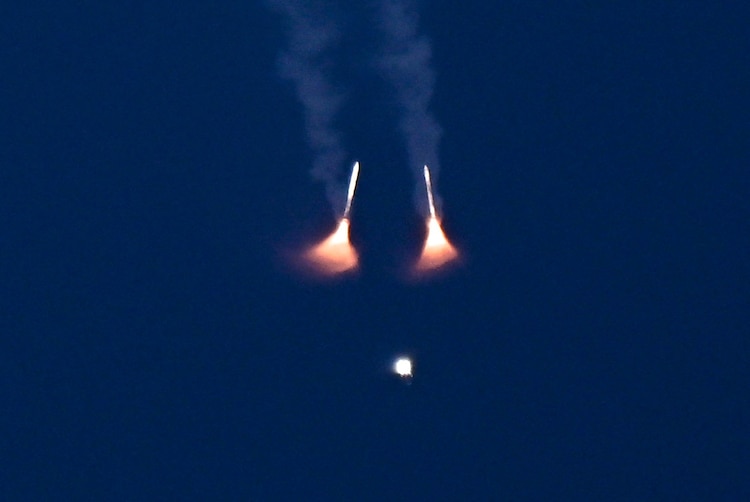
The Space Launch System rocket carrying NASA's Artemis II Orion crew capsule ascends after liftoff, with its solid rocket boosters already detached, from the Kennedy Space Center in Cape Canaveral, Florida, April 1, 2026.
Steve Nesius/Reuters
Earth orbit
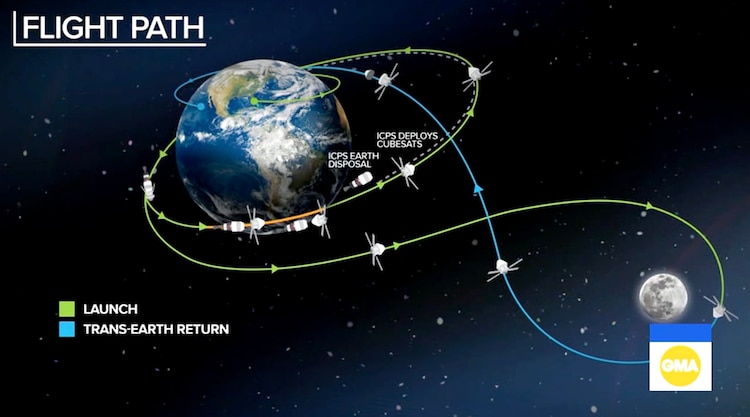
The Orion crew module, which the astronauts dubbed "Integrity," began to chart its own course in low Earth orbit about eight minutes into the flight, when the main engines cut off, allowing gravity and inertia to do the rest of the work.
At this point, the focus turned to test-driving Integrity and, if the test is successful, ultimately moving out of Earth’s orbit.
The spacecraft needed to perform two critical burns in order to do this. The two burns are called perigee and apogee burns, which help Orion reach high Earth orbit, where astronauts spend most of their first day in space. Those were completed within the first few hours of the flight.
Related
Artemis II mission to the moon: By the numbers
By then, the interim cryogenic propulsion stage’s job was done, and it was able to separate from Orion, lightening the spacecraft’s load for its lunar flyby.
The crew then got to test Orion’s ability to be manually driven close to and away from nearby spacecraft. NASA calls this part their proximity operations. The demonstration lasted approximately 70 minutes, the agency said in a press release.
READ Full Article : https://abcnews.com/Technology/earth-mo ... =131651840