 America makes its move to counter Europe’s most powerful military as it expands into Africa with 6 new military bases and a stealth fighter jet deal
Olamilekan Okebiorun
https://africa.businessinsider.com/loca ... to/bk630jg
19 August 2026
The United States is shifting from monitoring Russia’s expanding military presence in Africa to building a new strategic response.
America makes its move to counter Europe’s most powerful military as it expands into Africa with 6 new military bases and a stealth fighter jet deal
Olamilekan Okebiorun
https://africa.businessinsider.com/loca ... to/bk630jg
19 August 2026
The United States is shifting from monitoring Russia’s expanding military presence in Africa to building a new strategic response.
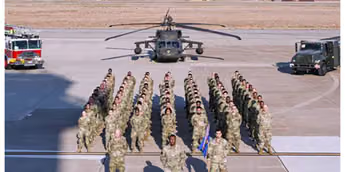 America makes its move to counter Europe’s most powerful military as it expands into Africa with 6 new military bases and a stealth fighter jet deal
• The US is shifting from monitoring to actively responding to Russia's increasing military presence and influence in Africa, particularly in Libya.
America makes its move to counter Europe’s most powerful military as it expands into Africa with 6 new military bases and a stealth fighter jet deal
• The US is shifting from monitoring to actively responding to Russia's increasing military presence and influence in Africa, particularly in Libya.
• Russia has expanded its network of military bases and assets in Libya, upgraded facilities, and increased deployments of troops, equipment, and advanced weapons.
• Algeria, a regional rival to Morocco, has received a significant arms buildup from Russia, while France and Europe are losing influence in the Sahel, creating opportunities for Russia and China.
• The US is positioning Morocco as a key long-term security partner in Africa, supporting it with advanced weaponry and considering a strategic F-35 fighter jet deal.
For years, the US has warned that Moscow is using security partnerships, military contractors and arms networks to expand its influence in Africa.
That concern has intensified as Russia deepens its footprint in Libya, where it is expanding operations across several strategic airbases and positioning military assets closer to North Africa’s Mediterranean corridor.
Washington now appears to be betting on Morocco as a long-term security partner capable of countering Russia’s growing influence while strengthening American access to one of Africa’s most strategically located countries.
Russia builds a North African military network
Russia’s expansion in Africa is part of a wider strategy that began taking shape years before its current military push in Libya.
Moscow has been weaving a web of influence since 2017 and 2018 to serve its new agenda of confrontation with the West,
Le Monde reported.
The US first raised concerns over Russia’s military activities in Libya in 2020,
https://www.businessinsider.com/photos- ... ?r=US&IR=T accusing Moscow of deploying fighter aircraft to support the Wagner Group, a Russian-backed military contractor that aided Libyan commander
Khalifa Haftar’s forces. A UN report later estimated that up to 1,200 Russian mercenaries were operating in the country.
More recently, Business Insider Africa
https://africa.businessinsider.com/loca ... -a/x0x4mz4 reported that Moscow has been expanding its activities across six Libyan airbases, including Jufra, Al-Khadim, Ghardabiya, Brak Al-Shati, Maaten Al-Sarra and Tamanhint.
The facilities are being upgraded with improved runways, aircraft shelters, warehouses and accommodation areas, while the deployment of fighter jets, drones, air defence systems, personnel and military equipment strengthens Moscow’s ability to move forces between North Africa and the wider Sahel region.
The urgency has particularly grown as Russia has armed Morocco’s regional rival Algeria with advanced Su-34 and Su-30 fighter jets, S-400 and S-300 air defence systems, and other weapons systems, making Algiers one of Africa’s most heavily armed militaries.
At the same time, France and other European powers have lost influence in parts of the Sahel, creating space for Russia and China to expand their access to Africa’s strategic resources, including gold and uranium.
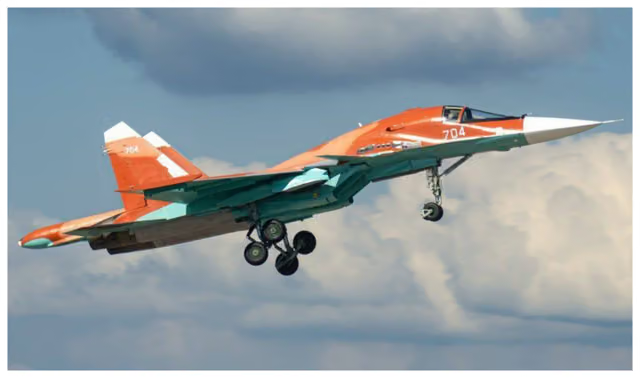 A Su-34M bomber flying in desert camouflage. Photo credits: Arab-Military
Washington turns to Morocco as a strategic defence partner
A Su-34M bomber flying in desert camouflage. Photo credits: Arab-Military
Washington turns to Morocco as a strategic defence partner
The stakes are rising, and Washington is now looking to utilise Morocco as a strategic military partner, with the long-sought F-35 fighter jet deal potentially becoming part of the next phase of the relationship.
The move is particularly significant as President
Donald Trump reshapes Washington’s military posture, including plans to reduce troop deployments in Germany and shift some forces to countries such as Poland and Africa.
Against this changing security landscape, Morocco’s location gives it a strategic advantage for the US, placing the kingdom between Africa, Europe and the Atlantic Ocean while keeping it close to the Mediterranean and Europe’s southern flank.
US expands military cooperation with Rabat
Recently, the US Senate Armed Services Committee has introduced a provision in the 2027 National Defense Authorization Act directing the Pentagon to develop a 10-year roadmap aimed at making Morocco America’s leading military partner in Africa.
The partnership is already backed by billions of dollars in advanced US weapons, making Morocco one of Washington’s most heavily equipped defence partners in Africa.
Morocco operates F-16 Block 72 fighter jets and has received precision weapons, modern battlefield systems and advanced surveillance technology.
Washington has also approved the sale of RTX FIM-92K Stinger Block I anti-aircraft missiles in a deal valued at $825 million, covering up to 600 short-range missiles.
The US has further approved the sale of 36 AH-64E Apache attack helicopters in a package worth about $4.25 billion, alongside HIMARS rocket systems estimated at $524 million.
The cooperation also includes Abrams tanks, Patriot missile systems and other advanced targeting capabilities, strengthening Rabat’s military position as Washington expands its strategic partnerships across Africa.
The creation of the Africa Military Technology Experimentation Centre (AMTEC) near Tan-Tan in southern Morocco expands the kingdom’s defence technology capabilities by providing a platform for military testing and experimentation.
The facility has already attracted US defence activity, with startup Covenant Industries recently conducting a live-fire test of its Anthem long-range cruise missile near the site.
Morocco’s role is further strengthened by hosting African Lion, one of the largest US-led military exercises in Africa, which analysts say could increasingly shift from broad regional training to a more focused US-Morocco military partnership as the race for influence intensifies
The ethnic violence and hatred among some Ethiopian ethnic communities has apparently crossed borders, following migrants thousands of kilometres from Ethiopia into the deserts of Saudi Arabia.
 The ethnic violence and hatred among some Ethiopian ethnic communities has apparently crossed borders, following migrants thousands of kilometres from Ethiopia into the deserts of Saudi Arabia.


