Re: The KGB and the Cubans advised Mengie to make peace with Eritreans.
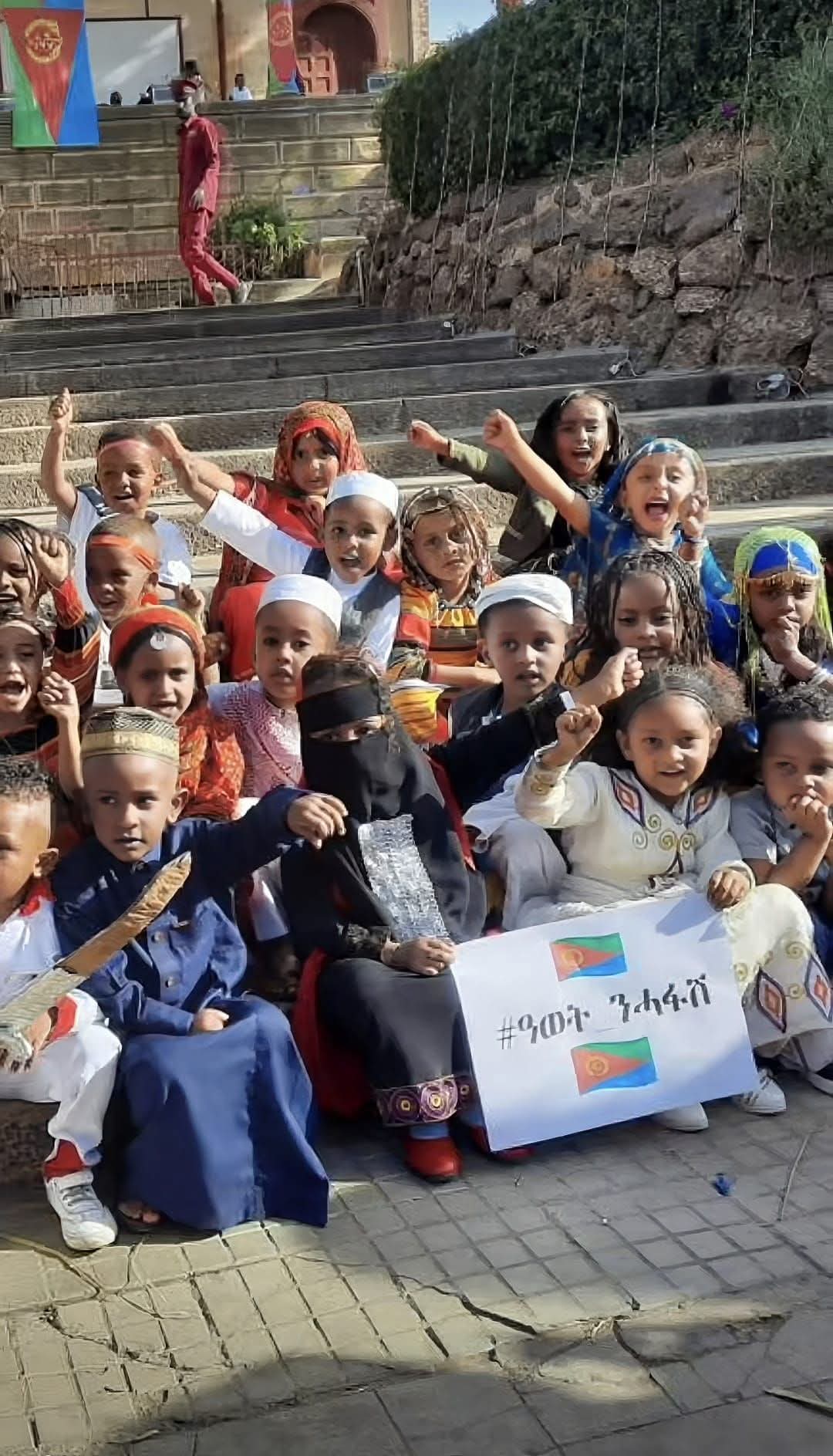
Eritrea in one Picture! 

Re: The KGB and the Cubans advised Mengie to make peace with Eritreans.
Interesting & fairly well informed article on the Horn of Africa by, of all outfits, the American Enterprise Institute (AEI), worthwhile reading for the most part.
____________

Gulf States
Authors: Michael DeAngelo and Liam Karr
https://www.criticalthreats.org/analysi ... ulf-states
Saudi Arabia held meetings with the heads of state of Eritrea and Sudan and the US senior adviser for African affairs to further its bilateral partnerships in the Horn of Africa and advance US-backed peace efforts in Sudan.
Saudi Crown Prince Mohammed bin Salman (MBS) met with Eritrean President Isaias Afwerki in Riyadh, the Saudi capital, on December 10.[41] Eritrea’s Ministry of Information said that the two discussed
[42]developments in the Nile River Basin, the Horn of Africa, the Red Sea and the Arabian Gulf.
Afwerki called for a larger Saudi role in
presumably referring to increased tensions between Eritrea and Ethiopia and the civil war in neighboring Sudan.[43]promoting peace and stability in the wider region, and in Eritrea’s immediate neighborhood,
Afwerki stated in an interview with a Sudanese news outlet on December 14 that he discussed external backers of the Rapid Support Forces (RSF) in Sudan with MBS, presumably referring to the United Arab Emirates (UAE) and possibly Ethiopia.[44]
Saudi Arabia hosted the Sudanese Armed Forces (SAF) head and the leader of Sudan’s government, Abdel Fattah al Burhan, in Riyadh on December 15 to discuss the ongoing Sudanese civil war.[45] MBS, the Saudi foreign and defense ministers, and the Saudi national security adviser met with Burhan.[46] Saudi Arabia has backed the SAF politically throughout the civil war and during US-led Quad peace efforts, which also involve SAF-aligned Egypt and the RSF-aligned UAE.[47] Saudi Arabia reportedly sent Burhan’s invitation during Afwerki’s visit, which is notable given Eritrea’s close ties with Sudan.[48] Eritrea has facilitated arms shipments to the SAF, potentially including drones.[49]
US Senior Adviser for Africa Massad Boulos, who is spearheading Quad peace efforts, also traveled to Riyadh to meet with Burhan and Saudi officials. [50] The meeting may have aimed to repair Boulos’s relationship with Burhan, which has been one of many recent obstacles in the Quad process. A local news outlet reported that Boulos’s team sent the SAF an incorrect Quad peace roadmap in November that the SAF deemed favorable to the RSF and UAE.[51] Burhan then accused Boulos of being biased in favor of the RSF and UAE in a November 23 speech in which he also rejected the Quad process.[52] Boulos also met with the Saudi foreign and defense ministers and national security adviser to discuss the Sudan peace efforts and US-Saudi bilateral ties.[53]
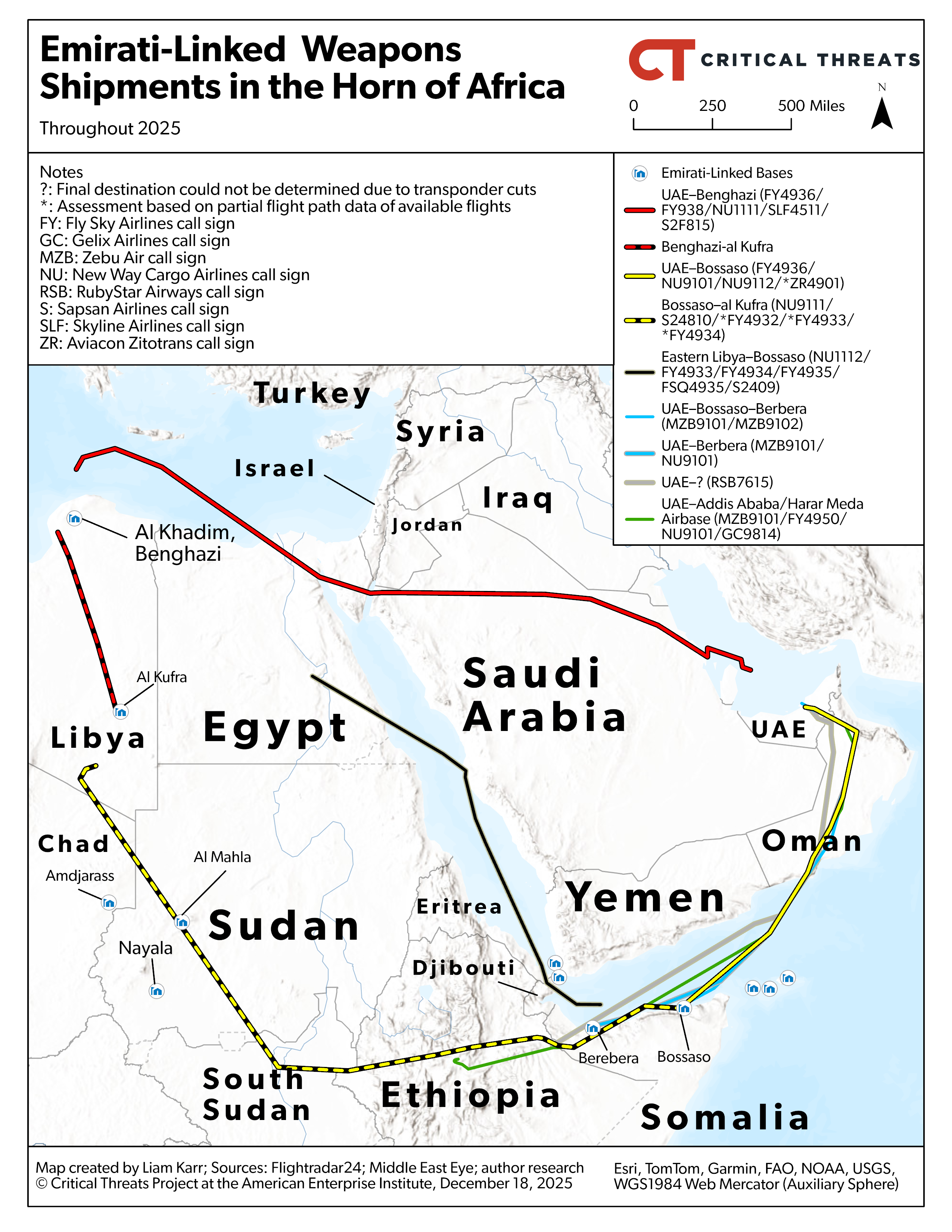
The meetings come amid a likely increase in Emirati-linked arms shipments to Ethiopia. Flight tracking data shows at least seven IL-76 cargo flights from the UAE to the Addis Ababa area, landing at the Addis Ababa international airport or possibly Harar Meda Airbase—the main air base for the Ethiopian Air Force—since November 2. The flights include three UK-based Zebu Air flights, three Russia-based Gelix Airlines flights, and one Kyrgyzstan-based Fly Sky Airlines flight.[54] At least four other Fly Sky cargo flights with the same callsign departing from the UAE have traveled along the same flight path in December, but transponder cuts prevent CTP from confirming their destinations.[55] Fly Sky was previously involved in Emirati weapons shipments to Ethiopia during the Tigray war, which included the provision of Chinese-made drones, and Gelix has been involved in Russian weapons shipments, including to Iran.[56] Rubystar—a US specially-designated Belarusian cargo company previously linked with Russian weapon shipments to UAE-backed forces in eastern Libya—has also made six flights from Abu Dhabi over the Gulf of Aden along the same flight path since November 28, although transponder cuts indicate they alternatively may have been flying to Emirati bases in northern Somalia.[57]
Fly Sky, Gelix, and Zebu are part of the wider Emirati-linked weapons trafficking network in the Horn of Africa, which has involved hundreds of flights to the Horn of Africa in the last six months, mostly related to Emirati weapons shipments to the RSF via rear bases near the Chadian and Libyan border with western Sudan. Flight tracking data shows hundreds of likely weapons shipments involving Fly Sky Airlines, Kyrgyzstan-based New Way Cargo Airlines and Sapsan Airlines, and US-sanctioned Russian cargo company Aviacon Zitotrans throughout 2025 that have appeared along a flight path that links Abu Dhabi to Bossaso, northern Somalia, and al Kufra—a known RSF-linked rear base in southwestern Libya, and other reports claim that Gelix and Zebu have also flown shipments.[58] In many cases, flight transponders were presumably turned off to obscure their origin and arrival points. Multiple organizations and outlets have reported that the UAE has used positions in Libya and northern Somalia as conduits to ship weapons to the RSF in Sudan throughout 2025.[59] Some flights departed from Benghazi, which is the capital of the UAE-backed eastern Libyan government and the destination of hundreds of Emirati-linked flights from Abu Dhabi involving Aviacon Zitotrans, Fly Sky, New Way Cargo, and Skyline Airlines, to reach al Kufra.[60] Several other partial flight paths indicate that some cargo flights likely departed from al Kufra to Benghazi and flew over the Red Sea, stopped at Emirati airbases in northern Somalia, and then continued over the Ethiopia-Somalia border, presumably back toward al Kufra to complete the loop.[61]
Figure 4. Emirati-Linked Weapons Shipments in the Horn of Africa
Source. Liam Karr; Flightradar24 and Middle East Eye.
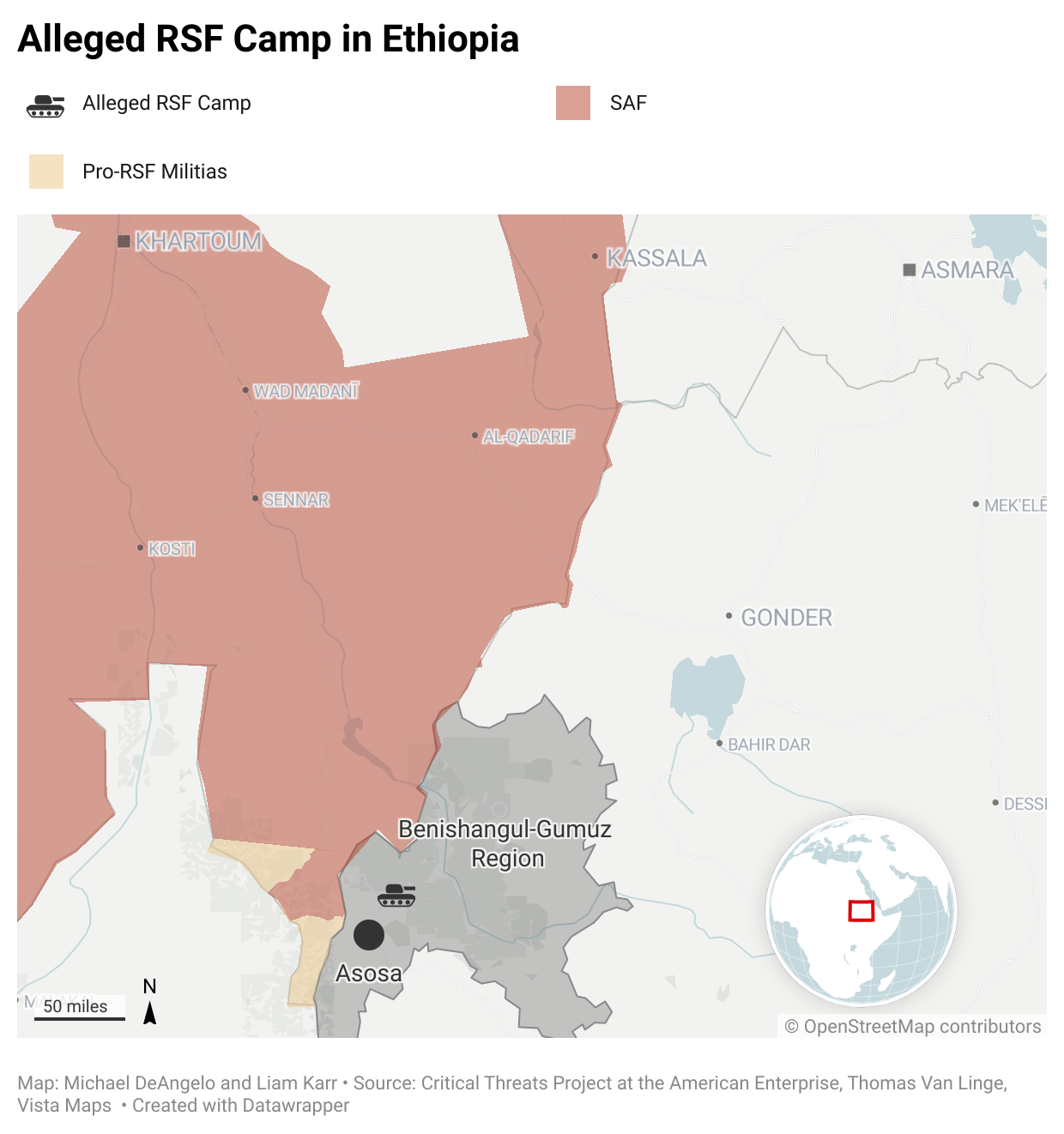
The arms shipments could support RSF in Sudan or an Ethiopian military buildup against Eritrea and the Tigray region in northern Ethiopia. Al Jazeera recently published a report in which SAF officials accused Ethiopia of arming the RSF and providing intelligence support to the group and aligned forces.[63] The officials claimed that Ethiopia is supplying the RSF with artillery, jamming devices, and military vehicles through Assosa, the capital of Ethiopia’s Benisgangul-Gumuz region, which borders Sudan’s Blue Nile state.[64] The UAE has provided the RSF with these supplies and other weaponry, including drones, throughout the war using similar cross-border supply lines through other African allies in Chad and Libya.[65] Multiple reports have stated that Ethiopia has supported RSF by allowing the group to use Ethiopian territory for rear bases, although these reports are unverified.[66]
SAF officials also alleged that Ethiopia has allowed the RSF to establish a training camp in Ethiopia near the Sudanese border, which would enable the RSF to open a new front on the SAF’s rear flank in eastern Sudan.[67] The camp allegedly can accommodate thousands of RSF fighters and is overseen by an Ethiopian general.[68] Ethiopian officials denied the camp’s existence, and independent reporting has not verified its presence.[69] The officials further claimed that the Ethiopian military is sharing intelligence with the RSF and RSF-aligned Sudan People’s Liberation Movement–North (SPLM-N) al Hilu militia, which controls the only existing pockets of RSF-aligned territory in eastern Sudan.[70] SAF officials stated that the SAF was preparing for a campaign against RSF-aligned forces in eastern Sudan in response, although the RSF is pressuring the SAF in central Sudan after multiple victories since late October.[71] The RSF has consolidated control over western and west-central Sudan and intensified an offensive on the frontlines around el Obeid, the SAF’s headquarters in central Sudan.[72]
Figure 5. Alleged RSF Camp in Ethiopia
Source: Michael DeAngelo; Liam Karr.
Ethiopia also faces increased tensions with Eritrea and the Tigray People’s Liberation Front (TPLF), which has led to growing militarization and threats of violence in northern Ethiopia. Ethiopia-Eritrea relations have deteriorated since the Pretoria Agreement peace process that ended the Tigray war. Ethiopia excluded Eritrea from the process despite their collaboration against the TPLF during the war.[73] Ethiopia’s frequent claims to Eritrea’s port of Assab and Eritrea’s refusal to withdraw from Tigray have since escalated tensions.[74] Ethiopian officials have left open the possibility of using force to annex Assab if Ethiopia cannot secure Red Sea access through peaceful means.[75] These tensions led Ethiopia and Eritrea to mobilize forces on their respective sides of the shared border in early 2025.[76]
Ethiopia-TPLF relations have continued to deteriorate in 2025 due to the contested implementation of the Pretoria Agreement. The TPLF launched a de facto coup against the federal government-backed Tigray Interim Administration in March and has continued to criticize the federal government’s approach.[77] Ethiopian and Tigrayan officials have made multiple statements about their readiness for war since September.[78] Tigrayan forces conducted an incursion into neighboring Afar region in early November to degrade an anti-TPLF rebel group that the TPLF accuses the federal government of backing.[79] The federal government reportedly responded with its first drone strike on Tigrayan forces since signing the Pretoria Agreement.[80]
Eritrea and the TPLF have likely responded to the increased tensions by pursuing rapprochement and aligning against the Ethiopian federal government. Senior Eritrean and TPLF officials have met multiple times in 2025.[81] The federal government filed a complaint to the United Nations in October accusing Eritrea and the TPLF of supporting Amhara ethno-nationalist Fano militias waging an insurgency against the federal government.[82] The Economist published a report on November 13 stating that Eritrean and TPLF officials recently met with Fano officials in Sudan regarding military collaboration.[83]
The Saudi-UAE competition in the Horn of Africa is part of broader competition across the Red Sea, including Yemen, which increases the risk of horizontal escalation on both sides of the Red Sea. The UAE’s continued support for the RSF has heightened tensions with Saudi Arabia and Egypt, which are competing with the UAE for influence across the region.[84] Egypt and Saudi Arabia both view the Sudanese war and resulting displacement crisis as detrimental to their domestic stability and priorities given their proximity to Sudan.[85] Both countries support the SAF due to long-standing ties with the SAF and the belief that the SAF is more capable of ensuring stability than the RSF.[86] The UAE has backed the RSF due to its ties with RSF leader Mohamed Hamdan Dagalo and concerns over Islamist influence within the SAF, although Egypt and Saudi Arabia are also anti-Islamist and have pressured the SAF on this issue.[87]
Saudi Arabia has responded to recent RSF advances by escalating peace efforts, which has resulted in greater international pressure on the UAE to halt support for the RSF. MBS met with US President Donald Trump in Washington on November 18 and asked him to become personally involved in Sudan peace efforts.[88] Trump publicly committed to working on ending the war on November 19, citing his meeting with MBS.[89] The United States has since put more pressure on the UAE, with US Secretary of State Marco Rubio twice speaking with the Emirati foreign minister about Sudan.[90] Saudi Arabia followed up on MBS’s meeting with Trump by facilitating the December 15 meeting between Burhan and Boulos in Riyadh.[91]
The UAE has since strengthened its position in its proxy battle with Saudi Arabia for influence in southern Yemen, which may have been a form of horizontal escalation given the timing in relation to Sudan peace talks, and increases the risk of an escalation cycle across the Red Sea. The UAE’s Yemeni proxy, the Southern Transitional Council (STC), seized the two remaining southern Yemeni provinces that Saudi Arabia’s Yemeni proxies had historically dominated in early December.[92] The STC’s move threatens to diminish Saudi proxies’ influence and effectively end the fragile 2022 power-sharing deal between the two sides.[93] Saudi and Emirati military officials met in Aden on December 12 to ease related tensions, but Saudi Arabia has reiterated its support for Yemen’s internationally recognized government and called for the STC to withdraw and allow Saudi proxies to reassume security responsibilities.[94] The STC has refused to withdraw and doubled down on its intention to create a breakaway state in southern Yemen.[95]

____________
Re: The KGB and the Cubans advised Mengie to make peace with Eritreans.
Cuba and russians were right. Mengistu was idiot. He has no knowledge of counter insurgency. A 33 year old idiot took power in a violent turmoil has no clue of Ethiopia complexity and it's structure. Like any kid who blows his house with fire. He did it. So the credit is for mengistu himself. Not to the skunni losers who lose like the below 
 :lol:
:lol:
 :lol:
:lol: Please wait, video is loading...
Re: The KGB and the Cubans advised Mengie to make peace with Eritreans.
Yes, they should indeed have listened to them. But they don't, to justify their silly, empty bravado. Ethiopian leaders are known to be fake event(s) worshipers, much deeper than worshipping heavenly creatures. They also love to regurgitate their usual "ተረት፡ ተረት" stories. That being the case, it becomes even more disappointing when the elites love to repeat those "ዕንቆቊልሽ" type stories.
Re: The KGB and the Cubans advised Mengie to make peace with Eritreans.
Their incurable inferiority complex towards the Eritrean people had prevented them from considering the peace plan proposed by the USSR and Cuba. "What is life without war?" was the Ethiopian leaders' response to the peace proposal, because mercenary wars and man-made famines are their bread and buṯṯer to garnering international attention and sympathy.

Re: The KGB and the Cubans advised Mengie to make peace with Eritreans.

Eritrean star
 Even Yemane officially joins
  bike aid!
 The versatile climber and sprinter makes a big move this holiday season.
A brilliant step forward for one of Eritrea's brightest cycling talents.
2025, is going to be huge! 
Kudos Eritrea!
-
Deqi-Arawit
- Senior Member
- Posts: 16298
- Joined: 29 Mar 2009, 11:10
- Location: Bujumbura Brundi
