Page 1 of 1

Ethiopia: Travel Warning!

Posted: 18 Aug 2025, 10:59
by Zmeselo


Safety

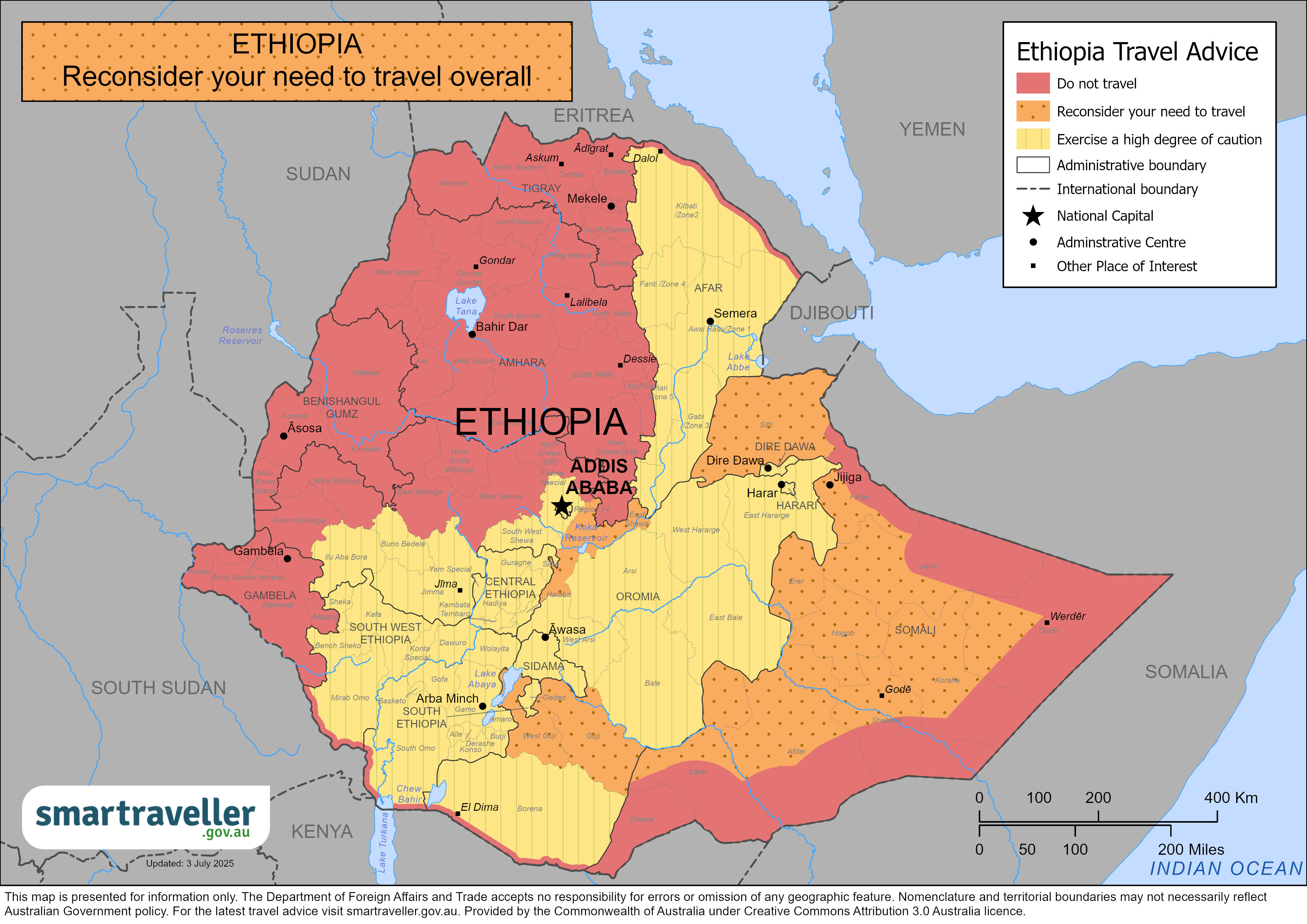
•The security situation in Ethiopia is dynamic and could deteriorate without warning. Roads can be closed at any time and communications may not be reliable.

•Ethiopia’s borders with Eritrea, Somalia, Kenya, South Sudan, and Sudan are high-risk areas. If, despite our advice, you plan to travel to these areas, get professional security advice.

•There's a threat of terrorism across Ethiopia. Attacks could occur with little or no warning. Possible targets include hotels, markets, places of worship, government buildings, transport hubs and aircraft. Avoid possible targets, be alert on days of national significance, and maintain a high level of vigilance.

•The threat of kidnapping is particularly high in some parts of Amhara, parts of Oromia Regional State, and near the border areas with Kenya, Somalia and South Sudan. Aid and humanitarian workers may be targeted. Several active terrorist groups have the intent and capability to kidnap foreigners.

•Petty crime, particularly pickpocketing, is common in Addis Ababa. Foreigners may be targets. Be vigilant in all areas, particularly around Meskel Square, Mercato market, Hyatt Regency, Hilton and Sheraton hotels, Yeka Hills, Entoto, and Bole. Violent assault can occur and is more common after dark. Don't walk at night.

•Drink spiking can happen anywhere. Be alert to the potential risks, and don't leave food or drinks unattended. Pay attention when your drinks are being mixed. Stick to reputable venues and avoid homemade alcoholic drinks due to the risk of methanol poisoning. Get urgent medical help if you suspect you’ve been a victim.

•Earthquakes and volcanic activity can affect parts of Ethiopia.
https://www.smartraveller.gov.au/destin ... 0vigilance

Re: Ethiopia: Travel Warning!

Posted: 18 Aug 2025, 14:02
by Fiyameta
:shock: :shock: :shock: :shock: :shock:

Re: Ethiopia: Travel Warning!

Posted: 18 Aug 2025, 16:15
by Zmeselo


News
Ethiopia’s Silent Catastrophe: A Nation Starves, a People Bleeds—While the World Looks Away

August 9, 2025

By VOH. His email [email protected].

https://zehabesha.com/ethiopias-silent- ... e_vignette


In the heart of Ethiopia, far from the headlines and policy summits, a humanitarian catastrophe is unfolding. It is a tragedy not born of natural disaster, but of a government at war with its people, an international community choosing quiet complicity, and a population left to starve, suffer, and disappear.

At the epicenter of this storm are the Amhara people—a historically marginalized population now bearing the brunt of Ethiopia’s descent into brutality. As conflict, displacement, and systemic neglect ravage the Amhara region, the scale of human suffering defies comprehension. This is no longer just a crisis. It is a deliberate dismantling of a people’s right to exist.

According to UNICEF’s Mid-Year 2025 Humanitarian Report, a staggering 21.4 million Ethiopians—more than one-sixth of the population—now require urgent humanitarian assistance. Over 4.5 million people are internally displaced, many of them from Amhara, forced to flee burned villages, deadly drone strikes, and summary executions. Nearly 900,000 children are experiencing severe acute malnutrition, their bodies wasting away while the regime pours billions into war machines, vanity projects, and propaganda.

Behind every number lies a name: a mother dying in childbirth because hospitals were shelled. A child traverses miles of desolate terrain without shoes, seeking water. A father executed in front of his family, accused of “collaborating” with the resistance. These are not abstractions. They are the human cost of authoritarian cruelty.

The Amhara region has become a killing field—bombed from above, blockaded from within, and erased from without. Schools have shuttered, clinics have been destroyed, and humanitarian corridors are closed or manipulated. Even religious institutions—once sacred and untouchable—are now being desecrated, with priests shot in their robes and churches looted or demolished.
This is not just about war. It’s about erasure. A slow-motion extermination carried out with surgical cruelty.
Let’s be clear: this is not the result of bad governance, it is the result of malicious policy. What we’re witnessing is the deliberate weaponization of poverty, famine, and displacement. The Abiy Ahmed regime has turned drones, aid blockades, and disinformation into tools of subjugation. The war is not just military. It is psychological, cultural, and existential.

And while this horror unfolds, the world’s institutions—the World Bank, IMF, and even UN bodies—continue to fund, engage, and enable the very regime orchestrating this catastrophe. Billions in loans and aid funneled into the black hole of authoritarianism. While the regime builds palaces and buys war machines, the people get nothing but silence and starvation.
You cannot fund tyranny and claim neutrality. You cannot ignore genocide and call it diplomacy.
Of all the crimes unfolding in Ethiopia’s Amhara region, few are as devastating and long-lasting as the war on children and their education.

More than 8 million children are currently out of school across Ethiopia, with the vast majority being from the Amhara region. This is not a side effect of war—it is a targeted assault on the next generation. Thousands of schools have been closed, damaged, or destroyed—many reduced to rubble by drone strikes, artillery, or intentional military occupation. What should be safe havens of learning have become battlegrounds, or worse, graves.

What this means: A lost generation is being created. When children are denied education, entire communities lose their future teachers, leaders, builders, healers, and defenders. The scars go deeper than statistics—they are psychological, cultural, and spiritual.

This is no accident. The Abiy Ahmed regime, driven by the ideology of Oromummaa, is not only committing mass atrocities—it is systematically dismantling the intellectual, moral, and cultural backbone of the Amhara people. This is a regime that understands the power of education and is determined to deny it to those it seeks to destroy.

It is not just genocide in the physical sense. It is cultural erasure. Generational sabotage. A war on memory and potential. And it may be the most unforgivable crime of all.

How many red lines must be crossed before action is taken? How many corpses must fill mass graves before someone says “enough”? The Western powers who claim to champion democracy and human rights have failed Ethiopia. They are not just absent—they are accomplices.
To media outlets: Do not tell us this is ‘unworthy’ to cover. This is massive war—declared by the regime in power on its own people—waged with battle drones, helicopter gunships, and a full-scale military.
This is a test of our collective humanity—and we are failing.

If this article makes you uncomfortable, it should. If this feels like an exaggeration, you haven’t been paying attention.

This is not a war in the abstract. It is a slow, grinding annihilation of a people the world has decided are expendable.

To those in power: Do not say you did not know. To media outlets: Do not pretend this is too ‘complicated’ to cover. To donors and institutions: Stop fueling a regime that eats its children and buries its future.

And to the Amhara people: The world may not see you, but we do. Your suffering is real. Your voice matters. And history will remember you not as victims, but as survivors who refused to disappear.
Because one day, the silence will break. The lies will collapse. And those who stood with the people—not the tyrants—will be remembered as the ones who held the line.

Re: Ethiopia: Travel Warning!

Posted: 18 Aug 2025, 16:28
by Zmeselo


Ethiopian migrants face kidnappings and death, leaving behind heartbroken families

For young Ethiopians hoping for a better life, trying to get to Europe or the Middle East is fraught with the dangers of kidnappings, extortion and sometimes death in the shipwrecks while making sea crossings

By AMANUEL GEBREMEDHIN BIRHANE and SAMUEL GETACHEW Associated Press

https://abcnews.go.com/International/wi ... -124734471

August 18, 2025

ADDIS ABABA, Ethiopia -- When 19-year-old Nigus Yosef told his parents he was going to leave home in Ethiopia’s Tigray region and try to get to Saudi Arabia, they begged him not to go.

Two of their children had already made the crossing, via the Gulf of Aden and then war-torn Yemen. Yosef’s brother is now in jail in Yemen for entering that country illegally. His sister made it to Saudi Arabia, also illegally, which means it will be difficult for her to leave.

On August 3, 2025, Yosef and five friends from his town of Adi Qeyih boarded a boat bound for Yemen. That night, it capsized. Only 56 people of the nearly 200 people on board survived. https://nam12.safelinks.protection.outl ... reserved=0

Yosef was not one of them.
His parents are in deep shock and grief,
his uncle, Redae Barhe, said in a telephone interview.
They can’t even voice their sorrow.
Nigus Yosef is one of 132 missing from the boat that capsized this month; one of countless people from African countries gone missing on a journey in search of a new life.

The families they leave behind know that there are high odds of misfortune. Boats are often overcrowded, unable to withstand rough seas. Once on dry land, there are other dangers. Migrants are vulnerable, with few resources or protection, making them easy prey for human traffickers and kidnappers.

Senait Tadesse says that her 27-year-old daughter made it to Yemen, only to be held captive by kidnappers who communicated with Tadesse through Facebook, demanding a US$ 6,000 ransom to release her only child.

Tadesse said in an interview with The Associated Press in the capital, Addis Ababa, that she sold her car and all her jewelry to raise the cash and deposited the money in an Ethiopian bank account.

But the kidnappers demanded more. She sold all her belongings; they still wanted more. Not knowing what else to do, she went to the police, armed with the local bank account number that the kidnappers had been using.

Meanwhile, she was on Facebook, trying to get news of her daughter. Eventually, a post from a survivor confirmed that Tadesse’s daughter had been killed. To date, no arrests have been made.

Although Ethiopia has been relatively stable since the war in the country’s Tigray region ended in 2022, youth unemployment is high and there are still pockets of unrest.
Many young people no longer see a future for themselves within a nation that does not prioritize their needs,
explained Yared Hailemariam, an Ethiopian human rights advocate based in Addis Ababa.
The cause of this migration is lack of economic opportunities and growing conflicts. Young people are faced with a choice of either taking up arms to fight in endless conflicts, or providing for their families.
The war in Tigray was the reason why Nigus Yosef never finished school. When the conflict started in 2020, he was in 7th Grade, and he dropped out to join the Tigray armed forces. When the ceasefire was signed in 2022, he came back home, but couldn’t find a job. After three years, he was desperate.

Residents in the region say that traffickers seize on that desperation, and that their networks extend even into remote areas and rural villages.

Eden Shumiye was just 13 when she left Adi Qeyih with Yosef and his friends. Her parents say that she was preyed on by people smugglers during the town’s public market day, and that they convinced her to leave with the group. Her parents heard nothing from her until one of the other migrants called them when they reached Wuha Limat, near the Ethiopia-Djibouti border. The news left them sick with worry.

After the boat capsized, a relative of one of the survivors managed to send a voice message to them from Saudi Arabia via the messaging app Imo, confirming that Eden’s dead body had been recovered. Of the six young people who left Adi Qeyih, only two survived.
Her mother is heartbroken,
Eden’s father, Shumiye Hadush, told The Associated Press.
The pain is truly overwhelming.
In response to the recent tragedy, the Ethiopian government issued a statement warning citizens
not to take the illegal route,
and to
avoid the services of traffickers at all cost,
while urging people to
pursue legal avenues for securing opportunities.
But Girmachew Adugna, a migration scholar specializing in Ethiopia and the Horn of Africa, points out that legal migration channels are slow and time-consuming.
Passports are hard to obtain due to rising costs,
he says.
Young people often have little or no access to legal migration pathways, which leads them to migrate through irregular means.
More than 1.1 million Ethiopians were classified as migrants who left their home country and were living abroad in 2024, up from about 200,000 recorded in 2010, according to United Nations figures.

In spite of Yemen’s civil war, https://nam12.safelinks.protection.outl ... reserved=0 the number of migrants arriving there has tripled from 27,000 in 2021 to 90,000 last year, the U.N. International Organization for Migration, or IOM, said last month.

To reach Yemen, migrants are taken by smugglers on often dangerous, overcrowded boats across the Red Sea or Gulf of Aden. The IOM said at least 1,860 people have died or disappeared along the route, including 480 who drowned.
Our youth are dying because of this dangerous migration,
says Eden Shumiye’s father Hadush.
They fall victim to the cruelty of traffickers. When will this tragedy come to an end?
___

Associated Press writer Khaled Kazziha in Nairobi, Kenya contributed to this report.
Re: Ethiopia: Travel Warning!

Posted: 18 Aug 2025, 16:37
by Zmeselo


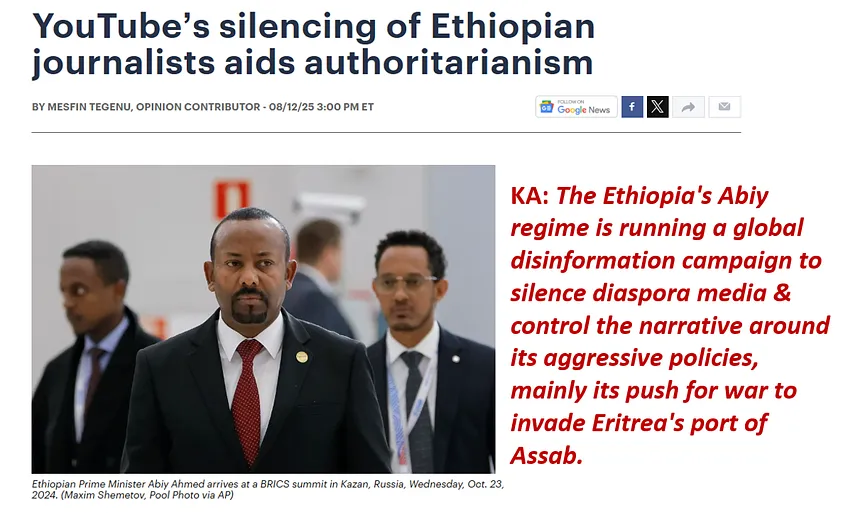
Exposing Abiy's Hidden Agenda: How the Regime's Campaign to Silence Ethiopian Dissent Aims to Regain Control of the Media Narrative for the Invasion of Eritrea's Port

Khalid A @AligidirEritrea

https://khalid83.substack.com/p/exposin ... irect=true

Aug 17, 2025

This week, an Ethiopian diaspora group successfully exposed how the Abiy regime is running a well-funded campaign to silence diaspora media outlets. The article 👉🏾 https://thehill.com/opinion/internation ... epressive/ , which was published in The Hill, is widely read by U.S. policymakers and influencers. When all is said and done, it is clear that the Abiy Ahmed regime in Ethiopia is taking drastic measures to stifle critical issues that Ethiopians want to discuss regarding their own country and the regime's failing policies. This is clearly preventing the regime from shaping the narrative around its Red Sea port war agenda, specifically its wish to invade Eritrea’s port of Assab.


At the crux of this campaign is a two-part approach that involves both the dissemination of favorable propaganda and the silencing of dissenting voices. By hiring foreign and local social media influencers to promote a positive portrayal of the regime's ‘corridor development’ initiatives in Addis Ababa, the regime attempts to create a façade of stability and prosperity in the country. At the same time, the regime is also working hard to stifle diaspora media outlets that tackle pressing issues within Ethiopia, such as ethnic fueled wars in the Amhara and Oromo regions, the looming conflict with the TPLF in Tigray, and the dire economic circumstances facing ordinary Ethiopians.

The targeting of diaspora media is clearly essential for the survival of Abiy's regime. These outlets play a critical role in shedding light on the internal and regional crises the regime has caused, thereby challenging its dangerous war agenda against Eritrea. These voices compelled Abiy Ahmed to take drastic measures by beefing up his extensive
30K digital army
to saturate social media platforms with pro-regime messages while launching attacks on Ethiopian journalists and activists who oppose his regime.

It's public secrete that the regime also employs diplomatic and legal pressure to force social media companies into removing critical content. This multifaceted strategy often involves legal complaints and takedown requests passed through Ethiopian embassies. Moreover, the regime is said to have hired U.S. based public relations and legal firms to bolster its efforts, even seeking the help of U.S. government contractors to assist in these initiatives.

In short, the Abiy regime's expensive and coordinated campaign to control the media landscape is intrinsically linked to its military ambitions against Eritrea. By silencing critical Ethiopian voices, particularly from the diaspora, the regime seeks to obscure the critical realities in the country and advance its agenda for a Red Sea war of invasion.

Note: Those tactics to stifle media outlets are not limited to Ethiopian diaspora; there’re some early indications that suggest that similar methods are being employed against critical Eritrean social media outlets as well.


_______________


Re: Ethiopia: Travel Warning!

Posted: 18 Aug 2025, 16:42
by Zmeselo


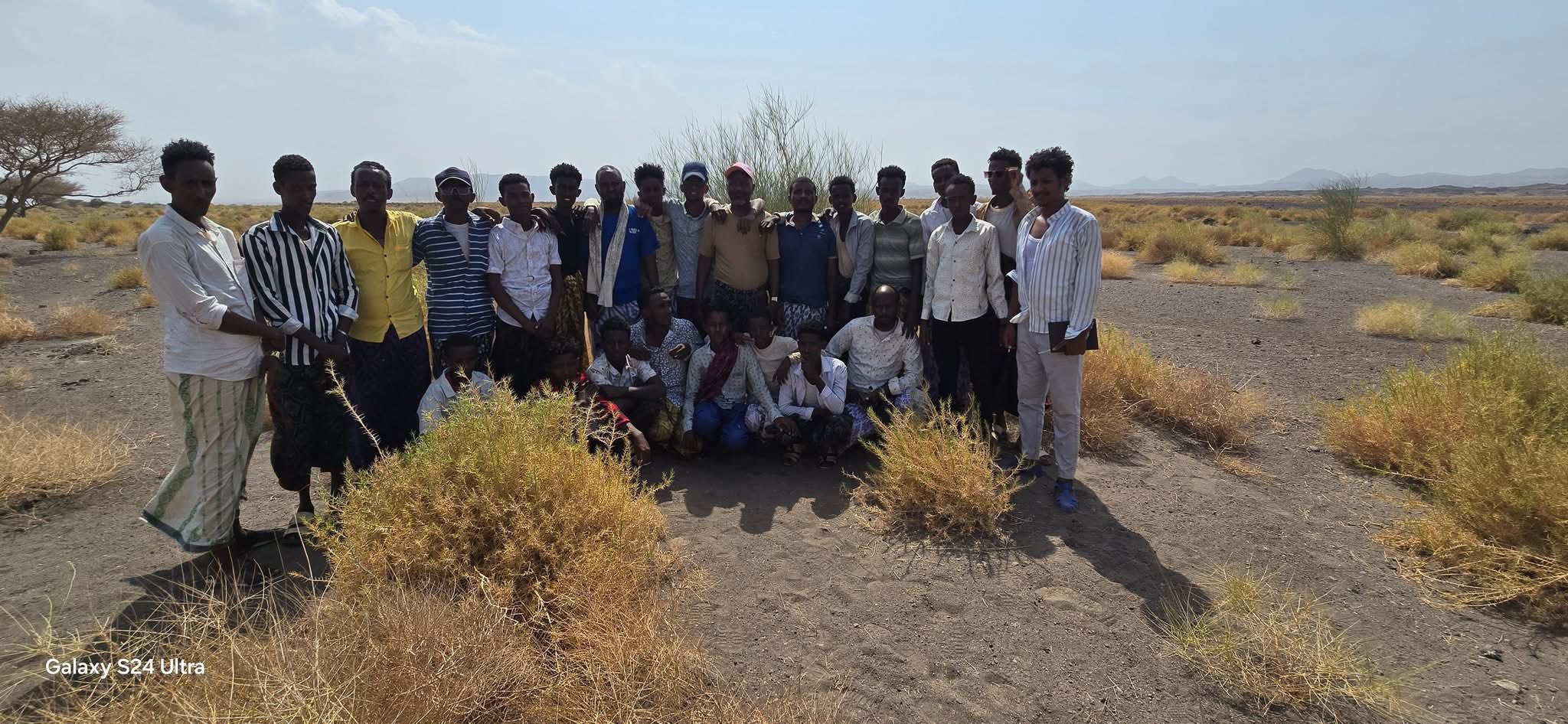
In defiance of Ethiopian Prime Minister Abiy Ahmed’s rule, Afar youth from Ethiopia are joining the Afar Unity Army to pursue their struggle.


(UPDATE) - በሰመራ ዩኒቨርስቲ ተማሪዎች የነበሩ በርከት ያሉ የአፋር ተወላጆች ዛሬ የአፋር ተቃዋሚ ሰራዊትን ለመቀላቀል ወደ ኤርትራ በሰላም ገብተዋል::

"የነብር ጭራ አትያዝ" ብለነው ነበር ለዚህ ጨቅላ ...