Ethiopian News, Current Affairs and Opinion Forum
Zmeselo
Senior Member+
Posts: 36764
Joined: 30 Jul 2010, 20:43

Empty threats

Post by Zmeselo » 13 Aug 2025, 12:59


Egypt will never allow Nile water to be touched: El-Sisi to Uganda president

Ahram Online

https://english.ahram.org.eg/NewsConten ... ed-El.aspx

Tuesday 12 Aug 2025

President Abdel-Fattah El-Sisi said on Tuesday that Egypt will never allow its share of Nile water, which sustains 105 million Egyptians and about 10 million guests, to be touched.


Egyptian President Abdel-Fattah El-Sisi speaks during a joint press conference with Ugandan President Yoweri Museveni in Cairo Egypt. Al-Ahram.

Speaking at a joint press conference in Cairo with Ugandan President Yoweri Museveni, El-Sisi underlined Egypt’s complete rejection of unilateral measures in the Eastern Nile Basin, which Cairo has sought to keep as a source of cooperation, not conflict.
Anyone who imagines that Egypt will turn a blind eye to an existential threat to its water security is mistaken… We will continue to monitor the situation and take all measures provided for under international law to safeguard our people’s existential resources,
El-Sisi warned.

El-Sisi’s remarks were referring to the Grand Ethiopian Renaissance Dam (GERD), which Cairo fears will drastically reduce its share of Nile waters.

Egypt has previously described the Ethiopian measures on the GERD as a clear violation of international law, https://english.ahram.org.eg/News/549132.aspx particularly the rules related to the fair and equitable use of international waterways and the prohibition of causing harm to neighbouring countries.

A decade of negotiations between the downstream nations and Ethiopia has failed to produce an agreement https://english.ahram.org.eg/News/532000.aspx balancing water security for downstream nations with Ethiopia's development targets.

In December 2023, Cairo announced the end of the GERD negotiation track due to Ethiopia's persistent rejection of any proposed technical or legal solutions.

In July, Egyptian Minister of Water Resources Hani Sewilam expressed the country’s firm rejection of Ethiopia’s repeated unilateral measures after Addis Ababa announced the completion of its multi-billion-dollar mega-dam, with plans for official inauguration in September.

Between 2020 and 2024, Ethiopia unilaterally completed the dam’s five-stage filling and began operating two turbines, without an agreement with its downstream nations, Egypt and Sudan.

Nile Basin countries' development

During the press conference, El-Sisi said that
We agreed that water is very important, and that development is also important. Our position has been clear from the start — we have never rejected the development of our partners and brothers in the Nile Basin countries. We have no problem with that, as long as such development does not affect the amount or share of water reaching Egypt.
Quoting Museveni, El-Sisi said:
President Museveni pointed out that the water falling on the basin — whether the Blue Nile or White Nile — amounts to 1,600 billion cubic metres annually. This water is divided between forests and swamps, agricultural use, evaporation, groundwater recharge, and only a small portion — about 85 billion cubic meters, roughly 4 percent of the total — reaches the White and Blue Nile.
When we demand that this amount reach Egypt and Sudan for livelihood — as we have no other source — does that mean we are rejecting development in the basin countries or their use of water for agriculture or electricity production? Of course not,
El-Sisi asserted.
We have never talked about a fair distribution of all 1,600 billion cubic metres; we are talking only about the remaining, which doesn’t exceed 4–5 percent… We do not say ‘us and them’ — we are all together, living, growing, and cooperating for the prosperity and stability of our countries.
El-Sisi recalled Museveni telling him that in Uganda, Egypt means
the garden.
This garden has no other water source than the Nile—we have no rain,
he said.
No one can imagine that Egypt would abandon it. Giving up any part of it would mean giving up our life—and that will never happen.
Egypt’s annual water needs exceed 90 billion cubic metres, https://english.ahram.org.eg/News/548898.aspx while its Nile share stands at just 55.5 billion. Per capita water availability is under 500 cubic meters per year—well below the United Nations’ (UN) water poverty threshold of 1,000, according to recent remarks by Egypt's foreign minister.

El-Sisi expressed hope that the seven-nation committee led by Uganda would reach a consensus to ensure the benefit of all basin countries.

This committee is part of the Nile Basin Initiative (NBI) and engages with countries that have not yet ratified the Cooperative Framework Agreement (CFA), also known as the
Entebbe Agreement.
Those who have rain will never feel what it is like for those who do not. The Egyptian people are extremely cautious and concerned about water, and I am responsible, along with my brothers and wise leaders like President Museveni, to find a solution that never harms the lives of Egyptians.
He warned that Egypt faces “significant pressures” over this issue.

Water may be part of a campaign to achieve other objectives, El-Sisi said, adding that
we are fully aware of this.
We have always been against interfering in others’ affairs, against conspiring against others, and against destruction. We are for building, cooperation, and development, as our African countries have suffered enough from years of conflict and fighting.
Once again, I reassure Egyptians that we will never allow the waters that sustain 105 million Egyptians and about 10 million guests to be touched. We do not call them refugees,
El-Sisi concluded.

Safeguarding Nile Basin countries

During the presser, President El-Sisi said he agreed with President Museveni that the Nile Basin countries must work together to preserve and develop this vital resource, achieve mutual benefit, and avoid harming any country per the rules of international law.

He stated that, according to President Museveni,
without preserving the Nile Basin environment, we will find nothing to share.
I assured President Museveni of our full support for development efforts in Uganda and other South Nile Basin countries and our readiness to finance the Angololo Dam project between Uganda and Kenya through Egypt's investment in the Nile Basin infrastructure projects, with an initial funding of $100 million,
President El-Sisi continued.

The president also expressed his pleasure upon the signing of a new memorandum of understanding in the field of integrated water resources management, building on more than 20 years of cooperation between the two countries to preserve the Nile River environment and develop its resources. The total value of the agreement is $6 million over five years.
This affirms our commitment to supporting development in Uganda and other brotherly Nile Basin countries,
he stressed.

El-Sisi also expressed Egypt’s confidence in the constructive role Uganda is playing in leading the consultative process within the Nile Basin Initiative https://english.ahram.org.eg/NewsConten ... nitia.aspx to restore inclusivity and consensus among basin countries to achieve mutual benefit.

Egypt-Uganda cooperation

The two presidents held a closed meeting on Tuesday, followed by an expanded session of talks attended by delegations from both countries.

During the discussions, both sides explored ways to strengthen the historic bilateral relations between Egypt and Uganda, particularly in political, commercial, and investment fields, to serve the shared interests of the two brotherly peoples.


The two presidents witnessed the signing of several memoranda of understanding for technical cooperation in water resources management, agricultural and food cooperation, investment, mutual visa exemptions for holders of official passports, and diplomatic cooperation to support the establishment of an Ugandan diplomatic institute.
The Egyptian-Ugandan bilateral relations have recently witnessed remarkable development, reflecting the close ties and interests between the two countries,
President El-Sisi said.

Moreover, El-Sisi said they discussed ways to activate economic cooperation and increase trade volumes between the two countries.
We agreed to expedite procedures for forming a joint business council and encourage visits between business communities to contribute to mutual interests. Thus, a joint business forum will be held on the sidelines of the visit to explore available investment opportunities and begin taking practical steps,
he added.

The two presidents also expressed interest in advancing cooperation opportunities in training, capacity building, combating animal diseases, and the energy sector.

Additionally, they agreed to continue cooperation in the security domain, especially after the recent visit of the Ugandan People’s Defence Forces commander to Egypt and the agreement to hold annual military cooperation committee meetings.

Zmeselo
Senior Member+
Posts: 36764
Joined: 30 Jul 2010, 20:43

Re: Empty threats

Post by Zmeselo » 13 Aug 2025, 14:49


Opinion | International
YouTube’s silencing of Ethiopian journalists aids authoritarianism

By Mesfin Tegenu, opinion contributor

https://thehill.com/opinion/internation ... epressive/

08/12/25


Ethiopian Prime Minister Abiy Ahmed arrives at a BRICS summit in Kazan, Russia, Wednesday, Oct. 23, 2024. (Maxim Shemetov, Pool Photo via AP)

With over 120 million people, Ethiopia is Africa’s second most populous country and one of the world’s oldest civilizations. Strategically located in the Horn of Africa, it carries immense geopolitical importance.

Yet despite its rich history, Ethiopia today is among the most repressive environments for press freedom. The government continues to stifle independent journalism through censorship, harassment and arbitrary detention.

According to the 2024 World Press Freedom Index by Reporters Without Borders, Ethiopia is ranked 141st out of 180 countries for media freedom. https://gijn.org/stories/perils-facing- ... hatgpt.com

The Committee to Protect Journalists further confirms that Ethiopia is one of sub-Saharan Africa’s top jailers of journalists, https://cpj.org/2025/05/7-journalist-ar ... lator/?utm holding six journalists in prison as of Dec. 1, 2024, making it second only to Eritrea in the region.

Since the outbreak of government-led conflict in the Amhara region in 2023 — compounded by ongoing unrest in all parts of the country — journalists have faced escalating threats and imprisonment for simply reporting the truth. In August 2023, the Ethiopian government declared a state of emergency covering the Amhara region and beyond. This has been criticized by Amnesty International as a pretext for authoritarian control. https://www.amnesty.org/en/latest/news/ ... ssent/?utm

The Committee to Protect Journalists has documented misuse of anti-terror laws and prolonged detentions in unofficial facilities.

Among those unjustly detained is Meskerem Abera, founder of Ethio Nikat Media. Amnesty International https://cpj.org/?p=277370 has stated that the charges against her appear politically motivated as part of a broader crackdown on journalists critical of the government.

Equally emblematic is the case of Dereje Habtewold, a veteran journalist sentenced to imprisonment in exile by the former Ethiopian People Revolutionary Democratic Front regime. https://www.refworld.org/reference/annu ... 1/en/81749

In exile, he continued to report through Ethiopian Satellite Network TV, a YouTube-based outlet serving the diaspora.

But YouTube — owned by Google — is increasingly undermining that mission.

According to a recent Ethiopian Satellite Network TV statement, Maede Zenachannel (where Habtewold serves as main reporter) was arbitrarily terminated on July 21, 2025, https://esantv.net/esan-tv-cond/ followed by Ethiopian Satellite Network TV’s main YouTube channel on July 30, 2025. YouTube issued only vague references to violations of “community standards,” offering no transparency or meaningful recourse.

Other independent Ethiopian media outlets — such as Zewdu Show, Ethio 360 and 14 channels affiliated with the Amhara Media Council including Merja TV, Ethio 251 Media, Ghion TV Multimedia — have also been removed from YouTube without warning or justification. These outlets, many with hundreds of thousands or even millions of subscribers, have served as lifelines for independent news, https://amharamediacouncil.org/index/ especially as press freedom deteriorates inside Ethiopia.

Even American journalists are being swept up in this wave of silencing. Salome Mulugeta, founder of Hello Ethiopia, has had her YouTube channel blocked for more than eight months. YouTube has provided the same non-compliant to community standards justification for blocking her channel.

YouTube CEO Neal Mohan’s 2022 testimony before U.S. Congress included a powerful statement:
YouTube’s mission is to give everyone a voice and show them the world. https://www.govinfo.gov/content/pkg/CHR ... g51542.htm
That mission is commendable, but it must be upheld consistently. Ethiopian journalists and diaspora media leaders cannot accept the selective enforcement of content standards, particularly those Mohan outlined https://www.hsgac.senate.gov/wp-content ... -09-14.pdf to then-Sen. Rob Portman (R-Ohio) and the Senate Committee on Homeland Security and Governmental Affairs.

When principles of fairness and transparency are applied unevenly, it erodes YouTube’s credibility and also enables authoritarian regimes to shape the global narrative without challenge.

YouTube plays a critical role in amplifying the voices of exiled and independent journalists, especially those reporting on crises ignored by state-controlled or mainstream outlets. Yet its opaque and seemingly biased moderation practices increasingly threaten that role.

By disproportionately targeting content critical of the Abiy Ahmed regime, particularly reporting on war on Amhara region, human rights abuses, the imprisonment of civilians and opposition party leaders, systemic corruption, religious persecution and the erosion of the rule of law — YouTube risks becoming complicit in suppressing truth. These actions contribute to an information vacuum, embolden authoritarianism and undermine the democratic values the platform claims to uphold.

This is not just an Ethiopian diaspora journalist problem. As artificial intelligence and algorithms increasingly control what content is visible — and what is silenced — the unchecked power of tech platforms threatens global press freedom.

Congress must take concrete steps to remedy this.

• Hold public hearings on content moderation, compelling tech executives to explain how and why journalistic content — especially from politically sensitive regions — is being removed.

• Demand transparency from YouTube and Google regarding their moderation policies, enforcement data and algorithmic biases that may disproportionately affect dissident voices.

• Introduce legislation to establish clear standards and oversight for how tech platforms manage news and political speech globally.

• Pass resolutions affirming U.S. support for press freedom and working with international organizations to pressure governments — like Ethiopia’s — to halt the persecution of journalists.

• Invest in independent journalism, including training, digital security and tools to help reporters navigate censorship and algorithmic suppression.

Failure to act now risks normalizing the dangerous precedent that global tech platforms can silence journalists without accountability, while authoritarian governments cheer them on. When truth tellers are digitally erased and propaganda prevails, the foundation of democracy itself begins to crack.

Mesfin Tegenu is executive chairman of the American Ethiopian Public Affairs Committee. https://www.aepact.org/

Zmeselo
Senior Member+
Posts: 36764
Joined: 30 Jul 2010, 20:43

Re: Empty threats

Post by Zmeselo » 13 Aug 2025, 17:52


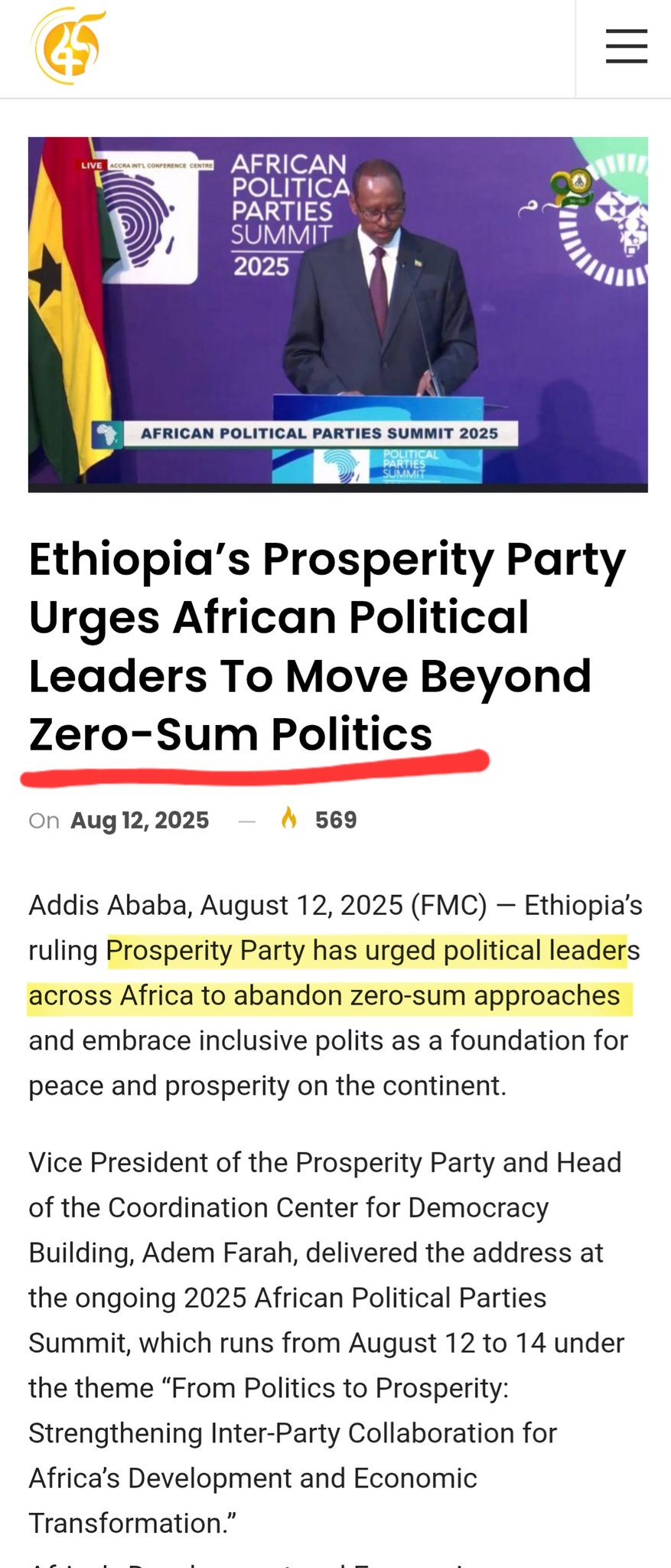
Amusing, that the Abiy regime would have the audacity to lecture others to "abandon zero-sum approaches."

Itself an incompetent regime with a zero-sum approach to governance.
👇


Abiy Ahmed’s Incompetence and Zero-Sum Approach to Governance https://ethiopianpolicy.com/2024/10/20/ ... overnance/

Zmeselo
Senior Member+
Posts: 36764
Joined: 30 Jul 2010, 20:43

Re: Empty threats

Post by Zmeselo » 13 Aug 2025, 20:07

The mayor of Addis, is scared.


Tiago
Member
Posts: 2917
Joined: 30 Jul 2018, 02:09

Re: Empty threats

Post by Tiago » 13 Aug 2025, 22:11

Al sisi and others before him used the issue of the Nile water for political purpose.
If they real mean stopping Ethiopia build the dam,why did they stand and watch all along??

Abiy is using access to port/taking Assab as political tool.If you ask the average Ethiopian about Assab,the answer is simply "we don't want it".
unfortunately ,there are some Ertreans who believe the suffering of Ethiopians will bring success to Eritrea. ( schadenfreude)

The unspoken anger of Eritreans is why Ethiopia is not using Eritrea ports.
Ethiopia has massive untapped resources and manpower to do business with neighbouring countries minus Eritrea and there is nothing you can do about it than wishing ill.

Affable
Member
Posts: 620
Joined: 15 Jul 2023, 13:21

Re: Empty threats

Post by Affable » 13 Aug 2025, 22:44

The real question should be why is the Isayes’ ደደብ ካድሬ ቂጡን ጥሎ ይደንሳል በ Al sisi ድንቁርና ነው። ለግብፅ መኖር ኢትዪጺያ ወሳኝ ነች። ለ ኢትዪጺያ መኖር . 0000000001 ግብፅ አስተዋፅአኦ የላትም። ለዛ ጭንቅላቱ እየቀጨጨ ላለው የሰሜኑ ወዳጃችንና አምላኪዎቹ ኢትዪጺያን ሊያስፈራራ የሚችል ግብፅ የሚባል አገር እንደሌለ ቢያውቁ ይበጃል። በጠላት መከበባችንን ስላወቅን we have worked on it. Because we knew an Arab slave is the leader of our northern neighbor, yes, we have worked on it.
Therefore, we are confident we prevail.

Zmeselo
Senior Member+
Posts: 36764
Joined: 30 Jul 2010, 20:43

Re: Empty threats

Post by Zmeselo » 13 Aug 2025, 23:35

Wishing ill? What, wishing ill? Only because I said his words, are empty? :lol:

I'm talking about it now, because his speech happened yesterday. As simple as that!

Ethiopia, can opt not to use Assab. It's Ethiopia's prerogative. What Ethiopia can't do, is threaten to OWN it by hook or by crook.


Tiago wrote:
13 Aug 2025, 22:11
Al sisi and others before him used the issue of the Nile water for political purpose.
If they real mean stopping Ethiopia build the dam,why did they stand and watch all along??

Abiy is using access to port/taking Assab as political tool.If you ask the average Ethiopian about Assab,the answer is simply "we don't want it".
unfortunately ,there are some Ertreans who believe the suffering of Ethiopians will bring success to Eritrea. ( schadenfreude)

The unspoken anger of Eritreans is why Ethiopia is not using Eritrea ports.
Ethiopia has massive untapped resources and manpower to do business with neighbouring countries minus Eritrea and there is nothing you can do about it than wishing ill.
Last edited by Zmeselo on 13 Aug 2025, 23:48, edited 1 time in total.

Zmeselo
Senior Member+
Posts: 36764
Joined: 30 Jul 2010, 20:43

Re: Empty threats

Post by Zmeselo » 13 Aug 2025, 23:40

Says the one, owned by a UAE sheikh. :lol:

A country, the size of 0.00000001% as that of Ethiopia.

Affable wrote:
13 Aug 2025, 22:44
The real question should be why is the Isayes’ ደደብ ካድሬ ቂጡን ጥሎ ይደንሳል በ Al sisi ድንቁርና ነው። ለግብፅ መኖር ኢትዪጺያ ወሳኝ ነች። ለ ኢትዪጺያ መኖር . 0000000001 ግብፅ አስተዋፅአኦ የላትም። ለዛ ጭንቅላቱ እየቀጨጨ ላለው የሰሜኑ ወዳጃችንና አምላኪዎቹ ኢትዪጺያን ሊያስፈራራ የሚችል ግብፅ የሚባል አገር እንደሌለ ቢያውቁ ይበጃል። በጠላት መከበባችንን ስላወቅን we have worked on it. Because we knew an Arab slave is the leader of our northern neighbor, yes, we have worked on it.
Therefore, we are confident we prevail.

Zmeselo
Senior Member+
Posts: 36764
Joined: 30 Jul 2010, 20:43

Re: Empty threats

Post by Zmeselo » 13 Aug 2025, 23:45

The 2018 Joint Declaration of Peace and Friendship, signed by president Isaias Afewerki and Prime Minister Abiy Ahmed, included an agreement to resume air services and for landlocked Ethiopia to use Eritrean ports. This was widely seen as a significant step towards economic cooperation. ​However, in recent years, the delusional Prime Minister Abiy Ahmed has made several statements regarding Ethiopia's need for direct access to the Red Sea, which have been interpreted by Eritrea, Somalia and Djibouti as a threat to thier sovereignty. The three nations responded with alarm, accusing Ethiopia of harboring "unlawful ambitions" and militaristic intentions. Eritrean officials have been clear that their ports are for civilian, commercial use, and have rejected any notion of ceding territory or allowing a foreign naval base.

Watch this video in Tigrigna and Amharic explaining how Abiy jeopardize the peace agreement both signed.


Post Reply