Page 1 of 1

Africa’s Eternal Crossroads: Between Exploitation and a New Dawn

Posted: 26 Jul 2025, 17:13

by Zmeselo


Africa’s Eternal Crossroads: Between Exploitation and a New Dawn


Composite: Eritrea's President Isaias Afwerki with Eritrean flagged Africa map.

By Ternafi Hadelibi

https://mesobjournal.com/africas-eterna ... -new-dawn/

July 26, 2025

If ever there was a moment to reassess Africa’s place in the world, it is now. And no voice is speaking with more clarity—or moral authority—than that of President Isaias Afwerki. In his recent July 2025 interview, President Isaias didn’t mince words. He diagnosed Africa’s condition with surgical precision:

it’s not only the chains of past colonizers that weigh down the continent—it is the willingly worn shackles of dependency, aid addiction, and external tutelage.

Africa possesses an estimated 60% of the world’s natural resources,” President Isaias said plainly. “Yet, the continent remains in a state of low socio-economic development, largely confined to a primary or nascent economic structure.


Why? Because instead of owning its destiny, much of Africa has outsourced it—trading dignity for donations, sovereignty for subsidies.

The hypocrisy of Western aid was laid bare. Take the U.S. threat to scale back HIV/AIDS programs. Western media predicted African bodies in the streets, as though life itself was tied to a pipeline of goodwill from Washington. But President Isaias flipped the narrative: why must Africans die because aid stops? Why should healthcare—a basic right—depend on an external lifeline in the first place?

This, he declared, is a modern form of slavery.

And the exploitation isn’t limited to charity. Africa’s role in the global economy is designed to be minimal: extract, export, and remain poor. He cited Niger, sitting on one of the world’s richest uranium deposits, and yet unable to power a single nuclear reactor of its own. For decades, France raked in profits while Niger remained in the dark—literally and figuratively.

It is a pattern seen across Mali, Burkina Faso, Congo, and beyond. Mountains of wealth above and below ground—yet stagnant development, failing schools, crumbling hospitals. Not because the continent lacks resources or intellect, but because value creation was outsourced, and local human capital systematically drained. Brain drain wasn’t just a byproduct—it was policy.

President Isaias didn’t absolve African governments either.
The more urgent question is: What have we done for ourselves?
he asked.
There is no form of bondage more degrading than dependency.
His prescription is unapologetically nationalist: build internal capacity, invest in indigenous systems, elevate education, and stop the intellectual hemorrhage. He challenged Africans to see the end of US aid not as a crisis, but a
blessing in disguise.
Let them cut the cords, he urged—then let Africa finally grow on its own terms.

He also took aim at the bloated industry of foreign NGOs:
400 to 500 in some countries,
many of which are thinly veiled operations of global intelligence or economic sabotage.

These aren’t neutral actors. They profit from poverty.
Aid has become a business,
he warned.
And too many benefit from its perpetuation.
Stability, he insisted, will not come from copy-pasting Western political models. Africa needs governance rooted in its own cultural and historical realities, not some IMF PowerPoint.

The path forward demands national unity, sovereign institutions, and honest political systems—not tribalism dressed up as democracy, nor ballot boxes imported from Brussels.

As for the drumbeat of terrorism that always seems to justify foreign military occupation? Another colonial echo. Whether in Somalia, Niger, or Nigeria, the formula is the same: create a crisis, insert external forces, and carve up influence zones.

President Isaias’s message is unambiguous: Enough. Africa must industrialize, unify, and govern itself. The path is hard, but it is necessary.
Each country must assess its own situation honestly… African countries cannot be built by warlords and militias, but on the solid foundations of sovereign institutions.
In a continent where speeches often mean little, Eritrea’s words carry weight because they are backed by action. The country that refused to bow to aid, that expelled the NGO complex, and that built its foundations brick by brick, offers not just critique—but example.

Africa stands again at a crossroads. One path leads to renewed servitude, gift-wrapped as support. The other demands sacrifice, but promises sovereignty.

Eritrea has already chosen its road. The rest of the continent must decide.
Re: Africa’s Eternal Crossroads: Between Exploitation and a New Dawn

Posted: 26 Jul 2025, 17:22
by Zmeselo
Abiy's Latest Tirade: LOL, What a Mess!

Once more, I couldn’t make head or tail of PM Abiy’s recent diatribe. He surely tries to run the same old playbook-- using Eritrea as a scapegoat while distracting his countrymen from his own absolute failures. It’s like watching an old, terrible magician who can’t pull off another trick. He talks about peace and love in one breath, then points fingers at Eritrea for every problem in Ethiopia. Yep! He claims Eritrea is funding nearly every opposition group in the country (TPLF, FANO, OLA (aka Shene)), and frankly, I couldn't stop LOL hearing him saying this. It’s public knowledge that the TPLF and Eritrea barely see eye to eye; I mean there's a 50 year record of this, for goodness sakes. The TPLF even blames Eritrea for their failure to capture Addis Ababa in November 2021, yet here's Abiy attempting to link the two...it's like trying to mix oil and water. Bizarre!

In this drama, he basically tries to cater to two audiences: the PP loyalists and the large number of Ethiopians in the diaspora who wanted to see him gone yesterday. To his cadres, he insists that Eritreans are our brothers and that they should be treated with respect, while telling them they’re a lot economically poorer than them. Wait, what? Sure, Eritrea faces sever economic challenges, but so does Ethiopia! It’s like he’s saying,

Join us for a better life,


without looking himself in the mirror--the reality is Ethiopia is just as poor and more.

Then he turns to the critics in the diaspora, feeding them the absurd narrative that Eritrean leaders have it out for him and want Ethiopia to be in chaos. This is the second part of the comedy.

Oh, they want us to fight among ourselves!


he claims, while ironically trying to preach unity.

The mixed messages here, could use some serious clarity. It’s as if he’s talking out of both sides of his mouth, trying to charm his critics while veering off into nonsensical territory.

And let’s talk about his remarks on the Red Sea. Yeah, the big one. He says losing access to it was a “mistake” and that “we” (Ethiopians), did it without knowing its implications. LOL. He thinks Ethiopians don’t know the historical, political, and legal facts of Eritrea and Ethiopia. By saying

we made a mistake,


he basically attempts to tell them that he is leading them to rewrite history and to give himself a free pass.

At the end of the day, Abiy Ahmed’s latest diatribe feels less like a political strategy and more like another frantic attempt to cling to power. The man clearly knows, his regime is slipping away faster than a goat escaping a hungry lion. I can’t blame him for trying, though.

WTH , has Menghistu Hailemariam come back to power? His final years were full of insulting his colleagues, subordinates and the people at large. He looked scared and his favourite word was ወንበዴ - Déjà vu


Re: Africa’s Eternal Crossroads: Between Exploitation and a New Dawn

Posted: 26 Jul 2025, 17:31
by Zmeselo
Ethiopia’s version of the state of Oceania in Orwell's 1984 novel: Abiy’s/PP's Ethiopia is obsessed with absolute power over every aspect of life, from thought to action, through propaganda, surveillance, & the Federal Police turned into a Thought Police.

Federal Police to launch crackdown on ‘destabilizing’ social media posts, vows to conduct sweeping citywide checks

The Ethiopian Federal Police has announced plans for intensified operation targeting individuals and groups it accused of
using social media platforms to incite unrest and sow disorder
both inside the country and from abroad.

In a statement issued this week, the Federal Police warned that it is preparing “enhanced operations” against what it described as
media campaigns aimed at turning the country into a center of chaos and disorder.
It added that efforts will be strengthened to
bring to justice those attempting to destabilize the country.
The statement also confirmed that
searches and inspections will be carried out in Addis Abeba and its surroundings, as well as at all entry and exit checkpoints,
with a focus on identifying and neutralizing so-called
anti-peace forces.
The announcement followed a high-level discussion on a new security plan designed to maintain stability during several major international, continental, and national events scheduled in Ethiopia between July and September 30, 2025.

The meeting, chaired by Ethiopian Federal Police Commissioner General Demelash G/Michael, brought together senior officials from the National Defense Force, the Ministry of Foreign Affairs, the Republican Guard, the National Intelligence and Security Service, and the Addis Ababa Police. Commissioner General Demelash underscored the importance of coordinated and orderly security deployment,
starting from the reception of guests,
to ensure the peaceful conduct of upcoming events.

Re: Africa’s Eternal Crossroads: Between Exploitation and a New Dawn

Posted: 26 Jul 2025, 17:36
by Zmeselo
Megazines were introduced to Addis Ababa by an Eritrean, Gherezgiher Gilay, one of the prison breakers from Nakura, during Italian colonial rule. Prior to that, "news" was disseminated through megaphones in churches & other public gatherings.

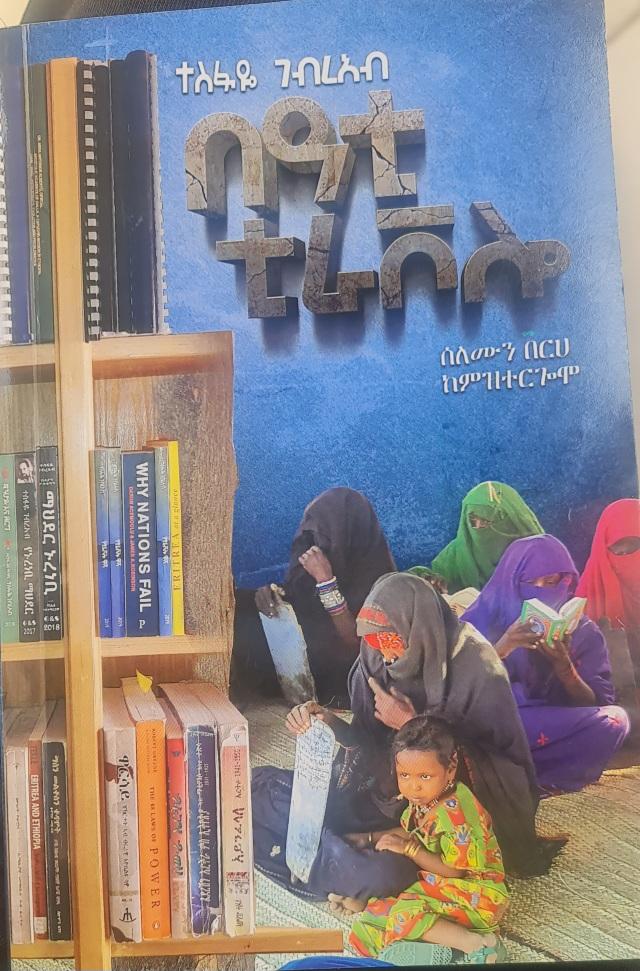
Tesfaye Ghebreab, the TiraVollo Cave


______________


Independence and nationalism, as we are witnessing in our region, aren't a done deal, secured and recognized once and for all. They need nurturing, bûttressing, and attuning to the times.


Eritrean Historian, Alemseged Tesfai.

Re: Africa’s Eternal Crossroads: Between Exploitation and a New Dawn

Posted: 26 Jul 2025, 19:07
by Deqi-Arawit
Zmeselo wrote:
26 Jul 2025, 17:13


Africa’s Eternal Crossroads: Between Exploitation and a New Dawn


Composite: Eritrea's President Isaias Afwerki with Eritrean flagged Africa map.

By Ternafi Hadelibi

https://mesobjournal.com/africas-eterna ... -new-dawn/

July 26, 2025

If ever there was a moment to reassess Africa’s place in the world, it is now. And no voice is speaking with more clarity—or moral authority—than that of President Isaias Afwerki. In his recent July 2025 interview, President Isaias didn’t mince words. He diagnosed Africa’s condition with surgical precision:

it’s not only the chains of past colonizers that weigh down the continent—it is the willingly worn shackles of dependency, aid addiction, and external tutelage.

Africa possesses an estimated 60% of the world’s natural resources,” President Isaias said plainly. “Yet, the continent remains in a state of low socio-economic development, largely confined to a primary or nascent economic structure.


Why? Because instead of owning its destiny, much of Africa has outsourced it—trading dignity for donations, sovereignty for subsidies.

The hypocrisy of Western aid was laid bare. Take the U.S. threat to scale back HIV/AIDS programs. Western media predicted African bodies in the streets, as though life itself was tied to a pipeline of goodwill from Washington. But President Isaias flipped the narrative: why must Africans die because aid stops? Why should healthcare—a basic right—depend on an external lifeline in the first place?

This, he declared, is a modern form of slavery.

And the exploitation isn’t limited to charity. Africa’s role in the global economy is designed to be minimal: extract, export, and remain poor. He cited Niger, sitting on one of the world’s richest uranium deposits, and yet unable to power a single nuclear reactor of its own. For decades, France raked in profits while Niger remained in the dark—literally and figuratively.

It is a pattern seen across Mali, Burkina Faso, Congo, and beyond. Mountains of wealth above and below ground—yet stagnant development, failing schools, crumbling hospitals. Not because the continent lacks resources or intellect, but because value creation was outsourced, and local human capital systematically drained. Brain drain wasn’t just a byproduct—it was policy.

President Isaias didn’t absolve African governments either.
The more urgent question is: What have we done for ourselves?
he asked.
There is no form of bondage more degrading than dependency.
His prescription is unapologetically nationalist: build internal capacity, invest in indigenous systems, elevate education, and stop the intellectual hemorrhage. He challenged Africans to see the end of US aid not as a crisis, but a
blessing in disguise.
Let them cut the cords, he urged—then let Africa finally grow on its own terms.

He also took aim at the bloated industry of foreign NGOs:
400 to 500 in some countries,
many of which are thinly veiled operations of global intelligence or economic sabotage.

These aren’t neutral actors. They profit from poverty.
Aid has become a business,
he warned.
And too many benefit from its perpetuation.
Stability, he insisted, will not come from copy-pasting Western political models. Africa needs governance rooted in its own cultural and historical realities, not some IMF PowerPoint.

The path forward demands national unity, sovereign institutions, and honest political systems—not tribalism dressed up as democracy, nor ballot boxes imported from Brussels.

As for the drumbeat of terrorism that always seems to justify foreign military occupation? Another colonial echo. Whether in Somalia, Niger, or Nigeria, the formula is the same: create a crisis, insert external forces, and carve up influence zones.

President Isaias’s message is unambiguous: Enough. Africa must industrialize, unify, and govern itself. The path is hard, but it is necessary.
Each country must assess its own situation honestly… African countries cannot be built by warlords and militias, but on the solid foundations of sovereign institutions.
In a continent where speeches often mean little, Eritrea’s words carry weight because they are backed by action. The country that refused to bow to aid, that expelled the NGO complex, and that built its foundations brick by brick, offers not just critique—but example.

Africa stands again at a crossroads. One path leads to renewed servitude, gift-wrapped as support. The other demands sacrifice, but promises sovereignty.

Eritrea has already chosen its road. The rest of the continent must decide.


Behold, folks — the mini skunis are now telling us that Eritrea has chosen its path, and the rest of the continent must also make a choice. 😂😂

Really? Which road is that?

The road that empties the country of its own citizens?
The road that leaves Eritreans scattered across failed states in Africa and beyond?
The road that discourages investment and mismanages national resources?
The road that promotes backwardness
The road that violates human dignity and dishonors the chastity of women?
If that’s the road we've chosen, then it’s not a path forward — it’s a dead end.