Soldier Becomes Unlikely Face of Ethiopian-Israeli Discontent
Prime Minister Benjamin Netanyahu of Israel met on Monday with Demas Fikadey, a soldier of Ethiopian descent who was beaten last week by police. Credit...Israel's Government Press Office
By Isabel Kershner and Jodi Rudoren
https://www.nytimes.com/2015/05/05/worl ... =url-share
May 4, 2015
JERUSALEM
Soldier Becomes Unlikely Face of Ethiopian-Israeli Discontent
Prime Minister Benjamin Netanyahu of Israel met on Monday with Demas Fikadey, a soldier of Ethiopian descent who was beaten last week by police. Credit...Israel's Government Press Office
By Isabel Kershner and Jodi Rudoren
https://www.nytimes.com/2015/05/05/worl ... =url-share
May 4, 2015
JERUSALEM — A slender and boyish-looking Israeli soldier, wearing a skullcap and an army shirt with sleeves too long for him, has become the unlikely and unwitting face of an outburst of anger and violent protests that have shaken Israel.
But
Demas Fikadey, a 21-year-old soldier of Ethiopian descent, said he did not see himself as a symbol or a hero.
He was heading home alone, in uniform, on April 26 when he was beaten by two Israeli police officers in the Tel Aviv suburb of Holon, where he lives. The seemingly unprovoked assault, caught on video,
was broadcast on national television and went viral on social networks, unleashing the pent-up rage of a young generation of Ethiopian-Israelis who have taken to the streets in recent days.
It just happened to me,
Mr. Fikadey said in an interview Monday, more than a week after his assault and a day after thousands of demonstrators converged on Tel Aviv’s Rabin Square
http://www.nytimes.com/2015/05/04/world ... tment.html to protest police harassment and the discrimination many Israelis of Ethiopian descent say they experience regularly.
The police said on Sunday that protesters pelted them with stones and bottles. The police responded with stun grenades and water cannons, and officers on horseback charged the crowds.
Fifty-six officers were injured, according to the police, and at least one remained hospitalized with moderate injuries on Monday. Several protesters were also wounded, and 43 were arrested. A smaller protest in Jerusalem last week also ended in fierce clashes.
 Ethiopian-Israelis confronted Israeli security forces in Tel Aviv on Sunday. Israeli leaders appealed for calm after a demonstration in Tel Aviv on Sunday night in which 56 police officers were injured and 43 protesters were arrested. Credit...Jack Guez/Agence France-Presse — Getty Images
Mr. Fikadey said he was opposed to violence, and as a soldier on active duty, he could not join the protesters.
But my heart is with them,
he said.
Mr. Fikadey came to Israel seven years ago from the Gojam region in Ethiopia. His father died before the family left for Israel, and his mother died a couple of years after their arrival, according to Selah,
http://www.selah.org.il/ an Israeli nongovernmental organization that supports vulnerable immigrants and that has aided Mr. Fikadey and his four brothers.
In high school, Mr. Fikadey was one of eight outstanding students nationwide who won an annual leadership award. He now serves in the military as a computer technician.
On the same day he met with Prime Minister
Benjamin Netanyahu,
http://www.nytimes.com/2015/05/05/world ... tests.html in an effort to help defuse the violent outbursts, Mr. Fikadey recounted the events that set off the initial protests. It was about 6:30 in the evening, he said, and he was on his way home from duty. He had gotten off his bicycle when a police officer stopped him and told him to turn around and go back, without any explanation. Mr. Fikadey said he did not know that the road on which he was traveling had been closed because of a suspicious object, and that police investigators had been called.
He said he waited for the police officer to get off his cellphone so that he could pass. But the officer threw Mr. Fikadey’s bicycle down and started to shove him.
When I asked him why he was pushing me, he began hitting me in the face,
Mr. Fikadey recounted.
A volunteer policeman came to help the officer, and Mr. Fikadey ended up on the ground. The officer later told his superiors that the soldier had hit him and thrown a stone at him, according to Mr. Fikadey’s lawyer.
If it hadn’t all been caught on camera from beginning to end, I would be in some prison now,
Mr. Fikadey said.
 An Israeli of Ethiopian descent at an immigrant center. There are about 135,000 Ethiopian Jews in Israel, and many speak of discrimination and police brutality. Credit...Ronen Zvulun/Reuters
Since the attack on Mr. Fikadey, many young Ethiopian-Israelis have shared their own tales of police harassment and brutality that they say are commonplace. Ethiopian leaders say the community also faces discrimination in housing, education and employment, painting a bleak picture of the group’s position in society 24 years after a mass airlift
http://www.nytimes.com/1991/05/26/world ... leted.html of descendants of an ancient Jewish tribe.
There are now about 135,000 Ethiopian Jews in Israel, less than 2 percent of the state’s population. But Ethiopians represent up to a third of youths in detention facilities, according to government reports, and have higher rates of poverty, unemployment, suicide, divorce and domestic violence.
Rabbinic authorities have offended Ethiopians by questioning their Jewishness
http://www.nytimes.com/1985/07/17/world ... srael.html and requiring conversion before approving weddings. Health officials prompted outrage in 1996 by dumping Ethiopians’ blood donations
http://www.nytimes.com/1996/01/29/world ... blood.html over fears of H.I.V. Schools have restricted Ethiopian enrollment.
In 2012, protests started
http://www.nytimes.com/2012/06/10/world ... tance.html after residents of four apartment buildings in the southern town of Kiryat Malachi vowed not to rent or sell to Ethiopians.
This year’s movement has been propelled in part by the parallels with African-American protests against police brutality in Baltimore; Ferguson, Mo.,
http://www.nytimes.com/interactive/2015 ... guson.html and elsewhere.
Shlomo Molla, an Ethiopian-Israeli former member of Parliament, called for civil disobedience, including refusing to serve in the army or pay taxes until the situation improves.
Ethiopians are demonstrating, but no one is giving the right answer, no one is hearing, no one wants to understand,
Mr. Molla said.
 Protesters on a Tel Aviv road on Sunday. Thousands of people demonstrated against the police harassment and discrimination they say that Ethiopian-Israelis experience regularly. Credit...Baz Ratner/Reuters
Israeli leaders have called for calm, and began on Monday to address the rising tensions.
Mr. Netanyahu convened meetings with Ethiopian-Israeli community leaders and officials from relevant government ministries. He held a separate, half-hour meeting with Mr. Fikadey that was also attended by the minister of internal security and the national police chief.
I told the prime minister he must work to end racism and discrimination,
Mr. Fikadey said after the meeting.
We dreamed for so many years to come to Israel. He must work to solve the problem.
Mr. Netanyahu posted on Twitter
a photo of the two shaking hands and smiling.
I said to the soldier, ‘I was shocked by the pictures. We cannot accept this and we will change things,’
he wrote.
In a statement later Monday Mr. Netanyahu said,
We must all line up against racism, condemn it and work to eradicate it.
He said he would chair a ministerial committee to advance plans to resolve problems in education, housing, culture, religion, employment and in other areas.
President
Reuven Rivlin of Israel said the protests by Ethiopian-Israelis had
revealed an open and raw wound at the heart of Israeli society,
but he condemned the violence that erupted the night before.
We must look directly at this open wound — we have erred, we did not look, and we did not listen enough,
said Mr. Rivlin, who has emerged as a leading advocate
http://www.nytimes.com/2014/10/28/world ... wound.html for Israel’s Arab and other minorities during his first year in his largely ceremonial post.
Speaking in the Rose Garden, a park opposite the prime minister’s office, Mr. Fikadey said Mr. Netanyahu appeared informed about the situation and listened to what he had to say.
As he spoke, a group of schoolgirls, including several of Ethiopian descent, spotted the reluctant hero and ran up to him screeching, as if he were a rock star. Seeming to enjoy the attention, he spoke to them with quiet words meant to encourage and motivate them to serve their country.
Myra Noveck contributed reporting from Jerusalem. ICC has rejected Israel’s request to have arrest warrants for PM Netanyahu and Defence Minister Gallant withdrawn.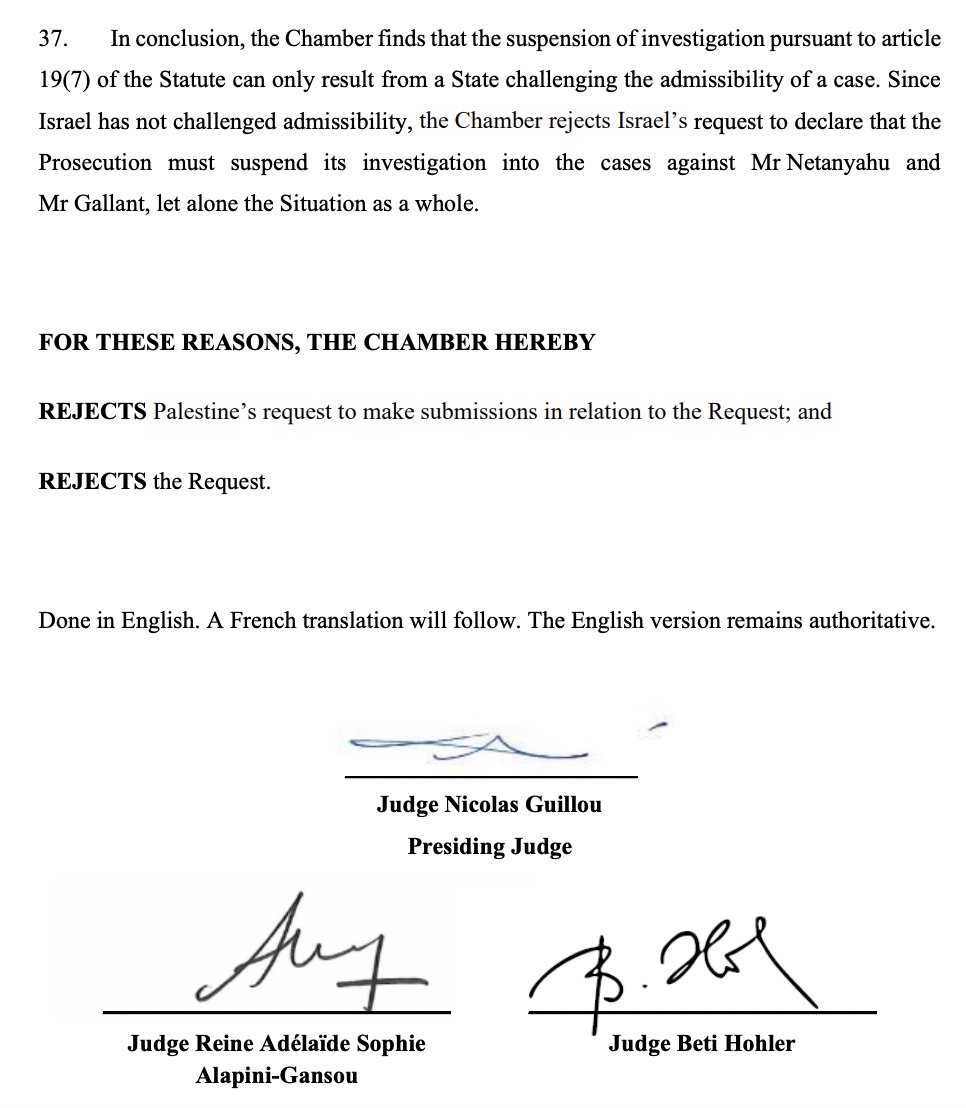
 ICC has rejected Israel’s request to have arrest warrants for PM Netanyahu and Defence Minister Gallant withdrawn.