Guardian
 The fossilised remains of ‘Selam’, a 3.3m-year-old Australopithecus afarensis child, which were discovered by Zeresenay Alemseged, who began his career as a young geologist with the National Museum of Ethiopia’s laboratory. It is the most complete skeleton of a human ancestor yet found
‘It’s always been some white dude’: how Ethiopia became the world leader in uncovering the story of humankind
Housed in an unremarkable office block in the capital, the country’s national museum is home to the most extensive collection of the remains of modern humans’ ancestors – and a team of world-leading scholars
Words and photographs by Fred Harter
Mon 14 Jul 2025 00.00 EDT
When Berhane Asfaw was in California beginning his graduate studies into the origins of humanity, he realised all the fossils he was examining had come, like himself, from Ethiopia. They had been shipped to the US to be researched and pieced together.
Back then, in the early 1980s, the only Ethiopians working on archaeological digs in their own country were labourers, employed by foreigners.
“Because everything discovered in Ethiopia was exported, there was no chance for Ethiopians to study the items and develop expertise,” says Berhane, who returned home in the late 1980s as his country’s first palaeoanthropologist – a scientist who studies human evolution.
“You can’t train people if everything is taken to France, the US or Britain,” the 70-year-old says.
 Berhane Asfaw, Ethiopia’s first palaeoanthropologist
With his American colleagues, Berhane clawed together funding to establish a laboratory at the National Museum of Ethiopia to clean fossils clogged with rock-hard bits of sediment, a painstaking process that can take years. The laboratory could also produce perfect replicas of specimens for foreign researchers to take home.
“Once we had the lab organised, there was no need to export fossils. We could do everything in-house,” says Berhane.
Housed in an unremarkable grey office block in the Ethiopian capital, Addis Ababa, his lab is now home to the world’s most extensive collection of the remains of modern humans’ ancestors: about 1,600 fossils representing 13 of more than 20 confirmed species of early humans. They are stored in a series of bullet-proof safes.
The oldest is of an ape-like creature called Ardipithecus kadabba that lived 6m years ago. The most recent, at 160,000-years-old, represents [deleted] sapiens, or modern humans, who evolved in east Africa before colonising the rest of the world. The discoveries led to Ethiopia being viewed as the cradle of mankind.
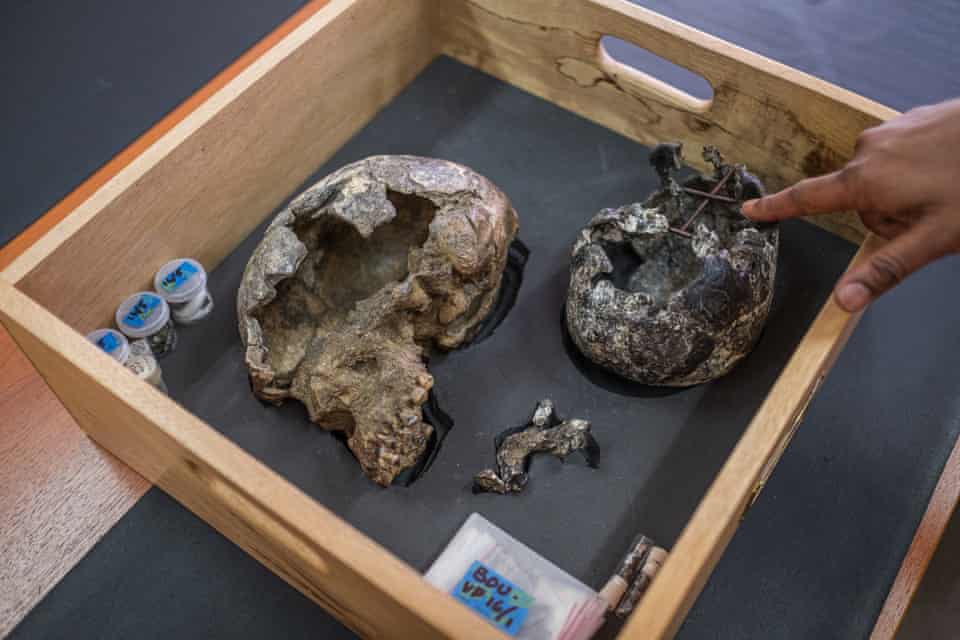
Adult and child craniums of ‘Herto man’, a 160,000-year-old sub-species of [deleted] sapiens
“The range is absolutely staggering. Ethiopia is the only place on Earth where you can find fossils stretching that far back to the present, without any gaps in the record,” says Berhane in his office. It is crammed with books, piles of papers and copies of hominin skulls; in one corner sits the huge, fossilised remains of a 400,000-year-old pair of buffalo horns.
Ethiopia takes the lead, and that is a great source of pride. The discoveries have literally rewritten the history of humanity
Yohannes Haile-Selassie
“The history of all humanity is housed in this place,” he says.
On the third floor of the building, a palaeontologist, Yared Assefa, lays several hominin fossils out on a conference table. They include “Lucy”, a 40% complete, 3.2m-year-old skeleton of a female hominin, whose discovery in Ethiopia’s arid Afar region in 1974 was a global sensation.
At the time, the Australopithecus afarensis skeleton represented the oldest human ancestor to be discovered by fossil hunters, and significantly advanced our understanding of humanity’s evolutionary trajectory. Today, her 47 bones are neatly arranged in a series of wooden drawers.
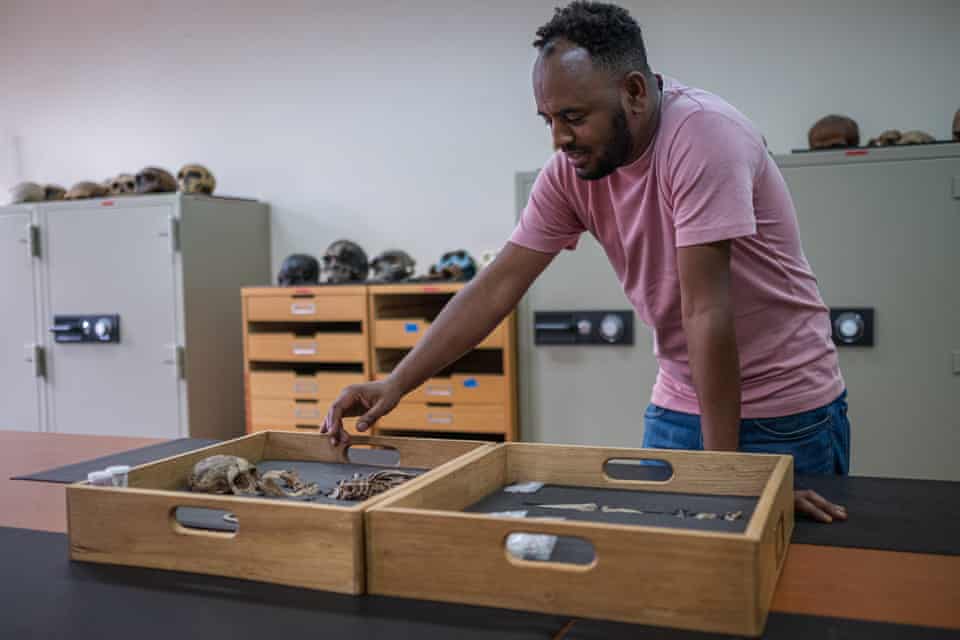
Yared Assefa, a palaeontologist, with some of the lab’s fossils
In the cavernous basement are kept the non-human fossils. The vast rows of filing cabinets contain everything from 3m-year-old chimpanzee teeth to fossilised frogs. The giant jaws and tusks of prehistoric elephants and hippos sit on low-slung trolleys.
https://i.guim.co.uk/img/media/a6c5ad45 ... &crop=noneGemechis Getaneh holds a 2.6m-year-old stone chopping tool of early humans

One of the earliest stone tools used by humans’ ancestors lies in one drawer. It is 2.6m years old and was used for chopping.
“This is an amazing piece,” says a geologist, Gemechis Getaneh, holding it in his palm. “All the technology we have today comes from this stone.”
This vast collection has nurtured a generation of world-leading Ethiopian scholars. Their research has been crucial to shining a light on humanity’s origins. Berhane, for example, is co-leader of the Middle Awash Project in the Afar region, which since the 1990s has discovered eight early humans, including one who lived 6m years ago.
https://www.theguardian.com/global-deve ... in-fossils