The Pancea does not Lie in Externalizing the Conflict or Scapegoating Eritrea
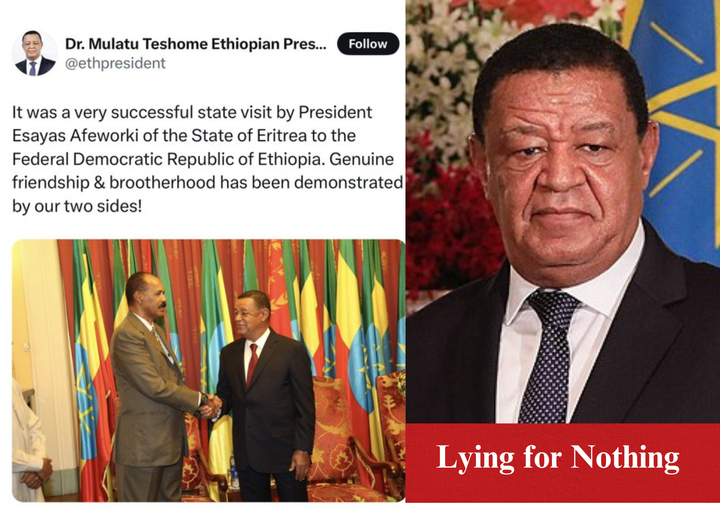
In classical fashion, Ethiopia’s former figure-head President, Mr. Mulatu Teshome, raises a false-flag alarm to accuse Eritrea for stoking a “new conflict in the Horn of Africa”. Audacious claim is precisely intended to conceal and rationalize a war-mongering agenda. The facts are otherwise crystal-clear:
1. Contrary to distorted historical accounts that Mr. Mulatu attempts to project, Eritrea and Ethiopia went to war in 1998 precisely because the TPLF-led Ethiopian regime occupied sovereign Eritrean territories - including Badme, Adi Murug and other places - in flagrant violation of international law and the OAU cardinal principle on the sanctity of colonial boundaries.
2. Even after the costly war, Ethiopia continued to defy international law and occupy sovereign Eritrean territories in breach of the Arbitral EEBC Award for twenty long years. Mulatu endorsed – even if his authority was arguably nominal - the violation of international law as well as the “regime change” agendas of regional destabilization of the Melles regime during his Presidency in those times (2013-2018).
3. Eritrea normalized ties with Ethiopia in 2018 when the Abiy Government publicly announced its readiness for the full and unequivocal acceptance and implementation of the EEBC Award of 2002. Eritrea reciprocated in good-faith and worked in earnest to foster and nurture good-neighbourly ties with Ethiopia on the basis of full respect of each other’s sovereignty and territorial integrity.
4. But soon, Ethiopia was embroiled in a deadly conflict with its Tigray region when the latter unleashed what was widely termed as a War of Insurrection on the night of 3 November 2020. Eritrea gave sanctuary to the contingent of the Ethiopian Northern Command who escaped from coordinated and massive assaults in the TPLF “blitzkrieg”. The TPLF’s war plans also included massive and phased attacks on Eritrea.
5. Eritrea’s involvement in the imposed war was dictated by these circumstances as well as the request of the Ethiopian Government. Shameful and unconscionable acts of backstabbing aside, the Ethiopian Government and its Defense establishments officially and publicly paid tribute to Eritrea’s indispensable role during Ethiopia’s dark days.
6. As underlined in previous occasions, the Pretoria Agreement is an exclusive matter for the Ethiopian Government and its internal protagonists. Eritrea has neither the interest nor the appetite to obstruct or tamper with a purely internal Ethiopian affair.
7. Indeed, Eritrea duly re-deployed its troops within its internationally recognized sovereign borders. Still, those who never accepted the EEBC Arbitral Award in good-faith, or harbour some intent in fomenting conflict, have and continue to peddle false allegations of Eritrean troop presence in “the border areas”— apparent euphemisms/references to Badme and other similar territories.
8. The ill-intent and provocations have not been confined to these acts only. For reasons that are difficult to fathom, the Ethiopian Federal Government has unleashed, in the past months, an intensive and unwarranted campaign of provocation against Eritrea through its “thinly-veiled” agenda of acquiring ports and maritime land “legally if possible and militarily if necessary”.
9. The commotion and disquiet precipitated by Ethiopia’s opaque MOU with “Somaliland” remains another element of regional tension. Ethiopia is also embroiled in another vicious internal war in the Amhara Region.
10. In a nutshell, the myriad problems besetting the region stem and find their fulcrum in Ethiopia; not elsewhere. And the panacea does not lie in externalizing the conflict or scapegoating Eritrea.
______________________
 Diplomacy and International Relations
Ethiopia’s Endless Lies: The Hypocrisy Behind the Anti-Eritrea Campaign
Exposing the Real Destabilizer in the Horn of Africa
By SETIT
https://setit.org/ethiopias-endless-lie ... -campaign/
20 hours ago
Diplomacy and International Relations
Ethiopia’s Endless Lies: The Hypocrisy Behind the Anti-Eritrea Campaign
Exposing the Real Destabilizer in the Horn of Africa
By SETIT
https://setit.org/ethiopias-endless-lie ... -campaign/
20 hours ago

Eritrea, a nation that won its independence through sheer resilience, continues to be the target of a coordinated disinformation campaign aimed at undermining its sovereignty. The latest offender is former Ethiopian President
Mulatu Teshome Wirtu, who, in a shameless display of hypocrisy, has called for international punishment against Eritrea—conveniently ignoring Ethiopia’s own history of aggression and instability.
https://www.aljazeera.com/opinions/2025 ... ime-to-act
Teshome’s audacity is staggering. Coming from a country that has repeatedly violated international law, waged wars of expansion, and sought to redraw regional borders,
https://setit.org/ethiopias-distortion- ... -ethiopia/ his demand for punitive action against Eritrea is not only absurd but laughable. Instead of addressing Ethiopia’s internal crises—ethnic conflicts, insurgencies, and chronic instability—he resorts to the tired, baseless narrative that Eritrea is to blame for Ethiopia’s self-inflicted chaos.
Eritrea’s Struggle for Sovereignty: A History of Ethiopian Hostility
Eritrea’s independence, achieved after a grueling 30-year war, was solidified in 1993 through a near-unanimous referendum. Yet, Ethiopia’s ruling elites have never fully accepted an independent Eritrea. The 1998-2000 war was not a mere border skirmish but a calculated Ethiopian attempt to seize Eritrean land, particularly the crucial port of Assab.
Even after the Eritrea-Ethiopia Boundary Commission (EEBC) ruled in Eritrea’s favor in 2002, Ethiopia—backed by Western allies—brazenly refused to withdraw from Eritrean territory, violating international law with impunity. Instead, it doubled down on its strategy of diplomatic sabotage, orchestrating UN sanctions in 2009 based on fabricated accusations that Eritrea supported Somali extremists—claims later discredited and lifted in 2018.
Where was Mulatu Teshome’s moral outrage when Ethiopia was illegally occupying sovereign Eritrean land for over a decade? Where was his call for sanctions when Ethiopia defied international rulings? His selective amnesia exposes his argument for what it truly is: a desperate, politically motivated attack designed to justify Ethiopia’s own expansionist ambitions.
The 2020 Ethiopian Civil War: Eritrea’s Right to Defend Itself
Teshome also perpetuates the widely debunked claim that Eritrea destabilized Ethiopia during the 2020 civil war. What he conveniently ignores is that the conflict was triggered by the Tigray People’s Liberation Front (TPLF), which launched a surprise attack on Ethiopian federal forces. In a reckless act of escalation, the TPLF fired over a dozen rockets into Eritrean cities, including Asmara and Massawa, dragging Eritrea into a war it did not start.
Eritrea’s response was not an act of aggression but a necessary exercise of self-defense. No nation would stand idle as hostile forces launch missile strikes on its civilian centers. Furthermore,
Eritrea had a legitimate security pact with Ethiopia following the 2018 peace agreement. When Ethiopia, under direct attack from the TPLF, invoked this agreement, Eritrea responded as any responsible ally would.
Yet, Teshome dares to paint Eritrea as the villain while ignoring the blatant TPLF aggression that started the war. If hypocrisy were a currency, Ethiopian politicians like him would be billionaires.
Ethiopia’s Ongoing Obsession with Eritrean Territory
The Ethiopian elite’s fixation on Eritrea’s Red Sea access is no secret. In 2023, Prime Minister
Abiy Ahmed openly stated that Ethiopia would one day reclaim Eritrean ports, even if it took generations. This was no slip of the tongue—it was a calculated declaration of Ethiopia’s long-standing territorial ambitions.
For decades, Ethiopian leaders have viewed Eritrean sovereignty as an inconvenience rather than an established reality. The TPLF’s Greater Tigray Agenda sought to annex key Eritrean regions, and now Abiy Ahmed’s administration continues the rhetoric that Eritrea’s independence is negotiable. Teshome’s recent statements fit neatly into this agenda—demonizing Eritrea to justify future territorial claims.
Eritrea’s Strength: A Nation That Stands on Its Own
Despite relentless external pressure, Eritrea has remained steadfast, refusing to be dictated by foreign powers or regional bullies. Unlike Ethiopia, which has relied on billions in foreign aid while fueling ethnic conflicts, Eritrea has pursued self-reliance.
Critics often point to Eritrea’s governance structure, yet they fail to acknowledge that the country has been in a constant state of defense against existential threats. National service, often misrepresented, is a necessity given Ethiopia’s repeated invasions and ongoing threats. If Eritrea were to let its guard down, figures like Teshome and Abiy Ahmed would waste no time in pursuing their Red Sea ambitions.
The Real Destabilizer: Ethiopia’s Never-Ending Crises
Mulatu Teshome’s attacks on Eritrea serve a clear purpose: to distract from Ethiopia’s own internal chaos. While he demands punitive measures against Eritrea, Ethiopia is engulfed in violent uprisings across the Amhara and Oromia regions. The so-called “
federal government” struggles to maintain control, and the scars of the Tigray conflict remain fresh.
Instead of scapegoating Eritrea, Ethiopian leaders should focus on their own house of cards. Eritrea did not create Ethiopia’s ethnic strife. Eritrea did not orchestrate the Amhara rebellion. Eritrea did not provoke the TPLF into war. Ethiopia’s crises are of its own making, yet its officials would rather blame Eritrea than confront their own failures.
Conclusion: Eritrea’s Sovereignty is Untouchable
Mulatu Teshome’s feeble attempt to rally international actors against Eritrea is not just hypocritical—it’s laughable. Coming from a country with a long history of defying international law, his words carry no weight. The world has seen Ethiopia’s aggressive tendencies, its refusal to respect past agreements, and its insatiable desire to control Eritrean territory.
Eritrea’s sovereignty is non-negotiable. No amount of diplomatic maneuvering, false accusations, or calls for sanctions will change that. Those who continue to push this tired anti-Eritrea narrative are simply delaying the inevitable realization that Eritrea is here to stay—strong, independent, and undefeated.
If Ethiopia truly seeks peace, it should abandon its expansionist dreams, respect international rulings, and clean up the mess within its own borders before pointing fingers at others. Until then, Eritrea will remain vigilant, unwavering, and ready to defend its hard-earned sovereignty against all threats—no matter how desperate or hypocritical they may be.