Page 1 of 1

Why Hasn’t the UNSC Sanctioned Rwanda or Referred Its President to the ICC?

Posted: 29 Jan 2025, 18:22
by Zmeselo


Why Hasn’t the UNSC Sanctioned Rwanda or Referred Its President to the ICC?

Ann Garrison, BAR Contributing Editor

https://blackagendareport.com/why-hasnt ... sident-icc

29 Jan 2025
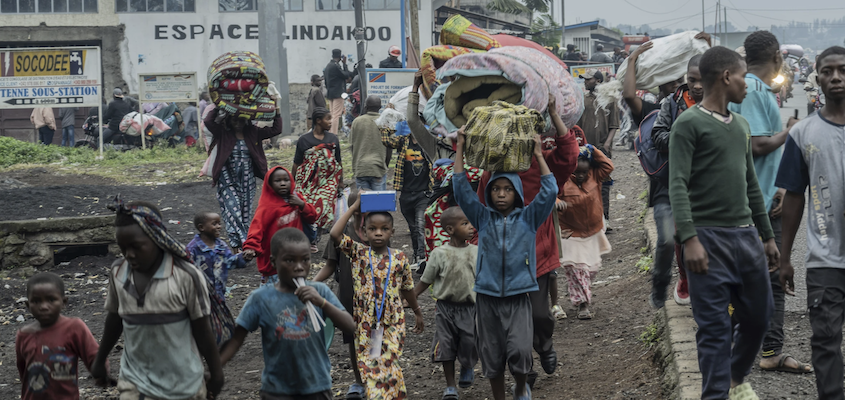

People displaced by the fighting with Rwandan forces make their way to the center of Goma, Democratic Republic of the Congo, Sunday, Jan. 26, 2025. Photo: Moses Sawasawa/AP

The UN Security Council (UNSC) has never sanctioned Rwanda or referred its president to the International Criminal Court (ICC), despite decades of UN documentation of their international crimes in the Democratic Republic of the Congo (DRC).

On December 27, Rwanda’s M23 militia claimed to have seized Goma, the capital of Congo’s North Kivu Province and a city of three million people. Some sources reported, however, that Congolese forces were still fighting.

On January 28, Al Jazeera reported that protestors in Kinshasa, the capital of the Democratic Republic of the Congo (DRC), had attacked the embassies of France, Belgium, Rwanda, Uganda, Kenya, and the US, accusing them all of responsibility for Rwanda’s war in DRC’s eastern North and South Kivu Provinces.

Rwandan forces had killed 13 UN peacekeepers https://www.bbc.com/news/articles/c2l07e550qko from South Africa, Malawi, and Uruguay and the military governor of North Kivu Province, Major General Peter Cirimwami https://www.bbc.com/news/articles/ckgy6qlv5kro.

Electricity in Goma was out, children were out of school, and there were bodies in the streets. Hundreds of thousands of Congolese people were fleeing Rwandan troops and M23.

Rwanda had cut off electricity and water supplies and used advanced weaponry to interfere with GPS required for humanitarian operations.

Three days earlier, on January 25, the UN Security Council met https://webtv.un.org/en/asset/k1f/k1fig ... LBHe_IuM8g about the crisis for three and a half hours. In addition to Council members, Congolese and Rwandan representatives were invited to speak, as were those of Angola, Burundi, South Africa, and Uruguay and the heads of UN peacekeeping, and relief operations in DRC.

All voiced support for the sovereignty and territorial integrity of DRC. Most all called on Rwanda to withdraw its forces from DRC and stop supporting M23, but only a few, including South Africa and DRC, explicitly proposed imposing UN sanctions on Rwanda.

In an eloquent statement, Congolese Minister of Foreign Affairs Thérèse Kayikwamba Wagner said:
What the DRC is going through is not a conflict like others. It is a deliberate and methodical aggression against a sovereign state, a flagrant violation of the founding principles of this organization and an intolerable attack against international peace and security.

The Democratic Republic of the Congo legitimately expects from this council to act firmly and promptly to safeguard international peace and security and to uphold international law. This is a power that is exclusively granted to the Council by the UN Charter.
She said that the Council could not keep limiting its responses to
declarations of concern
and
remain seized of the matter.
Instead she called on it to:

1. Order the end of hostilities by Rwanda and demand the immediate withdrawal of Rwandan troops on Congolese soil;

2. impose targeted sanctions, including asset freezes and travel bans, not only against members of the Rwandan chain of command, but also against the political decisionmakers responsible for the aggression;

3. embargo all mineral exports labeled as Rwandan, especially coltan and gold, in order to end the illicit exploitation of DRC’s mineral wealth at the heart of the conflict;

4. revoke Rwanda’s status as a troop contributor to UN peacekeeping operations; and

5. establish a systematic regime of violation of all transfer or sale of weapons to Rwanda by member states or private entities.

One more measure that the Council is empowered to take is referral of Rwanda’s leaders to the International Criminal Court for investigation and potential indictment for their well-documented international crimes. Some ambassadors and officials identified the attacks on UN peacekeepers as war crimes, and previous UN reports have identified Rwanda’s crimes against humanity. The 2010 UN Mapping Report https://www.ohchr.org/en/countries/afri ... ing-report even documented crimes that it said could be judged as genocide if brought to a competent court.

The ICC indicted Libya’s Muammar Gaddafi, Sudan’s Omar al-Bashir, Ivory Coast’s Laurent Gbagbo, and Russia’s Vladimir Putin, but despite decades of abundance of his crimes, it has never indicted Rwandan President Paul Kagame or any of his top officials and commanders. This demonstrates, of course, that Western leaders use the ICC to pursue their political agendas, not to impose international criminal justice.

The UN Security Council has never taken the measures proposed by DRC’s Foreign Minister nor the referral of Paul Kagame to the ICC and most likely never will. Why? No doubt because the illegal minerals traffic is enriching powerful Western states, corporations, and individuals who ultimately prefer the status quo, no matter how much suffering it causes the Congolese people.

Another equally sinister reason may lie in the roots of the Rwandan Genocide, the 1994 tragedy that Kagame and his Rwandan Patriotic Front party have used as an excuse to justify their tyrannical rule in Rwanda, https://blackagendareport.com/rwandan-d ... rikes-deep their ethnic Tutsi dominance, https://blackagendareport.com/wikileaks ... iation-lie and their crimes in DRC ever since.

If Kagame were ever brought before the ICC, he might well start talking about Bill Clinton and other members of the US State Department, military, and national security apparatus involved in covert support for his Rwandan Patriotic Army’s aggression in Rwanda during the 1990 to 1994 Rwandan Civil War, which ended in the infamous 90-day bloodbath.

In 2009 https://www.ipinst.org/2009/09/africa-i ... i-audience, at an International Peace Institute event, Kagame said,
Genocide in Rwanda — the causes of it are not Rwandan, are not African.
The genocide, he said,
has its roots somewhere else.
He went on to criticize the International Criminal Court as unfairly targeting Africans. Indeed, prior to its indictment of Vladimir Putin, the ICC had earned its reputation as the International Caucasian Court for prosecuting Africans. However, without naming individuals or countries, Kagame seemed to be warning that, should he one day find himself on trial in the Hague, he would start naming names and countries outside Rwanda's borders who organized and benefited from the 1994 bloodbath and its aftermath in DRC.


Ann Garrison is a Black Agenda Report Contributing Editor based in the San Francisco Bay Area. In 2014, she received the Victoire Ingabire Umuhoza Democracy and Peace Prize http://www.rifdp-iwndp.org/letter-from- ... pol-i-mas/ for her reporting on conflict in the African Great Lakes region. She can be reached at [email protected]. You can help support her work on Patreon https://www.patreon.com/annmgarrison/posts.

Re: Why Hasn’t the UNSC Sanctioned Rwanda or Referred Its President to the ICC?

Posted: 30 Jan 2025, 07:17
by Somaliman
The West and its dog (The UN) do not sanction Rwanda or refer its president to anywhere, as both Kagame and Museveni are enablers of the West, enabling the latter to loot the mineral resources of the DRC unchecked and at will.

Re: Why Hasn’t the UNSC Sanctioned Rwanda or Referred Its President to the ICC?

Posted: 30 Jan 2025, 07:46
by Zmeselo


Editor's Picks
Sudanese army advances in Khartoum, claims control of key areas


Sudanese soldiers at the Faculty of Agriculture, Khartoum University, Khartoum North, January 28, 2025

https://sudantribune.com/article296631/

January 28, 2025 ( KHARTOUM) – The Sudanese army said on Tuesday it had gained further ground in the battle for Khartoum, claiming control of key sites in the Bahri district, including areas in Shambat and Old Bahri.

The army’s advances included the former Parachute Corps headquarters, which the Rapid Support Forces (RSF) had used as a medical facility before the conflict erupted in mid-April 2023, the army said.

On Jan. 25, the army announced it had completed the second phase of its Khartoum offensive, linking forces from Omdurman and North Bahri with troops at the Signal Corps headquarters in southern Khartoum Bahri. This effectively broke the RSF’s siege of the army’s General Command in central Khartoum.
The Armed Forces are advancing on the Bashir Towers and Al-Baraha Hospital axes, clearing them of the (RSF) militia that used the hospital as a military base after looting and destroying it,
the army said on its official Facebook page.

Military sources told Sudan Tribune that the army had also taken control of the Blue and Bashir Towers, as well as the RSF’s Medical Directorate, which was previously the Parachute Corps base in Shambat.

The RSF had used the tall buildings along Al-Maouna Street, including the Bashir and Blue Towers, as sniper positions and launch sites for Kornet anti-tank missiles, hindering the army’s advance for months.

Footage shared on pro-army platforms showed the deployment of troops and Central Reserve Police in Shambat, including the Lands and Immigration areas, and the Al-Mazzad and Al-Shaabiya neighbourhoods. Sudan Tribune could not independently verify the footage. The RSF could not immediately be reached for comment.

Re: Why Hasn’t the UNSC Sanctioned Rwanda or Referred Its President to the ICC?

Posted: 30 Jan 2025, 08:08
by Zmeselo


Ethiopia and Somalia: Back to Square One

By Belete Belachew Yihun

https://africanarguments.org/2025/01/et ... quare-one/

January 29, 2025


Credit: Al Jazeera

A year after intense diplomatic frictions, https://www.crisisgroup.org/africa/horn ... iland-mou/ Ethiopia and Somalia appear to have found room to manoeuvre and address their differences. The Ankara Declaration of 11 December amounts to the return to normalcy in their bilateral engagement, more so in light of the pressing security challenges facing Somalia and the immediate region. Two takeaways stand out as major pillars of the agreement: recognition of Somalia’s sovereignty and territorial integrity, and admission of Ethiopia’s unparalleled importance to the peace and security of Somalia. Ethiopia’s quest for sovereign access to the sea via Somaliland now appears to have been put on hold, while ascertaining the continued presence of the Ethiopian troops/peacekeepers on the ground in Somalia and the potential inclusion of Ethiopia in the Africa Union Support and Stabilization Mission in Somalia (AUSSOM) troop-contributing countries.

At the outset, the whole deal signifies the growing weight of Turkey in the affairs of the Horn of Africa. Turkey succeeded where others more close to the affair, including immediate neighbours, IGAD, and the AU have failed to seek a solution to the problem. Recent maritime and defence agreement (of February 2024) and the oil and gas cooperation deal (March 2024) https://www.atlanticcouncil.org/blogs/t ... artnership have heightened Ankara’s influence over Mogadishu, making it a sizeable actor in the security and economic sectors of Somalia. Though not as strong as the immediate pre-2018 times in Ethiopia, Turkey equally enjoys strong ties with the government of Abiy Ahmed. Altogether, the dynamics might offset, at a major scale, adjacent powers operating in Somalia, particularly Egypt. In this regard, the government of President Hassan sheikh Mohammed has to carefully navigate the presence of competing security interests in Somalia.

Ethiopia’s MoU with Somaliland https://www.iiss.org/publications/strat ... mou-162032 has set the ground for tense diplomatic frictions of regional magnitude. It inadvertently provided a windfall to the government in Mogadishu, which invoked the principles of sovereignty and territorial integrity in projecting the cause of Somalia among potential allies. Somaliland’s three decades de facto independent existence, coupled with exemplary democratic credentials, https://www.crisisgroup.org/africa/horn ... ica-242131 would not dissuade Mogadishu from successfully invoking the principles and rallying international support to its cause. This occurred amidst the volatile peace and security realities in the Republic, and the growing fragmentation between the Federal Government and the Federal Member States. https://peacerep.org/2024/10/23/somalia ... 9/2024C50/

Ethiopia’s move lent a lifeline to a rather cornered political establishment in Mogadishu. Efforts by Somalia leaders to blemish and dismiss the contributions of Ethiopian troops and peacekeepers in combating terrorist and extremist groups operating in Somalia have unnerved sensibilities across the board. But there was recognition across the board, by regional, continental and global bodies, that Ethiopia remains vital to the peace and security architecture of Somalia, either unilaterally or within broader frameworks. Nonetheless, the government of Hassan Sheikh made the bilateral affairs with Ethiopia and the involvement of Ethiopian troops in peace keeping operations in Somalia conditional on the former abandoning its quest for sovereign access to the sea via Somaliland.

Ethiopia’s MoU with Somaliland (January 2024), on the other hand, appears premature, for the objective realities on the ground were not conducive for such a move to materialize. In the absence of strategic endorsement and potential leverage by a given regional or global power, it was clear from the onset that the gamble would backfire on Ethiopia. UAE, though apparently in favour of the move, has refrained from openly supporting the deal. Ethiopia’s weak internal and diplomatic posture made it difficult to initiate such a grand project of greater consequences to the wider region. Desperation apparently led Addis Ababa into the hands of a lesser player, i.e. Somaliland, who successfully brandished the allure of access to the sea in exchange for illusive recognition. The government of Abiy Ahmed jumped the gun and committed a serious diplomatic blunder entering into an ineffectual deal with a breakaway state desperately seeking international recognition. Ethiopia’s miscalculations stem primarily from ignoring the geopolitical ramifications of such a bold move. The country soon found itself hard pressed between regional and global backlashes of immense proportions, and was seeking a way out of the potential quagmire.

The Ankara Declaration bears meaning within these contexts. Short of providing much-desired respite for both parties, however, it equally unnerves others involved in the equation. Ethiopia has to convince the new government of President Abdirahman Mohamed Abdullahi (Irro) on the current standing of the January 2024 MoU, and the meaning and tenet of holding ‘technical talks’ with Mogadishu over the issue of Ethiopia’s access to the sea. The fact that the Ankara Declaration didn’t mention Somaliland or the 2024 MoU leaves room for anticipation. If the adherence to the principles of Somalia’s sovereignty and territorial integrity were suggested specifically in reference to the outstanding deal with Somaliland, then Ethiopia stands to be a loser in the overall equation. In the context of the 2018 agreement with Hargessia and the DP World, for Ethiopia to acquire 19% stakes on the port of Berbera, scaling down the prospect to mere utilization of available infrastructures might not assure Somaliland leaders of Ethiopia’s commitment to the ‘recognition’ clause.

Somalia has to choose between Turkey and Egypt as a primary defence and maritime security partner. Given the volatile relationship between Cairo and Ankara, and the tense rapport between Turkey and the UAE and other Arab League powers, Somalia could face additional challenges. Mogadishu’s ongoing tensions with Jubaland, Puntland and Somaliland stand the risk of exacerbation, for stakeholders from the immediate region and the Gulf would intervene in the affairs of the country to advance immediate strategic interests. Recent altercations in Jubaland https://lansinginstitute.org/2024/11/29 ... -jubaland/ lend ample credence to this observation. Regional state leaders, the likes of Ahmed Mohamed Islam (Madobe), and Saeed Abdullahi Deni, of Jubaland and Puntland, respectively, might acquire political lifelines in their bids to rally respective supporters compared to the possible backlash awaiting President Hassan Sheikh in the aftermath of Ankara Declaration.

On a positive note, Ethiopia’s foreign policy posture was forced back to the time tested method of principled and institutional approach in handling its international engagements. Statement by the Prime Minister, scripted and formal, signify a major departure from previous pronouncements. Coexistence, cooperation and region-wide development were amplified. Ethiopia’s quest for access to the sea, through Somalia (including Somaliland), or another country, now has to be sought after careful consideration of all factors. Long existing proposals to utilize Somalia’s expansive shorelines as alternative routes to the sea can be a point of discussion in forthcoming negotiations. Nonetheless, their realization depends upon the peace and security realities of Somalia. Given prevailing uncertainties, such a venture would be unattainable in the near future.

A more significant outcome of the Ankara talks is likely assurance on Ethiopia’s continued presence on the ground in Somalia. Diplomatic ties could be re-established https://gga.org/federal-feud-escalating ... /full/html soon, and Somalia might allow Ethiopia to be part of the forthcoming AUSSOM peacekeeping operations. President Hassan Sheikh’s public pronouncement on Ethiopia’s sacrifices in the struggle against terrorism and the peace and security of the republic speaks volumes. But this has to be equated against the complications of the last couple of months, and especially in connection with the Al Shabaab resurgence, the standoffs in Puntland and Jubaland regional states, and the imagined and actual places of regional actors like Kenya and Egypt in the dynamics.

To conclude: irrespective of the conflagrations of the recent past, Ethiopia and Somalia have put their bilateral relations back to square one. It takes grounded and sober leadership to build on future trajectories. Ankara specifically signifies the future over past imperfections. Of course, this remains more of a wish given an array of complex factors militating against its realization. Let the recent fiasco be a lesson on how to carefully navigate the difficult terrain the Horn always represents for Ethiopia and others in the vicinity.


Belete Belachew Yihun is a foreign policy and international relations analyst specializing on the Horn of Africa and Middle East/Gulf. He currently resides in the USA.

Re: Why Hasn’t the UNSC Sanctioned Rwanda or Referred Its President to the ICC?

Posted: 30 Jan 2025, 08:11
by Somaliman
If you've been following the conflict in Sudan, who are the Sudanese population supporting, Al Burhan or the so-called RSF?

Re: Why Hasn’t the UNSC Sanctioned Rwanda or Referred Its President to the ICC?

Posted: 30 Jan 2025, 08:30
by Somaliman
Zmeselo wrote:
30 Jan 2025, 08:08


Ethiopia and Somalia: Back to Square One

By Belete Belachew Yihun

https://africanarguments.org/2025/01/et ... quare-one/

January 29, 2025


Credit: Al Jazeera

A year after intense diplomatic frictions, https://www.crisisgroup.org/africa/horn ... iland-mou/ Ethiopia and Somalia appear to have found room to manoeuvre and address their differences. The Ankara Declaration of 11 December amounts to the return to normalcy in their bilateral engagement, more so in light of the pressing security challenges facing Somalia and the immediate region. Two takeaways stand out as major pillars of the agreement: recognition of Somalia’s sovereignty and territorial integrity, and admission of Ethiopia’s unparalleled importance to the peace and security of Somalia. Ethiopia’s quest for sovereign access to the sea via Somaliland now appears to have been put on hold, while ascertaining the continued presence of the Ethiopian troops/peacekeepers on the ground in Somalia and the potential inclusion of Ethiopia in the Africa Union Support and Stabilization Mission in Somalia (AUSSOM) troop-contributing countries.

At the outset, the whole deal signifies the growing weight of Turkey in the affairs of the Horn of Africa. Turkey succeeded where others more close to the affair, including immediate neighbours, IGAD, and the AU have failed to seek a solution to the problem. Recent maritime and defence agreement (of February 2024) and the oil and gas cooperation deal (March 2024) https://www.atlanticcouncil.org/blogs/t ... artnership have heightened Ankara’s influence over Mogadishu, making it a sizeable actor in the security and economic sectors of Somalia. Though not as strong as the immediate pre-2018 times in Ethiopia, Turkey equally enjoys strong ties with the government of Abiy Ahmed. Altogether, the dynamics might offset, at a major scale, adjacent powers operating in Somalia, particularly Egypt. In this regard, the government of President Hassan sheikh Mohammed has to carefully navigate the presence of competing security interests in Somalia.

Ethiopia’s MoU with Somaliland https://www.iiss.org/publications/strat ... mou-162032 has set the ground for tense diplomatic frictions of regional magnitude. It inadvertently provided a windfall to the government in Mogadishu, which invoked the principles of sovereignty and territorial integrity in projecting the cause of Somalia among potential allies. Somaliland’s three decades de facto independent existence, coupled with exemplary democratic credentials, https://www.crisisgroup.org/africa/horn ... ica-242131 would not dissuade Mogadishu from successfully invoking the principles and rallying international support to its cause. This occurred amidst the volatile peace and security realities in the Republic, and the growing fragmentation between the Federal Government and the Federal Member States. https://peacerep.org/2024/10/23/somalia ... 9/2024C50/

Ethiopia’s move lent a lifeline to a rather cornered political establishment in Mogadishu. Efforts by Somalia leaders to blemish and dismiss the contributions of Ethiopian troops and peacekeepers in combating terrorist and extremist groups operating in Somalia have unnerved sensibilities across the board. But there was recognition across the board, by regional, continental and global bodies, that Ethiopia remains vital to the peace and security architecture of Somalia, either unilaterally or within broader frameworks. Nonetheless, the government of Hassan Sheikh made the bilateral affairs with Ethiopia and the involvement of Ethiopian troops in peace keeping operations in Somalia conditional on the former abandoning its quest for sovereign access to the sea via Somaliland.

Ethiopia’s MoU with Somaliland (January 2024), on the other hand, appears premature, for the objective realities on the ground were not conducive for such a move to materialize. In the absence of strategic endorsement and potential leverage by a given regional or global power, it was clear from the onset that the gamble would backfire on Ethiopia. UAE, though apparently in favour of the move, has refrained from openly supporting the deal. Ethiopia’s weak internal and diplomatic posture made it difficult to initiate such a grand project of greater consequences to the wider region. Desperation apparently led Addis Ababa into the hands of a lesser player, i.e. Somaliland, who successfully brandished the allure of access to the sea in exchange for illusive recognition. The government of Abiy Ahmed jumped the gun and committed a serious diplomatic blunder entering into an ineffectual deal with a breakaway state desperately seeking international recognition. Ethiopia’s miscalculations stem primarily from ignoring the geopolitical ramifications of such a bold move. The country soon found itself hard pressed between regional and global backlashes of immense proportions, and was seeking a way out of the potential quagmire.

The Ankara Declaration bears meaning within these contexts. Short of providing much-desired respite for both parties, however, it equally unnerves others involved in the equation. Ethiopia has to convince the new government of President Abdirahman Mohamed Abdullahi (Irro) on the current standing of the January 2024 MoU, and the meaning and tenet of holding ‘technical talks’ with Mogadishu over the issue of Ethiopia’s access to the sea. The fact that the Ankara Declaration didn’t mention Somaliland or the 2024 MoU leaves room for anticipation. If the adherence to the principles of Somalia’s sovereignty and territorial integrity were suggested specifically in reference to the outstanding deal with Somaliland, then Ethiopia stands to be a loser in the overall equation. In the context of the 2018 agreement with Hargessia and the DP World, for Ethiopia to acquire 19% stakes on the port of Berbera, scaling down the prospect to mere utilization of available infrastructures might not assure Somaliland leaders of Ethiopia’s commitment to the ‘recognition’ clause.

Somalia has to choose between Turkey and Egypt as a primary defence and maritime security partner. Given the volatile relationship between Cairo and Ankara, and the tense rapport between Turkey and the UAE and other Arab League powers, Somalia could face additional challenges. Mogadishu’s ongoing tensions with Jubaland, Puntland and Somaliland stand the risk of exacerbation, for stakeholders from the immediate region and the Gulf would intervene in the affairs of the country to advance immediate strategic interests. Recent altercations in Jubaland https://lansinginstitute.org/2024/11/29 ... -jubaland/ lend ample credence to this observation. Regional state leaders, the likes of Ahmed Mohamed Islam (Madobe), and Saeed Abdullahi Deni, of Jubaland and Puntland, respectively, might acquire political lifelines in their bids to rally respective supporters compared to the possible backlash awaiting President Hassan Sheikh in the aftermath of Ankara Declaration.

On a positive note, Ethiopia’s foreign policy posture was forced back to the time tested method of principled and institutional approach in handling its international engagements. Statement by the Prime Minister, scripted and formal, signify a major departure from previous pronouncements. Coexistence, cooperation and region-wide development were amplified. Ethiopia’s quest for access to the sea, through Somalia (including Somaliland), or another country, now has to be sought after careful consideration of all factors. Long existing proposals to utilize Somalia’s expansive shorelines as alternative routes to the sea can be a point of discussion in forthcoming negotiations. Nonetheless, their realization depends upon the peace and security realities of Somalia. Given prevailing uncertainties, such a venture would be unattainable in the near future.

A more significant outcome of the Ankara talks is likely assurance on Ethiopia’s continued presence on the ground in Somalia. Diplomatic ties could be re-established https://gga.org/federal-feud-escalating ... /full/html soon, and Somalia might allow Ethiopia to be part of the forthcoming AUSSOM peacekeeping operations. President Hassan Sheikh’s public pronouncement on Ethiopia’s sacrifices in the struggle against terrorism and the peace and security of the republic speaks volumes. But this has to be equated against the complications of the last couple of months, and especially in connection with the Al Shabaab resurgence, the standoffs in Puntland and Jubaland regional states, and the imagined and actual places of regional actors like Kenya and Egypt in the dynamics.

To conclude: irrespective of the conflagrations of the recent past, Ethiopia and Somalia have put their bilateral relations back to square one. It takes grounded and sober leadership to build on future trajectories. Ankara specifically signifies the future over past imperfections. Of course, this remains more of a wish given an array of complex factors militating against its realization. Let the recent fiasco be a lesson on how to carefully navigate the difficult terrain the Horn always represents for Ethiopia and others in the vicinity.


Belete Belachew Yihun is a foreign policy and international relations analyst specializing on the Horn of Africa and Middle East/Gulf. He currently resides in the USA.


The government of Ethiopia and Somalia: Back to Square One
This is between the two incompetent governments. The Somali people don't want to have anything to do whatsoever with Ethiopia and its senseless people. All we want is to live as good neighbours respecting each other, as the fuc'kers are not moving out, and nothing more.

Re: Why Hasn’t the UNSC Sanctioned Rwanda or Referred Its President to the ICC?

Posted: 30 Jan 2025, 09:11
by Dama
Somaliman wrote:
30 Jan 2025, 08:11
If you've been following the conflict in Sudan, who are the Sudanese population supporting, Al Burhan or the so-called RSF?
Zmeselo does not want to hear crimes of Rwanda against the innocent people of Goma told. He wants us to abandon discussion of Rwanda crimes and be sidetracked to issues of Sudan.

Re: Why Hasn’t the UNSC Sanctioned Rwanda or Referred Its President to the ICC?

Posted: 30 Jan 2025, 09:32
by Dama
Black Agenda Report asked itself a good question but failed to answer it. It left for the reader to answer the question it was supposed to answer.

Re: Why Hasn’t the UNSC Sanctioned Rwanda or Referred Its President to the ICC?

Posted: 30 Jan 2025, 10:57
by Dark Energy
I think the UN should sanction all president for life around the the World. Off course, the so called socialists and communists are the worst.

Re: Why Hasn’t the UNSC Sanctioned Rwanda or Referred Its President to the ICC?

Posted: 30 Jan 2025, 11:19
by Abdisa
Rwanda's Paul Agame is obviously doing the bidding of Neo-colonial powers exploiting Congo's vast mineral resources.