Page 1 of 1

JUNE 1, IN THE HISTORY OF ERITREA

Posted: 02 Jun 2023, 02:43
by Zmeselo


JUNE 1, IN THE HISTORY OF ERITREA

June 1, 1870 Egypt, in a protest to the purchase of land by Italy, sent a note of protest to Italy pointing out that the alleged "sultans" had no authority to sell the land but Italy answered that the "tribal chiefs" appeared in effective possession of the territory.

In 1869 and 1870 Mr. Sapeto (as an Agent of an Italian Company Rubbattino & Co. & an agent of the Italian government as well) bought land apparently,

to store supplies of coals & other goods for his steamers between Genoa & Bombay (Mumbai) through the Suez Canal.


June 1, 1899, Protocol on the Frontier between the Anglo-Egyptian Sudan & Eritrea was signed at Sabderat. The Protocol was part of Treaties & Protocols of Apr 15, 1891, Dec. 7, 1891, Apr 16, 1901 & the Anglo Egyptian Agreement of Nov. 22, 1901.

June 1, 1991,

If the Eritreans want to exercise the right of self-determination, there is not body who is going to stop them…The United States isn’t going to stop them or allow them.


Herman Cohen

June 1-3, 1994, President Isaias Afwerki led an Eritrean delegation attending the to the Global Coalition for Africa in Harare, Zimbabwe. Leaders of many African countries, as well as donor government representatives, discussed the political and economic problems of the continent at the meeting.

June 1, 1998, while the Peace Plan, (on May 30, 1998 US- Rwanda presented a four point Peace to Eritrea and Ethiopia) was under discussion then TPLF led Ethiopia launched its aggression on Eritrea around Ambesete-Geleba area.
@Erihistory

Re: JUNE 1, IN THE HISTORY OF ERITREA

Posted: 02 Jun 2023, 08:04
by Zmeselo


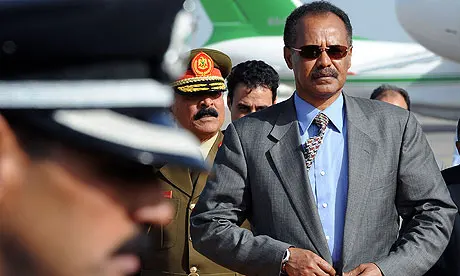
Building a Better Future: Successes and Achievements of Eritrea


Dr. Ali Said Faqi

https://www.conseilafricaindesmedias.ne ... of-eritrea

On May 24, 2023, Eritrea celebrated its 30th anniversary of independence. That was a significant milestone for the country. Eritrea gained independence from Ethiopia on May 24, 1991, after a 30-year-long struggle for liberation.

Eritrea has made significant progress in various areas since gaining independence. For example, the country has made significant strides in improving its education, healthcare system, and infrastructure. The government has also implemented policies to promote economic growth and development, which has helped to reduce poverty and improve the quality of life for its citizens.

Ever since 2018, I have had the pleasure of frequenting Eritrea and exploring its numerous regions, all while developing a deep admiration for its vibrant community, rich heritage, and breathtaking scenery. This article delves into the triumphant accomplishments that Eritrea has attained since gaining its independence. Will begin with Eritrea's policy on self-reliance, also known as the "self-reliance strategy”. This is a guiding principle of the country's economic development. The policy was introduced in the early 1990s.

Self-reliance strategy

The self-reliance strategy aims to promote economic independence and reduce reliance on foreign aid and external assistance. It emphasizes the development of local resources, including human capital, natural resources, and local industries. The policy also prioritizes the development of local infrastructure, such as roads, energy, and water supply, as well as the promotion of agriculture and other domestic industries.

To execute the self-reliance strategy, Eritrea has implemented a number of policies and programs, including land reforms, investment in education and healthcare, and the promotion of small and medium-sized enterprises. The government has also worked to attract foreign investment in key strategic sectors, such as mining and energy while maintaining a strong role in the management of these industries.

Eritrea has been investing heavily in infrastructure projects in recent years. Some of the major projects include the construction of new roads, bridges, and airports, as well as the expansion of existing ports and railways. These projects are aimed at improving transportation and connectivity within the country, as well as boosting economic growth and development. Additionally, there are plans to build new hospitals, schools, and other public facilities to improve the quality of life for Eritreans.

Foreign Policy

Eritrea's foreign policy is guided by the principles of non-alignment, regional integration, and the promotion of African unity. The country's foreign policy is largely focused on regional issues, particularly those related to the Horn of Africa.

One of the key priorities of Eritrea's foreign policy is the promotion of regional peace and stability. The country has been involved in a number of peace initiatives in the region, including the peace agreement between Ethiopia and Eritrea in 2018.

Eritrea has also sought to strengthen its relations with neighboring countries, including Somalia, Sudan, Ethiopia, and Yemen. The country has signed a number of bilateral agreements with these countries, covering areas such as trade, investment, and security cooperation.

At the international level, Eritrea has been critical of what it sees as Western interference in African affairs. The country has been a vocal supporter of African unity and advocates for greater African representation in international organizations such as the United Nations.

Eritrea has faced a number of sanctions imposed by the United Nations and other countries over the years. The most significant of these is the UN sanctions, which were imposed in 2009 in response to a false allegation of Eritrea's support for Al-Shabab in Somalia. The sanctions include an arms embargo, a travel ban on certain Eritrean officials, and the freezing of assets belonging to individuals and entities associated with the government. The Eritrean government has strongly denied the allegations and has criticized the sanctions as being politically motivated. On the international stage, the government has relentlessly argued that the sanctions are having a negative impact on ordinary Eritreans, who have been denied access to basic goods and services. Despite the politically motivated sanctions,

Social Cohesion

In Eritrea, social coherence is strong due to the country's strong sense of national identity and shared history of struggle for independence. This is reflected in the country's strong sense of community and support for one another, as well as the high level of trust between individuals and institutions. There are many positive impacts of strong social coherence in Eritrea. For example, it has helped to create a stable and peaceful society with low crime rates and zero incidences of social unrest. It has also allowed for effective governance and the implementation of policies that benefit the entire society, such as universal healthcare and education. Additionally, it has helped to foster a strong sense of national pride and unity, which has been key to Eritrea's continued development and progress.

Education

Education has been a top priority in Eritrea since gaining independence. The government has made significant investments in education, which has helped to improve literacy rates and access to education in the country. Eritrea has a 5-4-3-4 system of education, which includes five years of primary school, four years of junior secondary school, three years of senior secondary school, and four years of tertiary education.

Compulsory education in Eritrea is mandated by law for all children between the ages of 7 and 16. The government of Eritrea has made significant efforts to ensure that every child has access to education, and the country has achieved remarkable progress in this area.

The Education Proclamation of 1991 established the legal framework for education in Eritrea, including the requirement for compulsory education. The government has also implemented policies and programs to ensure that children in remote and disadvantaged areas have access to education.

Primary education in Eritrea is free and compulsory for all children, and the government has made significant investments in building schools and improving the quality of education. The curriculum includes subjects such as mathematics, science, social studies, and languages.

Secondary education is also provided, but it is not compulsory. Students who wish to continue their education beyond primary school must pass an entrance exam to enter secondary school. The curriculum in secondary school includes more specialized subjects such as chemistry, physics, biology, and history.

The country has made significant progress in improving access to education for girls as well. The government has implemented policies to encourage girls to attend school, such as providing free school uniforms and building schools closer to rural communities. As a result, the gender gap in education has significantly decreased, and more girls are now enrolling in schools.

Eritrea has also made strides in improving the quality of education. The government has invested in teacher training and curriculum development to ensure that students receive a high-quality education. As a result, Eritrean students perform well in international assessments such as the Trends in International Mathematics and Science Study (TIMSS).

Health Care System

Eritrea has made significant progress in improving its health system since gaining independence in 1991. The government has prioritized healthcare as a fundamental human right and has invested heavily in the health sector. Eritrea has implemented a comprehensive health system that includes primary healthcare, community health services, and specialized healthcare services.

The government has made significant investments in infrastructure, including building hospitals and clinics across the country. Eritrea has also trained and deployed more healthcare workers to improve access to healthcare services in remote and underserved areas. As a result, there has been a significant increase in the number of health facilities and healthcare workers in the country.

Eritrea has also realized several health programs to address specific health challenges. For example, the country has implemented a comprehensive malaria control program, which has significantly reduced the incidence of malaria. Programs to prevent and control the spread of diseases such as tuberculosis, and HIV/AIDS have been devised. These programs include the provision of antiretroviral therapy and the implementation of tuberculosis control measures. Likewise, it has executed a successful immunization program, which has helped to reduce the incidence of vaccine-preventable diseases.

Eritrea's public health policy stipulates free basic healthcare services to all citizens. The government has established health centers and clinics across the country to provide primary healthcare services, including immunization, maternal and child health, and treatment of common illnesses. It has also prioritized the reduction of maternal and child mortality rates by implementing programs to improve maternal healthcare, including the provision of prenatal care, skilled birth attendants, and postnatal care.

Another important policy is the promotion of public health awareness. The government has implemented programs to promote healthy lifestyles, including campaigns to encourage physical activity, healthy eating, and smoking cessation. It also provides education about the importance of hygiene and sanitation to prevent the spread of diseases.

Food and Water Security

Eritrea has made significant efforts to achieve food security in the country. Despite being a small country with limited resources, the government has realized various policies and programs to improve agricultural production and food availability.

One of the key strategies that the government has employed is to promote sustainable agriculture. This involves the use of environmentally friendly farming practices that conserve natural resources such as water and soil. The government has also provided farmers with improved seeds, fertilizers, and other inputs to increase crop yields.

Eritrea has also invested in irrigation infrastructure to increase the amount of land available for cultivation. The government has built dams, reservoirs, and other water management systems to increase water availability for irrigation.

To address the issue of food insecurity in remote and underserved areas, the government has instigated programs to improve access to food. Eritrea has also implemented policies to promote food self-sufficiency. This involves reducing dependence on food imports by promoting domestic production. The government has employed policies to support farmers and increase their productivity, which has led to a reduction in the amount of food imports.

Eritrea's government has recognized the importance of water security and has adopted policies aimed at improving access to clean water and managing water resources sustainably. The National Water Resource Management Policy, adopted in 2014, outlines strategies for improving water management, including promoting water conservation, increasing access to clean water, and establishing effective water governance structures. The government has also established the Ministry of Land, Water, and Environment to oversee water management and conservation efforts.

Eritrea has over 700 dams including the Gash Barka Dam, the Mai Nefhi Dam, and the Adi Halo Dam. These dams provide irrigation for crops and also generate hydroelectric power.

The Gash Barka Dam is located in western Eritrea and was completed in 2005. It has a capacity of 1.6 billion cubic meters of water and generates up to 20 MW of electricity. It is primarily used for irrigation and has helped increase agricultural production in the region.

The Mai Nefhi Dam is located near the capital city of Asmara and was completed in 1998. It has a capacity of 17 million cubic meters of water and generates up to 3 MW of electricity.

The Adi Halo Dam is located in the Southern Red Sea region and was completed in 2002. It has a capacity of 120 million cubic meters of water and generates up to 10 MW of electricity. The Mai Nefhi and the Adi Halo dams are primarily used for irrigation as well.

In conclusion, Eritrea is known for its strong commitment to economic, and social development, self-reliance, and sovereignty. Overall, Eritrea's vision is centered around promoting the well-being and prosperity of its people, while maintaining its independence and sovereignty. By keeping these strategies in perspective, Eritrea is ready to embrace a more promising and prosperous future.

Re: JUNE 1, IN THE HISTORY OF ERITREA

Posted: 02 Jun 2023, 08:18
by Zmeselo


News
The Eritrean President Deserves Appreciation For Being A Multipolar Pioneer

http://zububrothers.com/2023/06/02/the- ... r-pioneer/

June 2, 2023

President Afwerki was right about International Relations all along and he’s finally seeing his vision of a fairer world order enter into fruition, which is why he deserves appreciation from everyone.

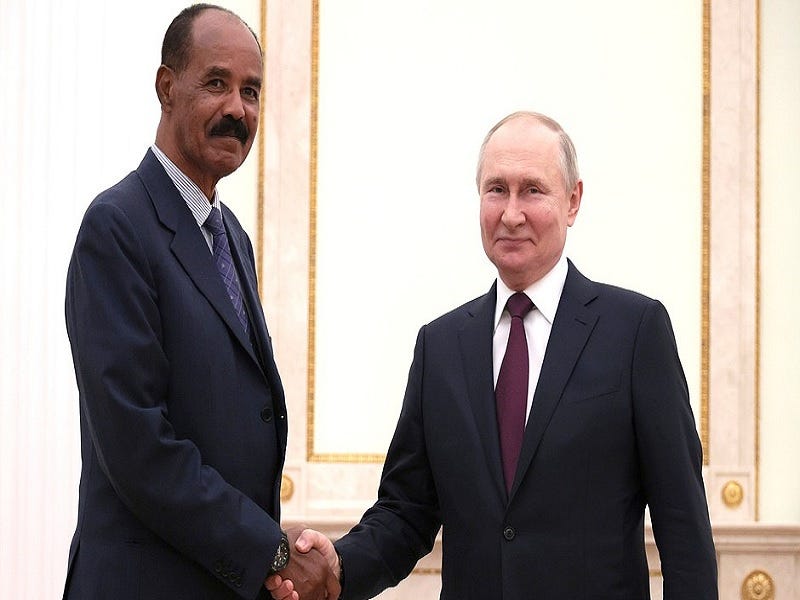
Eritrean President Isaias Afwerki just paid his first-ever visit to Russia since the establishment of bilateral relations three decades ago, which follows Russian Foreign Minister Sergey Lavrov’s trip to this Horn of Africa country in late January. That visit was also the first in their history and was analyzed here https://korybko.substack.com/p/lavrovs- ... a-advances at the time. It was importantly noted that Eritrea was a multipolar pioneer even before Russia assumed the role https://korybko.substack.com/p/vladimir ... -manifesto over the past 15 months of leading the global systemic transition https://korybko.substack.com/p/The%20Ru ... 0increased. in this direction.

Few are aware of this fact, but it’s a point of pride for the Eritrean people, who deeply respect their leader for consistently remaining committed to his vision of a fairer world order. President Afwerki took the opportunity during his meet with President Putin to politely remind his counterpart of this too as proven by the official Kremlin transcript http://en.kremlin.ru/events/president/news/71261 of the talks that were held before their meeting. Here’s what he said:

The Russian Federation was the primary competitor and rival of the policy of encirclement and containment by the forces of domination from the early 1990s, and its global impact in the past 30 years was considerable indeed. The Russian Federation, too, did not undertake, at the outset, all the necessary preparations for effective resistance. An integrated and comprehensive strategy of resistance was not accordingly set in motion.


President Afwerki shared this insight while concisely reviewing the evolution of International Relations since the end of the Old Cold War. The other points that he made are all relevant as well, but most observers are probably already aware of them since they’ve since been reflected in official Russian statements after Moscow assumed the role of leading the global systemic transition to multipolarity. Nevertheless, everyone should know that the Eritrean leader was the first one to express these views.

For those who aren’t familiar with his biography, President Afwerki is a lifelong revolutionary who led his country to independence from Ethiopia after a three-decade-long struggle. Unlike most of his peers across the Global South, he never betrayed his ideals after the dissolution of the USSR. In fact, it’s precisely for this reason that Eritrea was framed by the Mainstream Media as a so-called “rogue state”. It was even sanctioned by the UNSC for nearly a decade from 2009-2018 https://www.aa.com.tr/en/africa/un-secu ... ea/1311540 too.

At the time, Russia had yet to realize that the West was manipulating it into dropping its strategic guard through the Obama-era “reset” and former German Chancellor Merkel’s outreaches, https://korybko.substack.com/p/merkels- ... -minsk-was which resulted in policymakers falsely concluding that the West didn’t pose an existential threat https://korybko.substack.com/p/russia-w ... es-exactly to their country. President Putin has since acknowledged this error of judgement and radically recalibrated https://korybko.substack.com/p/the-five ... completely his country’s grand strategy, but President Afwerki never had to do this since his policy has always remained the same.

Eritrea and Russia are two completely different countries that found themselves in totally dissimilar situations after the end of the Old Cold War, with the first being a tiny war-raved state led by a bonafide revolutionary while the second was a comparatively stable giant led by a pro-Western liberal–globalist. https://astutenews.com/2022/05/whats-di ... worldview/

These initial conditions are responsible for their diverging trajectories in International Relations that only converged after Russia radically recalibrated its own over the past 15 months.

To be sure, President Putin was gradually changing his country’s trajectory even prior to the start of its special operation https://korybko.substack.com/p/20-const ... ut-russias as was explained here https://astutenews.com/2020/01/20-years ... successes/ and here, https://astutenews.com/2022/04/vladimir ... astermind/ though it wasn’t with any revolutionary intent. Rather, he envisaged Russia functioning as a bridge between China and the EU, which he predicted would imbue his country with the potential to become the supreme balancing force in Eurasia. In pursuit of this grand strategic goal, he sought to retain close ties with the EU while reaching a rapprochement with the US.

He obviously didn’t succeed, but his intentions were sincere and everything made sense from his perspective at the time. The only reason why Russia never ended up playing the role that President Putin foresaw was because the US calculated https://russiancouncil.ru/en/analytics- ... ver-china/ that it’s better to contain his country than to cooperate with it. This assessment is attributable to the influence that its ruling liberal-globalists’ ideology plays in the formulation of their policy, which the Russian leader didn’t recognize until it was too late.

Whereas President Afwerki has always operated as a revolutionary, President Putin has always operated as a pragmatist, which led to him subconsciously projecting his management style onto the West. Had he understood the ideological drivers behind that de facto New Cold War https://korybko.substack.com/p/the-impo ... ly-framing bloc’s policies like his Eritrean counterpart did, which President Afwerki also described during their meeting, then he might have launched his special operation earlier like Belarusian President Lukashenko recently lamented. https://www.rt.com/russia/577303-lukash ... operation/

The past can’t be undone but the future can still be built, which is what Presidents Afwerki and Putin discussed during the former’s first-ever visit to Russia. This isn’t wishful thinking https://astutenews.com/2022/07/putin-ca ... -thinking/ either since it’s confirmed by the official Kremlin transcript of their meeting, which notes that the Eritrean leader concluded his remarks by saying that
There is hope and conviction that the Russian Federation will play its appropriate role in this mission of humanity in solidarity and cooperation with the free peoples.
The historic nature of their meeting should leave no doubt that Eritrea will play a major role in Russia’s grand strategy towards the Horn of Africa, https://www.nefasitpost.com/russias-gra ... w-korybko/ which is an integral part of its newfound approach https://korybko.substack.com/p/analyzin ... ins-vision to Africa that aims to accelerate the continent’s rise as a sovereign https://korybko.substack.com/p/presiden ... into-state center of influence in the multipolar world. President Afwerki was right about International Relations all along and he’s finally seeing his vision of a fairer world order enter into fruition, which is why he deserves appreciation from everyone.

Re: JUNE 1, IN THE HISTORY OF ERITREA

Posted: 02 Jun 2023, 09:19
by Zmeselo


Henok Mulubrhan (GreenProject - Bardiani) finished 3rd, at the 84th edition of the Tour of the Apennines. #GirodellAppennino


Re: JUNE 1, IN THE HISTORY OF ERITREA

Posted: 02 Jun 2023, 10:14
by Zmeselo


Eritrea’s Journey in its Economic Development

Sabrina Solomon

https://shabait.com/2023/06/02/eritreas ... velopment/

Q & A

Jun 2, 2023


Mr. James Wakiaga, UNDP representative to Eritrea

Our guest today, Mr. James Wakiaga, UNDP representative to Eritrea, discusses before his departure the economic and social aspects of development that he witnessed during his four-year stay in Eritrea.

***

Thank you so much for your time, Mr. James Wakiaga. Can you please give us a brief introduction to UNDP’s work in Eritrea?

Thank you so much for having me. I would like to take this opportunity to convey warm greetings and congratulations to the people of Eritrea as you mark Independence Day on the 24th of May. I think many are familiar with the works of UNDP. I have been in the country for the past four years, and so this has been quite a journey. I have been carrying out the works of UNDP, just like those who were before me, in promoting sustainable development in Eritrea. We have covered quite a lot of ground and the work we’ve been doing touches on many important sectors of the economy.

It’s been a very interesting and revealing journey, taking into account that we’ve been working on areas prioritized by the government. For example, UNDP has been accompanying the government in the areas of sustainable management of resources, specifically looking at nature-based solutions to adapt [to deal with] climate change, looking around the works of soil conservation, as well as working closely with the cross-segment in the area of capacity development at institutional level and systems. We have seen tremendous progress that has been achieved in the area of the human development index.

If you look across the board, even in areas that are critical for the country’s investment such as energy, where we see energy transition as a catalyzer of sustainable development, UNDP has been a partner with the government. One good example is that we worked with the government, together with the European Union, on the Mai-dima Areza project which I had an occasion to visit. It had a transformational impact on the community as the beneficiary, on the economy, and on health and education.

Tell us your reflections on your tenure with UNDP-Eritrea on moving the agenda on development.

When I arrived in 2019, I needed to understand the Eritrean model of development. So I quickly learned the national philosophy in terms of the development approach which is self-reliance. That has been a critical factor in how we as UNDP can find entry points, to further engage and support the national development priorities. I would really love to thank Eritrea, for providing those platforms and those spaces for us to be able to engage and accompany the government.

There have been aspects that are critical in the area of youth and skills development, which is an important project. Here, we’ve been working with NUEYS (National Union of Eritrean Youth and Students) to advance skills development across the country in different youth centers. The area of the energy transition, as I mentioned earlier, has been one area that we look for to further advance in terms of moving forward and delivering critical important development results for the country. So, I think there is a whole range of areas where I still see we have an opportunity.

I had an opportunity to visit Massawa and saw the whole potential of promoting tourism and promoting the marine industry. I see this as another area that can catalyze development, particularly in the area of the blue economy. There is also the date palms, and this is another area that the Ministry of Agriculture is pursuing and investing in, and as UNDP we are happy about our partnership to support the growth of the dead palm in the Red Sea region. This can open up job opportunities and we’ll witness more women’s engagement, as well. But what’s most important, is seeing Eritrea become one of the nine exporters of dates globally.


How’s Eritrea doing on some of the key development indicators, and where does it need to invest and accelerate actions to deliver results?

I must say, that Eritrea is on the right track in terms of its development trajectory. We are looking at investment in the human capital, because it is critical in supporting the country’s development process. In the area of education, we have seen an increase in enrollments, and we’ve witnessed how Eritrea has been performing in the area of health. As you know, Eritrea is among the first countries that achieved health indicators under the MDG paradigm, and, therefore, it’s building on these in the context of sustainable development goals.

In terms of human capital, I see a huge opportunity for improving and building on education in terms of quality and in terms of skills development in areas that will be critical in powering the country’s development. Secondly, I look at the area of food security, and Eritrea, again, has a good track record. The investments that the Ministry of Agriculture is making by going beyond food security to achieve its trajectory in areas of food nutrition are critical, particularly for children. Diversification in terms of production in the area of agriculture by shifting towards value chain systems is an area in which the Ministry of Agriculture is working with other partners, the UN is already looking into. Another important resource is water, where the government has been increasingly making a lot of investments over the years in providing clean water to citizens in rural as well as urban areas.

How do you feel about working here in Eritrea?

I’m proud, to have the opportunity to work in Eritrea. Eritrea’s journey is something that I deliberately looked forward to being part of, as it is one of the youngest countries to gain its independence. Eritrea is a young proud nation and it offers a lot of lessons to other countries in terms of its credentials in pan-Africanism and in terms of its development approach, the philosophy of self-reliance. I think this is a paradigm, that offers vital lessons on how you rely on your own resources to sustain your own development. This is a vital lesson, I carry with me. And, I’m looking at the ambition of the country. The ambition is to be a country that is peaceful and able to create job opportunities for its young population, and able to provide the basic necessities to each and every Eritrean. I think this is an aspiration for all countries, and this is part of what we call the SDG agenda.

What are the key drivers of change?

One of the key drivers of change that I see is agriculture, not just for Eritrea but for the continent as a whole. It will be important in food security and the provision of the necessary material for the manufacturing sector, particularly that of the value chain system.

Another area, is tourism and heritage. I’m always proud of Eritrea’s heritage in terms of the fact that it was able to conserve the culture and maintain the beauty of Asmara, as one of UNESCO heritages. It’s a huge attraction.

The other area I see, is innovation. I must say, I have been in contact with a lot of youth in the country and I get amazed with their knowledge and their level of understanding of areas such as digitalization. And so as UNDP, we’ve been working closely with the National Union of Eritrean Youth and Students to look, for example, at how we can develop the capacity of the innovation lab that is under establishment.

Then, of course, the fact that the country has invested a lot in soil conservation and afforestation is a key driver of change. Those projects are something to be proud of because of their transformative nature in soil conservation, land security, and diversification of crops. A lot of the initiatives that are being taken in the country are people-centered, which is critical, and it aligns with the UNDP mantra of ensuring that nobody is left behind.

You have traveled to different parts of the country. Tell us your impressions.

It was good to travel and I had the opportunity to travel to different parts of the nation and interact with the community. One thing that always struck me, is the solidarity of the community and the role of the community in driving the development agenda in those areas. I saw that community has always been central and it aligns with our African tradition, where we have to view everything from the lenses of the community. And the warm welcomes I received to share coffee and injera and the generosity, were truly impressive. The landscapes and the mountains that I saw during every trip, are also amazing attractions the country offers. Also, the sandy beaches of Massawa with its clean water and amazing fisheries is something to be proud of.

How do you see the partnership with the government and what potential lies ahead as you leave Eritrea?

What I have witnessed in the past four years, is the deepening of the partnership between the Government of the State of Eritrea and the UN. The hallmark of this was of course the recent signing of the cooperation framework that run from 2022 to 2024, which accentuates the confidence and trust between the government and the UNDP. My role as a UNDP representative over the years has been to cultivate the confidence and trust to achieve their ambition in the area of development, through dialogues with the government and the people. This has been the mantra of the UN, in terms of ensuring that we build that trust and we accompany the government in fostering its development agenda. Eritrea is part of the UN family and that’s why we tend not to be prescriptive, but rather to look at what it is that the government wants to do to promote its development ideas. We are happy, that we have a very strong relationship. And, I must once again thank the government for providing that space and that platform. I’m sure we will continue to sustain moving into the future and look forward to further support because, at the end of the day, we all share a common future, which is to ensure we have improved livelihoods.

Any final remarks you want to add?

We are here to share ideas in terms of what we see as viable policy choices and options, in an open-minded way. We are also here to learn what Eritrea is doing well, so that we can share it with other countries. I see a lot of opportunities that are being presented to Eritrea in a number of areas where Eritrea can be a leader — energy transition, infrastructure, mineral resources, and more.

Thank you!