Re: (EMNA): ኤርትራውያን ንዘንተ እለት ዘይርስዕዎ በሰላ


Grateful to the Government & people of Eritrea and
 @UNDPEritrea + @UNinEritrea, for a warm welcome!

I had the opportunity to meet w/Pres. Isaias Afwerki & discuss the country’s development pathways + regional engagement & conferred w/senior gov. officials + development partners.


I also witnessed the impactful Community-based Sustainable Land Management Project in Serejeka, supported by UNDP + @theGEF The project combines life-long land use rights & best land mgmnt practices, encouraging increased investments & improving livelihoods of rural communities. Achim Steiner: @ASteiner
Re: (EMNA): ኤርትራውያን ንዘንተ እለት ዘይርስዕዎ በሰላ

Independence Cup in Southern Red Sea Region
https://shabait.com/2023/05/03/independ ... ea-region/
Assab, 03 May 2023- The Independence Cup that commenced its journey in the Southern Red Sea Region from Tio on 30 April, toured the trenches of Duhtoum, Rehaita, Ras-Dumera and the port city of Assab accompanied by Ambassador Mohammed-Seid Mantai, Governor of the region, Sultan of Rehaita Abdulkadir Dawud, Mr. Rezene Micael, Secretary of PFDJ in the region, and Mr. Ali Nur Ali, chairman of the regional Assembly.

During its tour to the historical areas, the Independence Cup was accorded warm welcome by the residents and members of the Defense Forces featuring military marches as well as cultural and artistic performances.

At the welcoming ceremony organized at the trenches of Duhtoum, Ambassador Mohammed-Seid said that Eritrea’s history proves that the people of Eritrea do not give away their interest and land and that the heroic feat demonstrated at the trenches of Duhtoum attests to the transfer of Martyrs Trust to generations.


_____________


The magnificent Imba Soira (Mount Soira), over 3000 meters above sea level. The highest mountain in Eritrea. @Mebrak_G
Last edited by Zmeselo on 03 May 2023, 16:59, edited 1 time in total.
Re: (EMNA): ኤርትራውያን ንዘንተ እለት ዘይርስዕዎ በሰላ


EYFF getting their hands dirty
Mussie Merhazion
https://eriyouth.org/2023/05/eyff-getti ... nds-dirty/
Wednesday, May 3, 2023
This past weekend the new group within NUEYS created by the diaspora, for the diaspora, called the Eritrean Youth of the Fourth Front (EYFF) planned and took part in another event. This event took them to Biet Gergish (a little bit outside of Asmara), where they would participate in a tree planting mini project. This event is one that has two parts, which have been planned for two separate days. The event that took place last weekend was the first half of the planned mini tree-planting project.
On the morning of Saturday the 29th of April, the EYFF met up at Bahti Meskerem (near the center of Asmara) and went to Biet Gergish together. Once they had arrived representatives of NUEYS central region who were awaiting them welcomed them, gave the group the needed equipment (pickaxes & shovels) and showed them to the area they were going to be working at.


The area the group was taken to was up, on a hillock. The land there has been divided to multiple different ministries, associations, organizations, etc. Each governmental facility, has been given the responsibility of making the place as clean & green as possible. By doing this, it helps in developing the nations land into a greener and more environmentally friendly place. This is done by dividing it up and assigning it to different parties in order for there to be a swifter and wider affect in a more organized manner.

As was noted before, this was part 1 of the two part event. Part 1 was entirely focused on digging up the holes that would later be used to plant the trees. So the group spent the morning digging up numerous holes. Though the group was completely diaspora centered, the group didn’t have much trouble in getting the hang of using the tools. After they were done, the group took a moment to take in the lovely scenery and of course take some picture alongside it.


In addition to this event, the week before last, the group had another event that was a bit more centered on the relaxing/entertaining side. The group went to a restaurant called Pyramid and had a very nice dinner. This was an event where group members were able to just unwind, enjoy the positive vibes and get to know their fellow group members on a closer level.

A fact the needs to be acknowledged about these events and even the ones before these, is how these events have been able to strengthen the bonds and friendships within the group. When the youth come together to get their hands dirty or just have a good time, their chemistry strengthen and the relationships they create within the group carry on outside of the group as well. That is what the aim of EYFF has been from the beginning, bringing the Eritrean diaspora youth together so that they can create beautiful bonds in and outside of the group which ultimately makes their experience in Eritrea so much sweeter.
___________

Congratulations to Yohannes Berhane for your latest friendly win against the champion in Tallink, Estonia, in late April. Yohannes, is one of the fighters representing the Eritrean Boxing Organization and is on his way to greatness. @Nueys2023
Last edited by Zmeselo on 03 May 2023, 17:08, edited 1 time in total.
Re: (EMNA): ኤርትራውያን ንዘንተ እለት ዘይርስዕዎ በሰላ

Was the Trip to Asmara Worth it?
Milena Beyene Mesfun
https://shabait.com/2023/05/03/was-the- ... -worth-it/
May 3, 2023
Traveling back home after several years, has been a sentimental and nostalgic experience. What made it special was that I travelled along with my two younger siblings, who have never been to our hometown. The following article highlights the emotions, memories and a life time experience that came along with this unique journey.
In the summer of 2022, I decided to travel back to Asmara, the city I was born and raised in until I was 10, with my brothers Mohammed and Adam. I felt an overwhelming sense of pride, walking around town and showing my Gen Z brothers the city that made me who I am today.
The thought of returning evoked a mixture of excitement and nervousness, as it had been over eight years since I had last visited. It meant a chance to reconnect with our families and meet the new additions; reconnect with my childhood friends whose lives have evolved, most of whom now have their own families and kids and are leading successful businesses, while some are serving their city from reputable positions.
On the other hand, it feels like not much has changed as the memories and emotions that were left behind are still the same. These feelings become even more pronounced with my younger siblings as they got to experience not only the city, but also all my raw emotions with me.


One of the most special things about this journey was the opportunity I got to show them what my childhood was like, where our parents used to work and the places our great grandparents used to trade in. I got to take them to the places that hold the most meaningful memories for me and share with them stories of what growing up in Eritrea was like.
What surprised me the most, was how quickly my brothers adjusted to the new environment and became familiar with the city. They began roaming around town by themselves, just the second day after our arrival. They knew what routes to take that I didn’t know and soon began guiding me and even suggesting places where we should dine in. They found some of the restaurants and cafes by searching on the social media platforms prior to our arrival and some others by asking the locals, especially taxi-drivers, who were good at telling them places they should visit.
The most heart-breaking and heart-warming statement my brother Mohammed said to me as we were standing in a queue at Asmara airport immigration was this: ‘
He said this, with so much pride and a smile on his face. The reason this statement touched me so much was perhaps because it had never occurred to me that he felt like a foreigner all these years living abroad in Dubai, UAE. Even though he was born and raised there, studying in reputable schools, having the latest gadgets, and lacking nothing materialistic, it never crossed my mind that he felt some void. A void, that would be filled by stepping his feet in his motherland.For the first time in my life, I will stand in a lane that is for locals, as a local in my own country.
A void that was filled by the warm embrace of Eritreans, whether it was family and friends or complete strangers. Surrounded by people, who looked like him and sounded like our parents.
Our summer trip wasn’t just a fun vacation, it was a navigation through life.
That’s what my mother used to say to us, when we were growing up. I finally understood how true that statement was, after observing the effect it had on my brothers and how quickly their behaviors began to change. My only regret, is not having done this earlier.Know who you are to know where you are going in life; know where you come from to know who you are.


This summer vacation, had planted a seed in my brothers’ hearts – a seed of who they want to become. It gave them a purpose, to thrive more in life and excel in their studies. It has enhanced their decision-making skills and influenced how they approach life.

Upon our return to Dubai, all they could talk about for months on end was what they could do in Eritrea when they come of age, how they could serve their people and what they should invest in.
Every adventurous trip you take with your loved ones gives you an opportunity to have new and exciting memories together, that become part of your shared family history. Of course, not every trip strengthens your identity, builds your character and inspires you to become a better person whilst feeling alive and being present in the moment.
But the summer trip in Asmara did just that for us: it gave my brothers a sense of belonging and made them love their culture a lot more, and ignited their desire to learn about Eritrea and its history. Our trip also inspired other members of our family who live abroad to visit Asmara, with their kids.

Re: (EMNA): ኤርትራውያን ንዘንተ እለት ዘይርስዕዎ በሰላ

May Day and Workers’ Rights in Eritrea
Ann Garrison
https://www.blackagendareport.com/may-d ... ts-eritrea
03 May 2023
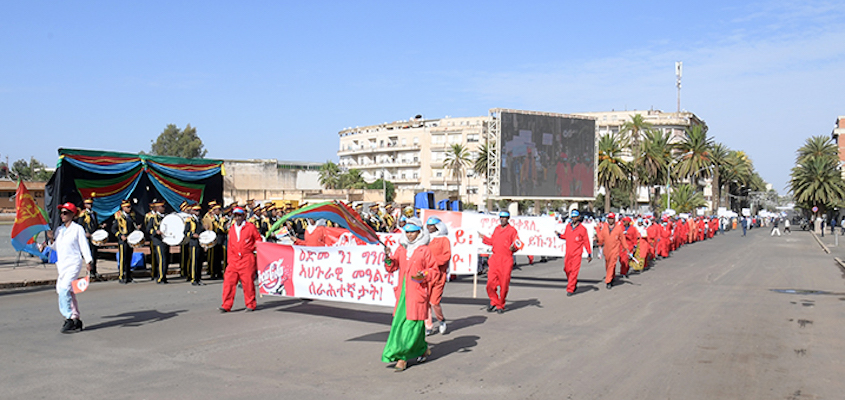
The Eritrean people struggle against sanctions and warfare instigated by the US. They recognize their efforts on International Workers Day, May Day.
May Day is a federal holiday in Eritrea, meaning that all workers have the day off and May Day celebrations and marches are held in the capital, Asmara, and in Masawa, Keren, Barentu, Mendefera, and Asseb.
The primary goal of the National Confederation of Eritrean Workers (NCEW) https://www.ncew-er.org/index.php/en/ is industrial peace in accordance with the tripartite agreement between government, workers, and employers defined in the Labour Proclamation of Eritrea. http://ilo.org/dyn/travail/docs/495/The ... 202001.pdf

I spoke to Abraham Bereket, International Relations Officer for the NCEW, via Zoom. He was in Turkey on a diplomatic mission and celebrating with the Turkish Public Workers Union in Ankara, but he had been involved in organizing the workers’ celebrations in Eritrea, which went on for several days.
ANN GARRISON: Greetings, Abraham. Can you tell us about International Workers’ Day in Eritrea?
ABRAHAM BEREKET: May Day celebrations went on for several days. There was a series of events we organized to make it a vibrant May Day.
One thing I organized, as part of a committee, was a series of seminars and panel discussions on the challenges and opportunities in the future of work.
I’m sure you know about the immense challenges of nation-building from the ashes of the thirty years war for independence, the recent economic destruction and social disruption caused by the border war with Ethiopia, and the pervasive poverty and economic underdevelopment. We face a huge challenge to lift the living and working conditions of Eritrean workers to acceptable, decent levels.
AG: What else took place, in addition to the marches and the panels to celebrate May Day?
AB: We also had events to encourage civic participation. We did three days of blood donations, and we did some tree planting. That’s part of a greening campaign, that goes on throughout the year.
AG: Tell us about the National Confederation of Eritrean Workers (NCEW).
AB: It was created in 1979, during the independence struggle. At that time it was formed to recruit workers, to serve in the independence struggle. Outside the armed forces, it also served to support the struggle financially and logistically.
Now, of course, our aims are different. After independence we did our fourth congress, in 1994, where we shifted our key strategic priorities to securing the rights and well-being of workers.
Now we are spearheading the social dialogue and negotiation with the government and the National Employers' Federation of Eritrea https://shabait.com/2014/04/15/national ... f-members/ to secure collective bargaining agreements and guarantee International Labour Organization https://www.ilo.org/global/lang--en/index.htm standards. Working with the government and private employers, we have established the Labour Relations Board to safeguard workers’ legal rights in disputes.
AG: Who belongs to the Confederation of Eritrean Workers?
AB: We have workers representing five federations, constituted of 164 base unions operating in similar products or service areas. As of December 2019, NCEW had a total of 26,000 members, of which 10,702 (41.1%) were women and 15,298 (58.9 %) were men. The five Federations are:
Food, Beverage, Hotels, Tourism, Agriculture and Tobacco Workers Federation of Eritrea – 22%
Mining, Chemical, Construction and General Works Workers Federation of Eritrea – 39%
Service Industries Workers Federation of Eritrea – 10%
Transport and Communication Workers Federation of Eritrea – 15%
Textile, Leather and Allied Products Workers Federation of Eritrea – 14%
AG: And what is the Labor Proclamation of Eritrea?
AB: The labor movement in Eritrea generally is guided by the government’s Labour Proclamation of Eritrea No.118/2001. http://ilo.org/dyn/travail/docs/495/The ... 202001.pdf
It is a legal framework that guarantees workers’ rights, the basic rights within international labor organizations—the freedom of speech, freedom to unionize, and collective bargaining rights. This legal framework acts as a base when we try to organize within an enterprise. These are the rights that all workers have.
AG: And what about public workers?
AB: We don’t yet have a legal framework for organizing public workers in the Labour Proclamation, but it is written and waiting for ratification.
We are also working to ratify a legal frameworks for organizing cooperatives and workers in the informal economy.
AG: I know that the majority of Eritrean workers are in the informal economy, meaning they are largely self-employed, farming to feed their own families.
AB: Yes, that is true.
AG: When I was there, the Agriculture Minister showed me the Minimum Integrated Household Agricultural Package (MIHAP) developed to help farmers expand to where they could produce a surplus to sell at market, feed four more families, and thus free workers from farm labor to help build an industrial base.
AB: Yes, expanding the industrial work force is essential to the future of work in Eritrea.
AG: I have the pamphlet describing the MIHAP and how it is to increase production, right here. It says the government will provide one dairy cow or six goats, 25 chicks, two bee hives, and 20 trees—10 fruit trees, five for supplementary forage, and five for firewood.
It’s an impressive development plan for moving beyond basic family farming.
AB: Yes, that’s right, and thank you.
AG: And what sort of work do you do in the informal economy?
AB: We do awareness raising about health and safety, and technical and vocational training—skills development.
AG: What is the rest of the informal economy and what is the challenge of organizing it?
AB: There are domestic workers, street vendors, and similar small- scale participants in the informal economy. What we need first, is a legal framework for organizing and guaranteeing the rights of these workers. We’re working on that.
AG: Of course, Western oligarchs and officials and their press hate Eritrea because they can’t stand its egalitarian example. They love to tell the story, that Eritrean soldiers have been forced to work in the Bisha Gold Mine. What is your answer to that?
AB: As a trade union, we organized a symposium and conference in Asmara and we invited delegates from labor organizations in Europe, Africa, and Asia. At the end we provided vehicles to travel to the Bisha Mine, and allowed them to engage with any workers they liked. When they returned, we asked them if they found any forced labor conditions and they said no. We had proven to them that there were no soldiers forced to labor in the mine, and at that time those stories stopped.
AG: That story may have stopped, but the Western Eritrea-haters never stop. They can’t hate or sanction Eritrea https://blackagendareport.com/us-still- ... ns-eritrea enough.
AB: Yes, that’s true.
AG: I know, that the history of the NCEW is intertwined with the history of the independence struggle. Could you tell us about that?
AB: The first Eritrean trade unions, were factory-based during the colonial period. They emerged in 1948. On February 4, 1952, the factory-based unions coalesced to form the National Union of Eritrean Workers for Independence (NUEWI).
Then the erosion of Eritrea’s political independence by Ethiopia in the 1950s, catapulted the union movement into the leading force of the Eritrean nationalist movement.
Ethiopia canceled our trade union rights, in 1957. The NUEWI responded by organizing a strike and many members were jailed.
The dispute between the unions and the Ethiopian government came to the forefront, in March 1958. Because of the increasing repression perpetrated by the Ethiopian regime, Eritrean workers had sought employment in Europe, North America and the Middle East and regrouped themselves alongside Eritrean students to participate in the Eritrean liberation movement.
AG: I know that the Eritrean independence movement captured the imagination of the world, at that time.
AB: Yes, it did. The first meeting of the Eritrean workers in the diaspora was held in Germany, in 1970. They named their organization “Eritreans for Liberation” and began to organize in different countries, as the Eritrean Workers Union.
Eritrean workers from many parts of the world assembled in the liberated area of Eritrea in November 1979 and founded the National Union of Eritrean Workers (NUEW), in full allegiance to the principles of the Eritrean People’s Liberation Front (EPLF). https://en.wikipedia.org/wiki/Eritrean_ ... tion_Front
The second congress of the NUEW was held in 1983 and the third Congress in 1988, all in the liberated areas.
AG: And what happened after the liberation in 1991?
AB: The NUEW leaders and members from the diaspora came to Eritrea after the liberation of the country, in May 1991. NUEW coalesced with workers who came from the liberated areas and members of the trade unions, previously existing under the Ethiopian military regime in the country.
In June 1992, the NUEW was reconstituted as a provisional organization of Eritrean workers until it was formally organized as the independent National Confederation of Eritrean Workers at the Congress held in September 1994.
In the process, membership was declared to be voluntary. Democratic elections were held, at the base union level. The unions were organized, into the five sector federations. Each of the sector federations, held their congresses and democratically elected their respective leaderships.
A congress embodying representatives of the NUEW and the federations was convened, in September 1994. The National Confederation of Eritrean Workers (NCEW), was established at this congress with new and independent statutes. A decision, to limit the membership in the NCEW to workers residing within Eritrea was taken at the congress.
Each of the five Federations, then developed its own constitution. They hold their respective congresses and elect their representatives, organize their administrative set-ups, and implement their respective programs.
Unlike its predecessor, NCEW membership is open only to workers residing in Eritrea.
AG: What special steps have you taken to ensure the rights of women?
AB: An established Committee on Women’s Affairs ensures, that women workers’ issues are given attention. The NCEW has many women elected to positions at the highest leadership level, including membership in the Central Council and Executive Committees of the Confederation, as well as chairpersons and secretaries of federations.
AG: And have you affiliated with international labor organizations?
AB: The NCEW and the federations have become affiliates of regional and international trade union organizations, such as the International Trade Unions Confederation (ITUC), ITUC-Africa, the Global Union Federations (GUF), the Organization of African Trade Union Unity (OATUU), and the International Labour Organization (ILO).
AG: That’s a very impressive history.
AB: Thank you.
AG: Thank you for speaking to Black Agenda Report.
AB: You’re most welcome.