Ethiopian News, Current Affairs and Opinion Forum
Zmeselo
Senior Member+
Posts: 37347
Joined: 30 Jul 2010, 20:43

Johnnie Carson, rears his ugly head again to save the junta.

Post by Zmeselo » 20 Oct 2022, 13:51

US institute of Peace & TPLF lovers, Ambs. Johnnie Carson & Alex Rondos suggest: "activate US atrocity prevention capabilities".

This is code, for R2P.

Sudan & Egypt view Asmara’s military intervention in Ethiopia as a national security concern.


REALLY?


Wikileaks: Hillary (with Johnie Carson), asking Seyoum Mesfin's advice on how to engage with Eritrea epitomizes the incompetency. 👇


Analysis and Commentary
Ethiopia’s civil war is raging. How can it get on track toward peace?

As the conflict enters its deadliest phase, U.S. leadership and collaboration with African partners are desperately needed to stop the slide.

Tuesday, October 18, 2022

By: Ambassador Johnnie Carson; Ambassador Alex Rondos

https://www.usip.org/publications/2022/ ... ward-peace

In August, the devastating conflict in northern Ethiopia resumed, effectively ending the March 2022 humanitarian truce between the Ethiopian federal government and Tigrayan forces, which many hoped would pave the way for a negotiated cease-fire and peace talks. This week, the African Union’s chairperson called https://au.int/en/pressreleases/2022101 ... n-ethiopia for an immediate cease-fire and U.S. Secretary of State Antony Blinken also called on the parties to cease hostilities and participate in talks organized by the African Union. What comes next in Ethiopia will have major implications for its people, the strategically vital Red Sea arena and for U.S. interests in the region. Stepped up, senior-level U.S. engagement is direly needed to get Ethiopia on a path toward peace.


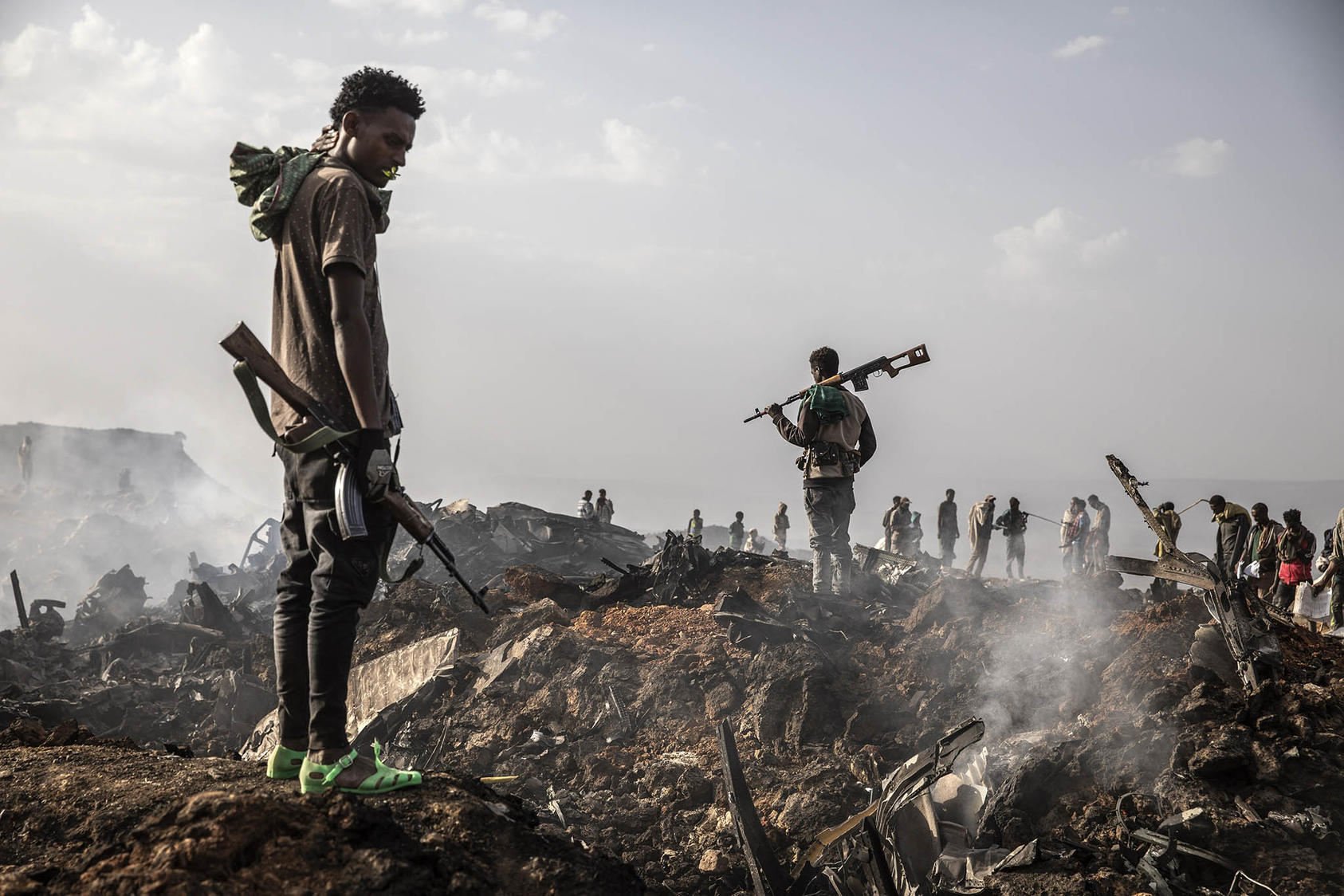
Tigray Defense Force fighters survey the wreckage of an Ethiopian Air Force plane downed in Mekelle, Ethiopia, June 23, 2021. (Finbarr O'Reilly/The New York Times)

A Shattered Truce

Amid the flurry of accusations, counteraccusations, propaganda and disinformation it is hard to know how hostilities escalated and why, but a few facts seem clear. Initial clashes in the eastern sections of the Tigray-Amhara border led to the capture of the border town of Kobo by Tigrayan Defense Forces (TDF). Within days hostilities had spread to other sections of the line of control, including Tigray’s border with Eritrea, with Ethiopian federal forces, Amhara militia and Eritrean troops launching a series of offensives on Tigrayan positions accompanied by aerial attacks across the Tigray region.

A September 11 offer by Tigrayan authorities to engage in African Union-led peace talks, in line with earlier public commitments made by the federal government, failed to blunt escalatory momentum. An initiative by the African Union (AU) to convene talks has also been postponed while consultations on the format and role of a panel of facilitators, along with the structure, agenda, security provisions and basis for the talks continue. In the meantime, the parties are now engaged in all-out war on multiple fronts, and a return to peace looks like a remote possibility.

The latest round of fighting should come as no surprise. It was preceded by weeks of steadily increasing tensions between federal and Tigrayan authorities over humanitarian aid flows, the resumption of core public services in Tigray, the structure of peace talks and alleged military provocations. In the background of the wrangling — played out through backchannel dialogues, dueling public statements and endless diplomatic maneuvering — loomed a difficult but important question: Did the parties to the conflict actually want a political solution, and how far were they willing to go for peace?

The Stakes Could Not Be Higher

From the moment the war in northern Ethiopia began in November 2020 it was apparent it posed a serious threat to regional stability and U.S. interests. An October 2020 report https://www.usip.org/publications/2020/ ... ty-red-sea by the USIP Senior Study Group on Peace and Security in the Red Sea Arena highlighted Ethiopia’s role as a U.S. partner in peacekeeping, and peace and security in the Horn of Africa more broadly. In a statement in November 2020, the Senior Study Group warned https://www.usip.org/press/2020/11/stat ... -sea-arena with concern that
the fragmentation of Ethiopia would be largest state collapse in modern history.
This new chapter of the conflict raises the stakes considerably. A recent report https://www.ohchr.org/en/hr-bodies/hrc/ ... iopa/index by the International Commission of Human Rights Experts on Ethiopia and earlier reports by the Ethiopian Human Rights Commission and a joint U.N. investigation https://www.ohchr.org/sites/default/fil ... Report.pdf have established that war crimes and crimes against humanity occurred in the previous cycle of war. Two years of bloody hostilities have only magnified the impunity, insecurity and grievances that animated earlier mass atrocities and could drive another more catastrophic round of harm to civilians.

The concern is magnified by the evolving battlefield situation and the risk that the TDF may return to asymmetrical warfare retreating from Tigray’s cities, towns and villages. The Ethiopian government announced on October 17 that it will assume immediate control of all airports, federal facilities and installations in the region. Both dynamics leave civilians in and around the region vulnerable to further repression and abuses. Broader humanitarian conditions in Tigray and conflict-affected zones of Amhara and Afar also grow worse by the week, and continued conflict and access constraints risk provoking a famine of unprecedented proportions.

This war is now being internationalized in alarming ways. Eritrea’s full-scale re-entry into the conflict has major strategic consequences and threatens to draw in other parties more directly, in particular Sudan and Egypt, which view Asmara’s military intervention in Ethiopia as a national security concern. Neighboring Djibouti quietly shares this alarm and risks being destabilized. The UAE and Turkey were active in earlier phases of the conflict and may find reason to re-engage depending on how the battlefield pendulum swings. Further afield is Russia, which has a track-record of exploiting African conflicts for geopolitical gain and has long sought opportunities to enhance its presence along the Red Sea corridor.

The resumption of war in northern Ethiopia will only reinforce deteriorating political and economic conditions across the rest of the country. The Oromo Liberation Front remains active in western and southern Oromia and large parts of the region sit outside the government’s effective control. Debates about the approach to war — or peace — in Tigray and Oromia are rippling into the Amhara region, where the regional authorities are key partners in Prime Minister Abiy Ahmed’s governing coalition. Intercommunal violence is persistent and wide-spread, and conflict and drought have left millions food insecure across the country. The economy is stumbling, encumbered by inflation, debt and hard currency shortages. And the closing space for political opposition — or even calls for peace — runs counter to the promised democratic reforms so central to Abiy’s first years in office, the country’s long-term stability and U.S.-Ethiopia ties.

Refocusing U.S. Engagement

With much hanging in the balance, there is an urgent need for U.S. policymakers to take a high-level, all-hands-on-deck approach. Blinken’s October 14 call https://www.state.gov/intensifying-mili ... -ethiopia/ for the parties to cease their escalatory conduct — including the ongoing joint offensives by the Eritrean and Ethiopian militaries — underscores the message that there is no military solution to the conflict and attempts to impose one will be rebuked. How Washington responds — and how it’s perceived to be responding — to the present moment will have strategic, long-term consequences for Ethiopia, the Horn and broader U.S. interests.

U.S. Special Envoy for the Horn of Africa Mike Hammer is working tirelessly with his counterparts at the AU, the U.N. and in Europe to halt the violence and move the parties to formal AU-led talks. The recent announcement of a U.S.-South Africa joint high-level group to focus attention on Ethiopia could be an important engagement. These efforts demand attention, support and public engagement from the senior-most levels of the U.S. government. Who delivers important diplomatic messages matters. President Biden did raise Tigray in his recent U.N. General Assembly speech. Still, many around the region talk about an impression that the Biden administration has become disengaged and even indifferent to the looming catastrophe. Some speculate that the Russia’s war on Ukraine has shifted the attention of senior policymakers away from Ethiopia.

Renewed senior, principal-level U.S. engagement with the warring sides and relevant international partners should be part of a broader strategic push that involves several elements, including the following:

1. Press for the immediate announcement and convening of talks to silence the guns, and activate U.S. atrocity prevention capabilities. Dates, location, format, agenda and logistical arrangements for African-led talks — which would be supported by additional African partners, the U.N., the United States and Europeans — need to be agreed. Similarly, the mandate of those facilitating or mediating needs to be agreed based in consultation with the parties and anchored in the African Union’s own policies, frameworks and principles. Swift action in this regard would circumvent further haggling about the structure of negotiations and call the bluff of those actors not ready to sit for dialogue. An immediate cessation of hostilities and mechanisms for ensuring the credibility of commitments need to be central agenda items for talks. Such talks also need to offer a clear path to a nationwide political dialogue that can resolve the country’s broader challenges. Even more immediately, the atrocity prevention capabilities of the U.S. government can be activated to take steps to mitigate the risks of further mass violence.

2. Move to impose material costs on those fueling the conflict, restricting humanitarian assistance and obstructing investigation and documentation of abuses and crimes. The Biden administration’s recently renewed executive order https://www.whitehouse.gov/briefing-roo ... -ethiopia/ on Ethiopia offers significant scope for action. At a minimum, existing measures on the Government of Eritrea applied under the executive order should be strengthened.

3. Catalyze a regional conversation with neighboring states committed to a peaceful settlement of the Ethiopian conflict, with the goal of managing the strategic fallout of the crisis, containing spoilers and supporting a path to peace and stability. Relevant extra-regional players, including those in the Middle East, should be consulted in this process. If the mandate of the U.S. special envoy for the Horn of Africa is to remain limited, it is all the more essential that senior U.S. officials help drive this effort, particularly in conjunction with top officials from partner countries.

4. Sustain significant levels of humanitarian assistance to Ethiopia, despite competing needs in many other global hot spots.

There is little doubt that the above approach — more direct and robust — will not be welcomed by some or all parties to the war. Up until now, U.S. policymakers have sought to capitalize on the halting steps toward peace through quiet diplomacy that eschewed confrontation. Such an approach made sense in the context of the now shattered humanitarian truce. But with the latest escalation of violence and the risk of mass atrocities, a new strategy is needed. Washington must act with the leadership, pace and urgency that meets the moment.


Ambassador Johnnie Carson and Ambassador Alex Rondos are co-chairs of USIP’s Senior Study Group on Peace and Security in the Red Sea Arena.

Zmeselo
Senior Member+
Posts: 37347
Joined: 30 Jul 2010, 20:43

Re: Johnnie Carson, rears his ugly head again to save the junta.

Post by Zmeselo » 20 Oct 2022, 15:14

ERITREA: Johnnie Carson’s shoddy Diplomacy Further Sours US Relations

MARCH 8, 2011


Incompetent or?

By: Sophia Tesfamariam

The 11 November 2009 Wikileaked “Cable 09CAIRO2129, A/S CARSON AND EGIS CHIEF SOLIMAN’S OCTOBER 27” shows how Johnnie Carson, US Assistant Secretary for African Affairs and his incompetent team at the Bureau of African Affairs lack of adequate knowledge of the region and its people, have distorted the reasoning and analysis on Somalia and prevented the Obama Administration from crafting a coherent policy for the Horn region.

The above cable reminded me of an article I wrote, back in March of 2010. In that piece I addressed the many distortions by US Assistant Secretary for African Affairs, Johnnie Carson on issues relating to Eritrea and his rehearsed 5 ­point spill on Eritrea. As we shall see later, that spill was not limited to his speeches at various US institutions, but seems to be one that he uses in all his “diplomatic” interactions, in which he maligns the Eritrean leadership.

In the 11 November 2009 Cable from the US Embassy in Cairo, we find part of Johnnie Carson’s rehearsed script again. Let us take a look at an excerpt from that cable:
… A/S Carson met with EGIS chief Omar Soliman on October 27 to discuss Somalia and Sudan… Carson thanked Soliman for Egyptian efforts to bring peace to Somalia and noted that the U.S. and Egypt share the strategic goal of supporting the TFG and the Djibouti process… Carson said Isaias was “one of the most difficult leaders with whom he had interacted.” He noted that Isaias had refused to accept the credentials of the U.S. Ambassador in Asmara, grant A/S Carson a visa, or accept a phone call from Secretary Clinton
For the record, allow me to state that Johnnie Carson has NEVER met H.E. President Isaias Afwerki (PIA), and from the way US-­Eritrea relations are today, he probably never will.

Jendayi E. Frazer, his vindictive and incompetent predecessor also left office without ever meeting the President of Eritrea in person. Had he pursued a personal engagement with PIA, he would have learned a lot from this seasoned statesman and intellectual. He would have had an insight to the region, that would have advanced US interests without alienating the populations. He would have seen the rare qualities of true blue leadership, something that is nonexistent in Africa or anywhere else in our world today. He would have learned the difference, between fear and respect.

Neither Johnny Carson, nor his incompetent predecessor Jenday E. Frazer, has ever personally “interacted” with H. E. President Isaias Afwerki (PIA). I suppose by “interaction”, Johnnie Carson means gossiping about PIA. I suppose he takes his divisive and evil back-room shenanigans, as being diplomatic engagements.

That may well work for Meles Zenawi and other mercenary regimes in the region; it will not work with the Honorable President of Eritrea. While PIA tolerates immaturity and naiveté, he abhors liars. He believes in respecting everyone, young or old. He believes in constructive engagement and partnership, not backstabbing, lies and bullying. He is not only an astute politician with a vision for his country and people, but he is an honest and incorruptible one, as Ambassador McMullen is forced to admit in one of his childish cables. Here is what McMullen wrote:
… Although his portrait adorns many shops in Asmara, there is no cult of personality in Eritrea. Isaias often appears in the media clad casually in slacks, jacket, open-necked shirt, and sandals or loafers. He rarely travels in a motorcade…
But Ambassador McMullen, who relied on street gossip and other “diplomats” for his information on the Eritrean President, was determined to portray PIA in the ugliest terms. That is not a reflection on PIA and the people of Eritrea; it is in fact a reflection of the US Ambassdor and the institution he represents. PIA has earned the trust and respect of the Eritrean people, inside the country and in the diaspora.

Unlike Johnnie Carson’s friends in the region, PIA bears no ill feelings towards his neighbors and has worked his entire life to improve the lives not just of the Eritrean people, but all peoples in the region. What has Johnnie Carson done in his life that can even compare with a single day in the life of PIA? In my humble opinion, globe trotting to various African capitals, encouraging leaders to take stab at their colleagues, spill state secrets and sow discord and enmity amongst populations is not diplomacy or friendship. That is the work of enemies and morally corrupt personalities. At the risk of repeating myself­ Carson gives me no other choice, I will re­post my comments from March 2010 so that the readers will understand how and why US-­Eritrea relations have soured to a point of no return. In that post, I addressed Johnnie Carson’s rehearsed spill on Eritrea. I believe they will also address the issue he raised in that 11 November cable, from the US Embassy in Cairo. It will take years to cover all the other cables, but Eritrean Americans such as myself, will endeavor to address them as they come. It is important to set the record straight. So let me address the script, once again.

Rehearsed script-speak item #1­ Refused to
accept a phone call from Secretary Clinton.
On several occasions, and as we have seen in the above cable, Johnnie Carson has said that Hillary Clinton’s attempts to reach out to Eritrea were “rebuffed”.

Supposedly, she wanted to reach President Isaias Afwerki over the phone and he was not available to speak to her. Considering the strained US­-Eritrea relations, is that the best she could do? Eritrea is not a strange country for Clinton and when she visited Eritrea as First Lady, she was warmly welcomed by the President of Eritrea and the people of Eritrea. If Hillary Clinton can criss­cross the worlds oceans to “sanction” and “isolate” countries, I think she can make a little effort to make peace with the people of Eritrea…assuming that is what she really wants. This is a flimsy excuse for not engaging Eritrea and says a lot about US diplomacy and the Obama Administration. It also shows that US­-Africa policy remains a low priority for the Obama Administration, hence handling of the Horn region is left to incompetent bureaucrats and Meles Zenawi’s “skirted friends”.

It should be recalled that even though Jendayi E. Frazer left the Bureau of African Affairs when Bush left the White House, Meles Zenwi’s still unfettered access to US Administration officials as well as diplomatic and political shield and cover which Jendayi E. Frazer provided whilst she was in office. She was there to defend this “staunch US ally” as he committed genocides in the Gambela, Ogaden and Oromia regions of Ethiopia, refused to abide by the Border Commission’s rulings, refused to abide by over two dozen UN Security Council resolution, rigged the 2005 Ethiopian elections, detained over 40,000 Ethiopians for voting him out of office, massacred over 200 people in cold blood on the streets of Addis Abeba for marching in protest against his regime’s vote rigging and when his marauding US ­backed forces invaded and occupied Somalia in 2006. Today, the same personalities are in the Obama Admnistration, cuddling Africa’s genocidaire.

Susan E. Rice, now US Ambassdor to the United Nations served as US Assistant Secretary of State for African Affairs in the Clinton Administration. She was Johnnie Carson’s boss, while Carson served as US Ambassador to Kenya. Rice mishandled, the Eritrea-Ethiopia border conflict. Her diplomatic faux pas, resulted in emboldening Meles Zenawi to launch successive offensives against Eritrea.

The Eritrea – Ethiopia border conflict resulted in the deaths of over 120,000 Ethiopians who were used as cannon fodder and minesweepers, in Meles Zenawi’s aggressive war or expansion and invasion. It was during her tenure that the Algiers Agreements were signed, yet today, 11 years later, Meles Zenawi refuses to abide by that Agreement and is militarily occupying sovereign Eritrean territories, including Badme. Instead of taking punitive actions against Meles Zenawi, Rice has chosen to provide him with diplomatic and political shield and cover; as he creates havoc in the Horn region.

Vicki Huddleston, who served as US Charge D’Affaires in Ethiopia was instrumental in providing Meles Zenawi’s mercenary regime the diplomatic and political shield needed as he invaded and occupied Somalia at the behest of Washington in order to “prop up” the illegitimate transitional national government of Somalia led by Abdulahi Yusuf and Ali Mohammed Ghedi. After leaving Ethiopia, she continued to speak up on behalf of the belligerent regime and has authored several articles in its defense. Today, Huddleston is in Charge of African Affairs at the Pentagon…

Gayle Smith, is another one of Meles Zenawi’s “skirted friends”. Peter Rosenblum, in his 2002 article “Irrational Exuberance­-The Clinton Administration in Africa” describes Smith as a:
confidante of the Tigrean leadership
and a
booster for Meles.


Another American writer, said that Gayle Smith was a,
close confidant to the leadership of the TPLF, and that she spent the decade of the 1980s as the liaison between the CIA and Meles Zenawi.


Gayle Smith who served in the Clinton Administration with Susan Rice, is today serving as Special Assistant to the President and Senior Director at the National Security Council. I suppose we can now add Ms. Hillary, to his list of “skirted friends”.

Rehearsed script-speak item #2­ – Embassy of Eritrea, refused to issue Johnny Carson a visa.

Whenever he is approached by Eritrean-­Americans and questioned about US policy for Eritrea, Johnnie Carson begins his rehearsed script­ speak by telling them that the Eritrean Ambassador refused to grant him a visa. As we have seen in the cable above, he tells the Egyptian official the same lie. No matter how many times he repeats the lie, it is still a lie and will not change to fact. I don’t know, how a grown man can lie with such ease. This issue has also been addressed, but Carson is not willing to drop it from his script and so it will be used repeatedly. So, it needs to be explained repeatedly. The Government of Eritrea does not have the time to address such shameful issues, so it will have to be done by folks like me; who are interested in setting the record straight.

Johnnie Carson’s passport was at the Eritrean Embassy, for less than 10 minutes. The person, who brought it, took it back to fill out the necessary forms and never came back.

On 18 June 2009, Voice of America reported the following about Johnny Carson:
... I met with the Eritrean ambassador and asked to meet with President Isaias Afewerki. If he will give me a visa, I will be there. However, after Carson left his passport with the Eritrean embassy “for an extended period”, he was surprised to find it returned without a visa in it… If relations are not improved, it will not be because we’re not trying to act as a respected partner…
The Eritrean Ambassador to the United States, H.E. Ghirmai Ghebremariam clarified the issue in an interview with Voice of America. He at no time, denied Carson a visa. Carson had expressed his desire to visit Eritrea, but did not specify any date. Eritrea´s Ambassador to the United States advised Mr. Carson, that the Eritrean officials that he wanted to meet with were not going to be available; they were on travel out of the country. The Eritrean Ambassador told him that his visa would be issued within minutes, when he had fixed his travel date to Asmara. Since he was going to attend the African Union summit in Libya, Mr. Carson said that he needed to get a visa and that he would send someone to pick up his visa from the Eritrean Embassy- and that is what he did.

Soon after he picked up his passport, Voice of America reported that Eritrea had refused to issue Mr. Carson a visa. Repeating this rehearsed script, says more about Carson’s diplomatic skills than it does about Eritrea’s desire to engage the US constructively. Whining and lying about not getting a visa is not “respectful” and it certainly is not diplomatic. Johnnie Carson does not want to engage with Eritrea and this is yet another excuse for not doing so.

Well, the issue is now moot. Johnnie Carson is now considered persona non grata, in Eritrea. Now he can tell the whole world, that he is not welcomed in
Eritrea and he would not be lying!

Rehearsed script-speak item #3 – ­Eritrea has refused to accept the credentials of the US Ambassador to Eritrea.

This is a moot issue now, since the Ambassador Ronald McMullen has since left his post in Eritrea, but in order to set the record straight, I will repeat what I said back in March 2010. In Eritrea, as in all other countries, precedence is regulated by seniority, dating from the notification of the arrival of the envoy and is scheduled in groups. When Ambassador McMullen and those in his batch were called to present their letters of credentials to H.E. President Isaias Afwerki, he was not available. He chose to leave the country, eventhough he was notified almost a month earlier. If Eritrea did not want him to present his credentials, they would not have scheduled him to do so in the first place. Eritreans are not shy, at expressing themselves. This excuse used by Johnnie Carson is a ruse, another self-­fulfilling act used to justify deliberate US disengagement with Eritrea.

The Wikileaked cables from the US Embassy in Eritrea show, Ambassador McMullen’s contempt for the people of Eritrea and his evil intentions towards PIA and the Eritrean leadership. He will be remembered in Eritrea for his boisterous bullying tactics and threats, distorted news items published by Reuters stringers who seemed to be in his employ and the many Embassy notices that he published insulting the Government and people of Eritrea. In a way, I am glad that he didn’t get a chance to represent the US in any official capacity whilst he was there. The Government and people of Eritrea would not have suspected that he had ugly ulterior motives, and judging from his tantrums on Wikileaks, he meant to disrupt Eritrea’s exemplary ethnic and religious harmony and respect and sought to corrupt Eritrea’s youth as well as members of the Eritrean armed forces. Fortunately, he failed at both…

I, along with other Eritrean Americans met with Ambassador McMullen before he left for Eritrea and I left that meeting feeling very uncomfortable with his attitude and arrogance. At the meeting, when he pulled out a map of Eritrea and Ethiopia and circled areas that he wanted to “adjust”, I knew that the relationship was going to be a contentious one. I told him then that if he really wanted to improve relations with Eritrea, he should not tamper with the final and binding delimitation and demarcation decisions of the independent Eritrea-Ethiopia Boundary Commission (EEBC).

Judging from what US Ambassador John Bolton wrote in his book, McMullen and his partners worked instead, to “revise” the decision in order to appease Meles Zenawi, the genocidal, vote rigging, flip flopping leader of the minority regime in Ethiopia- a “staunch US ally”.

So much, for respecting the rule of law!

Johnnie Carson and his incompetent Bureau of Africa team, are incapable of resolving the very serious outstanding issues that divide the US and Eritrea. In my opinion, this is an unfortunate reflection of Obama Administration’s inability to act effectively in the strategically important Horn region. No doubt the further deteriorating situation in Somalia will greatly impact US credibility, integrity and reputation, both regionally and internationally and with it US-­Eritrea relations. The souring of relations will have a detrimental effect on America’s influence in the Horn region and the Middle East in general, relative to other external players, particularly China, India and Russia. Whether the US acknowledges Eritrea’s pivotal role in the region or not, more so than in the past, diplomatic stasis between the United States and Eritrea, with the US “sidelining”, “isolating” and “sanctioning” Eritrea will not promote US’ long term strategic and political interests in the region.

Every single US Ambassadors to Eritrea, abused the magnanimity and respect of the Government and people of Eritrea. Without exception, each one worked to plant seeds of discord and hatred and contributed to the progressively souring of US-­Eritrea relations. Looking back, with or without Wikileaks, I find their tenures in Eritrea to be a glaring example of incompetence and diplomatic blunder- not to mention a gross disservice and embarrassment to the American people whom they purport to represent.

The 20 ­post independence years in Eritrea, have seen a string of unprovoked hostilities by the US State Department. From undermining Eritrea’s economic development, to sowing discord amongst its otherwise peaceful, respectful and harmonious ethnic and religious populations, to supporting “human rights” and “democracy” groups to undermine the unity of the population ­both in Eritrea and in the Diaspora, to incessantly campaigning to diplomatically and politically isolate Eritrea, to sanctioning Eritrea ­officially and unofficially etc. etc.

As the record will show and as we have seen in the Wikileaked cables, the US is not ready for a meaningful long term relationship with Eritrea. According to Ambassador McMullen’s 9 February 2009 cable, “ASMARA47, AN ERITREAN OVERTURE TO THE UNITED STATES”, Eritrea’s attempts to repair Eritrea­ US relations remain futile as the US’ “regime change” policy remains. The cable says:

We have seen no serious cracks in its loyalty… but we will step up our efforts to cultivate cordial relations with key military leaders as circumstances permit…
Further souring of relations is inevitable and if the US does not change its policies, they will remain irrevocable. As they say, with friends like these who needs enemies?

The rule of law must prevail over the law of the jungle!


Post Reply