Page 1 of 1

And this is why Ethiopia will never use it

Posted: 05 Oct 2021, 22:09
by AbyssiniaLady
DCI probes container smuggling at Mombasa port

Wednesday September 29 2021

The Directorate of Criminal Investigations (DCI) is targeting three top executives of Kenya Ports Authority (KPA) labelled key suspects in the racket involving release of containers through a manual system,

Western diplomats say it is also the main exit point for ivory poached in East Africa and smuggled to Asia, and has become a key entry point of heroin bound for Europe via East Africa.


https://www.businessdailyafrica.com/bd/ ... rt-3566564

Tighten cargo clearance controls at Mombasa port

Thursday September 30 2021

The reported smuggling scandal at the port of Mombasa is a pointer to a failure in systems meant to prevent such acts at the key gateway, and will take more than a few arrests to resolve permanently.

It also has the effect of damaging the reputation of the port, which will be costly in an environment of intense competition with fellow East African ports for business.

https://www.businessdailyafrica.com/bd/ ... rt-3567492


End all illegal activities for growth at port

EDITORIAL By Editorial | October 2nd 2021

Last week, there were revelations that the DCI is probing container smuggling at the Port of Mombasa.

https://www.standardmedia.co.ke/editori ... th-at-port

Re: And this is why Ethiopia will never use it

Posted: 05 Oct 2021, 22:25
by AbyssiniaLady
Billions lost as cargo theft hits Kenya Ports Authority


COAST By Benard Sanga | November 29th 2015


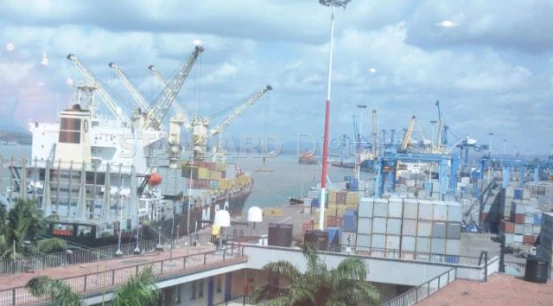
The Port of Mombasa risks losing its competitive edge following a wave of cargo theft that has hit the supply chain along the Mombasa-Malaba highway, importers and transporters have warned.

The Kenya Revenue Authority (KRA) describes the theft of the cargo as “a grave concern” but says it cannot quantify the loss.

KRA Southern Region manager George Muia said the taxman has launched investigations into the theft and diversion of transit goods into the local market, which is blamed for the failure to meet revenue targets.

He said that the ongoing probe conducted by the Revenue Protection Unit will be extended to Uganda and Rwanda.


“An investigation is going on. But to start with, we have imposed sanctions on two Electronic Cargo Tracking System (ECTS) seal providers that have had repeated cases of interference,” said Muia.

A status report compiled by transporters and customs agents reveals a spike in cargo pilferage or theft along the highway by a cartel able to interfere with cargo tracking systems undetected.

The report handed to the National Police Service Commission reveals that in the month of September and October, 65 cases of attempted or actual theft of goods from containers fitted with the mandatory ECTS were documented by the Kenya Transporters Association (KTA) and customs agents.

Transporters say they are suffering losses running into millions as a result.

The Standard on Sunday established that officers from the Ethics and Anti-Corruption Commission as well as the Directorate of Criminal Investigations are expected in Mombasa this week to probe the alleged theft of more than 2,000 containers loaded with assorted items destined for Uganda in the last nine months.

Supply chain stakeholders are puzzled at how the theft is taking place undetected despite the ECTS system being in place.

Seals puzzle

Trucks ferrying transit containers are required to fit a tracking system that monitors their movement in real time. Containers are also secured with ECTS seals and KRA, the transporter and ECTS service providers are alerted when there is an attempt to tamper with this system.

The ECTS is deactivated once the cargo arrives at the Malaba border and bonds cancelled.

Kenya licensed several private companies that supply the gadgets at a fee of up to $1,000 (about Sh102,000) and another $200 (Sh20,400) for the seal, with the fee levied on the transporter and cargo owner.

However, on September 8, one transporter’s records indicated that his truck was ferrying 632 cartons of dry iron boxes from Mombasa but only 294 cartons were found in the container when the cargo reached the owner.

“On arrival at the client premises in Nairobi, it was discovered that the container had a different seal number from the original. The case (151/34/2015) is going on at the Nairobi Law Courts but we have paid Sh2,088,619 as penalties,” states the transporter’s report.

On October 9, a consignment of 582 microwaves was missing from a container load. The theft was only discovered when the truck reached its destination.

And on October 18, robbers attacked a transit truck heading to Kagali at Chimoi along the Eldoret-Webuye road, an area the report cites as a hotspot for such activities. “They cut the seal and tracking gadget and stole five hand sprayers,” the report says.

Then on October 20, another transporters lost a 20ft container loaded with coffee on its way to the port of Mombasa. The truck is parked at Changamwe Police Station, where the incident was reported.

Less than a week later, on October 26, another truck enroute from Mombasa was attacked by robbers in Taru, Kwale County, along the Mombasa-Nairobi highway and a container loaded with rice stolen.

The matter was reported at MacKinnon Road Police Station the next day under OB Number 03/27/20/2015.

Mr Wellington Kiverenge, KTA’s chief executive officer, a lobby group representing truckers, said the cartel appears to have an elaborate collusion network.

The observation is shared by Shippers Council of East Africa CEO Gilbert Langat, who adds that the effectiveness of the cartel “could only mean that it involves drivers, corrupt customs officers, unscrupulous traders and some law enforcing authorities”.

“These guys are able to open seals and remove part of the cargo, empty part of the consignment and replace the seals and sometimes steal goods without tampering with the seals,” Kiverenge said.

And Langat pointed out that the sophistication of the cartel demands that the rapid response teams have sufficient resources, such as aircraft, to respond to emergencies promptly.

He said high-value goods such as coffee, sugar and electronics were the most targeted.

“Pilferage can only be done when the contents of a container are well known. And for this to happen, there must be some element of collusion by those handling it,” said Langat.

“In Uganda, the tracking devices are offered by URA for free and the system has worked smoothly. In Kenya, where private companies play a key role in the system, and being in competition among themselves, the providers can easily be motivated to make each other look bad.”

Other experts say that after the region embraced a Single Customs Territory, requiring the payment of the taxes at the point of entry, it erred in failing to employ uniform tariffs and taxes on isolated goods. Thus, they argue, unscrupulous traders import goods as destined for Uganda, pay duty to the Uganda government and exploit the weak monitoring system to divert the goods into the Kenyan market.

“In fact, this is denying the revenue authority a huge amount of revenue since various products such as sugar attracts significantly varying levels of taxation in Kenya and Uganda,” a custom agent in Mombasa who want to remain anonymous.

KRA also says the number of importers who ship in cargo as destined to Uganda but later pay Kenyan taxes and cargo diverted to Kenya has increased.

“Although it is not illegal for cargo destined for Uganda to be diverted into the local market once the shipper has paid the taxes, we are witnessing an increase in that trend,” said Muia.

He said KRA had reports of ten cases of cargo theft in transit but added that it was upon the law enforcing agencies to curb the vice.

National Police Service Commission Deputy Director for Communication Winifred Kitonga the transporters’ damning report will be handed to the Inspector General of police.


https://www.standardmedia.co.ke/coast/a ... -authority


Nothing has changed since then, Kenyans are thieves.
Re: And this is why Ethiopia will never use it

Posted: 05 Oct 2021, 22:38
by AbyssiniaLady
Analysis into the corruption at Mombasa port


Alexander Farrow, Business Intelligence Officer at MAST comments on the investigation.
It has been reported that Kenya’s Ethics and Anti-Corruption Commission (EACC) is working in partnership with international security agencies such as Interpol and Britain to assist with the investigation of corruption allegations involving cargo theft at the port of Mombasa.

The extent of the corruption is still unclear, but the involvement of Interpol and Britain among other nations suggests that this is a significant breach of the ports security.


The first phase of the new container terminal in Mombasa was inaugurated on the 3rd September which is expected to boost cargo capacity by 50%. Ensuring that this corruption is curbed before the new terminal is fully operational will be crucial to ensure that contracts are won to fill the new capacity.

The robust approach being taken by the EACC and the involvement of international partners demonstrates the serious intent to safeguard the port as an asset, as well as to abide by the ISPS Code.

The incorporation of internal security systems and checks to increase the ports resilience against corruption and other crimes is likely to be a key recommended outcome of the investigation.

Corruption is rarely confined to a single criminal enterprise, but is highly integrated into networks which can directly or indirectly fuel more serious crimes including terrorism. If there is high level corruption involving cargo theft, it is possible there is corruption in other areas of the ports operation, as well as further afield, even as far as Mombasa’s trading partner ports.

Whilst this investigation is ongoing and the extent of the corruption is unknown, it would be prudent for vessel operators to consider individual security implications.

https://mast-security.com/analysis-corr ... mbasa-port

Re: And this is why Ethiopia will never use it

Posted: 05 Oct 2021, 23:04
by AbyssiniaLady
Cargo theft on Northern Corridor still major threat to regional trade

Tuesday August 20 2019


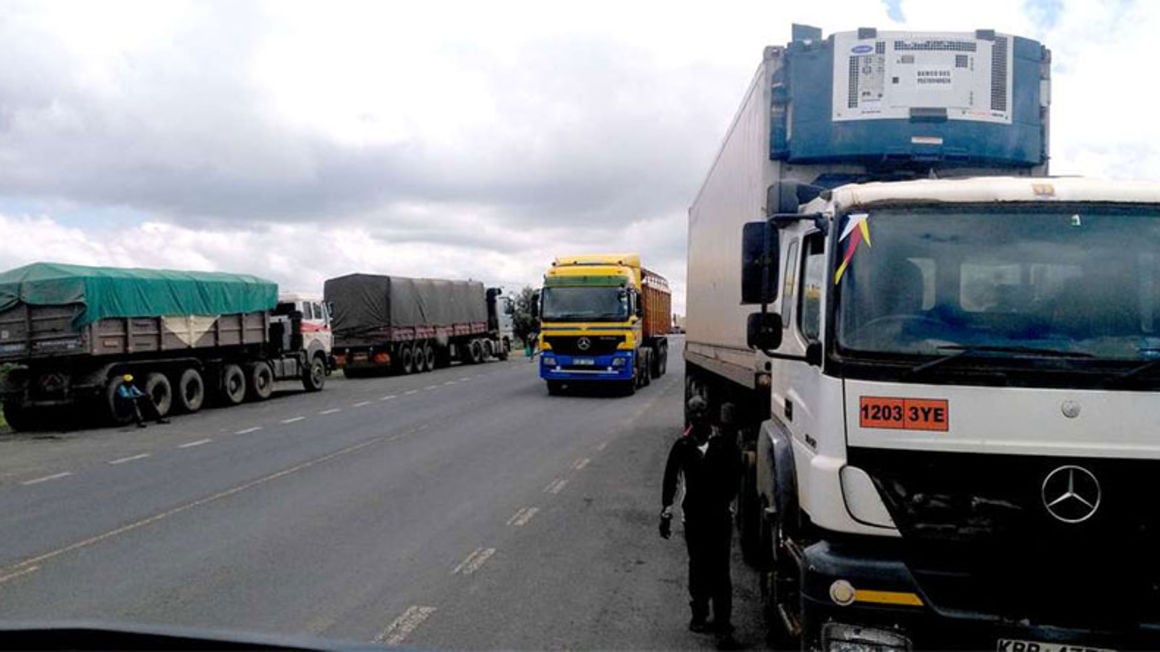
Trucks parked by the roadside in Kikopey, Gilgil. FILE PHOTO | NMG

The Northern Corridor is becoming an unattractive route for transporters due to cargo thefts along the highway.

The Coast security committee said the cargo thefts and fuel siphoning from trucks plying Mombasa-Nairobi highway and the Northern Corridor are threatening the regional trade, warning that stern action would be taken against the culprits.

The latest theft incident was on August 16, when GSU and detectives from Mombasa County seized goods suspected to have been stolen on transit. The goods were impounded after police officers from the Directorate of Criminal Investigation, Central Police Station and GSU conducted a joint operation at Mikindani and Bangladesh areas.

“Fertiliser suspected to have been stolen while on transit was recovered,” read a police report.

However, according to the Kenya Transporters Association (KTA) chief executive Dennis Ombok, cases of stolen transit goods on the road have reduced.

“This is due to the introduction of the Northern Corridor Transit Patrol Unit (NCTPU) some years back. Contacts of the patrol police officers in each station have been shared to all truck drivers and owners,” he said.

“Furthermore tracking devises installed in the trucks have played a very big role in the reduction of diversion of cargo.”

In 2016 the NCTPU, a special police unit constituted to combat cargo theft and general crime along the Northern Corridor, began its operations. The unit, which operates between Mombasa and Busia, has been divided into 10 sectors, each headed by a superintendent of police.

President Uhuru Kenyatta had directed that a joint unit be constituted to oversee security of cargo on transit. The then Inspector-General of Police Joseph Boinnet deployed 200 police officers to the unit.

In 2016, theft cases were so rampant that some transporters rerouted to Tanzania.

Coast Regional Police Commander Marcus Ochola told Shipping this week theft incidents are hurting Kenya’s stature as a transit hub.

“We have heard of cases of stolen goods on transit, especially trucks ferrying cargo from the Port of Mombasa to Uganda, and other neighbouring countries. This crime should stop, it is destroying our image as a country,” Mr Ochola said.

The theft cases, he said is detrimental to smooth flow of trade in the region while criminal acts such as siphoning of fuel pose dangers to human lives.

“Siphoning fuel is not only a criminality but it is dangerous and can cause disasters,” Mr Ochola said.

“The theft of goods is also a threat to trade flows and economic integration in the East and Central African region.”

Mr Ochola said most of the cargo thefts occur when drivers stop by the side of the road for a break or to sleep.

Some drivers said the criminals involved in the racket often drug them.

“The crimes happen when truck drivers are drugged by criminals during stopovers either for food or rest. Many long distance truck drivers have been drugged along the highway,” said Kazungu Juma, a truck driver.

The Northern Corridor connects Kenya from the Port of Mombasa to Uganda, Rwanda, Burundi, the Democratic Republic of Congo and South Sudan.

“Police officers along this route must ensure safety of cargo. Long distance truck drivers must equally be aware of their surroundings. We must deal with this crime,” Mr Kazungu said.

Last month, the regional police commandant held meetings with stakeholders and residents in Maji ya Chumvi Township along the Mombasa-Nairobi highway urging them to help police in dealing with the crime.

“Cargo worth millions of shillings is stolen along this trade route from trucks as drivers make stopovers. This crime should stop. Transporters from neighbouring countries are complaining that Kenyans are stealing their goods imported through the Port of Mombasa,”Mr Ochola said.

He warned that the crime is scaring away investors including importers and transporters.

Police records indicate that cargo and vehicle thefts, drugging and even loss of lives have been reported over the last few years.

https://www.businessdailyafrica.com/cor ... index.html