
የአክሱም ጽዮን ማርያም ቄስ በመምሰል "በአክሱም ከተማ በክርስትያኖች ላይ ጭፍጨፋ ሲፈጸም በአይኔ አይቻለሁ" ብሎ ለአምነስቲ ኢንተርናሽናል የውሸት መረጃ የሰጠው እና በአሜሪካን ሀገር ቦስተን ከተማ ነዋሪ የሆነው አቶ ሚካኤል በርሄ ወደ ኢትዮጵያ ተጠርዞ እንዲመጣ አልያም ባለበት ሀገር ፍርድ ቤት እንዲገተር የውጭ ጉዳይ ሚኒስቴር አሜሪካ ለሚገኘው የኢትዮጵያ ኤምባሲ በጻፈው ደብዳቤ ገልጿል።
This is unacceptable! Ethiopia cannot do this, to a holy man of god.
የአክሱም ጽዮን ማርያም ቄስ በመምሰል "በአክሱም ከተማ በክርስትያኖች ላይ ጭፍጨፋ ሲፈጸም በአይኔ አይቻለሁ" ብሎ ለአምነስቲ ኢንተርናሽናል የውሸት መረጃ የሰጠው እና በአሜሪካን ሀገር ቦስተን ከተማ ነዋሪ የሆነው አቶ ሚካኤል በርሄ ወደ ኢትዮጵያ ተጠርዞ እንዲመጣ አልያም ባለበት ሀገር ፍርድ ቤት እንዲገተር የውጭ ጉዳይ ሚኒስቴር አሜሪካ ለሚገኘው የኢትዮጵያ ኤምባሲ በጻፈው ደብዳቤ ገልጿል።
Re: This is unacceptable! Ethiopia cannot do this, to a holy man of god.
Sudan takes center stage in US regional strategy
https://www.al-monitor.com/originals/20 ... l-strategy
Khartoum gets a boost this week from the World Bank and the International Monetary Fund as US Sudan envoy tours the region; the latest Nile dam talks kick off in Kinshasa, Congo, on Saturday.
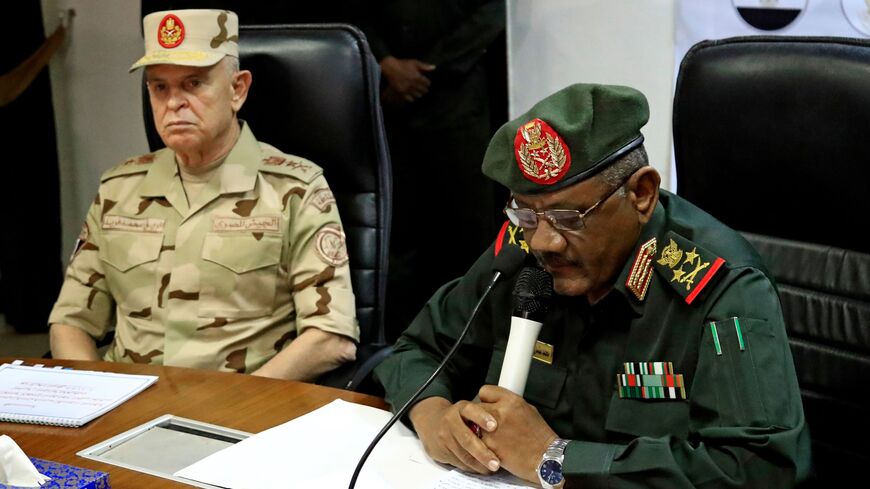
Egyptian and Sudanese military officials ASHRAF SHAZLY/AFP via Getty Images
April 1, 2021
US-Sudan relations are in full turnaround from where they were two years ago. The transition is still fragile, but on a fast track, especially after this week.
A decision by the World Bank and the International Monetary Fund (IMF) gives Sudan’s 44 million people a chance to break the cycle of chronic poverty and fragility.
And the visit to the region this week by US Sudan envoy Donald Booth also signals the increasingly pivotal role Khartoum plays in the region — especially in the regional Nile dam talks and addressing the civil war in Tigray, which has spilled over into Sudan.
The flurry of diplomacy comes as the risk of escalation grows. The latest round of African Union-mediated talks among the foreign ministers of Sudan, Egypt and Ethiopia are slated to start in Kinshasa on Saturday.
“New chapter” in US-Sudan ties
On March 31 US Secretary of State Antony Blinken welcomed a “new chapter” in US-Sudan relations after Khartoum paid $335 million to compensate victims of al-Qaeda terrorism in the 1998 bombings of the US embassies in Kenya and Tanzania and the USS Cole in Yemen in 2000.
Sudanese President Omar al-Bashir, who was deposed following popular demonstrations in April 2019, was implicated in al-Qaeda’s terrorist actions in Africa, including providing safe haven to Osama bin Laden in Sudan from 1994-1996. Sudan was designated by Washington as a state sponsor of terrorism.
The country’s payment and its recognition diplomatically of Israel is part of the deal to get Sudan off the US list of state sponsors of terrorism, which had blocked Sudan in terms of receiving international aid and assistance. Sudan’s delisting had been in the works for a while, but was accelerated by Sudan’s decision to join the Abraham Accords, as Jared Szuba reported https://www.al-monitor.com/originals/20 ... laims.html at the time.
“Once in a generation” opportunity
With Sudan leaving the terrorist list in Washington, the IMF and the World Bank are now considering Sudan’s application for debt relief under the Enhanced Heavily Indebted Poor Countries Initiative.
On March 26, David Malpass, World Bank Group President, called the decision a "breakthrough," https://www.imf.org/en/News/Articles/20 ... initiative adding that the reform steps taken so far by Sudan’s government,
An IMF reportincluding arrears clearance and exchange-rate unification, will put Sudan on the path to substantial debt relief, economic revival and inclusive development.
httpss://www.imf.org/en/Publications/CR/Issues/2 ... -456-42847 this month referred to Sudan as having a
to build on, and accelerate, structural reforms undertaken by the civilian-military transitional government of Prime Minister Abdalla Hamdok.once in a generation window of opportunity
The challenges remain daunting. Sudan faces chronic poverty and underdevelopment. As a primarily agricultural economy, Sudan is especially sensitive to climate variations and flooding. The incidence of extreme poverty (living below $1.90 per day) is high at 13.5%, but rises to 46.1% if the lower-to-middle-income country poverty standard is used ($3.20 per day). Sudan ranks near the bottom on the Human Development and Human Capital Indices.
Sudan’s economy, especially hard hit by COVID-19, shrank by an estimated at 3.6% in 2020. Unhappily for the country, it was the third straight year of negative growth. The IMF projects Sudan’s economy to grow this year by 0.9%.
“Unprecedented” partnership with Egypt
The United States is not the only country that has opened a new chapter with Sudan. Egypt-Sudan ties over the past two years have also witnessed a dramatic turnaround, from the days of Bashir, who had an affinity for the Muslim Brotherhood.
Ayah Aman writes, https://www.al-monitor.com/originals/20 ... al-players
The Ethiopian civil war in the Tigray region has led to a hot border dispute with Sudan. Sudan is hosting 70,000 refugees https://www.washingtonpost.com/world/20 ... -refugees/ from Tigray, and the numbers are growing. Sudanese forces have skirmished with Ethiopian military and militias on the border.There now seems to be an unprecedented strategic partnership between the two countries amid cooperation at all levels aimed at confronting regional threats.
Blinken this month accused Ethiopia of "ethnic cleaning" in Tigray, https://www.msn.com/en-us/news/world/bl ... r-BB1esEBP a charge denied by Addis Ababa. Troops from neighboring Eritrea have also been implicated in the attacks. Ethiopian Prime Minister Abiy Ahmed received the Nobel Prize in 2019 for making peace with longtime rival Eritrea. Both Ethiopia and Eritrea oppose the Tigray People’s Liberation Front, which they blame for the conflict.
The second issue is the stalled talks on the Grand Ethiopian Renaissance Dam.
On March 31, Egyptian President Abdel Fattah al-Sisi said,
Egypt's population of 100 million depends on the Nile for 95% of its water needs. Any interruption in the flow of Nile water because of the dam would be devastating. Egypt wants an internationally brokered plan for water management of the dam. For Ethiopia, the Nile is a sensitive nationalist issue. Talks mediated by the United States, the World Bank and the African Union have so far yielded little progress. And now Ethiopia is consumed by the fighting in Tigray.No one can take a drop of water from the waters of Egypt. Whoever wants to try, let him try. But this would destabilize https://www.msn.com/en-xl/news/other/su ... r-BB1fbXdZ the whole region. No one should dare question our capabilities but if they want to put us to the test, then so be it.
Although Sudan would be less impacted by any potential disruption of Nile water flow, Khartoum is backing Cairo’s call for mediation, as its concerns with Ethiopia are increasingly affected by the fighting in Tigray.
The Nile dam dispute and the Tigray fighting have sparked an intensification of regional diplomacy. Egypt has been reaching out to Burundi, https://www.al-monitor.com/originals/20 ... dam-crisis Djibouti and Somalia to counter Ethiopia’s regional network, as Muhammed Magdy reports. https://www.al-monitor.com/originals/20 ... d-djibouti
The Egypt-Sudan partnership has meanwhile taken off diplomatically, economically and militarily. On March 31, Egyptian and Sudanese air forces launched joint training exercises. Mohamed Saied writes https://www.al-monitor.com/originals/20 ... ay-network that even
Congo, African Union take up next round of Nile dam talksbilateral economic projects such as the railway project, an electrical connection https://egy-map.com/project/%D8%A7%D9%8 ... 9%86%D9%8A project and others in the fields of transportation, agriculture and irrigation cannot be analyzed in isolation from the [dam] dispute.
In his Senate confirmation hearing in January, Blinken said the United States would be "fully engaged" in the Horn of Africa, and warned that the Nile dam talks could "boil over." https://www.al-monitor.com/originals/20 ... -over.html
US President Joe Biden has already sent a close ally, Democratic Sen. Chris Coons of Delaware, to the region to convey US concerns about the situation in Ethiopia, and reportedly may appoint https://foreignpolicy.com/2021/03/22/bi ... rica-gerd/ former senior US/UN diplomat Jeffrey Feltman as envoy.
US special envoy for Sudan Donald Booth was in the region last week, seeking to find ways to jumpstart the dam talks and de-escalate tensions in Tigray, as Muhammed Magdy reports. https://www.al-monitor.com/originals/20 ... -dam-talks
Egypt and Sudan are invested in a diplomatic outcome in both Tigray and the dam talks. Neither wants nor is served by escalation or conflict. Sudan has backed a proposal, supported by Egypt, https://www.al-monitor.com/pulse/origin ... water.html to involve the United States, the European Union and the UN, as well as the African Union, in mediating the dam talks, but Ethiopia rejected the offer.
Following Booth’s tour, Democratic Republic of Congo President Felix Tshisekedi, the incoming head of the African Union, announced a new round of Nile dam talks starting in Kinshasa on April 3.
There have been other bids for mediation. Sudan welcomed an offer by the United Arab Emirates to help broker a solution to the stalled dam talks, as Khalid Hassan reports. https://www.al-monitor.com/originals/20 ... dam-crisis Egypt, however, has held back on the offer, as Hassan and Ayah Aman explain. https://www.al-monitor.com/originals/20 ... -dam-talks
Abu Dhabi has good relations with Abiy and substantial investments in Ethiopia. As Sam Ramani explains, https://www.al-monitor.com/originals/20 ... a-strategy
Saudi Arabia has also deepened its ties with Sudan. Last month, Hamdok, in a meeting with Saudi Crown Prince Mohammed bin Salman (MBS), praised the kingdom for its mediation in the Sudanese peace process. https://www.al-monitor.com/originals/20 ... iyadh.html Just this week, MBS called the chairman of Sudan’s Transitional Sovereignty Council, Lt. Gen. Abdel Fattah Abdelrahman al-Burhan, to discuss the Saudi "Middle East Green" initiative. https://menafn.com/1101824259/Saudi-HRH ... l-of-Sudan In February, the kingdom offered to mediate on the Nile dam talks, as Ayah Aman reported https://www.al-monitor.com/originals/20 ... t-dam.html in February.The UAE is reorienting its Red Sea strategy away from direct military intervention and toward a synthesis of economic investment and remote power projection.
Saudi Arabia, Jordan, Bahrain, Oman, Kuwait and the Organization of Islamic Cooperation all weighed in https://www.msn.com/en-xl/news/other/su ... r-BB1fbXdZ this week in support of Egypt and Sudan in the Nile talks.
Eyes on Sudan
As we wrote here in October 2019, https://www.al-monitor.com/originals/20 ... -2019.html the popular demonstrations that began in Sudan in December 2018 and that eventually deposed Bashir, a war criminal and dictator, foreshadowed a kind of sequel https://www.al-monitor.com/originals/20 ... egypt.html to the Arab Spring, which also occurred in Algeria, Iraq, Lebanon and elsewhere.
Sudan’s role in the region is increasingly impactful. And its people, which in the past have suffered from chronic poverty, abusive and corrupt governance, and, in Darfur, genocide, deserve this opportunity for a new direction and social contract with their rulers.
Re: This is unacceptable! Ethiopia cannot do this, to a holy man of god.
As an avowed God-fearing Christian I know deep in my heart that agame's blasphemy against God is the unforgivable sin. It is the "Thou shalt not take the name of the LORD thy God in vain" God's commandment that the agame keep breaking over and over again, and as a consequence they fall on the hands of war, famine, pestilence, a plague, locust invasion and diseases.
For example, when the terrorist agame Awash changed his nick to "Aba" and used God's name in vain to promote his terrorist agendas against both the Ethiopian and Eritreans people, that's when I knew the hottest spot in hell was reserved for him.
Re: This is unacceptable! Ethiopia cannot do this, to a holy man of god.

Can Turkey Break With the Muslim Brotherhood?
2 April 2021
Sami Moubayed
https://eeradicalization.com/can-turkey ... otherhood/

On 20 March 2021, the Acting General Guide of the Egyptian Muslim Brotherhood (MB), Ibrahim Munir, appeared on the Doha-based Al-Jazeera television station to speak about the rapprochement-in-the-making between Cairo and Ankara, which has raised eyebrows, and a storm of speculation, across the region. He seemed confident and very well-informed, telling his followers that no deal had been reached at their expense between Turkish and Egyptian governments. Turkey, he added affirmatively, would never expel members of the Egyptian Brotherhood from its territory. On that, Munir was right.
The Egyptian Islamist leader was echoing a line that had been peddled by Turkish authorities behind closed doors to its Egyptian MB guests. He added that he continued to trust Turkey, calling on his followers to do the same.[1] The fact that he was actually given airtime on Al-Jazeera, a long-time supporter of the MB, is in itself testimony that little has changed in Turkish-Qatari backing for the outlawed Islamist group. But he felt obliged to come out and speak in light of an avalanche of media reports about an upcoming Turkish abandonment of the MB, which sent shivers down the spine of many members of the Egyptian MB. One said that Turkey had muzzled thirty members of the MB, ordering them to stop speaking to the press. Another added that Egyptian Islamists in Turkey were being placed under house arrest in anticipation of their deportation, while a third claimed that investigations were underway into the bank accounts of Egyptian MB members based in Turkey.[2]
Fact or Fantasy?
Many of these reports about Turkey turning on the MB were more fantasy than fact, however, either the doing of an imaginative journalists or anti-Brotherhood hopefuls—both categories well-represented in the Arab World. All of these reports were seemingly based on recent instructions from Turkish authorities to three Egyptian opposition channels broadcasting from Turkey, ordering them to tone down their criticism of Egyptian ruler Abdul Fattah al-Sisi. The three channels—El-Sharq, Watan TV, and Mekameleen—are all affiliated with the MB and they were threatened with penalties if they defied the order.[3] Immediately El-Sharq came out with a statement, apologizing to viewers for not airing an evening episode of a program called, “The Streets of Egypt,” which was usually dedicated to bashing the Sisi government.
Putting things into perspective was Yasin Aktay, an adviser to Turkish president Recep Tayyip Erdogan, who appeared on Al-Jazeera TV to deny that his boss had any intention of closing the three television channels or extraditing members of the Egyptian MB. Aktay described the backlash as “barking,” adding:
[4]It is impossible for Turkey to extradite any person, neither to Egypt nor to any country that observes capital punishment.
Prominent Egyptian opposition member Ayman Nour, who manages El-Sharq TV, added that Turkish authorities had asked them politely to amend their editorial policy towards Egypt, also denying an order to shut down his channel.[5]
Not that these statements did much good; the media speculation about a divorce between Erdogan and the MB continued to mushroom. One report said that a senior delegation had been created to revisit the residency permits of Egyptian Brotherhood members residing in Ankara and Istanbul since 2013. The Syrian Observatory for Human Rights (SOHR), which admittedly has a very spotty record when it comes to accuracy, added to the wave of speculation, saying that Turkish-backed fighters in Libya have been ordered to pack up and leave in a gesture of goodwill towards the Egyptians. The report added that 9,000 of them have already left the Libya battlefield and were flown out by Turkish intelligence.[6] At least one of those military groups, Faylaq al-Sham, is openly affiliated with the Syrian branch of the Muslim Brotherhood.[7]
Erdogan Will Not Abandon the Brotherhood
Expecting Erdogan to sell out the MB is akin to asking Iran to abandon Hezbollah or Russian ruler Vladimir Putin to withdraw his troops from Syria. It is wishful thinking that simply will not happen. The Turkish leader has built his entire foreign policy towards the Arab World on supporting non-state players like the MB, using them as pressure cards to destabilize governments and advance his own political ambitions. Without the MB he would lose his leverage in Egyptian, Palestinian, and Syrian affairs, eroding his recent victories in Libya, where he managed to thwart the military offensive of Khalifa Haftar last year, through MB-affiliated mercenaries. He needs Hamas to maintain a threshold in the upcoming Palestinian elections, and their Syrian comrades to keep the territory that he grabbed in Syria during the years 2016-18.
Abandoning these proxies would be akin to Erdogan shooting himself in the foot, depriving himself of a reliable tool of state policy that he has used, time and again, to influence events in the Arab World. And we need to ask what Erdogan will get in return for such a suicidal policy? Turkish-Egyptian economic relations are on the rise, but they were never suspended despite the political tensions. According to official figures, Egyptian exports to Turkey rose to $2 billion in 2018, slightly up from $1.9 billion in 2017, while Turkish imports stood at an impressive $2.3 billion.[8] With or without a U-turn on the MB, those economic relations are likely to continue. That, of course, is in addition to the fact that he is ideologically committed to the MB, where he started his career as a young politician. It must be remembered that not even the multi-state boycott of Qatar, succeeded in getting its young emir, Tamim Bin Hamad, to abandon Hamas and the MB or amend the pro-Islamist editorial policies of Al-Jazeera TV—and Qatar is much more vulnerable to pressure than Turkey.
Still, it does seem there is an Egyptian-Turkish rapprochement underway, motived by mutual interests and shifting regional dynamics related to the Biden Administration. Turkish-American relations are at all-time low after a recent decision by the White House to recognize the Armenian genocide that took place during the First World War.[9] Turkey is also already facing the threat of sanctions from both the European Union and the United States for, respectively, drilling in waters claimed by Cyprus and purchasing S-400 anti-aircraft missiles from Russia. Erdogan feels increasingly vulnerable and isolated, searching for regional and international allies. Many of those on whom he had relied for years are gone, including Egypt’s Mohammad Morsi, Omar al-Bashir of Sudan, and more recently, Fayez al-Sarraj of Libya.
The Path Ahead
Official admission from Ankara came on 12 March when Erdogan’s Foreign Minister Mevlüt Çavuşoğlu announced that talks have resumed with Egypt, at both an intelligence and political level, a significant breakthrough, no doubt, after years of tension and animosity resulting from the 2013 ouster of President Morsi, who was backed fully by Erdogan.[10] On 14 March, Egypt’s Foreign Minister Sameh Shukri confirmed that talks had indeed resumed, saying that Turkey’s statements of good will needed to be followed with concrete action for the normalization to move forward, explaining why Turkey floated the trial balloon of clipping the wings of the three MB-affiliated channels—as a confidence building measure with Cairo. But for those talks to move forward and bear fruit, Erdogan will have to do better than that, taking serious action against the MB, which—pending some radical, unforeseeable event—he will not do.
said Abdullah Bozkurt, a Turkish journalist affiliated with the Turkish opposition Gulen movement. Speaking to EER, Bozkurt went on:The disengagement of President Erdogan from the Muslim Brotherhood is nothing but a balloon full of hot air,
concluding:He may offer sacrifices [and] concessions, but his overall strategy won’t change,
This recent posturing is not a strategic shift for him and his MB-minded political Islamists in Turkey. He will revert to his old policies openly as soon as the circumstances allow. In the meantime, he will continue lending his government’s support to the MB discreetly.
European Eye on Radicalization aims to publish a diversity of perspectives and as such does not endorse the opinions expressed by contributors. The views expressed in this article represent the author alone.
__________________________________________
References
[1] “Cairo sees little place for Brotherhood in rapprochement with Ankara” Arab Weekly (March 22, 2021): https://thearabweekly.com/cairo-sees-li ... ent-ankara
[2] Abdul-Razeq, Said. “Turkiya tuqayid harakat al-Ikhwan” Alsharq Alawsat (March 20, 2021): shorturl.at/gDRTZ
[3] “Turkey orders Muslim Brotherhood TV channels to stop airing anti-Egypt rhetoric” Al-Arabiya English (March 18, 2021): https://english.alarabiya.net/News/midd ... t-rhetoric
[4] “Mustashar Erdogan: Lam natlob iglak qanawat muarida li Masr, wa tasleem muarideen lam yutrah” CNN Arabic (March 19, 2021): https://arabic.cnn.com/middle-east/arti ... ions-egypt
[5] “Mustashar Erdogan: Lam natlob iglak qanawat muarida li Masr, wa tasleem muarideen lam yutrah” CNN Arabic (March 19, 2021): https://arabic.cnn.com/middle-east/arti ... ions-egypt
[6] “Bad Awdet Erdogan ila al-Hudn al-Arabi, tarakub li awdat al-murtazaka al-Souriyeen min Libya ila Souria bi awamer Turkiya” Syrian Observatory for Human Rights (March 19, 2021): shorturl.at/oHUZ6
[7] Lefevre, Raphael & El Yassir, Ali. “Sham Legion: Syria’s Moderate Islamists,” Carnegie Middle East Center (April 15, 2014): https://carnegie-mec.org/diwan/55344
[8] Cengiz, Sinem. “Can Egypt and Turkey break the ice after years of chilly relations?” Arab News (March 5, 2021): https://www.arabnews.com/node/1820551
[9] Ghazanchyan, Siranush. “Biden Administration will officially acknowledge Armenian genocide,” Public Radio of Armenia (March 23, 2021): https://en.armradio.am/2021/03/23/biden ... mmer-says/
[10] Burc Eruygur. “The Turkish-Egyptian Rapprochement: Prospects for the Future” The Center for Middle East Studies, (March 20, 2021): https://www.orsam.org.tr/en/the-turkish ... he-future/