When One Door Closes, Another One Opens
Posted: 22 Mar 2021, 09:43
Even if the US and the EU were to impose politically motivated illegal sanctions on both Ethiopia and Eritrea, it won't have any effect whatsoever on these two African lions that are enjoying sustainable peace, friendly cooperation and co-prosperity. As President Isaias Afewerki famously said:
The picture below is of President Isaias in 1967 at the Nanjing Military College in China.
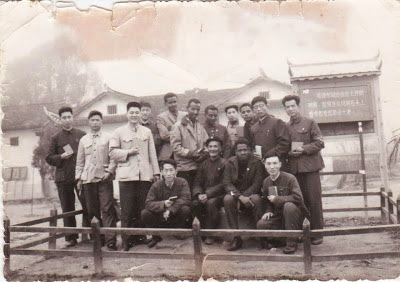
Standing L-R: 5th Isaias Afwerki, 6th Mahmoud Ibrahim Chekini/Cecchini, martyred 1972, 7th Ramadan Mohammed Nur, 9th Ahmed Adem Omer. Sitting L-R: 3rd Ahmed Ibrahim Ahmed
And for the record: China’s trade with Africa grew to US$208 billion in 2019. During the same period, the combined total value of African trade with the U.S. was just $39 billion.
Not only that. The total value of Chinese investments and construction in Africa is closing in on $2 trillion, according to the American Enterprise Institute (AEI) China Global Investment Tracker. Washington's top diplomat on the continent, Tibor Nagy, has sought to address the issue and restore influence in a part of the world where the U.S. and Europe, particularly France, have not faced genuine competition for political or economic influence in recent decades.
The battle for political and economic influence between the U.S. and China is playing out across Africa, and Beijing's growing presence is troubling Western policymakers, experts say.
Africa has become the fastest urbanizing region on the planet, and China has placed itself at the infrastructural vanguard of the new frontier.
Chinese firms have been most active in building ports, roads and railways that will underpin integration and trade between African nations — an intention most recently exemplified across the continent in the landmark African Continental Free Trade Agreement (AfCFTA). The AfCFTA recently launched its operational phase, and eventually intends to bring together all 55 African Union member states into the world's largest free trade area, spanning 1.2 billion people.
- "Self-reliance is often misinterpreted as an isolationist trend, which it is not at all. Self-reliance is preparing yourself for partnership-- equal partnership. We believe Africa should have its own alternative, not because Africa is unique, but because Africa is marginalized; not because of colonial history, but because of existing realities. There is a path we can adopt to extricate ourselves from the state of affairs in which we currently find ourselves and through which we can be equal partners with everybody.”
The picture below is of President Isaias in 1967 at the Nanjing Military College in China.
Standing L-R: 5th Isaias Afwerki, 6th Mahmoud Ibrahim Chekini/Cecchini, martyred 1972, 7th Ramadan Mohammed Nur, 9th Ahmed Adem Omer. Sitting L-R: 3rd Ahmed Ibrahim Ahmed
And for the record: China’s trade with Africa grew to US$208 billion in 2019. During the same period, the combined total value of African trade with the U.S. was just $39 billion.
Not only that. The total value of Chinese investments and construction in Africa is closing in on $2 trillion, according to the American Enterprise Institute (AEI) China Global Investment Tracker. Washington's top diplomat on the continent, Tibor Nagy, has sought to address the issue and restore influence in a part of the world where the U.S. and Europe, particularly France, have not faced genuine competition for political or economic influence in recent decades.
The battle for political and economic influence between the U.S. and China is playing out across Africa, and Beijing's growing presence is troubling Western policymakers, experts say.
Africa has become the fastest urbanizing region on the planet, and China has placed itself at the infrastructural vanguard of the new frontier.
Chinese firms have been most active in building ports, roads and railways that will underpin integration and trade between African nations — an intention most recently exemplified across the continent in the landmark African Continental Free Trade Agreement (AfCFTA). The AfCFTA recently launched its operational phase, and eventually intends to bring together all 55 African Union member states into the world's largest free trade area, spanning 1.2 billion people.


