Page 1 of 1

(Al- Monitor): Ethiopia, China sign deal amid stalled Nile dam talks

Posted: 19 Mar 2021, 20:48

by Zmeselo


Ethiopia, China sign deal amid stalled Nile dam talks

Ethiopia and China recently signed an agreement to protect investment projects, at a time Egypt and Sudan are seeking an international quartet to break the deadlock in the negotiations on Addis Ababa’s controversial Nile dam.
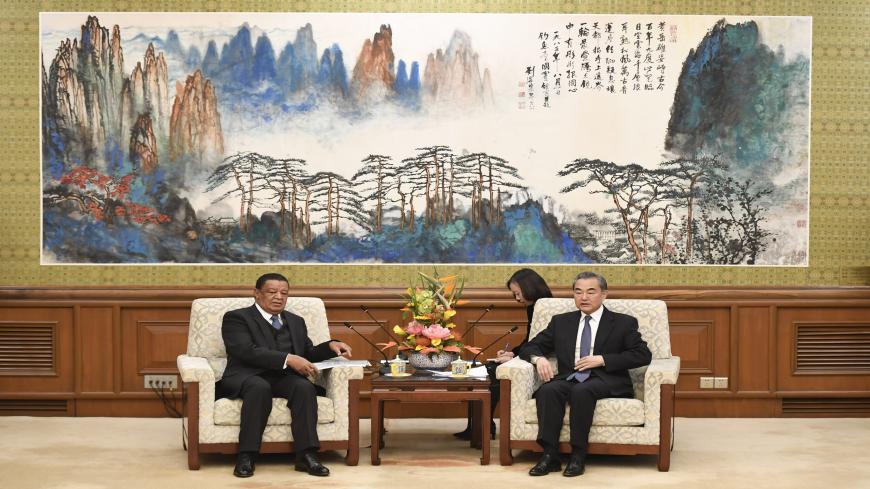

Former Ethiopian President Mulatu Teshome (L) and Chinese State Councilor and Foreign Minister Wang Yi attend a meeting at the Diaoyutai State Guesthouse, Beijing, China, Oct. 30, 2019.


Khalid Hassan

https://www.al-monitor.com/originals/20 ... -dam-talks

CAIRO — On March 6, the commissioner-general of the Ethiopian Federal Police, Demelash Gebremichael, signed a memorandum of understanding with the Chinese ambassador to Ethiopia, Zhao Ziyuan, on establishing a protection mechanism http://arabic.news.cn/2021-03/07/c_139790113.htm for the security of major projects implemented within the framework of the Belt and Road Initiative in Ethiopia.

During the signing ceremony, http://www.china.org.cn/world/2021-03/0 ... 280556.htm Gebremichael said this agreement will boost safety and security in the country's major development projects.

He continued,
Ethiopia and China are two countries that have a long history, ancient civilization and splendid culture. To achieve our goal, the support provided by China and its esteemed embassy plays an important role. We wish to continue our joint efforts in long-term construction and strategic partnership, and today’s event comes at a critical time.
According to the Chinese agency Xinhua, http://www.xinhuanet.com/english/2021-0 ... 792150.htm the agreement will play an important role in enhancing the security and normal course of Chinese investments in Ethiopia.

Following the signing ceremony, Ziyuan said,
China and Ethiopia have established strong partnerships, https://almalnews.com/%D8%A7%D8%AA%D9%8 ... %A7%D9%8A/ which helped implement major development projects in Ethiopia efficiently.
As soon as the agreement was concluded, questions arose about its importance and timing. Ethiopian activist and analyst Munir Adam tweeted March 8 that amid Sudanese-Egyptian pressure on Ethiopia, Beijing concluded an agreement with Addis Ababa to protect and secure huge projects

in the country.

The Ethiopian move comes after Egypt and Sudan signed an unprecedented military agreement https://www.skynewsarabia.com/middle-ea ... 9%8A%D8%A9 to secure the borders and protect the national security of the two countries during the March 2 https://www.al-monitor.com/pulse/origin ... water.html visit of the Egyptian army chief of staff, Lt. Gen. Mohamed Farid, to Khartoum.

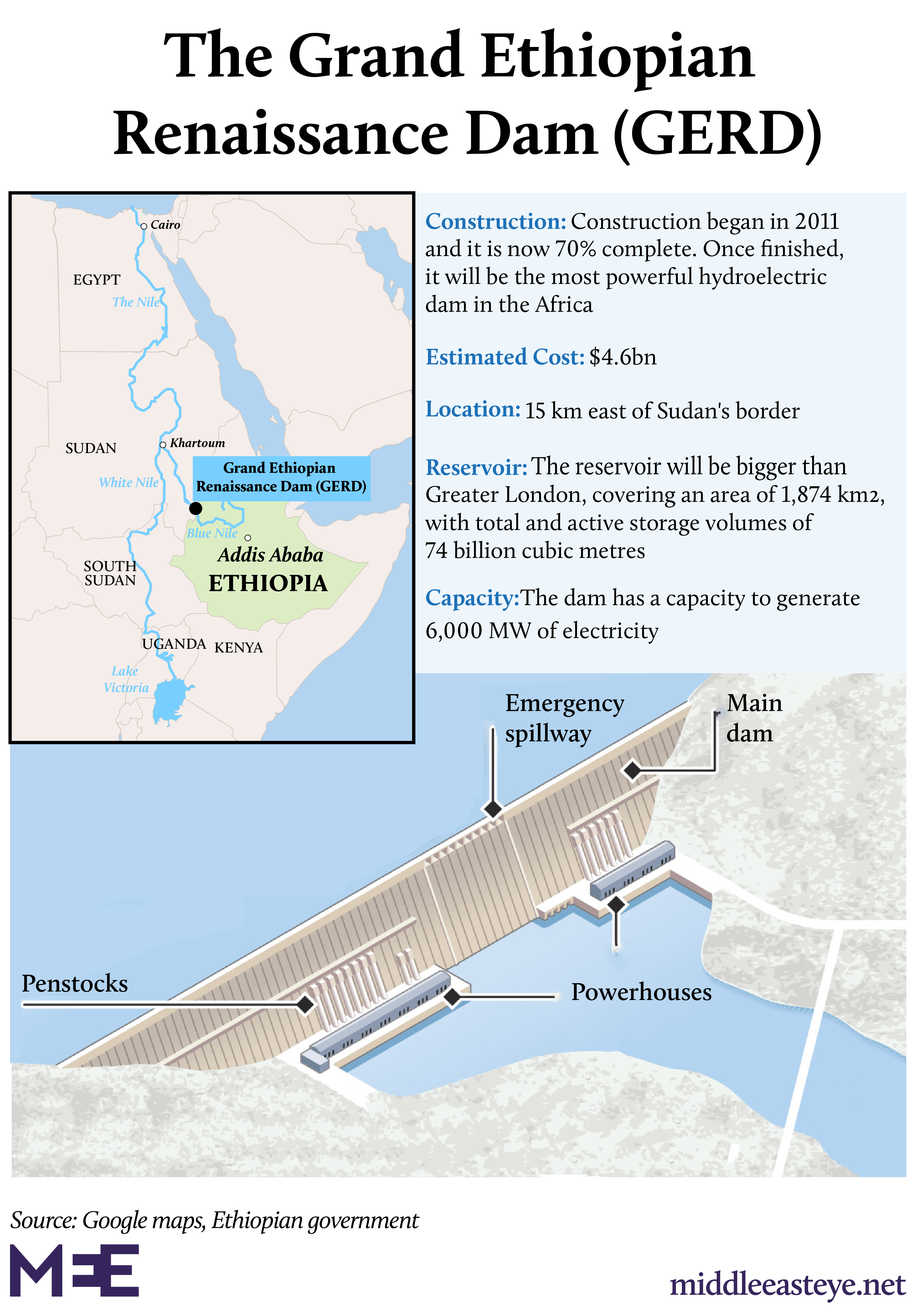
Regarding the timing of the agreement, Maj. Gen. Gamal Mazloum, a military analyst and adviser at the Nasser Military Academy, told Al-Monitor that Ethiopia is seeking to bring in international parties in response to the Egyptian-Sudanese military alliance. According to Mazloum, Ethiopia is concerned about an Egyptian-Sudanese military intervention to strike the Grand Ethiopian Renaissance Dam (GERD), as the dam is only 15 kilometers (9 miles) from the Sudanese border. It is an easy target for Egypt, as it would not need drones, long-range missiles or military bases, he said.

Mazloum noted that the recent Egyptian moves, President Abdel Fattah al-Sisi’s visit to Sudan, his warning to Ethiopia from within the Sudanese territories and Egypt’s recent communication with the United Nations sent a clear message to Ethiopia and the international community, whereby Egypt will not accept the second filling of the GERD before reaching a binding legal agreement between the three parties. Otherwise Egypt will strike the dam to protect its water rights, he added, which would prompt Ethiopia to take action.

During a phone call with UN Secretary-General Antonio Guterres March 5, Egyptian Foreign Minister Sameh Shoukry expressed his country’s concern about the stalled GERD negotiations. https://arabic.rt.com/middle_east/12088 ... %B6%D8%A9/

Sisi paid an official visit https://www.skynewsarabia.com/middle-ea ... 8%B6%D8%A9 to Sudan March 6 and announced his rejection of any unilateral measures by Ethiopia to impose
a fait accompli and monopolize the resources of the Blue Nile.
On March 9, Sisi said during an extended meeting with leaders, officers, noncommissioned officers and soldiers of the armed forces that the Nile River
is our life and the life of our brothers in Sudan. We insist on proceeding with our negotiations, but our negotiations are not without end.
https://www.youm7.com/story/2021/3/9/%D ... A9/5239585

Regarding the impact of the Ethiopian-Chinese agreement on the Egyptian position, Mazloum said,
This step is expected, and Egypt knows very well that Ethiopia will move to involve foreign parties to support it, as it has previously tried to push Turkey to intervene. Consequently, this step will not affect the Egyptian position, and Egypt will not reconsider striking the dam, unless the international community takes action, or Ethiopia agrees to postpone the second filling scheduled in July until an agreement is reached.
On Feb. 17, the Ethiopian Ministry of Foreign Affairs called on Turkey to intervene to solve its border crisis https://arabic.sputniknews.com/world/20 ... %A7%D9%86/ with Sudan.

On March 31, 2015, the Ethiopian parliament ratified http://www.almorakib.com/%D8%A7%D9%84%D ... A9-%D8%AA/ the Defense Cooperation Agreement between Turkey and Ethiopia.

Samir Ghattas, former member of parliament and head of the Middle East Forum for Strategic Studies, told Al-Monitor that China will not intervene to support Ethiopia in confronting Egypt. He said,
Despite China's keenness to consolidate ties with Ethiopia and its enormous investment in Addis Ababa, I do not expect it to intervene to support Ethiopia [in the GERD issue], because Egypt is an important and pivotal country for China, and a pillar of investment in Africa. China fears the deterioration of its relations with Egypt, and it does not want to give the United States https://www.al-monitor.com/pulse/origin ... ycott.html the opportunity to take over the Egyptian market.
On Feb. 25, the Chinese Embassy in Cairo said that China is the most active country to invest in Egypt https://almalnews.com/%D8%AD%D8%AC%D9%8 ... B9-%D8%A8/ in recent years. According to statistics of the Chinese Ministry of Commerce, the volume of new direct investments in Egypt reached about $190 million in 2020, recording an annual increase of 83.4%, which is a record number.

Meanwhile, on March 5, the Chinese ambassador to Egypt, Liao Liqiang, https://www.elbalad.news/4725558 said in an interview with DMC channel that China is keen on achieving strategic consensus with Egypt, adding that there is ongoing cooperation between the two countries in the fields of the rule of law and security.
China is supporting Chinese companies to invest in Egypt in the infrastructure and information technology fields, as part of efforts to boost the partnership between the two countries,
Liqiang added.

On Oct. 25, 2020, the United States asked Egypt https://enterprise.press/ar/stories/202 ... 89-%D8%AA/ not to deal with Chinese companies to obtain the 5G technology, and to seek the assistance of American companies instead.

Shifa al-Afari, political writer and analyst on African affairs, considered that a military strike on the dam could ignite the African continent. He told Al-Monitor,
Ethiopia is a disintegrated state, and its army has become dilapidated in border crises and internal wars with the Tigray People's Liberation Front [TPLF]. It is natural that it would summon international parties to support it in the event of a military strike against it.
On Nov. 5, 2021, the central government in Ethiopia announced a military operation https://www.france24.com/ar/%D8%A3%D9%8 ... 9%8A%D8%A9 on the Tigray region, to
reimpose the authority of the federal government in the region governed by the TPLF.
On March 1, the Sudanese army was able to recover lands https://arabic.rt.com/middle_east/12070 ... %8A%D8%A9/ in al-Fashqa al-Kubra region in the state of Gedaref after violent confrontations with Ethiopian forces.

Afari called on the international community not to remain silent about this escalation. He expected that the international community would take action in light of these developments and the mutual escalation between the parties, fearing the outbreak of a war in the region.

On March 9, Al-Arabiya TV https://www.alraimedia.com/article/1525 ... 8%B6%D8%A9 cited sources as saying that Egypt and Sudan had submitted a request to Washington to intervene to solve the GERD issue. According to the sources, the United States would intervene in the coming phase, given Ethiopia's intransigence.

Ethiopian writer and political analyst Noureddin Abda told Al-Monitor that Ethiopia is following up on the unprecedented Egyptian support to Sudan, namely when it comes to taking over Ethiopian lands across the border and the military agreement signed recently between the two countries. This has pushed Ethiopia to seek new alliances to confront this Egyptian-Sudanese alliance, he said.

Abda noted,
Ethiopia is now seeking to take advantage of its relations with various countries to confront the Egyptian-Sudanese alliance. Ethiopia has previously asked Turkey to intervene as a mediator in the border crisis, and it [Ethiopia] is now seeking Chinese support in this issue.
He added,
I expect Ethiopia to seek new alliances with African countries in the coming days in the face of the Egyptian-Sudanese alliance. Ethiopia wanted to send a message to the international community that it is capable of establishing alliances, and that any military escalation will affect the whole region.
Sherif el-Gabaly, head of the Egyptian parliament’s African Affairs Committee, told Al-Monitor,
We, at the African affairs committee, support a political solution, and this has been the position of the political leadership for the past years. Egypt wants to protect its water rights, since water is vital for both the Egyptian and Sudanese peoples. Ethiopia refuses to recognize the rights [of Egypt and Sudan] and refuses to respond to Egypt’s requests.
He added,
We are also backing the formation of an international quartet in the GERD negotiations, which Ethiopia also rejects, since the participation of the international community would give any deal a major push to reach a legal binding agreement. But the Ethiopian intransigence is complicating matters.

Re: (Al- Monitor): Ethiopia, China sign deal amid stalled Nile dam talks

Posted: 19 Mar 2021, 21:31
by Zmeselo


Opinion | Inside Egypt
Will Egypt go to war with Ethiopia over the Grand Renaissance Dam?

Mustafa Salama

https://www.middleeasteye.net/opinion/e ... ce-dam-war

19 March 2021

Sisi backs Sudan's proposal for internationally mediated negotiations on the project, but he could use war to unify a divided Egypt


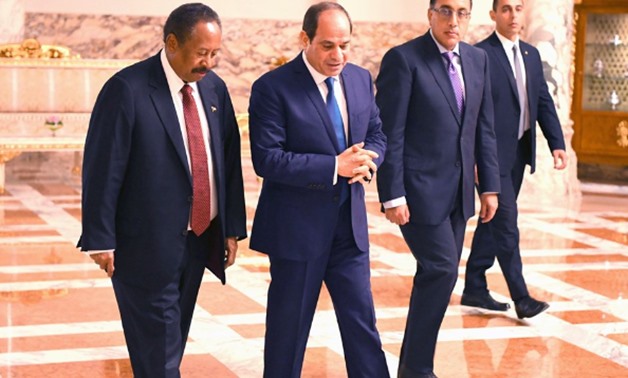
Egyptian President Abdel Fattah al-Sisi speaks with Sudanese Prime Minister Abdalla Hamdok in Cairo on 11 March 2021 (Egyptian Presidency/AFP)

In a media conference
in Sudan earlier this month, Egyptian President Abdel Fattah el-Sisi expressed the two states’ desire to reach a binding legal agreement https://www.al-monitor.com/pulse/iw/ori ... ?skipWem=1 before the coming Nile flooding season on operating the Grand Ethiopian Renaissance Dam (GERD). https://www.middleeasteye.net/news/gran ... gypt-sudan

Sisi warned Ethiopia against trying to extend control https://www.al-monitor.com/pulse/iw/ori ... ?skipWem=1 over the Nile, noting that the Horn of Africa country has unilaterally announced its intention to start the second phase of filling the GERD basin, https://www.france24.com/en/20200721-et ... e-mega-dam which could cause immense harm to Egyptian and Sudanese interests. Sudan has previously stated that such a move would threaten its own security. https://www.voanews.com/middle-east/fil ... s-security

At the media conference, Sisi backed Sudan’s proposal to restart negotiations mediated by a quartet https://www.al-monitor.com/pulse/iw/ori ... ?skipWem=1 of the African Union, European Union, United States and United Nations.

Such a speech would have normally made international headlines, but unfortunately for Egypt and Sudan, it mostly fell on deaf ears, reflecting Egypt’s dwindling regional influence. https://criticalissues.umd.edu/sites/cr ... nnaire.pdf

Running out of patience

In past decades, Egypt has considered the Nile’s flow a matter of national security, with a former defence minister calling for military intervention
in Nile basin countries should Egypt’s share of the river be threatened. Conversely, Sisi has repeatedly used a language of diplomacy https://www.reuters.com/article/sudan-e ... SL8N2L4026 instead of the threat of force. His new, sterner posture is not out of the blue; Egypt is not only running out of patience, but the reshuffling of regional relations is giving it more leeway to put additional pressure on Ethiopia.

Egypt has been deescalating with several regional foes. Though not entirely of its own making, Egypt and Qatar have reached a better footing after the recent Saudi-Qatar rapprochement. https://www.ft.com/content/eeb4f0ec-0f9 ... 201adfc48b

Egypt held talks https://www.aljazeera.com/news/2021/2/2 ... g-gulf-row with Qatar in late February, and the two countries’ foreign ministers met https://www.reuters.com/article/qatar-e ... SKCN2AV2RH on the sidelines of an Arab summit earlier this month.


On the Libyan front, https://www.middleeasteye.net/opinion/l ... s-bad-news Egypt has had little choice but to accept the new internationally supported status quo on its western border, even though Sisi would have wanted an authoritarian regime in Tripoli. Last month, Sisi met his Libyan counterpart, Abdul Hamid Dbeibeh, https://www.reuters.com/article/egypt-l ... FL1N2KO16M in Cairo, and offered him support in post-conflict development. Egypt and Libya have also been coordinating on a number of bilateral issues, with the Egyptian embassy https://english.ahram.org.eg/NewsConten ... drawn.aspx expected to reopen soon.

_________________________________________________
Egypt could use a potential war as a national rallying tool to unify the country
_________________________________________________

This is not to say that Egypt is ignoring its own security concerns. Particularly worrisome to Cairo is the Turkish military presence in Libya, which has largely tilted the balance of power https://www.middleeastmonitor.com/20200 ... -in-libya/ in favour of the revolutionaries who overthrew the Gaddafi regime in 2011.

Turkey does not deem Egypt’s post-2013 coup regime as legitimate; this is why Sisi famously
in Libya that, if crossed by Turkish-backed forces, would spur Egyptian retaliation.

In response, Egypt reportedly developed the largest land military base https://www.aljazeera.net/news/politics ... 8%A2%D8%AA in the Middle East and North Africa at Sidi Barrani, around 90km from the Libyan border.

Bilateral cooperation

And yet, Egypt has also been much more receptive of Turkey’s willingness for rapprochement. Egypt’s state media https://www.aljazeera.net/news/politics ... 8%B0%D8%A7 has pointed to the benefits of such rapprochement, while Cairo has given signals that it would be open https://www.reuters.com/article/us-turk ... SKBN2B41G9 to cooperation. Egypt could benefit from a calming of relations with Turkey, in order to focus on Ethiopia.

In addition, Egypt and Sudan have recently intensified their bilateral cooperation in several sectors, https://english.ahram.org.eg/NewsConten ... tions.aspx including trade, agriculture, transport, health, energy and mining, topped off with a defence pact https://www.thenationalnews.com/mena/eg ... -1.1176240 in early March. It is clear that the latter is primarily directed at Ethiopia.

Ethiopia is already in a vulnerable position, with its ongoing civil war in the Tigray region, https://foreignpolicy.com/2021/03/08/th ... igray-war/ which has created a refugee crisis https://www.bloomberg.com/news/articles ... f=am1wYMj6 primarily borne by Sudan. There have been numerous credible reports https://www.ohchr.org/EN/NewsEvents/Pag ... 8&LangID=E of grave human rights violations in the war, with Ethiopia facing international isolation. The EU has suspended aid https://www.reuters.com/article/us-ethi ... SKBN29K1SS to Ethiopia over its violations in Tigray, while the US last year suspended aid https://www.bloomberg.com/news/articles ... f=am1wYMj6 over the GERD dispute.

On Thursday, US President Joe Biden dispatched Senator Chris Coons to Ethiopia to discuss the humanitarian crisis and human rights abuses in Tigray. The conflict with Egypt and Sudan over the dam will likely be among the items on Coon's agenda.

To Egypt and Sudan, the Nile is a matter of life and death. Egypt seems to have done its regional homework, and alongside Sudan, it is preparing to seriously take on Ethiopia. Ethiopia and Sudan had already reached a point of high tension last month, trading accusations https://www.usnews.com/news/world/artic ... r-conflict of territorial breaches over a disputed border.

Regional comeback

One might say that Egypt’s dire economic situation https://www.middleeasteye.net/opinion/e ... nk-teeters does not give it the leeway to launch an attack. But Egypt could use a potential war as a national rallying tool to unify the country, deflect attention from its domestic woes https://www.reuters.com/article/egypt-r ... SL8N2L975R and announce a comeback as a top regional contender.

For decades, political scientists have debated the
which sees water-sharing states becoming more prone to war in the future.

While it may seem unlikely, one should not rule out a disastrous military confrontation. Given Ethiopia’s vulnerability, along with Egypt’s and Sudan’s willingness to negotiate, one would hope for a peaceful settlement soon.

The views expressed in this article belong to the author and do not necessarily reflect the editorial policy of Middle East Eye.

Mustafa Salama is a Political Analyst, Consultant and Freelance writer. Salama has extensive experience and academic background in Middle East affairs. Salama holds a Bachelors and Masters degrees in Political Science from the American University in Cairo.

Re: (Al- Monitor): Ethiopia, China sign deal amid stalled Nile dam talks

Posted: 19 Mar 2021, 22:49
by Zmeselo


A border war looms between Sudan and Ethiopia as Tigray conflict sends ripples through region


A boy stands next to the Atbarah River in al-Fashaga, Sudan. The border dispute over this fertile farmland, sandwiched between two rivers, and where Ethiopia’s northern Amhara and Tigray regions meet Sudan’s eastern Gedaref state, dates back decades. (Ashraf Shazly/AFP/Getty Images)

By Max Bearak

https://www.washingtonpost.com/gdpr-con ... -bearak%2f

March 19, 2021

AL-FASHAGA, Sudan — This fertile borderland between two rivers has long held the key ingredients for a war.

For decades, a precarious status quo prevailed here between Sudan, which owns the land according to a century-old treaty, and Ethiopia, which has occupied it while its citizens tilled the fields of sesame, sorghum, sunflower and cotton.

But Ethiopia’s sudden descent into civil war in its Tigray region has upended a delicate web of regional political equations, sending ripple effects across this corner of Africa, and bringing Ethiopia and Sudan to the brink of a territorial war over this disputed area, known as al-Fashaga. Military and government officials on both sides, as well as independent analysts, said they worry such a war would quickly escalate into a much broader regional conflict.


Sudanese officials also accused Ethiopian Prime Minister Abiy Ahmed of attempting to force Sudan’s hand over al-Fashaga by holding up negotiations over the filling of a mega-dam Ethiopia is building near the two countries’ border. Filling the dam without an agreement, they claimed, could imperil drinking and irrigation water for half of Sudan’s population.
Abiy is underestimating the risk to the region his actions create. Does he believe that he can put the water and livelihoods of 20 million Sudanese at risk and that we would accept that?
said Yasir Abbas, Sudan’s water minister.
Regional stability is at stake. Any kind of conflict between us will immediately spread to a wider region — the Red Sea, the rest of the Horn of Africa.
On a recent trip with Sudanese forces to the front line, a major deployment of military and paramilitary troops was visibly underway. Through binoculars, Sudanese officers eyed Ethiopian settlements and fortifications in parts of al-Fashaga they had not yet retaken.

Despite blisteringly hot weather, the Sudanese side buzzed with activity. In just a couple months, Sudan has built an extensive road network in areas it now controls. Locals had been pulled into the effort, working on construction, cooking for soldiers and even patching up their uniforms. But nervousness lay beneath the industriousness.


Since retaking much of al-Fashaga early this year, the Sudanese military has quickly set about building infrastructure in the region. (Max Bearak/The Washington Post)

An internal United Nations map published last week and reviewed by The Washington Post shows multiple deployments of Ethiopian National Defense Forces in al-Fashaga, and at least 16 sites of clashes, including an attack on civilians. The Sudanese military says more than a dozen of its soldiers have been killed, and Sudanese residents said armed Ethiopian farmers had slaughtered at least a dozen unarmed civilians.

Ethiopia’s military has not announced its casualties, but Gizachew Muluneh, an Ethiopian regional government spokesman, said nearly 2,000 civilians had been displaced. He called the Sudanese deployment an invasion and said al-Fashaga belonged to Ethiopia’s Amhara region, which he represents. Abiy has made statements https://www.fanabc.com/english/ethiopia ... ary-issue/ supporting that claim.

According to a 1902 agreement between Menelik II, then Ethiopia’s emperor, and Sudan’s British colonial overlords, al-Fashaga is Sudanese land. In the mid-1990s, however, while Sudan’s military was fighting numerous domestic wars, Ethiopian soldiers and farmers moved into the area and established settlements behind military lines.


Sudanese army soldiers pose with a water tank painted in the colors of the Ethiopian flag. It was recovered from what the soldiers said was an Ethiopian military base in al-Fashaga. (Max Bearak/The Washington Post)
Before, it was an irregular occupation, but since Abiy came to power, they have begun to claim, ‘This is our land,’
said Col. Abadi el-Tahir, a field commander in the Sudanese military.
They even dug up cemeteries and brought dead bodies to rebury them in Sudan in an attempt to claim that this land is theirs, as if they have been there for generations.
We are working day and night to take it back,
he added.
Al-Fashaga is not totally under our control yet, but almost.
Sudan retook most of al-Fashaga after Ethiopian soldiers and Amhara militias were deployed to fight in Tigray.
Up until the war in Tigray began, the situation was essentially an Amhara occupation of al-Fashaga,
said Maj. Gen. Ibrahim Gabir, one of 11 members of Sudan’s so-called sovereign council that presides over government decisions.
As they became occupied with the war in November, we were able to retake the area with fewer casualties. But recently the Amhara militias came back and killed so many of our people, robbed so many,
he said.
Ethiopia is not controlling these militias, so of course we see it as supporting them. We do not want to be drawn into a reckless war.
Abiy’s increasing reliance on Amhara support for the war in Tigray is a fundamental driver of conflict in al-Fashaga, analysts said. Even though Abiy claimed victory in the war in November, fighting has continued, https://reports.unocha.org/en/country/e ... xF1pkLh8b5 according to the United Nations and journalists who have gained access to the region.

The conflict has drawn the attention of the United States. This week, Delaware Sen. Christopher A. Coons traveled to Addis Ababa to meet with Abiy to discuss the
deteriorating situation in the Tigray region and the risk of broader instability in the Horn of Africa.
In congressional testimony earlier this month, Secretary of State Antony Blinken called for an investigation into what he called “acts of ethnic cleansing” in Tigray.

Amhara militias as well as troops from neighboring Eritrea have become essential to Abiy’s efforts to subdue rebels in Tigray — a war that has already cost thousands of lives and left millions in dire need of humanitarian aid.

In return for sending reinforcements to Tigray, Amhara leaders including Abiy’s intelligence chief and foreign minister have pressed Abiy to give major concessions to the region, including retaliation at Sudan’s border deployment, according to Nizar Manek, an independent analyst who is writing a book about the region. On Tuesday, Muluneh, the Amhara regional spokesman, said the federal government was preparing to transfer https://www.bloomberg.com/news/articles ... f=KLEAnfc7 a huge swathe of Tigray’s land into Amhara administration, a form of retribution that Amhara hard-liners have long demanded.
Under Abiy, Sudan rightly sees Ethiopia’s foreign policies as having tribalized on Amhara lines,
said Manek.

He noted that the Amhara position is even further strengthened by coming national elections in June, for which the region has become a kingmaker.

That sudden gaining of leverage among Amhara hard-liners has made Abiy less able to compromise on either al-Fashaga or the dam, said Abbas, the water minister.
Ethiopia is linking the dam issue with the border issue even though it has no right to do so. But Dr. Abiy is in a corner and must have Amhara support for his war in Tigray,
Abbas said.
The rise of the Amhara in Ethiopia’s politics is threatening the future of relations between our nations — not countries, but nations, peoples with literally thousands of years of shared history.
Abbas said that Sudan’s government sees Ethiopia’s filling of the nearly complete dam during the coming June-July rainy season as an existential threat. During an initial filling that took place last year, he said millions of Sudanese were deprived of water for three days, and parts of the Blue Nile were shallow enough to walk across.

High-ranking Sudanese officials painted the dam and border disputes as easy to iron out, if not for Ethiopia’s increasingly uncompromising internal politics. On the border, joint demarcation was still on the table, Gabir said. Ethiopian farmers could be leased land in al-Fashaga, for instance.
We have been asking for Ethiopia to cooperate in demarcating the border for decades,
he said.
We have said please, please, please and please again. They are not interested. Why? Because al-Fashaga is very good land. The Amhara will not give it up just like that.
For now, though, Sudanese forces say they have retaken much of al-Fashaga’s farms, though at least three large Ethiopian settlements remain guarded by Amhara militias.

With their recent advances, Sudanese locals are rekindling hopes that they will be able to reclaim farms in the region that belonged to their parents and grandparents.


Residents of the village of Wad ‘Arud on the edge of al-Fashaga convene to discuss plans to reenter the region ahead of the coming rainy season. (Max Bearak/The Washington Post)
God willing, for the first time in 25 years we will cultivate that land between the two rivers,
said Abbas el-Tayyib, the mayor of the town of Qurayshah, where many farmers from al-Fashaga relocated after the Ethiopian occupation.

He, like many, remembers a time when Ethiopian farmers peacefully came to work as laborers on Sudanese farms. While their bitterness toward the Ethiopian government was sharp, locals commonly referred to Ethiopian farmers as their brothers and said the land was fertile enough to share.
We remember exactly which fields are whose, even if the Ethiopians have changed the landscape,
said Ali Mohamed Ali, chief of the village of Wad ‘Arud.
If it rained tomorrow, we would go plow. We are ready.
With Ethiopia’s next dam filling just months away and the massing of troops in al-Fashaga, however, the chances that any new clashes could quickly escalate into open war are high. Sudanese officials said all options to regain total control of al-Fashaga remain on the table.
We both have serious, sensitive, internal issues to deal with, and we will respect Ethiopia’s right to deal with their own,
Gabir said.
But if they come into al-Fashaga, we will kill them, yes.

Residents of Wad ‘Arud walk toward a meeting place where they discussed plans to reenter the region. (Max Bearak/The Washington Post)

*Max Bearak is The Washington Post's Nairobi bureau chief. Previously, he reported from Afghanistan, Bangladesh, India, Somalia and Washington, D.C., for The Post, following stints in Delhi and Mumbai reporting for the New York Times and others.

Re: (Al- Monitor): Ethiopia, China sign deal amid stalled Nile dam talks

Posted: 19 Mar 2021, 23:43
by Zmeselo


ENGLISH | INVESTIGATIVE REPORTS


Threats over water and war:

Sudan rift with Ethiopia continues as links with Egypt increase

AYIN NETWORK

https://3ayin.com/en/threats-over-water-and-war/

18 March 2021

On Monday, Prime Minister Abdalla Hamdok made a formal request https://www.aljazeera.com/news/2021/3/1 ... an-dam-row to the African Union (AU), United Nations, European Union and the United States to mediate in an increasingly bitter regional dispute over the filling of Ethiopia’s ambitious hydro-electric dam along the Blue Nile River.


Sudan Minister of Water and Irrigation, Dr Yasser Abbas (social media)

In a statement released the same day, Sudan’s foreign ministry expressed concerns over Ethiopia unilaterally filling the Grand Ethiopian Renaissance Dam (GERD) without regional consultation during the rainy season in July this year. The move, water minister Dr Yasser Abbas said https://www.aljazeera.com/news/2021/2/6 ... y-minister last month, could effectively
threaten the lives of half the population in central Sudan, as well as irrigation water for agricultural projects and power generation from Roseires Dam.
This would not be the first time Ethiopia has filled GERD, without warning.

Neither Sudan nor Egypt appreciated Ethiopia’s unilateral decision to start filling the dam without notification, last year. The three countries had agreed prior to that step to store the first 4.9 Billion cubic meters in July and August 2020, but Ethiopia opened the dam’s gates to store the entire quantity in one week in July.
As a result of this, there was a sudden drop in water levels all the way downstream the Blue Nile, causing many water stations to go out of service, including those inside the capital Khartoum,
said Dr Salih Hamad, the previous chief negotiator, adding that millions of people suffered from this action.

Future talks remain unclear with the AU failing to bridge the gap between the regional actors in the past and with Sudan and Egypt questioning the union’s ability to succeed. Sudan’s former chief GERD negotiator Hamad told https://3ayin.com/en/dam-talks-stalled/ Ayin the negotiation process had become politicized and no progress was made during the last South African-led AU negotiation process.

Two against one?

Ethiopia’s intractability towards opening the negotiation forum may be a product of the change in the regional relations between the three Nile River-linked countries. Over the past few months, Sudan has sided more with its northern neighbour in more ways than one. Sudan and Egypt have exchanged many high-ranking diplomatic visits recently while the gap between Sudan and Ethiopia increases.


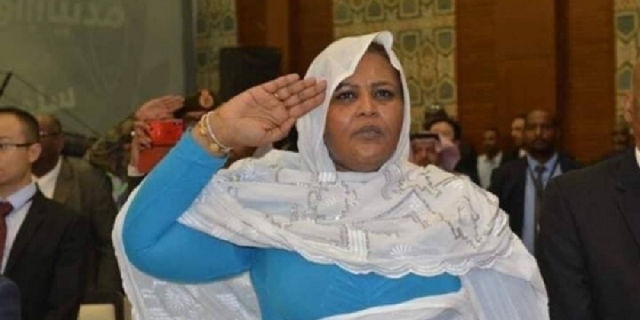
Dr Mariam al-Sadiq al-Mahdi (social media)

New Sudanese Foreign Minister, Dr Mariam Al Sadiq Al Mahdi met https://suna-sd.net/read?id=705919 with Egyptian counterpart Sameh Shoukry on her visit to Egypt earlier this month. During the meeting, the two countries warned if Ethiopia unilaterally filled the Renaissance Dam it would prove a violation of the Declaration of Principles signed by the three countries six years ago.

Sudan has been a revolving door for Egyptian official visits this month.

First, the Chief of Staff of the Egyptian Armed Forces signed https://suna-sd.net/read?id=705958 a military cooperation https://3ayin.com/military-talks/ agreement with Sudan in Khartoum which then followed by Egyptian President Abdul Fattah Al Sisi meeting the head of the Sovereign Council, Lt.-Gen. Abdul Fattah Al Burhan.

The series of visits was followed by Sudanese PM Abdullah Hamadok taking a short official trip https://suna-sd.net/read?id=706956 to the Egyptian capital right after concluding a trip to Saudi Arabia. He discussed the cooperation between the two countries in many fields with the Egyptian president, including the GERD issue and the two states options in dealing with the file.

According to political analyst Mohamed Hamid , the recent closeness may prove a necessary measure in terms of security.
Sudan needs an ally if the border conflict is to escalate as Eritrea will offer military aid to Ethiopia. In fact, Sudan did declare that some of the border clashes involved Eritrean troops, which was denied by Eritrea,
he said.

But this close link to Egypt’s Al Sisi may also be triggering a greater rift between Sudan and the Ethiopian government, Hamid told Ayin, not least suspicions within Sudan’s civilian government and its military counterparts.


SPLM/A – N Chairman Abdelaziz al-Hilu in Kauda (Nuba Reports)

Border tensions in the Blue Nile

While the Sudanese-Ethiopian border dispute https://3ayin.com/en/border-tensions/ continues to simmer in Al-Fashqa amid a growing refugee crisis, https://3ayin.com/en/ethiopian-refugee- ... -in-sight/ further tensions could emerge along Sudan’s Blue Nile border.

On 7 March, Sudan’s news agency accused Ethiopia of providing logistical support to Joseph Touka – deputy chair of the Sudanese People’s Liberation Army-North (SPLA-N) – and his forces in the Blue Nile, including weapons, ammunition, and combat equipment late last February.
It is to be noted that the Ethiopian government aims to use Commander Joseph Touka to occupy the city of Kurmuk with the support of Ethiopian artillery, with the aim of dispersing the efforts of Sudan’s army on the eastern front,
the news read. https://suna-sd.net/read?id=706459

A military source accused Ethiopia of working to disband the efforts of the Sudanese army as the autumn approaches.
Ethiopia is trying to persuade Joseph Touka to repeat the attempt by providing supplies, and they did start sending it,
the source told Ayin.

A member of the Security Arrangements Committee of the Juba Peace Agreement, Kamal Ismail, however, refuted these allegations.
SPLM-N headed by Abdel Aziz Al-Hilu is committed to the ceasefire arrangement with the transitional government that involves all areas under the movement’s control and therefore cannot receive weapons from Ethiopia,
Ismail explained.

Sovereign Council member Mohamed Al-Faki also denied the claim, telling Ayin they have not received any official information in this regard.
Touka’s troops are not very strong, and the power of the SPLA-N is centred in South Kordofan,
Hamid added.
Besides, the movement is controlled by South Sudan, and the latter would not allow any such military support to pass considering its relations with Sudan.
The day following the accusation, reports https://addisstandard.com/news-security ... -violence/ emerged on Ethiopian media alleging that Sudan and Egypt had supported violent attacks within Ethiopia.
A committee set up by the House of People’s Representatives (HoPR) to evaluate and provide solutions to the unrest in the Metekel Zone said that Egypt and Sudan backed the conflict,
one Ethiopian report reads. https://addisstandard.com/news-security ... -violence/

While the above accusations may be more a war of words than reality – tensions over Ethiopia unilaterally filling the GERD in July are very real. With upcoming general elections in Ethiopia, Prime Minister Abiy Ahmed faces a challenging popularity contest amidst multiple https://www.spiegel.de/international/wo ... fe4a80c5b8 internal conflicts, Hamid says. Capitulating foreign demands to curb filling the country’s popular and ambitious hydro-electric dam could be politically fatal. Ethiopia’s Minister of Water and Irrigation, Sileshi Bekele, confirmed https://dailynewsegypt.com/2021/03/17/e ... -minister/ in a conference last week that they would indeed fill the dam despite their Nile counterparts’ objection.

Sudan and Egypt’s best option may be to place diplomatic pressure via the UN Security Council as a complainant for any damage triggered by Ethiopia filling the dam, Hamid told Ayin. This, according to news sources, is an option Sudan is considering.
Some people mention a war, but it’s is a highly excluded option as it comes with an unbearable price for all parties, and any damage to the dam will be extremely damaging to Sudan,
Hamid concludes.