
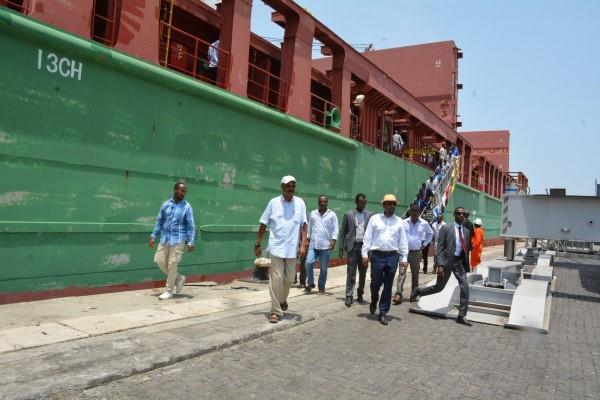
 Ethiopian premier Abiy Ahmed tours Assab port in Eritrea recently/google photo
Ethiopia: Why Assab Port Matters Most to Ethiopia?
Ethiopian premier Abiy Ahmed tours Assab port in Eritrea recently/google photo
Ethiopia: Why Assab Port Matters Most to Ethiopia?
11/25/2018
https://menafn.com/1097743450/Ethiopia- ... o-Ethiopia#
(MENAFN - Somali Land Sun) The Assab Port is the best and dependable option to advance Ethiopia's import-export activities and satisfy country's ever-increasing demand of sea outlets that has been triggered by the rapid economic progress over the years, economic experts say.
As its economy is booming, Ethiopia's use of ports has been increasing over the past decade and while the country is undertaking almost all its import-export activities via Djibouti ports, agreements were also reached to use ports in Sudan, Somalia and Kenya. So what Assab Port adds economically to Ethiopia?
Speaking to
The Ethiopian Herald, Addis Ababa University Public Policy Professor, Dr.
Costantinos Berhutesfa says that Djibouti Port is not sufficient to serving Ethiopia as it is becoming very congested due to the latter's bulk importations and servicing a lot of navies.
Dr. Costantinos notes that Assab is a viable option to serving the northern and north eastern parts of Ethiopia and helping transportation of goods becomes much easier and cheaper besides its role in stimulating the Eritrean economy.
Stating Ethiopia's tremendous potash resources in the Danakil Depression, the Professor says that Assab Port is ideal to enable the mineral-reach northern part of Ethiopia access to international markets.
He notes that Ethiopia could also establish a potash-processing plant, which serves both the local consumption and export market in Assab instead of at hinterland to reduce the transportation cost.
If we consider transport between Djibouti-Mekele and Djibouti- Bahir Dar, we need to build railway which are comparatively expensive. The road transport between Eritrean ports and northern parts of Ethiopia is very short and Assab is crucial in enabling the area's garment and beer factories export their products at a least cost.
Stating political turmoil could occur in any country in the world including Djibouti, Dr. Costantinos stresses that Ethiopia should take cautious measures to get alternative routes that give it additional access to the Red Sea.
Sharing the above rationale, Assistant Professor of Development Economics Dr.
Teshome Adugna says that the geographic proximity of Assab Port is beneficial to export commodities at least cost thereby enhancing international competitiveness.
Dr. Teshome points out that Assab has also a big role in ensuring trade security and building the efficiency of Ethiopia's export trade thus helping the country to export the desirable number of commodities in the intended time and place.
High transportation cost is one the major setbacks of Ethiopia's export trade and re-accessing Assab is instrumental in reducing the unit cost of products in the view to penetrate global markets.
Dr. Teshome says Djibouti's outsourcing of port service could cause sporadic price increments, adding that Assab is a viable option to get the service from Eritrean government and assuring unreasonable price increases could not occur.
Even though Assab is not as developed as Djibouti Port, the possibility for the two countries to mutually develop its facilities and infrastructures will also bring about positive outcome in Ethiopia's international trade and reduce the transport cost, he adds.
The Assistant Professor further notes that re-accessing Assab would avail the opportunity to Ethiopia to export processed oil to world market at better prices through renovating the existing oil refinery facility. Furthermore, the facility would be essential to produce oil derivatives locally.
By the same token, Economics Associate Professor at Jimma University Dr.
Wondaferahu Mulugeta says that using Assab gives Ethiopia alternative and creates a market competition between different ports to handle the country's goods hence the cost per good keeps coming down.
Dr. Wondaferahu points out that re-using Assab Port is instrumental in enhancing Ethiopia's international trade and enabling industrial parks in the northern and north eastern parts of the country do a lot of exports.
He says that the congestion in Djibouti Port enforces Ethiopia to build dry ports in hinterlands and incur additional costs in that Assab will be helpful to ease the traffic. Ethiopia needs to enhance the import-export activities and address delays in the importation of inputs to ensure the timely completion of mega projects.
Unlike Djibouti, where ships are staying at a high sea and enforces Ethiopia to use small boats to transport the goods and causing extra costs, Assab is a natural port and even huge ships could come to the port and unload their cargo.
The Associate Professor says that the Assab Port could also be expanded as duty-free and tax-free zone that are going to be important to speed up its move to become an international sea outlet.
The more development work in Assab Port could bring more opportunities for the local communities and Ethiopia's use and development of the Port is beneficial in revitalizing the City's once-famous business activities, he adds.
For his part, Dr. Costantinos says that the liberalization process that has been taking place in Ethiopia will enhance production of goods and the financial reforms bring in foreign capitals causing the country to need more access to the Red Sea.
The Professor adds that the recent economic reforms and its subsequent economic liberalization expected to sustain Ethiopia's rapid economic progress and triggering the quest for port service.
I do not think even Djibouti and Assab together could be sufficient for our growing economy especially now we are in the kind of economic transformations that are expected to bring influx of foreign investment and businesses in years to come.
The experts highlight that establishing a transparent and modern transaction system is crucial to speed up flow of goods and enhance Ethiopia's export capability while enabling Assab offers specialized services. To this end, Ethiopia should improve its technology and expertise to effectively utilize additional port and partnering with Eritrea to expand and modernize the port's facilities and infrastructures.
Nurturing a forward- looking perspective to reach a visionary agreement that ensures the mutual benefits of the two countries and paving the way for Ethiopia to secure plots in Assab will bring back the country's historically renowned economic attachment with the Port in years to come, they comment.
By Bilal Derso

