Page 1 of 1

Sometimes, Good News Comes Asswash's Way. Unfortunately!!!

Posted: 10 Oct 2020, 08:11
by Zmeselo


Re: Sometimes, Good News Comes Asswash's Way. Unfortunately!!!

Posted: 10 Oct 2020, 09:24
by Awash
Deqi komarit medhin berad:
Nothing is good until my people are free from Agame tyranny.
Please wait, video is loading...

Re: Sometimes, Good News Comes Asswash's Way. Unfortunately!!!

Posted: 10 Oct 2020, 10:10
by Awash
Please wait, video is loading...

Re: Sometimes, Good News Comes Asswash's Way. Unfortunately!!!

Posted: 10 Oct 2020, 10:37
by Zmeselo
You got that right, self confessed Ethiopian:
Sanction the country! Starve the people!
This are your words!

The NEVSUN thing was a lie & what you just posted is definitely a lie, as well.

But, it's all good! We know why! Listen to her advise, for ur own good: :lol:


Awash wrote:
10 Oct 2020, 09:24
Deqi komarit medhin berad:
Nothing is good until my people are free from Agame tyranny.
Please wait, video is loading...

Re: Sometimes, Good News Comes Asswash's Way. Unfortunately!!!

Posted: 10 Oct 2020, 10:55
by sesame
ፈረኽረኽ ዝብላ ዝነበራ እዘን ቆማላት ዓጋመ፥ ጉደን ኣብ ቅድሚ ኩሉ ዓለም ይቃላዕ ኣሎ። ኣንበጣ ከከላኸላ ዘይከኣላ ኢዚ ኹሉ ፈኸራ።

The dirty Agames are getting exposed before the whole world. They couldn't even handle locust invasion. What they need now is mental hospitals because many Agames, like agmusha, are going to need medical help. :lol: :lol:

Please wait, video is loading...

Re: Sometimes, Good News Comes Asswash's Way. Unfortunately!!!

Posted: 10 Oct 2020, 11:20
by Awash
Tweet, tweet. "Reliable source"? Is this your idea of "self-reliance"? :lol: :lol: You might as well call it self-deception. Idiot.
Zmeselo wrote:
10 Oct 2020, 08:11


Zmeselo wrote:
10 Oct 2020, 10:37
You got that right, self confessed Ethiopian:
Sanction the country! Starve the people!


This are your words!

The NEVSUN thing was a lie & what you just posted is definitely a lie, as well.

But, it's all good! We know why! Listen to her advise, for ur own good: :lol:


Awash wrote:
10 Oct 2020, 09:24
Deqi komarit medhin berad:
Nothing is good until my people are free from Agame tyranny.
Please wait, video is loading...

Re: Sometimes, Good News Comes Asswash's Way. Unfortunately!!!

Posted: 10 Oct 2020, 11:34
by sesame
Agames, I know that you are a primitive people suffering extreme inferiority complex and so you will not take my advice. But I think you are unable to take care of the locust invasion, so why don't you ask the Eritrean government to help you. It is either that or you are going to have famine this year.

This video will help you understand how Eritrea handles locusts.


Re: Sometimes, Good News Comes Asswash's Way. Unfortunately!!!

Posted: 10 Oct 2020, 11:42
by Awash
Speaking of "Reliable source"! E.U. member of "parliament"
Please wait, video is loading...

Re: Sometimes, Good News Comes Asswash's Way. Unfortunately!!!

Posted: 10 Oct 2020, 12:22
by quindibu
sesame wrote:
10 Oct 2020, 10:55
ፈረኽረኽ ዝብላ ዝነበራ እዘን ቆማላት ዓጋመ፥ ጉደን ኣብ ቅድሚ ኩሉ ዓለም ይቃላዕ ኣሎ። ኣንበጣ ከከላኸላ ዘይከኣላ ኢዚ ኹሉ ፈኸራ።

The dirty Agames are getting exposed before the whole world. They couldn't even handle locust invasion. What they need now is mental hospitals because many Agames, like agmusha, are going to need medical help. :lol: :lol:

Please wait, video is loading...


The idea that higher education institutions are more than bricks and mortar is an alien concept to the Adwa peasants who came to the Ethiopian throne with the ingenuity and muscle of Eritreans......

And of course, their incurable inferiority complex led them to believe that producing as many as PhDs, regardless of their qualifications, would be a panacea to the self-created 'we-have-been-looked-down' psychological malady.

Now, without their guns and looted money, they're being themselves- primitives!

Re: Sometimes, Good News Comes Asswash's Way. Unfortunately!!!

Posted: 10 Oct 2020, 12:53
by Awash
There is no such word in Agame deqi komarit vocabulary: "parliament"(ፓርላማ). "ባይቶ" is a word that seized to exist thanks to Agame tyrannical rule.
Please wait, video is loading...

Re: Sometimes, Good News Comes Asswash's Way. Unfortunately!!!

Posted: 10 Oct 2020, 13:04
by Awash
Tweet, tweet :lol: :mrgreen:
Please wait, video is loading...

Re: Sometimes, Good News Comes Asswash's Way. Unfortunately!!!

Posted: 10 Oct 2020, 13:27
by Awash
Don't you think the Agame Yemane Gebremeskel is suffering from inferiority complex? :lol: :mrgreen:

Re: Sometimes, Good News Comes Asswash's Way. Unfortunately!!!

Posted: 10 Oct 2020, 13:53
by Awash
:lol: :mrgreen: :lol:

Re: Sometimes, Good News Comes Asswash's Way. Unfortunately!!!

Posted: 10 Oct 2020, 15:30
by Awash

Re: Sometimes, Good News Comes Asswash's Way. Unfortunately!!!

Posted: 10 Oct 2020, 15:44
by Awash
:lol: :mrgreen: :mrgreen:
Please wait, video is loading...

Re: Sometimes, Good News Comes Asswash's Way. Unfortunately!!!

Posted: 10 Oct 2020, 16:27
by Zmeselo
We know why, PM Abyi is suddenly- "a dictator"!

ካብ ርእሲ ምድራቕ: ናብ ጁባ ምድራቕ! :lol:


ካብ ኣራት ኪሎ መቐለ ተወሸበት

01.10.2020

ብግብራ ካብ ኮረና ካንሰር ዝገደደት
ብሓሶት ስርቂ ሌብነት ዓይና ዝዓወረት
ይቕረ ክትብል ዓቕሚ ዝሰኣነት
ዕንደራ ደልያ ሽፍትነት ዝመረጸት
ኣብ መዓልቲ መዓልቲ ቃል እናቐያየረት
ሎሚ ሰላም ሰላም ኢላ እንተለመነት
ኣብ ልዕሌና ዘውረደቶ ዕንወት
ከመይ ጌርና ክንርስዖ ንዘንተ ዕለት
ጋህዲ ዝመስላ ለይቲ እንተሓለመት
ዓባይ ትግራይ ፈጢራ ኣብ ካርታ ወረቐት
ካብ ጽውጽዋይ 3 ሽሕ ዓመት ዘይተላቐቐት
ዘየለ ታሪኽ እናደባለቐት
ካብ ኣኽሱም ኣዱሊስ ዓሰብ ዝዘለለት
ንኑእሽተይ ትግራይ ነፊሓ ዘዕበየት
ባድመ ሒዛ ኣሻፈረኝ እንተበለት
ዘሚታ መሬት ወሎ ራያ ጎንደር ወልቃይት
ብትዕቢት ተሰንጢቓ ቅልጽማ እንተሕበጠት
ዓቕሊ ጌርና እንተርኣና ምቑሉልነት
መሲልዎም ኣላሽ ዝበልና ብፈኸራ ሰኽራማት

ኤርትራ ክትወርር ደቂሳ ከይሓደረት
20 ዓመት ጌራታ ኣይሰላም ኣይ ኩናት
ኤርትራ ምብርካኽ ብምንታይከ ዘይፈተነት
ይቕረ ዘይባሃሎ ታሪኻዊ ጌጋታት ዝፈጸመት
ጨሪሳ ከይጠፍአት ጉድጉዋድ ከይኣተወት
ዝኣምና የልቦን ሎሚ እንተተመጻደቐት
ትግራይ ተበዲላ ሓደ ለባም ዝሰኣነት
ጂሆ ተታሒዛ ብዝኣረጉ ቆልዑት
መርገም ዶ ኣይኮነን ነዚኦም ክትፈሪ ዕለት
ኣብ መረጻ ዝወጹ ቀዳሞት
ብበዓል ስየ ጻድቃን መስፍን ስብሓት
ቮድካቸው ረዳ ማለሊት ዓይና ዝዓወረት
ኣብ ሆቴላ መሽሚሻ ክትፍጽም እያ ነብሰ ቅትለት
ታሪኻ ክድምደም ትጽበያላ መቓብር ደበቢት
ከኒና Game is over ምውሓጥ ካብ ኣበየት

ዓወት ንሓፋሽ !!
ተስፋይ ወልደጊዮርጊስ ጀርመን

Re: Sometimes, Good News Comes Asswash's Way. Unfortunately!!!

Posted: 10 Oct 2020, 17:08
by Awash
Fessfass Agame,
Issu is definitely a dictator. Is there any doubt?
Please wait, video is loading...

Re: Sometimes, Good News Comes Asswash's Way. Unfortunately!!!

Posted: 10 Oct 2020, 17:13
by Zmeselo


THE BLOG

21/03/2016

The Undemocratic EU Explained - It Will Never Change

The EU is a highly undemocratic organisation ratcheting more and more power with every passing day. It is impervious to public opinion. The people who matter in the law-making process are unelected and therefore unaccountable...

Matthew Ellery: Programmes Officer at The Housing & Finance Institute

https://m.huffingtonpost.co.uk/matthew- ... _OBjiZIayz

The EU's law-making process is fundamentally undemocratic. Power is vested in the unelected and unaccountable elite who make laws - in secret - to preserve the status of large multinationals at the expense of small and medium-sized enterprises (SMEs). Multinationals achieve their preferential status by spending enormous sums of money on lobbying. They create a complicated regulatory framework, which only large companies with their Human Resources departments can comply with. This drives small competitors out of business, destroys competition and encourages monopolies, forcing the consumer to pay a higher price for poorer quality goods and services.

There are four key institutions of the EU: the European Commission, European Parliament, European Council and the Court of Justice of the EU. Each institution supposedly represents separate interests. The Commission represents the EU, the Parliament represents the people, the Council represents the Governments of each Member State and the Court interprets the law. However, these institutions do not do this in practice, as they all represent large multinationals and an integrationist agenda, as the intention is to create a federal United States of Europe. This new country already has a flag, a Parliament, an anthem, Presidents, currency, a legal system, legal status and a navy - to name just a few.

The EU Commission is the guardian of the treaties and enforces EU law. More importantly, this means it is the Government of Europe which has the sole right to propose the laws which increasingly encroach on our lives here in Britain.

The Commission is made up of 28 unelected commissioners, who cannot be held to account. Each commissioner has a specific policy area in which to create laws. The Commission has a President (currently Jean-Claude Juncker); unlike the other 27 commissioners he is personally elected by the European Parliament, however his was the only name on the ballot paper, not exactly democratic. The Commission is advised by the Directorate General, which along with the Commission is heavily lobbied. Once the Commission proposes an EU law, this proposal is taken to the Parliament.

Secondly, the Parliament is made up of 751 MEPs who are elected by the people in EU Member States every five years in elections. National parties arrange themselves into European groups of similar parties throughout Europe. It also has a President (currently Martin Schulz) who was voted in by the Parliament, but once again he was the only candidate. Theoretically, the Parliament has the ability to remove the Commission; however the Parliament has never successfully been able to remove it - even when the Commission has been full of corrupt cronies. The Parliament didn't even remove the commission of 2004 to 2009 which was full of questionable characters. This Commission included Siim Kallas the Anti-Fraud Commissioner who was given this role despite being charged with fraud, abuse of power and providing false information after £4.4million disappeared while he was head of Estonia's national bank.

This is not a Parliament in any real sense, as they have no right to propose laws. Instead it is a façade, created to make the EU look democratic, rather than give the public a choice over those who makes their laws. The Parliament does vote and can make amendments on laws proposed by the Commission, but the Commission must accept any of the amendments proposed for the changes to become effective, showing where the power lies.

Additionally, once something becomes an EU law, the Parliament has no ability to propose a change to this law. All the power is given to the Commission. It is clear the public's elected representatives do not matter in the EU. It's a 'club' to push through laws which would be rejected by national Parliaments. Once the Parliament approves an EU proposal, it is sent to the European Council.

The European Council - sometimes called The Council - is the meeting of the Member States. It is called the European Council when the leaders of each Member State are in attendance, and The Council when it's the ministers for the policy area being discussed attending. This is the final hurdle any European proposal has to pass in order to become law. Decision-making at this stage is done almost entirely by Qualified Majority Voting. This means the UK Government can vote against a proposal and as long as it receives enough votes from the other Member States, it becomes law in the UK anyway. The UK only has a veto to prevent EU laws impacting the UK in a very minor number of areas. If the European Council/Council approves proposals, they become EU law. They will be in the form of EU regulations or directives. If they are regulations the new EU law applies to all Member States without any of those states having to pass legislation in their own home Parliaments. If they are directives, the national Parliaments are forced to change their national laws within a specific time limit to comply with EU law - whether they want to or not.

Finally, the Court of Justice of the EU is supposed to interpret EU laws to ensure they comply with the EU treaties. Unfortunately, it does not do this. It happily ignores the treaties when it wants to if the EU is pushing its own federalist agenda. This is not a court like we have in this country; it is a kangaroo court wilfully ignoring the rule of law, as it did with the bailouts which should have been deemed illegal. The treaties clearly stated bailouts were illegal, but as the bailouts helped to prop up the failing Eurozone project, the EU court allowed them anyway.

The EU is a highly undemocratic organisation ratcheting more and more power with every passing day. It is impervious to public opinion. The people who matter in the law-making process are unelected and therefore unaccountable. The only way to secure genuine democratic control over our own law makers is to Get Britain Out of the EU by voting to leave in the EU referendum on the 23rd June.

_____________

Nigel Farage, torches the EU! :lol:


Re: Sometimes, Good News Comes Asswash's Way. Unfortunately!!!

Posted: 10 Oct 2020, 18:13
by Zmeselo


05.23.2019

EUROPE| PARTY POLITICS LAW BORDERS AND IMMIGRATION

The European Union Is an Antidemocratic Disgrace

BY: THOMAS FAZI

https://jacobinmag.com/2019/05/european ... democratic

The European Parliament elections start today. But the body itself is an insult against democracy that exists only to rubber-stamp neoliberal rule.


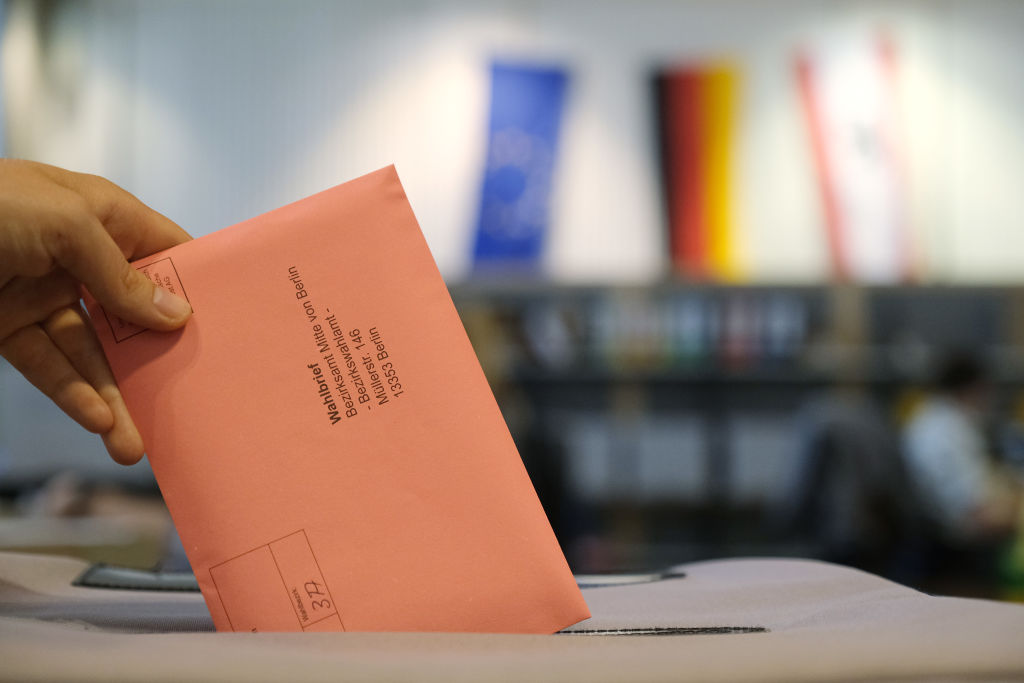
A voter casts her ballot in early voting at a local voting office in European parliamentary elections on May 21, 2019 in Berlin, Germany. Sean Gallup / Getty

If there’s an opinion that everyone, across the entire political spectrum, seems to share about the upcoming European elections, it is that these will be
the most important elections in the history of the European Union.
All sides pitted in battle – from the “eurosceptic populists” to pro-EU elites to everyone in between, including the UK Labour Party — claim that the make-up of the next Parliament will be decisive for Europe’s future. As former Greek finance minister Yanis Varoufakis recently stated: https://www.yanisvaroufakis.eu/2019/05/ ... statesman/
The contest for seats in the next European Parliament … will fundamentally shape the future of Europe for years to come.
But is this really the case? Such grand claims might make sense if the EU were a fully-fledged federal state with a truly sovereign parliament — in other words, if it were truly a parliamentary democracy. Yet it is anything but. In fact, the European Parliament has very limited powers: for starters, unlike national parliaments, it doesn’t even have the power to initiate legislation. This is a power uniquely reserved for the EU’s “executive” arm, the European Commission — the closest thing to a European “government” — which avows itself “completely independent,” promising
neither to seek nor to take instructions from any government or from any other institution, body, office or entity.
This, of course, includes the European Parliament, which may only approve or reject (or propose amendments to) the Commission’s own legislative proposals. This alone sets the EU https://www.jacobinmag.com/2016/10/eu-b ... it-troika/ firmly apart from any meaningful democratic tradition, and casts serious doubts over the alleged importance of this weekend’s elections.

The Commission itself is by no means democratically elected. Its president and its members (informally known as the commissioners) are proposed and appointed by the European Council, which is made up of the leaders of the EU member states. Even in this case, the Parliament may only approve or reject the Council’s proposals. In 2014, a new system — the so-called Spitzenkandidat, or “lead candidate,” process — was introduced, whereby prior to the European elections each major political group in the European Parliament nominates its candidate for the role of Commission president. The aim is to make the election of the Commission appear more democratic.

However, as Costas Lapavitsas notes,
this
represents a largely cosmetic change.
In fact, the Council is only required to “tak[e] into accounthttps://eur-lex.europa.eu/LexUriServ/Le ... 17:EN:HTML the results of the European elections. Ultimately, the final word still lies with the Council, i.e., with the member states. Indeed, as reported by the BBC, https://www.bbc.com/news/world-europe-48280134
[[t]his time round, EU leaders have said the European treaties give them the sole authority to nominate someone for the role, and that they only have to nod towards the results of the European Parliament election when they make their choice.
Thus, as has always been the case, the appointment of the Commission
is more likely to be the product of power-plays between countries
rather than a true exercise of democracy.

Even more worryingly, it is practically impossible for the Parliament to dismiss the Commission, as this requires two-thirds of votes cast and a majority of all MEPs.

Ultimately, it is still the Commission and the Council — and the dominant countries therein — that call practically all the shots. What matters in the EU is not democracy or still less the elections to the European Parliament, but the power relations among its member states.

Pooled Sovereignty?

We are often reminded by pro-EU apologists that there are grounds to consider the appointment of the European Commission “democratic”: after all, the argument goes, the Council is comprised of the heads of state and government of the various member states, which in turn are democratically elected by the peoples of Europe or appointed by the national parliaments. It follows that even the Commission itself can be considered to be indirectly chosen by the citizens of Europe. This argument is allegedly reinforced by the fact that the Council, along with the European Parliament, has the power to approve or reject the legislation proposed by the Commission.

Yet such reasoning perverts the very concept of democracy. Indeed, while the national leaders are generally — but not necessarily — elected, as a body the Council is neither elected nor accountable. Though Europe’s governments are theoretically accountable to their national parliaments and electorates, precisely what the Council allows them to do is to escape this accountability, approving laws
without having to submit to the bother or indignity of parliamentary questioning, let alone approval,
as John Laughland has written.
Furthermore,
when votes [in the Council] are taken by majority, the link between national parliaments and ministers is irretrievably cut. A minister can claim that he was outvoted if a law is passed to which his national parliament was opposed.
The entire architecture of the European Union thus favors executive and technocratic power over legislative power. This represents a huge step back even from the “bourgeois” understanding of liberal democracy. Indeed, the European treaties themselves state that
the functioning of the Union shall be founded on representative democracy
— an aspiration more than a reality — but they don’t actually claim the EU itself to be a democracy.

This reminds us why national elites and oligarchies have been so keen, over the course of the past decades, to transfer power to the EU. Their aim was not simply to insulate economic policies from popular-democratic challenges, but also to reduce the political costs of the neoliberal transition, which clearly involved unpopular policies, by displacing the responsibility onto external institutions and factors. This can be said to embody what Edgar Grande calls https://link.springer.com/chapter/10.10 ... 10001-0_13 the “paradox of weakness,” whereby national elites transfer some power to a supranational policymaker (thereby appearing weaker) in order to allow themselves to better withstand pressure from societal actors by testifying that “this is Europe’s will” (thereby becoming stronger). As Kevin Featherstone put it: https://www.researchgate.net/publicatio ... cial_Model
Binding EU commitments enable governments to implement unpopular reforms at home whilst engaging in ‘blameshift’ towards the ‘EU,’ even if they themselves had desired such policies
(emphasis added).

And this is not even taking into account the hierarchy of power of “actually existing Europe,” whereby — particularly in the eurozone — the Commission, the European Central Bank (ECB), and the dominant states, through the Council and the Eurogroup (a purely informal body which has no legal basis, comprising the finance ministers of the euro countries), are able to impose very damaging policies on the weaker states of the union, not to mention on any left-wing government that is lucky enough to get into power, as the case of Greece shows all too well.

Vested Interests

The undemocratic nature of the EU becomes evident when we look at its legislative process. As mentioned, in most cases, once the Commission — an effectively unelected and unaccountable body — proposes a new law, it then has to be approved by both the European Council and the European Parliament. This means that the Parliament effectively has a veto power, but so does the Council. At the Council level, the real work is done by the Committee of Permanent Representatives (COREPER), made up of the ambassadors of the member states, and by the over 150 Council working groups. These preparatory bodies can have a decisive influence on the text eventually approved by the Council. The entire process is opaque to say the least. As the German investigative journalist Harald Schumann writes: https://www.blaetter.de/archiv/jahrgaen ... ist-die-eu
These negotiations take place entirely behind closed doors. There are no publicly available protocols, and the press has no right to know who actually represents which position. For citizens, Europe’s most powerful legislator is de facto a black box.
Interestingly, the same view was echoed by none other than Emily O’Reilly, the official European Ombudsman. In a detailed report https://www.ombudsman.europa.eu/en/reco ... n/en/89518 published in 2017, she noted that the overwhelming secrecy of the legislative process makes it practically impossible not only for citizens, but even for national parliaments,
to scrutinise how their national representatives have acted.
This is very dangerous, because it makes the legislative process highly susceptible to the pressure of lobbyists and well-organized vested interests, at all levels, including that of the European Parliament. Rather than a bug in the system, this should be seen as an inherent consequence of the supra-nationalization of politics. As the Italian researchers Lorenzo Del Savio and Matteo Mameli write, https://www.opendemocracy.net/en/can-eu ... arliament/ the problems of oligarchic capture
are exacerbated at the supranational level. It is for this reason that, in general, the transfer of sovereignty to international loci of political decision-making contributes to the weakening of popular control. International loci are in general physically, psychologically, and linguistically more distant from ordinary people than national ones are. This distance means more room for oligarchic capture. International loci of political decision-making are usually designed in such a way as to make it extremely difficult for ordinary citizens to understand how decisions are taken and to be able to influence and contest such decisions in an effective manner. This enhances the effectiveness of the mechanisms of oligarchic capture.
This is particularly worrying if we consider that nowadays a very large portion of the laws adopted by national parliaments — on issues that affect the daily lives of consumers and workers across Europe, from food security to pesticides or the working conditions of truck drivers — are in fact decided at the EU level and then simply transposed into national law by national parliaments. Furthermore, aside from the new laws produced each year, it is worth recalling that the EU treaties essentially embed neoliberalism into the very fabric of the European Union, https://braveneweurope.com/thomas-fazi- ... -heres-why by codifying the four capitalist freedoms par excellence — the free movement of goods, services, capital, and persons — and placing huge barriers in the way of state intervention in the economy. This has laid the basis for a wholesale reengineering of European economies and societies.

As a further barrier to any attempt to push through left-wing policy at the national level, the EU’s economic constitution gives immense powers to the European Court of Justice, which has the final word on legal disputes between national governments and EU institutions. It is no surprise that Alec Stone Sweet, an international law expert, termed it http://digitalcommons.law.yale.edu/cgi/ ... fss_papers a “juridical coup d’état.” The EU’s constraints on left-wing policies don’t just apply to eurozone countries — though these are obviously much more constrained due to their lack of monetary sovereignty — but to all member states. For instance, if Brexit is ultimately derailed, EU rules would place severe restrictions https://www.jacobinmag.com/2018/05/corb ... mic-policy on a future British government led by Jeremy Corbyn.

The legal implications of these treaties — which are often overshadowed by social and economic considerations — cannot be overestimated. For while France and the Netherlands famously voted against a joint European constitution in 2005,
ultimately the treaties do establish a constitutional order for the EU. https://www.transform-network.net/en/pu ... a-commons/
This is a very peculiar constitutional order, which cannot be democratically amended by citizens, and nor can European election results have any effect: it can only be amended unanimously in the context of a new international agreement among the member states themselves — which, in practical terms, means that it is not amendable. The only thing individual states can do is repudiate the whole structure. As the president of the European Commission himself, Jean-Claude Juncker, said at the beginning of Syriza’s mandate,
there can be no democratic choice against the European treaties.
There is another problem: even assuming that the European Parliament actually had a decisive voice in shaping EU policies (which it does not), it would still have very few economic tools at its disposal. The EU budget is notoriously meagre — indeed, it’s not even an actual federal budget, since it’s comprised of the contributions of member states. Simply put, there is no European “treasury” that could enact a Europe-wide economic policy, let alone a central bank willing to support it. That is why the calls https://diem25.org/wp-content/uploads/2 ... 9.ENG_.pdf for a “European Green New Deal,” along the lines of the Green New Deal (GND) https://jacobinmag.com/series/green-new-deal proposed in the US by rising democratic socialists such as Alexandria Ocasio-Cortez, are frankly laughable. AOC’s GND is premised on the fact that the US is a monetarily sovereign state where an elected government could finance its investment plan by effectively instructing the central bank to create the necessary money “out of thin air,” in line with the teachings of modern monetary theory (MMT). None of this applies to the EU or the eurozone. As Eurointelligence https://www.eurointelligence.com/ recently noted,
MMT runs contrary to the philosophy underlying the construction of the European monetary union — in fact some of its policy prescriptions are outright illegal under the EU’s treaties.
The fact is that monetarily sovereign countries such as the UK are much better equipped to implement a GND than the EU as a whole is.

Shared Fate

In light of the above, is it at all surprising that the various anti-establishment uprisings that have engulfed Europe in recent years — from Brexit to the gilets jaunes https://www.jacobinmag.com/2019/02/gile ... uel-macron in France and the rise of the Five Star Movement https://jacobinmag.com/2018/03/five-sta ... gio-grillo in Italy: phenomena that have generally been treated with skepticism if not outright horror by the Left, but which also contain a legitimate request for popular empowerment https://blogs.lse.ac.uk/brexit/2018/12/ ... -ideology/ — have targeted their angst at the EU, the embodiment of technocratic rule and elite estrangement from the masses? Or that the EU elections generally register record-high abstention rates compared to national elections? Or that the overwhelming majority of European citizens don’t know — and don’t care to know — who the various candidates for the presidency of the Commission are?

On a basic level, most people are instinctively aware of the fact that their vote will have little impact on the overall direction of the EU, regardless of what the various political parties claim. And they are right. Indeed, to the extent that people will participate in the upcoming elections, they will cast their vote largely based on national, rather than “European,” concerns, such as tilting the balance of power towards one party or the other in their respective countries, as has always been the case.

On a more fundamental level, however, the depoliticized nature of the European elections isn’t just a consequence of the EU’s undemocratic architecture; rather, it has to do with the very nature of democracy itself. As the term suggests, and as history illustrates, democracy presupposes the existence of an underlying “demos” — a political community, usually (though not exclusively) defined https://journals.sagepub.com/doi/abs/10 ... 1007002001 by a shared and relatively [deleted] language, culture, history, normative system, etc. —
the majority of [whose members] feel sufficiently connected to each other to voluntarily commit to a democratic discourse and to a related decision-making process,
and therefore to accept the legitimacy of government and majority rule.

Furthermore, in modern states and federations, with highly developed welfare states, such an identification is crucial in generating the affective ties and bonds of solidarity that are needed to legitimize and sustain redistributive policies between classes and/or regions. Importantly, Costas Lapavitsas notes, the existence of a demos is also the precondition for democratic class struggle:
National parliamentary elections are occasions for the demos to express its collective will, and in capitalist societies the demos is inseparable from its class and other divisions. National democratic politics is a contest among social interests vying for electoral supremacy, which may take a conscious class form and thereby acquire a characteristic sharpness, bitterness, and rivalry.
Simply put, if there is no demos, there can be no effective democracy, let alone a social democracy. It is no coincidence that democracy evolved within the confines of the nation-state, since historically this has been the only political entity capable of giving rise to communities sufficiently large, in demographic and territorial terms, to guarantee their reproduction. But what the EU has in size it lacks in [deleted], with no signs of a common European demos emerging even forty years since the first elections to the parliament in Brussels. Indeed, the lack of significant EU-wide class struggles or social movements testifies to the difficulty of mounting a coordinated challenge against the economic oligarchies in almost thirty countries with twenty-four official languages.

In this sense, the notion that the solution to EU’s democratic deficit consists in its parliamentarization — that is, in granting the European parliament full legislative powers as in any parliamentary democracy — fails to acknowledge the fundamental obstacle to the creation of a European supranational democracy: the lack of a European demos. As Lapavitsas writes:
The absence of a European demos with its integral class divisions prevents the existence of “normal” politics in the EU. There are no social cleavages applying uniformly across EU member states that could be organically reflected in political contestation within EU institutions. … No class or other social divisions in Europe take a [deleted] ‘European’ form, for there are no occupational, organizational, habitual, cultural, and historical norms able to create such an overarching social integration. Actual class divisions in Europe always take a national form, as do the party politics that correspond to these divisions. In Marxist terms there is neither a European capitalist class nor a European working class.
This is not likely to change any time soon. Hence, for now, the only possible locus for class struggle and democratic conflict remains the nation-state, and that is where socialists and progressives should focus their attention.

This does not necessarily imply that the European elections should simply be ignored or boycotted: as we have noted, they can indeed be important in shifting the political balance within member states. But critics of the EU should also be aware that by participating in the European elections they are legitimizing its institutions by adding a democratic veneer to a structurally post-democratic system. They are also fueling the dangerous illusion that the EU is reformable and susceptible to democratic pressure, which it is not.

As Djordje Kuzmanovic — who recently broke away from Jean-Luc Mélenchon’s party in France over disagreements regarding the leader’s stance concerning the EU, among other things — argues: https://www.marianne.net/debattons/trib ... uropeennes
The European elections are an epiphenomenon. Those who wish to give back to our citizens’ control over their destiny should compete for elected positions in the only democratic framework that exists, that of the nation, and stop endorsing the European farce.
A recent gilets jaunes assembly also took the same stance, inviting citizens to
make a mockery of this electoral charade.
Ultimately, those who believe in democracy and popular sovereignty should aim at tearing the EU down — not at reforming it.

ABOUT THE AUTHOR

Thomas Fazi is a writer, journalist, translator, and researcher. He is the co-author of Reclaiming the State: A Progressive Vision of Sovereignty for a Post-Neoliberal World (Pluto Press; 2017).

_______________


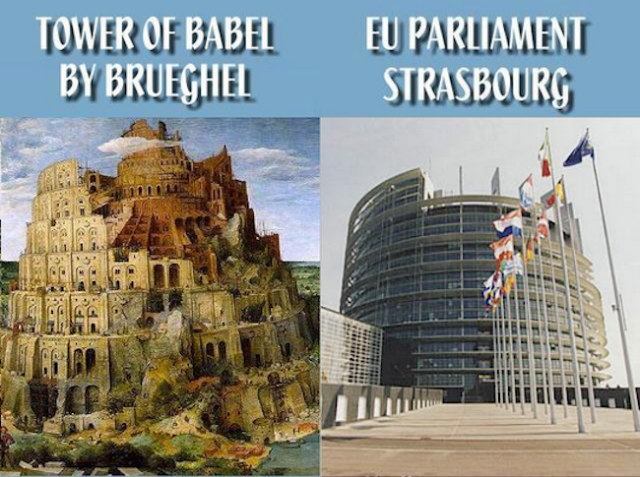
The EU Parliament building- tower of Babel?