Page 1 of 1

The politics of Saudi normalization with Israel: ANALYSIS

Posted: 02 Oct 2020, 20:45
by Zmeselo


The politics of Saudi normalization with Israel: ANALYSIS

A Mideast expert assesses if the Saudis could normalize relations with Israel.

By: Bilal Y. Saab

https://abcnews.go.com/International/po ... d=73324672

1 October 2020


An aerial view of Saudi Arabia's holy city of Mecca, with the Abraj al-Bait Mecca Royal Clock Tower overlooking the Grand Mosque and Kaaba in the center, May 24, 2020, during the early hours of Eid al-Fitr, the Muslim holiday that starts at the conclusion of the holy fasting month of Ramadan. AFP via Getty Images

As the United Arab Emirates (UAE) and Bahrain move forward with their separate processes to normalize relations with Israel, https://abcnews.go.com/alerts/israel the question that seems to be on the mind of many, both in Washington and in the region, is whether or when the Saudis will follow.

I've long argued (most recently here https://foreignpolicy.com/2020/08/13/in ... st-winner/) that Saudi Crown Prince Mohamed Bin Salman (MBS), the de facto ruler who's destined to govern the kingdom for decades to come, is hesitant to establish full diplomatic ties with Israel anytime soon because doing so is likely to generate significant political costs at home.

For starters, his father, King Salman, is committed to a comprehensive Arab-Israeli peace that includes the Palestinians and preserves the relevance and integrity of Riyadh's own Arab Peace Initiative of 2002, which called for Israel's complete withdrawal from Arab lands captured since 1967 in exchange for Arab recognition of Israel's right to exist and normalization of diplomatic ties.

Then there's the ultra-Orthodox elements of the Saudi religious establishment, who carry weight within a still largely conservative Saudi society. They are vehemently opposed to peace with the Jewish state that excludes the Palestinians and unjustly settles the fate of Jerusalem, Islam's third-holiest site. If MBS ignores or alienates them, they can make things very difficult for him by undercutting what he cares about the most: his transformation plan for the country. MBS has to keep the fundamentalist sheikhs at bay so he can proceed with his Vision 2030, which they’re not that excited about because of its social reforms -- so picking a huge fight with them over Israel might not be the smartest thing to do.

There's also the violent Al-Qaeda types in the kingdom, who the moment they hear of Riyadh consenting to Muslim-Jewish peaceful coexistence will lash out at the House of Saud, like they did in 1979 and then again in 2003- 2004. MBS has to seriously worry about those, too.

Last but not least, there's Iran and Turkey, who will viciously challenge Saudi Arabia's global Muslim leadership and management of the religion's holiest mosques if it prematurely accepts the Jewish state -- which is most ironic in the case of Ankara since it has had diplomatic relations with Israel since 1949.

That, at least, has been my assumption all along.

But what if news of MBS agreeing to embrace Israel broke? After all, he has managed to shock the world many times before. For example, did anybody expect him to singlehandedly blow up the decades-old Saudi system of consensus politics? Or sideline all his rivals, including America's counterterrorism darling, Mohamed Bin Nayef? Or launch a war in Yemen and an embargo on Qatar? Or, according to the CIA, order the grisly assassination of Saudi national and Washington Post columnist Jamal Khashoggi https://abcnews.go.com/alerts/jamal-khashoggi in Turkey?

The honest answer to all those questions is no.

The sample size is large enough to entertain all likelihoods and scenarios. While I remain skeptical that MBS would sign with Israel while King Salman is still alive -- which would be a sight to see, if he does -- I’m willing to believe that he just might after he becomes king, which is not a long time from now given the deteriorating medical condition of his 84-year-old father.

If he does -- for the same security and economic reasons shared by the Emiratis and the Bahrainis -- it will reveal important truths about him and Saudi Arabia, and suggest one of two things: Either he's totally in charge in the kingdom and has effectively co-opted all forms of domestic opposition including the traditionally influential religious elite, or he's not and once again he has decided to take his chances.


PHOTO: Ultra-Orthodox Jews, mask-clad due to the COVID-19 coronavirus pandemic, walk along a street in the neighborhood of Mea Shearim Jerusalem a few hours before the start of Yom Kippur, the Jewish holy day of Atonement, Sept. 27, 2020. Menahem Kahana/AFP via Getty Images

The first scenario would signal that for all his faults, MBS is the undisputed leader of the largest Arab partner of the United States, able to not only make historic foreign policy decisions but also implement groundbreaking domestic reforms without having to fear any major domestic backlash.

It's true that kings in Saudi Arabia have always had absolute power, but they also have had to share authority with a powerful group of spiritual leaders, the ulama. MBS could be the first king to achieve an upper hand over them and upend that traditional power-sharing arrangement.

The second scenario would logically imply that MBS is not omnipotent at home and the Saudi ulama remain a powerful voice and challenger to his reign. A more aggressive push-pull dynamic between MBS and the ulama could spell trouble for the stability of the kingdom.

So, will MBS keep the cold peace with the clergy, fend off the violent extremists, and preserve his transformation project?

Or will he prematurely embrace Israel and possibly lose it all?

Bilal Y. Saab, a senior fellow and director of the Defense and Security Program at the Middle East Institute (MEI), served from August 2018 to September 2019 in the Office of the Under Secretary of Defense for Policy as the senior advisor for security cooperation in the Middle East.

Re: The politics of Saudi normalization with Israel: ANALYSIS

Posted: 03 Oct 2020, 09:12
by Zmeselo


Normalizing Sudan-Israel Relations Now is a Dangerous Game

As Sudan is mentioned among the next states to normalize relations with Israel, concerns about what that would do to the democratic transition arise.

Thursday, September 24, 2020

BY: Payton Knopf; Jeffrey Feltman

https://www.usip.org/publications/2020/ ... erous-game

With the UAE and Bahrain having joined Egypt and Jordan in declaring peace with Israel, those asking “who’s next?” often look enthusiastically westward, toward Khartoum. Adding new chapters to the Abraham Accords is in the U.S. interest, but so is a successful transition in Sudan. And the sequence of these steps is critical. A unified Sudanese government with a popular mandate will be better able to forge a warm and sustainable peace with Israel, whereas a rushed Israeli-Sudanese agreement has the potential to unravel Sudan’s transition and generate renewed support for Sudan’s Islamists and their foreign backers.


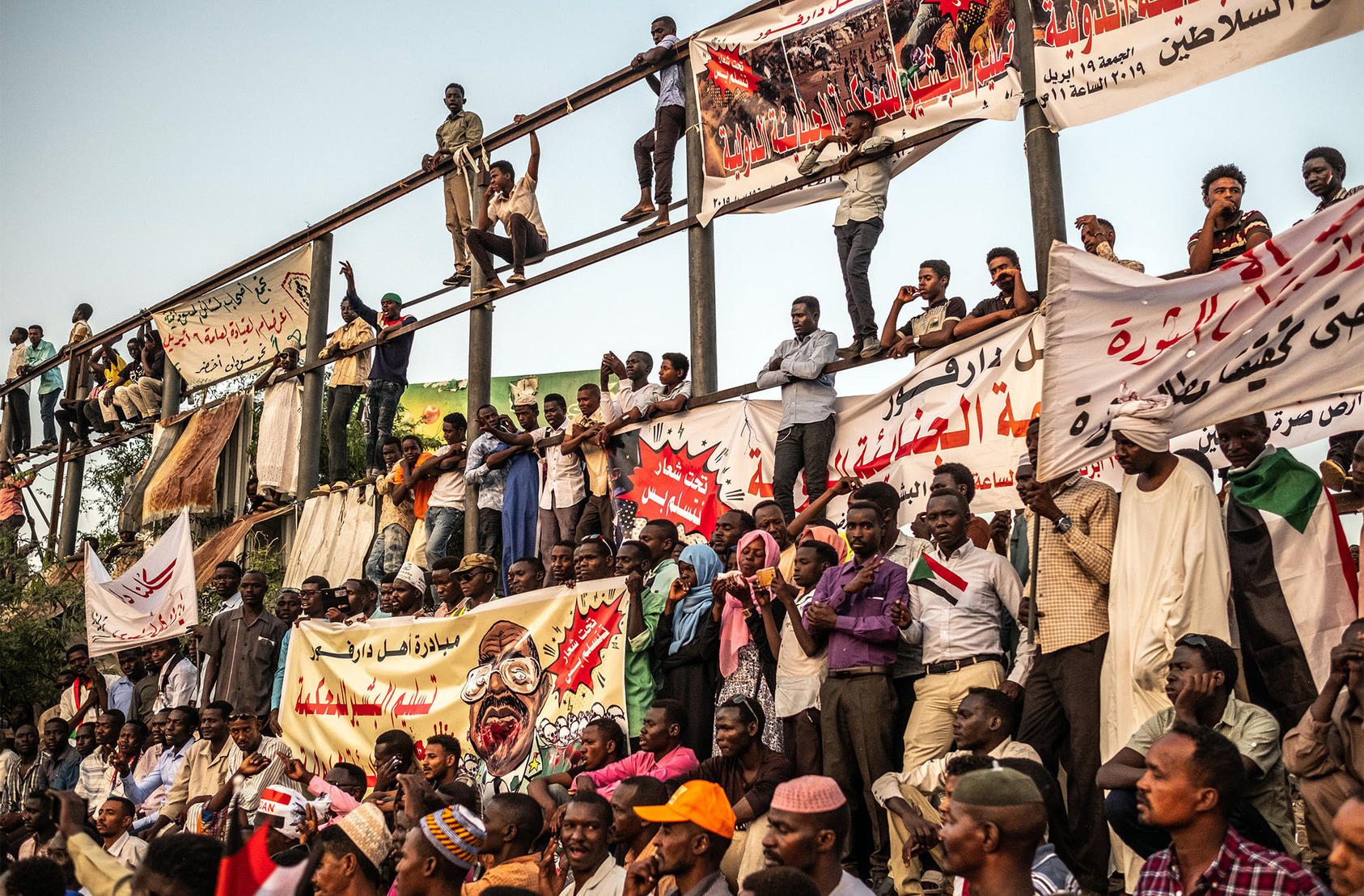
Protesters against former Sudanese President Omar al-Bashir in Khartoum, Sudan. April 19, 2019 (Bryan Denton/The New York Times)

The appeal of Sudan, once firmly in the grip of Islamists and still on the U.S. list of state-sponsors of terrorism, appearing on a positive peace ledger is obvious. Following the announcement of the Abraham Accords between Israel and the UAE, there has been a flurry of conjecture around which Arab countries might normalize their own relations with Israel—and of diplomatic activity to induce and incentivize such a move. Secretary of State Mike Pompeo’s visit to Khartoum on August 25 and a subsequent trip to Abu Dhabi https://in.reuters.com/article/uk-sudan ... NKCN26B0W8 by the chairman of Sudan’s Sovereign Council, Gen. Abdel Fattah al-Burhan, on September 20 have continued to fuel speculation.

Building on Shaky Ground: Sudan’s Fragile Transition

Unfortunately, much of the debate around the prospects for an improvement in the Israel-Sudan bilateral relationship has ignored the fragility of Sudan’s political transition and the risks that premature normalization could pose for the strategic interests of the United States, Israel, and the UAE. No one wants a repetition of the 1983 Israeli-Lebanese peace agreement, which, signed by a Lebanese government without popular legitimacy, collapsed in less than a year.

Five months after President Omar al-Bashir was deposed in 2019 following a 30-year dictatorship, an agreement on a transitional government was reached between the military junta that deposed him and the civilian protest movement that precipitated his downfall. This transition was predicated on a delicate cohabitation arrangement between military and civilian stakeholders, with the Sovereign Council, chaired by al-Burhan; the cabinet, led by a technocratic prime minister in Abdallah Hamdok; and a legislative assembly—with each having a delineated set of responsibilities until elections in 2022.

Despite the brutality of the Bashir regime, Sudanese civil society, including trade unions and professional associations, remained remarkably active. Sudan’s political landscape was one of the most diverse and vibrant in the Arab world, with organized forces ranging from communists and Baathists to liberal secular forces to a range of Islamist-oriented groups. Many of these aligned in opposition to Bashir but differed in their vision for what should follow him. The transitional arrangement was therefore designed to balance these myriad constituencies during the development of a new constitutional order, prevent the country’s fragmentation and a descent into civil war, and provide a pathway toward democracy that met the aspirations of the hundreds of thousands of Sudanese, predominately youth, who had demonstrated en masse for five months in an historic and nonviolent revolution.

Bashir had been adept at navigating among rivalrous Middle Eastern powers, demurring, for example, in choosing sides in the GCC crisis. And not surprisingly, Saudi Arabia, the UAE, Qatar, and Turkey all sought to influence the post-Bashir dispensation. In particular, the perception of Saudi and Emirati backing for the military junta against civilian, democratic forces led to a public backlash within Sudan. Qatar and Turkey were less overt in their support for particular individuals or factions, though Ankara gave refuge to a number of senior figures from Bashir’s regime.

Unfortunately, one year into the transition, the security and economic crises that were the proximate trigger of the anti-Bashir demonstrations have worsened. Millions remain displaced. The value of the Sudanese pound has plummeted from 45 to a U.S. dollar in August 2019 to nearly 300 this month. More than half of the country is severely food insecure. And despite pledges of support, the international community has failed to mobilize resources commensurate with the historic opportunity of the transition. Public disaffection with the transitional government has increased, and divisions not only between security and civilian actors, but within them, have widened.

Any steps toward a normalization of relations between Israel and Sudan must first and foremost be considered in this context. To do otherwise risks further fracturing the transition and the integrity of the state itself.

Sudan’s Revolution and the Legitimacy of the Transition

One of the most significant ambiguities in the Constitutional Declaration that established the transitional government was whether the Sovereign Council, the cabinet, or the legislative assembly holds primary responsibility for foreign policy. Following Secretary Pompeo’s visit to Khartoum, Prime Minister Hamdok asserted https://www.reuters.com/article/us-suda ... SKBN25L0XE that the government did not have a mandate to make such a significant decision, while Burhan allegedly expressed more openness. The legislative assembly, which is ostensibly empowered to set the political direction of the transition, has not yet been established.

Sudan’s revolution was animated by a widespread aspiration among Sudanese to have a say in their own governance, and the relationship with Israel remains a controversial issue. Burhan’s meeting with Israeli Prime Minister Netanyahu in Uganda in January, for example, sent shockwaves throughout the country—not just among Islamists, but among many of the liberal and secular forces that were on the vanguard of the revolution and are committed to pluralism. A decision on normalization cannot be both historic and inconsequential. For a caretaker government—or a set of individuals within it—to make a unilateral decision would mean the move lacks the legitimacy, and therefore the durability and sustainability, that the legislative assembly or an elected government could give it.

Press reports have indicated that the United States would de-list Sudan from the state-sponsors of terror list and, with Emirati support, provide several billion dollars of aid in exchange for normalization. However, if normalization is seen as resulting from exploitation of Sudan’s economic and humanitarian desperation, it will be even more polarizing among the public, accelerate the erosion of support for the transition, and expose the prime minister to the machinations of those within Sudan who are opposed to reform and, ironically, to the very regional actors that Israel and the UAE view as their primary adversaries.

Sudan’s transition presents a once-in-a-generation opportunity for the country to chart a path out of autocracy and violence toward democracy and stability, which would send positive ripples throughout the long-volatile region. That transition cannot succeed, however, if the country becomes enmeshed in regional rivalries. Libya should serve as a cautionary tale in that regard. Given that Sudan’s population is nearly six times that of Libya’s, however, state breakdown would be even more catastrophic—not just for its own citizens, but for the interests of the United States and its allies and partners in Europe and the Middle East. Washington’s first priority should be a successful transition in Sudan and the creation of a unified government with popular legitimacy that’s able to make the type of historic decision that an Israeli-Sudanese peace agreement would be.


Jeffrey Feltman is the John C. Whitehead Visiting Fellow in International Diplomacy at the Brookings Institution and a senior fellow at the United Nations Foundation. He was United Nations under-secretary-general for political affairs (2012-2016) and a U.S. foreign service officer for nearly three decades, including as assistant secretary of state for Near Eastern affairs.