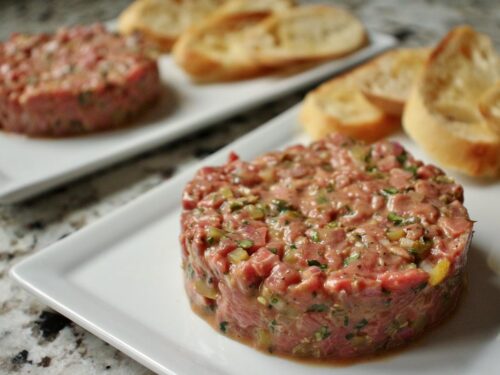
The name associated with Tartar(kitfo) is believed to have come from the Latin word Tartarus meaning hell, the Romans considered the Ta-ta people of central Asia (a nomadic group of Genghis Khan’s army) to be savage and barbaric and because of their blood thirsty reputation, they inserted an “r” in their name, thereby linking them with Tartarus (or hell).
It became a popular dish in the west after it evolved to what we know it as today, which is the combination of raw meat (beef or horse) with raw egg, capers, pickles and other seasonings. The adaptation of the extra garnishes most likely originated in Germany, Steak Tartar was most probably introduced to them by the Russians who learned the dish from their Tatar conquerors, and then exporting it to Europe via German contacts. American scholars suggest it reached their shores through German migrants some time in the late 19th century.
All though there is no historical evidence that the Mongolians ate raw meat, as there is no reference to this in Chinese historical records, and medieval observers in the Middle East never wrote anything about it either, the myth still lives on.
Steak Tartare is a dish whose main ingredient is raw beef or raw horse, usually, cut into small cubes with a knife (coarsely chopped), although often finely chopped in a food processor.
It is important to distinguish the ancient dish, originally from the Russian steppe nomads, from the modern recipe, which uses only the principle of raw meat. It is noted that Korean cuisine presents the steak tartare, usually spiced in one dish (Yukhoe) or sometimes mixed in bibimbap (Korean culture has also partially Mongolian origin). In the recipe Italian (Genoese) were added egg yolk and capers, pickles, a little olive oil, parsley, garlic and onions.
Traditionally, the seasoning is done with salt and pepper, Tabasco and Worcestershire sauce. The steak tartare is usually served with a side of French fries.