Ethiopian News, Current Affairs and Opinion Forum
Zmeselo
Senior Member+
Posts: 36993
Joined: 30 Jul 2010, 20:43

Qatar Spreads Conspiracy Theories About Israel’s Alleged Role in the Egypt-Sudan-Ethiopia Crisis

Post by Zmeselo » 04 Aug 2020, 18:07


Qatar Spreads Conspiracy Theories About Israel’s Alleged Role in the Egypt-Sudan-Ethiopia Crisis

Irina Tsukerman

https://www.algemeiner.com/2020/08/04/q ... ia-crisis/

AUGUST 4, 2020


The Sheraton hotel in Addis Ababa, Ethiopia. Photo: Pixabay.

While Ethiopia has threatened to mobilize its 105 million citizens in the event that Egypt puts up obstacles to the building of the Great Ethiopian Renaissance Dam (GERD, or the Renaissance Dam), the recent hostilities that broke out https://www.al-monitor.com/pulse/origin ... lkxWwsYFbM were between Ethiopia and Sudan, not Ethiopia and Egypt.

The concept of the Renaissance Dam, which would revolutionize energy and water delivery in Ethiopia, goes back decades, but despite the involvement of multiple Egyptian administrations, it has not moved forward. Egypt, which is heavily dependent on the Nile for its agriculture-based economy, cannot afford severe water shortages. Should the GERD be constructed, as much as 17% of Egypt’s arable land could be damaged. Over time, that figure could potentially rise to 51%, https://www.washingtoninstitute.org/pol ... ptian-view which would destroy the Egyptian economy and displace as many as 30 million Egyptians (just under a third of its total population).

Ethiopia insists on starting construction in July 2020 with a completion target in three years. Cairo is willing to accept a compromise in which Ethiopia pushes off the starting date and slows down construction to seven years, which would give the Egyptian economy time to adjust (though it will still suffer water shortages and other challenges). US-brokered talks failed to break this impasse; in fact, at one point, Ethiopia walked out of the negotiations.

The backstory of this conflict is complex. Ethiopia has been committed to the decision to construct the “Nahda” Dam since approximately 2000. Attempts were made several times to break ground, but Egyptian president Hosni Mubarak interfered with the process and it went nowhere. In fact, as Wikileaks eventually revealed, the Egyptian government went so far as to bomb https://wikileaks.org/gifiles/docs/21/2 ... urce-.html the dam’s site before construction began. When the Muslim Brotherhood came to power in 2012, however, President Muhammad Morsi was open to the project and proceeded with negotiations.

Then-Minister of Defense Abdel Fattah el-Sisi exposed
the secret meetings at which Morsi was negotiating this issue. Sudan’s Omar Bashir was also an Islamist, and both regimes were supported by Turkey and Qatar — as was Ethiopia, which benefited greatly from Qatari funding. Egypt was eventually forced to face the issue on both the political and military levels. According to sources, measures were taken to ensure that Egypt would not be overwhelmed in the long run.

The capacity of the Nahda Dam is 74 billion cubic meters. The water storage capacity in Egypt was expanded to 177 billion cubic meters to encompass https://www.dostor.org/2951619 the High Dam, Lake Nasser, and the Aswan Reservoir, exceeding the potential effect of the Nahda Dam by more than 100 billion cubic meters. In theory, this means the initial three years of construction would not take a catastrophic toll on Egypt. The military’s engineering corps was used to accomplish:

• Toshka expansion https://ar.wikipedia.org/wiki/%D9%85%D9 ... 9%83%D9%89 (lakes comprising excess water around the Aswan Reservoir).
• Lake Nasser expansion. https://www.youm7.com/story/2019/8/26/% ... B1/4389040
• Rehabilitation of the Aswan Reservoir.
• Rehabilitation of the Sarabium Siphon Project to deliver water to Sinai.
• Compensation https://www.youm7.com/story/2019/8/7/%D ... 86/4363131 for the shortage of electricity caused by the High Dam.
• Creation of the largest solar cell stations https://earthobservatory.nasa.gov/image ... the-desert established by NASA.
• Establishment of windmill stations to generate electricity.

Despite these efforts, the situation was complicated by several political factors.

First, Qatar brought the Gulf Crisis https://www.jpost.com/opinion/us-pivot- ... sis-533298 to Africa. It has essentially been paying off the Ethiopian government to make contrarian demands, deliver aggressive rhetoric, and remain immune to diplomatic outreach. Doha is doing this in retaliation for the boycott imposed by the Anti-Terrorism Quartet, which includes Egypt. This kind of interference serves Qatar’s foreign policy agenda, which is to destabilize anti-Islamist states and advance its own influence in regional affairs.

As a result, Ethiopia has made provocative comments and taken steps that appear designed to lure Egypt into the trap of a military confrontation, possibly something along the lines of another attack on the dam’s construction site. Populist media attacks by pro-Muslim Brotherhood outlets and Al Jazeera aim to rile the Egyptian street into demanding drastic solutions. Similarly, Qatar has tried in the past to exacerbate tensions between Egypt and Sudan by playing up https://www.southsudan.biz/south-sudan- ... JHuhbVlx08 news of Egypt’s alleged construction of a military base in South Sudan at a time of conflict and sensitivities between Khartoum and Juba.

Second, Qatar has worked to sow tensions in Egypt (especially among ordinary Egyptians) by spreading rumors that Israel funded the construction of the Nahda Dam and installed its own air defense systems to protect it, implying a veiled threat to Egypt. The Israeli embassy has denied http://www.xinhuanet.com/english/2019-1 ... 494425.htm these reports, but the PR damage has already been done and conspiracy theories are flying. These rumors have even greater power given Israel’s growing contacts with Qatar and Doha’s agreement to fund Hamas in exchange for quiet on Gaza’s borders. Egypt (like other anti-Islamist Arab states) considers Hamas a bitter enemy and finds this arrangement puzzling, especially after the important diplomatic role https://www.al-monitor.com/pulse/origin ... stine.html Cairo has played in easing tensions with Gaza.

Israel’s close trade relations with Turkey, despite their political tensions, likewise contribute to confusion. Many Egyptians and others at odds with Ankara and Doha believe Israel to be allied with both states against the Anti-Terrorism Quartet, which complicates Israel’s political maneuvering and diplomatic outreach. Furthermore, in 2016, Al Jazeera aired
clips of Benjamin Netanyahu allegedly expressing support for the dam. Despite general distrust of the Qatari state-funded mouthpiece and awareness of Doha’s information warfare/foreign policy media branch, which is known to fabricate news and manipulate media, Egyptians nevertheless came to believe that these rumors prove that Israel is siding with Ethiopia at Egypt’s expense.

Israel seems oblivious to the importance of the Gulf Crisis to most inhabitants of the Middle East and North Africa. It has spent an inordinate amount of time dealing with the Palestinian issue, which has come to matter less and less to the average resident of the Quartet countries. The problem of Qatari propaganda that distorts facts and harms Arab perceptions of Israel has not been addressed by Jerusalem.

Israel is in a difficult position, as it is torn between two developing alliances. On the one hand, it values its strong links, trade, and energy opportunities with Ethiopia, which Israel backed militarily https://www.jstor.org/stable/43661168?seq=1 during conflicts with Eritrea and which was an ally during the period of the periphery policy https://mepc.org/periphery-israels-sear ... ast-allies against hostile Sunni Muslim states. But on the other hand, Israel places great stock in its increasingly warm alliance with Egypt, which recently invited Israel to join the East Med Gas Forum https://www.cnbc.com/2019/03/13/gas-fin ... tions.html and with whom Jerusalem has upgraded its gas trade https://www.reuters.com/article/israel- ... SL8N29K1R8 ties.

For Egypt, the dam issue, while sensitive, is but one of many serious challenges it is facing at the moment. These include Gaza border issues, the threat of ISIS and other terrorists in Sinai, and Turkey’s backing of the Muslim Brotherhood and the al-Qaeda-supported and affiliated Government of National Accord (GNA) in Libya. Syrian mercenaries in Libya are battling Egypt’s ally, Field Marshal Khalifa Haftar and his Libyan National Army, on Egypt’s border. On top of all that, Turkey’s illegal gas drilling in the Eastern Mediterranean poses yet another threat.

Another contributing problem is the failure of the US in its role as mediator. From the moment Egypt asked the US to intervene, Washington has taken a lukewarm, passive position, ignoring the problem of third-party interference and Ethiopia’s unreasonable and intransigent demands, threats, and walkouts. A more creative approach would have had the US take a big-picture view of the situation, which will also affect neighboring countries that can benefit from the dam and attract investors into energy and other essential fields for Ethiopia and later Sudan. (Gulf investors have purchased a great deal of livestock, but have not put much thought toward addressing the issues Ethiopia claims would be solved by the dam.) Many possible alternative options were never proposed or even considered. Had they been put forward, the political conflict over the Nahda Dam could have been avoided.

For now, Egypt has taken the initiative by engaging in an assertive political rapprochement with Sudan, which is now more closely aligned with the Anti-Terrorism Quartet and whose military is closely connected to President Sisi. This engagement involved a recent military encounter with Ethiopians over border issues related to tensions over the dam. Ethiopian militias, likely with Qatari and Turkish prodding, tried to prevent another party’s water from reaching Sudan. A threat to the security and water supplies of Sudan, which has no water reserves or dams of its own, represents a threat to Egypt’s national security.

If the US and Israel play it smart, they can play an important role in dispelling myths and lowering tensions over a political crisis that is partly manufactured. They can utilize their regional contacts and their economic and trade acumen to provide a broad network of win-win opportunities for all involved. With some coordination and forethought, they can join forces to prevent the looming threat of a global crisis and mass migration from Egypt and Sudan.


Irina Tsukerman is a human rights and national security attorney based in New York. She has written extensively on geopolitics and US foreign policy for a variety of American, Israeli, and other international publications.

Zmeselo
Senior Member+
Posts: 36993
Joined: 30 Jul 2010, 20:43

Re: Qatar Spreads Conspiracy Theories About Israel’s Alleged Role in the Egypt-Sudan-Ethiopia Crisis

Post by Zmeselo » 04 Aug 2020, 18:52


Opinion | Environment
How Ethiopia's Renaissance Dam became Egypt's Nakba

David Hearst

https://www.middleeasteye.net/opinion/e ... -nile-sisi

4 August 2020

The GERD could displace millions of Egyptians and Sisi should be held fully responsible for this national disaster


An aerial view of water levels at the Grand Ethiopian Renaissance Dam in Guba, Ethiopia on 20 July (AFP)

Disaster struck not so much with a bang, but with a trickle.

At first, Ethiopia denied the very thing that 100 million Egyptians living downstream on the Nile feared - that the filling of the Grand Ethiopian Renaissance Dam (GERD) reservoir had started.

On 15 July, Ethiopia’s national television broke the news, https://www.middleeasteye.net/news/ethi ... -and-sudan only to retract and apologise https://www.aa.com.tr/en/africa/ethiopi ... ng/1912577 for it hours later. Ethiopia’s minister for water, irrigation and energy, Seleshi Bekele, initially claimed https://egyptindependent.com/sudan-anno ... m-filling/ photographs published by Reuters showed water from
heavy rains.
But after Sudan confirmed https://egyptindependent.com/sudan-anno ... m-filling/ that several of its Nile stations had gone out of service from a sudden decline in the river’s waters, Ethiopia was forced to come clean. https://english.alaraby.co.uk/english/n ... 0%9D-tweet
Congratulations! It was the Nile River and the river became a lake. It will no longer flow into the river. Ethiopia will have all the development it wants from it. In fact the Nile is ours!
Incredibly, this victory roll was performed https://www.talkofnews.com/ethiopian-fo ... -sanctions by the foreign minister himself, Gedu Andargachew, shedding all semblance of diplomacy.

A dream come true

For Ethiopia, the dam is the fulfilment of a dream dating back https://time.com/4354767/ethiopia-blue-nile-dam/ to the Emperor Haile Selassie in the 1960s. The $4.6bn project https://www.middleeasteye.net/news/gran ... gypt-sudan
for Ethiopians by Ethiopians
(it was self-funded) is not just a way of providing electricity to a power-hungry nation, https://www.middleeasteye.net/news/ethi ... ed-worries the dam is the cornerstone of the nation’s political and economic renaissance. Further, it means that Ethiopia can no longer be pushed around by colonial powers as it has been in the past.

For Ethiopia, the dam is the fulfilment of a dream dating back to the Emperor Haile Selassie in the 1960s

It hosts https://www.middleeastmonitor.com/20200 ... an-states/ the headquarters of the African Union and the United Nations Economic Commission for Africa. It has a powerful, battle-hardened army. Exactly the reverse path from regional power to basket case that's being trodden by Abdel Fattah el-Sisi's Egypt.

Under Sisi’s presidency, Egypt’s national debt has nearly tripled since 2014, from about $112bn to around $321bn. https://www.middleeasteye.net/news/midd ... s-covid-19 A report by Egypt’s official Central Agency for Public Mobilisation and Statistics showed https://apnews.com/6d1eebc161044d54b7dd24930e0309cb that poverty reached 32.5 percent in 2019, from 27.8 percent in 2015, while extreme poverty reached 6.2 percent from 5.3 percent for the same time periods.

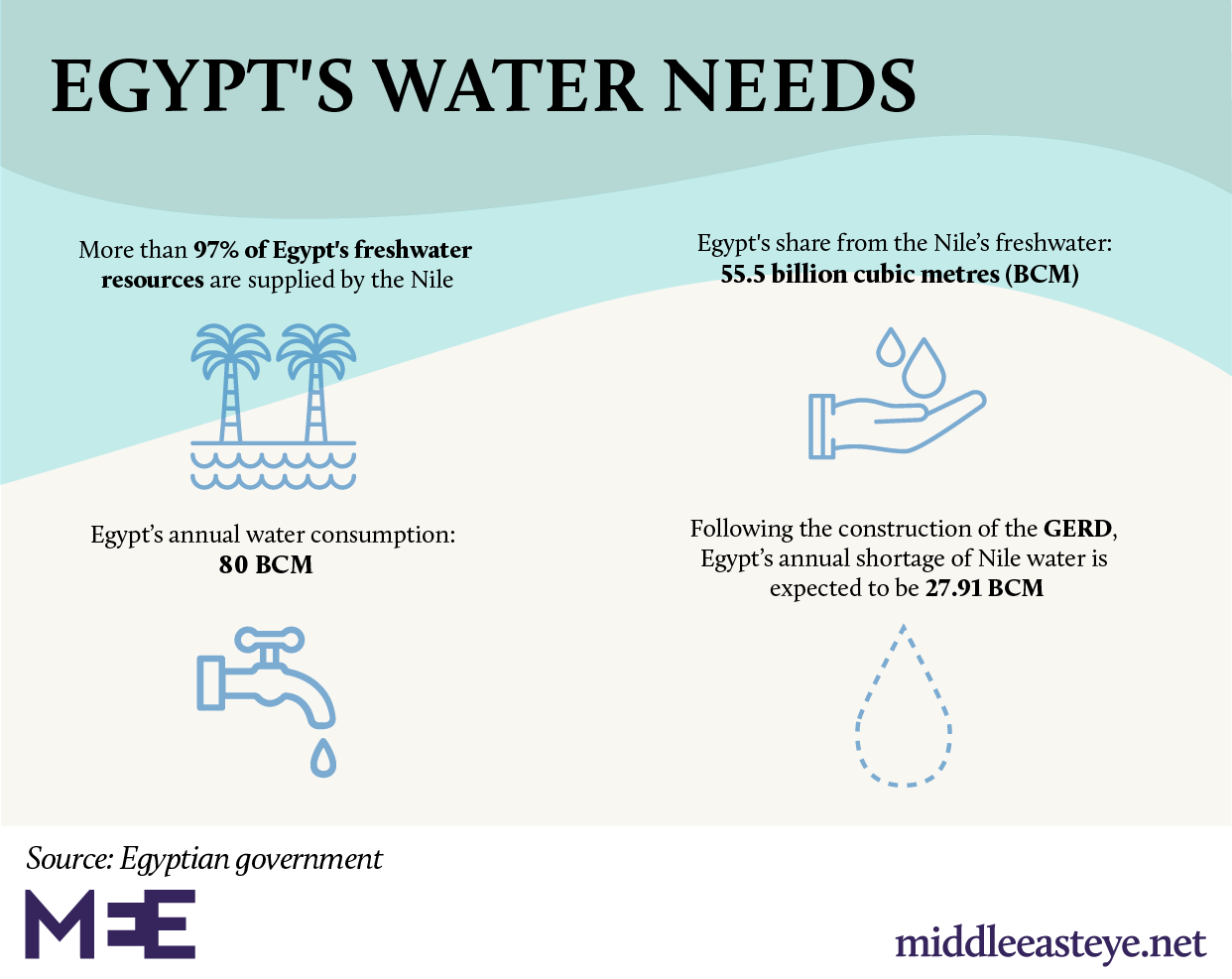
Its population, which has already broken through the 100m barrier, is increasing by a million every six months, https://www.nytimes.com/interactive/202 ... r-dam.html a rate that the UN predicts will lead to water shortages in five years' time, even without the dam.

Eighty percent of the water that reaches Egypt comes from Ethiopia. A study by the Geological Society of America in May 2017 predicted https://theconversation.com/plans-for-a ... ain-143558 that the country would suffer a 25 percent shortage in its annual water quota if the reservoir was filled in five to seven years.

A senior Egyptian source, who was involved in negotiations, told MEE:
If the dam is filled in three years as the Ethiopians want, the water level of the Nile in Egypt will be low to the extent that a lot of pipes of the pumps will be exposed.

When this level becomes as low as this, the Delta, the most fertile area of Egypt, if this level of the Nile came down, the water of the sea will come in, which means the soil of the Delta will be salty and not suitable for a lot of agriculture.
A terminal descent

In 2018, Reuters published a report saying that 17 percent of Egypt’s agricultural land would be destroyed if Ethiopia filled the reservoir in six years; and 51 percent if it filled in three years. Egyptian experts expect that 75 per cent of fish farms would be destroyed.

Egyptian experts expect that 75 percent of fish farms would be destroyed. This could lead to the displacement of as many as 30 million people, one third of the population

This could lead to the displacement of as many as 30 million people, one third of the population. If anything could be called a national emergency, it is the moment when the life-giving water level of the Nile starts its long and terminal descent. But the dam did not just happen. It was not a surprise.

Construction started in earnest in 2011. Soon afterwards, Mohamed Morsi became president and he was rightly concerned.

In an attempt to give himself some leverage at the negotiating table, Morsi said that "all options" were on the table in considering Egypt’s response to the project.

The Nile has always been the top national security issue for Egypt in the modern era. Egypt went to war with Ethiopia in 1874 https://en.wikipedia.org/wiki/Ethiopian ... yptian_War in a failed attempt to control the Blue Nile.

A US embassy cable https://wikileaks.org/gifiles/docs/21/2 ... urce-.html dated from 2010 and subsequently published by WikiLeaks revealed that Egyptians had blown up equipment on its way to Ethiopia in the mid 1970s.


The source, whose reliability was rated A by his US handlers and who was in touch with Hosni Mubarak and his director of military intelligence, Omar Suleiman, told the Americans:
There will not be a war. If it comes to a crisis, we will send a jet to bomb the dam and come back in one day, simple as that.

Or we can send our special forces in to block/sabotage the dam. But we aren't going for the military option now. This is just contingency planning. Look back to an operation Egypt did in the mid-late 1970s, I think 1976, when Ethiopia was trying to build a large dam. We blew up the equipment while it was travelling by sea to Ethiopia. A useful case study.
But Morsi was ridiculed by opposition deputies and undermined by the army for talking tough.

Sisi's plot

Three days before a crisis meeting with Morsi about the dam, Ayman Nour, one of the politicians involved in mediation with other African nations about the proposed structure, was contacted by Sisi himself.

Nour revealed last year that he was briefed by Sisi that Morsi wanted to explore the option of military action, but that the army was not prepared for that, and that the whole file should be dealt with by the army alone.

When Sisi and the army took over the file, they told the Ethiopians that Egypt was now in sensible, rational hands who would negotiate

The Morsi meeting was sabotaged. Morsi’s aides were told that a camera was recording the proceedings for internal communication, whereas in fact everything they thought they were discussing in confidence was being broadcast live. https://www.bbc.co.uk/news/world-africa-22771563 Sisi’s purpose was clear. His focus was to embarrass his president one month before Morsi himself was deposed.

Nour said:

This meeting was part of a plot to embroil Egypt in a big problem relating to the Renaissance Dam. It was part of the endeavour to prove the failure of the ruling regime at that stage.
Sisi had another reason for putting the brakes on a robust Egyptian response to the dam.

He knew that in a month’s time, when he carried out his military coup, the African Union would suspend Egypt’s membership. The AU’s suspension - which was the only significant international reaction to the coup - lasted just one year https://egyptianstreets.com/2014/06/18/ ... uspension/ and Sisi’s dove-ish noises with Ethiopia played their part in ending Egypt’s isolation.

When Sisi and the army took over the file, they told the Ethiopians that Egypt was now in sensible, rational hands who would negotiate. The days of the wild Islamists were over, they said.

But negotiations got nowhere.

The green light

A "preliminary" tripartite deal was signed between the leaders of Egypt, Sudan and Ethiopia in 2015.

At the signing ceremony, the Ethiopian Prime Minister Hailemariam Desalegn said in earnest:
I confirm the construction of the Renaissance Dam will not cause any damage to our three states and especially to the Egyptian people,
he said.

Sisi replied:
This is a framework agreement and it will be completed. We have chosen cooperation, and to trust one another for the sake of development.
This was repeated when, in 2018, Sisi asked
the new Prime Minister of Ethiopia Abiy Ahmed to repeat after him in Arabic
By Allah, By Allah we shall not cause any harm to Egypt’s water.
Sisi was laughing and clapping as Ahmed mouthed words he did not understand. Ahmed does not speak Arabic.

The cumulative effect of declarations it had no intention of enforcing was that Ethiopia got the green light to go ahead. Five more wasted years have passed and the dam has become a fact on the ground.

Few options

Try as Sisi might to divert attention elsewhere - such as threatening https://www.middleeasteye.net/news/egyp ... a-security to send troops to Libya to counter the Turkish-armed fightback of the government in Tripoli - the filling of the dam is a massive blow to the Egyptian army’s claim to be the protectors of the state. The army is being ignored, its true impotence revealed by a more powerful and more confident African neighbour.


Egyptian President Abdel-Fattah al-Sisi (L), Sudanese President Omar al-Bashir (C) and Ethiopian Prime Minister Hailemariam Desalegn shake hands during a meeting in the Sudanese capital Khartoum on March 23, 2015, to sign the agreement of principles on Ethiopia's Grand Renaissance dam project. (AFP)

Sisi cannot blame regional rivals Turkey, which is the second-largest investor in Ethiopia. Egypt’s ally, the United Arab Emirates, is playing the same game in Ethiopia, with a $3bn aid and investment package. https://www.cnbc.com/2018/06/18/united- ... risis.html To both the UAE and Turkey, friend and foe alike, Egypt has become secondary to their national interests.

The only other card Sisi has to play with Ethiopia is Donald Trump. The US journal Foreign Policy reported https://foreignpolicy.com/2020/07/22/tr ... otiations/ that several officials from the Trump administration commented that the administration could cut aid to Ethiopia if negotiations stalled again. But Trump’s currency in the run-up to the November elections is a devaluing one.

Achieving a just settlement between Ethiopia, Sudan and Egypt over the dam is not the US’s number one foreign policy priority. If Democratic presidential candidate Joe Biden succeeds Trump, Sisi will - at the very least - cease to be the US president’s
favourite dictator
https://www.middleeasteye.net/news/wher ... isi-report Biden has promised https://www.middleeasteye.net/news/us-e ... man-rights to make US aid contingent on Sisi’s behaviour on human rights.

Biden won’t have Sisi’s back. Nor are Ethiopia’s assurances that the dam will be only a temporary interruption in the Nile’s water levels to be trusted.

Egypt is truly facing an existential crisis. A country of over 100 million people can not survive on Nile waters that are retreating

One of the assurances given by Ethiopia internationally is that the reservoir - which will be the size of London - will be used for electricity generation only.

I know of Gulf businessmen who have been offered stakes in land by the reservoir - land will become of premium value once irrigated by the waters of the reservoir. The reservoir will be used for irrigation and agriculture as well as electricity generation.

Egypt is powerless to stop the dam filling and preventing the Ethiopians from using the water in the reservoir as they want. It truly is facing an existential crisis. A country of over 100 million people can not survive on Nile waters that are retreating.

This is Egypt’s Nakba. It has the potential to displace millions of people. And Sisi is one hundred percent responsible for this national disaster.

The views expressed in this article belong to the author and do not necessarily reflect the editorial policy of Middle East Eye.


David Hearst is the editor in chief of Middle East Eye. He left The Guardian as its chief foreign leader writer. In a career spanning 29 years, he covered the Brighton bomb, the miner's strike, the loyalist backlash in the wake of the Anglo-Irish Agreement in Northern Ireland, the first conflicts in the breakup of the former Yugoslavia in Slovenia and Croatia, the end of the Soviet Union, Chechnya, and the bushfire wars that accompanied it. He charted Boris Yeltsin's moral and physical decline and the conditions which created the rise of Putin. After Ireland, he was appointed Europe correspondent for Guardian Europe, then joined the Moscow bureau in 1992, before becoming bureau chief in 1994. He left Russia in 1997 to join the foreign desk, became European editor and then associate foreign editor. He joined The Guardian from The Scotsman, where he worked as education correspondent.

Za-Ilmaknun
Member
Posts: 4486
Joined: 15 Jun 2018, 17:40

Re: Qatar Spreads Conspiracy Theories About Israel’s Alleged Role in the Egypt-Sudan-Ethiopia Crisis

Post by Za-Ilmaknun » 04 Aug 2020, 19:32

Hehehe...they only are reflecting a narration of extremely one sided story. It is our water and we have the right to use our resources without significantly harming either of the two downstream countries. Why would Ethiopia has to stay perpetually poor when in-fact it has resources that can transform the country? For sure Abay dam will have significant boost for Ethiopia in-terms of political standing and economic development. PM Abiy is playing the game right in this regard. No amount of pressure will change what has already been reversed. When it comes to the dam, we all stand together!

Post Reply