Voices
Egypt is backed into a corner over the Nile dam – it may have no choice but to go to war
Voices
Egypt is backed into a corner over the Nile dam – it may have no choice but to go to war
 Water is not the only vital interest at stake: Egypt’s president and former general Abdel Fattah al-Sisi is fighting for his legitimacy
 Ahmed Aboudouh (@AAboudouh)
https://www.independent.co.uk/voices/eg ... 20041.html
6 hours ago
Ahmed Aboudouh (@AAboudouh)
https://www.independent.co.uk/voices/eg ... 20041.html
6 hours ago
When I warned in March that war between Egypt
https://www.independent.co.uk/topic/Egypt and Ethiopia
https://www.independent.co.uk/topic/Ethiopia over a Nile
https://www.independent.co.uk/topic/nile dam is possible, if they don’t reach an agreement, the official
Twitter account of Ethiopia’s foreign ministry accused me of being
alarmist and inaccurate.
Today, negotiations between Egypt, Sudan
https://www.independent.co.uk/topic/Sudan and Ethiopia have reached a diplomatic endgame - and, indeed, war looks like the only possible scenario, even as the world is still downplaying its drum-beating.
On Monday, African Union led-talks between Egypt, Sudan and Ethiopia over the Grand Ethiopian
Renaissance Dam, straddling the Blue Nile, reached another gridlock. Egypt fears that its share of the Nile water
https://www.independent.co.uk/topic/Water will be severely affected if Ethiopia started to fill its 74 billion cubic meters without an agreement with its upstream neighbours, Egypt and Sudan. Cairo wants to guarantee its annual share of water during severe droughts.
But Ethiopia sees filling and operating the dam as a sovereign right, resisting calls for an agreement that doesn’t guarantee new arrangements about its “fair” share too. It also says it will unilaterally start filling up the dam in the next few weeks, regardless of the outcome of these discussions.
Satellite photos on Monday showed the dam's reservoir already beginning to fill, perhaps due to seasonal rains. But if Addis Ababa makes good on its threat, the crisis will likely take a new turn.
Egyptian officials accuse the Ethiopian government of following a series of diplomatic one-upmanship ploys since signing the
2015-Declaration of Principles, which indicates that all parties should reach a deal first before filling the reservoir. But Ethiopian negotiators seem to have taken stock of the diplomatic prowess North Korea
https://www.independent.co.uk/topic/NorthKorea showed in its contracted negotiations with the US over denuclearisation. Since
Donald Trump https://www.independent.co.uk/topic/DonaldTrump and
Kim Jong Un’s 2018 joint statement in Singapore, the North Koreans have shown prudence in running the clock on their commitments. Now negotiations are frozen, and an agreement is far from complete. By following the same playbook, dragging its feet, Ethiopia seems to have led the Egyptians into a cul-de-sac.
The deadlock means Egypt is now running out of options. During a recent meeting of the UN Security Council to discuss Ethiopia’s hydro-electric plant, Egypt’s foreign minister
Sameh Shoukry stirred the pot. He described the dam as
a threat of potentially existential proportions,
and in a chest-thumping moment threatened that
Egypt will uphold and protect the vital interests of its people. Survival is not a question of choice, but an imperative of nature.
Ethiopia’s UN ambassador
Taye Atske-Selassie countered, saying that for his nation accessing water resources was an
existential necessity.
Water is not the only vital interest at stake: Egypt’s president and former general Abdel Fattah al-Sisi is fighting for his legitimacy, too. Since taking power in 2014, Sisi has advanced a populist/nationalist narrative based on cultivating too much pride in military strength and raising the people’s expectations over his ability to protect
Egypt’s national security and interests.
Sisi understands that by losing the diplomatic battle over filling up the dam, and succumbing to pressure from Ethiopia’s, he’d risk igniting popular unrest - and possibly a military coup.
A source in Cairo told me this week that Egypt has recently seen a
change of emphasis
in its strategy to deal with the GERD dam conflict, and that
Sisi is personally very disappointed about Ethiopia’s digging in strategy.
Ethiopia’s domestic restraints against giving too many concessions to Egypt and Sudan are ironically no different.
Ethiopians are equally invested in the conflict; they see the dam as a sign of renaissance and national pride. Its cost of $4.8bn has been, in large part, covered by Ethiopian state employees’ salaries and other donations from ordinary, poor people.
The nation's Nobel Prize laureate prime minister,
Abiy Ahmed, is also facing political and ethnic unrest at home. Last month the government cut internet access and sent troops into the streets to quell riots, following the killing of a popular singer from the long-oppressed Oromo ethnicity. Many also started to question the government’s legitimacy after having to postpone this year’s parliamentary elections due to Covid-19. The prolonged unrest since he took office in 2018 has dented Ahmed’s power and the stability of his government.
Yet the GERD dam is the biggest political issue behind which Ethiopians can rally, and it could yet provide Ahmed with the national unity he desperately needs. If he gives too much away, however, his government could possibly be thrown out by the people or by disgruntled generals who oppose his democratic reforms, seen by many as reckless.
Ethiopia is a crucial partner to the US too. Although Sisi relays on his personal bond with Trump, he can’t ignore Ethiopia’s strategic importance for the US as a bulwark against terrorism in Eastern Africa, as well as partner in the American endeavour to counterbalance China’s investments and growing influence in Ethiopia and the Horn of Africa.
This leaves no room for Egypt to manoeuvre. And, like his shambles in negotiating North Korea’s denuclearisation, Donald Trump’s failure to mediate the conflict in the region and the pressure of his looming presidential election at home are reasons enough for him to lose interest.
This could push Egypt to carry out a military action to prove a point, and to direct the attention of the international community towards the conflict and to impose on the agenda of the incoming US president later this year. It's is the same strategy used by President
Sadat to break the diplomatic stagnation over the
no peace, no war
status with Israel in 1973.
That ended with the triggering of a military conflict that concluded with signing a permanent peace treaty between the two countries in 1979. It doesn't look like an "alarmist" strategy at all.
_________
__________________
አቶ
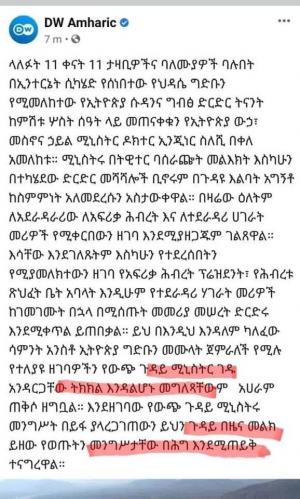
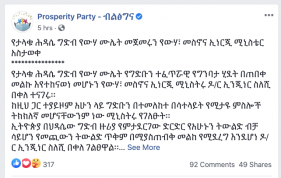
ገዱ አንዳርጋቸው: ኢትዮጵያ ግድቡን መሙላት ጀመረች የሚል ሐሰተኛ ዜና የሚያሰራጩ አካላት መንግስታቸው በሕግ እንደሚጠይቅ ገለፁ:: Ethiopian Foreign Minister denied local Ethiopian news reports, that Ethiopia began filing the GERD's reservoir.
 Why the confusion?
_________
___________________
(Courtesy of Berhe Habte-Giorgis) - For Egypt war is no option. The only damage it can inflict is on the dam wall. But retaliatory strike on the Aswan High Dam is also possible indicating that Egypt cannot attack Ethiopia with impunity. The consequences of war are hard to predict and become new causes leading into a spiraling sequence of uncontrollable events.
The problem should be managed through negotiations. If Egypt’s interest is security of the flow of water during periods of drought, accommodation can be worked out to minimize the consequences. However, if Egypt is interested mainly in Ethiopia having nothing to do with the flow of water, then it should see at the alternative of Ethiopia using the water from the tributaries for irrigation purposes. What then? Occupy Ethiopia militarily? So Egypt and Sudan should be happy with the GERD because Ethiopia will let the water flowing once the turbines are turned on.