Statue of racist journalist who married an Eritrean girl aged 12 attacked in Milan [BBC]
Posted: 14 Jun 2020, 14:27
ወይኔ ጣጣችን! ሲስተር በላይነሽ ከሰማች ደግሞ . . .Revelations wrote: ↑14 Jun 2020, 14:30
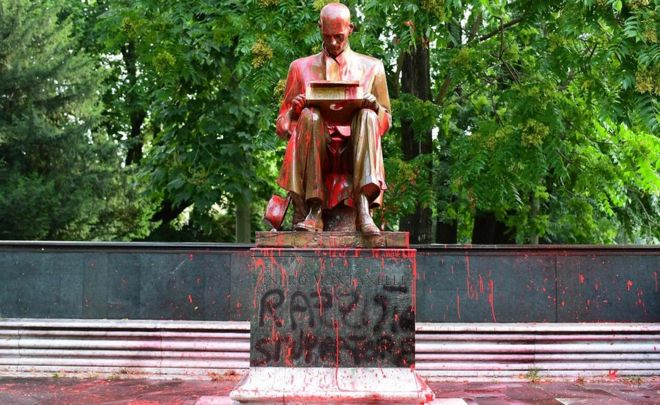
The graffiti "racist, rapist" was spray-painted on the plinth

The statue of a famous Italian journalist who defended colonialism, Indro Montanelli, has been daubed with red paint and defaced with the words "racist, rapist" in Milan.
Anti-racism protesters - a group called Retestudentimilano - claimed the attack and posted a video on Instagram.
They said the statue must be removed from the Milan park named after him.
Montanelli, who died in 2001, admitted having married an Eritrean girl aged 12, during army service in the 1930s.
It is reported to be the first such attack on a statue in Italy in the current anti-racism demonstrations in the US and Europe. Sparked by the death of George Floyd in US police custody, the protests have targeted statues seen as symbols of colonialism and slavery.
Retestudentimilano labelled Montanelli "a colonialist who made slavery an important part of his political activity" and said he "cannot and should not be celebrated in the public square".
Ethiopia has one of the highest rates of slave trade in the world. Each year, thousands of children, some as young as 10, are sold by their parents. According to the International Organization for Migration, impoverished Ethiopian families sell their children for the measly sum of around 1.50 US dollars.
present wrote: ↑14 Jun 2020, 14:44Her Ascari father sold her to the Italian
We have seen such cases before where the Ascari mothers selling their daughters. This is one testimony
Milan’s mayor has rejected calls to remove a statue from a public park of an Italian journalist who acknowledged having bought a 12-year-old Eritrean girl to be his wife during Italy’s colonial occupation in the 1930s.
Giuseppe Sala said in a Facebook video that he was perplexed by “the lightness” with which Indro Montanelli had confessed to buying the child from her father, in a widely circulated video of a 1969 talkshow appearance, but said “lives should be judged in their totality” and he believed the statue should stay.


Was Hana better off in the United States than in Ethiopia, as some who support international adoptions claim?beaten with sticks, hosed down, forced to eat frozen food and locked in closets.
The regime which receives millions in budgetary support and aid has decided that it is easier to sell Ethiopia’s children than to find ways to care for them in their own country and with their own families. The mainstream media and Ethiopia’s handlers speak of Ethiopia “achieving middle income status”, “Ethiopia has registered impressive economic growth” and Ethiopia remains the highest recipient of foreign development and humanitarian assistance in Africa, yet there is not enough in the regime’s coffers to take care of its orphaned children.…The country of 70 million has more than 5 million orphans, their parents lost to famine, disease, war and AIDS — a catastrophe that the government has said is “tearing apart the social fabric” of the east African nation…Caring for the orphans costs $115 million a month in a country whose annual health budget is only $140 million…So Ethiopia has gone out of its way to make adoption easier…
Dereje Feyissa Dori forgot to mention, that adoption of Ethiopia’s orphans is the fastest growing sector of the Ethiopian economy. In TPLF’s Ethiopia, one in eight children die before their fifth birthday and over 150,000 children live on the streets.…Changes are equally visible in trade and investment. Exports have diversified and the country has become a major shipper of oil seeds, flowers, gold and, increasingly, textiles and leather products. This has been enabled by a steady growth in foreign investment, particularly into floriculture and manufacturing. It is indeed astonishing to see Ethiopia fast becoming a popular destination for global giants such as Chinese shoemaker Huajian and H&M, the world’s second-biggest clothing retailer…
Bulti Gutema, the Ethiopian government official in charge of adoptions seemed to be justifying the selling of Ethiopia’s children. He tells IRIN:…The rising number of orphans has, however, raised the demand for adoptions to a record high. Some 1,400 children made new homes abroad last year, more than double from the previous year…Adoption agencies also doubled to 30 in the capital Addis Ababa in the last year, a highly lucrative market with some agencies charging parents fees of up to US $20,000 per child…
Did he call it alternative child care?…We would prefer these children to remain in Ethiopia because it is their country…Adoption is the last resort because it doesn’t help alleviate poverty in Ethiopia…We can’t afford to look after every orphan …That is why adoption is one of our existing alternative child-care programmes, although it really solves the problems of just a few children…
There would be no problem, if the welfare of the Ethiopian children was at the root of this boom. Recent investigative reports have shown not just the boom in adoptions, but also of corruption which at its center were Ethiopia’s helpless children, used as dispensable commodity, by unscrupulous adoption agents, with a complicit government.…Over the past several years, Ethiopia has rapidly become one of the top “sending countries” in international adoption: the number of children sent abroad has recently grown from a few hundred to several thousand annually. In the context of a global decline in international adoptions–which plummeted from a 2004 peak of 23,000 adoptions to the U.S. to under 12,000 in 2010–Ethiopia’s exponential growth has earned it the label of the adoption world’s “New China”…
Hence, the reluctance of the regime in Ethiopia to bring an end to this lucrative industry……widespread irregularities in the paperwork of children adopted out to the U.S. and Europe—sometimes misrepresenting living parents as dead; allegations of fraud or agencies coercing birth families into relinquishing their children; and stories of harassment campaigns against those who question the booming adoption trade, known for bringing significant foreign money into the country through a variety of channels…
Some astute Ethiopians say, the regime’s adoption scheme is tantamount to “a legally sanctioned export scheme of Ethiopian children to generate needed foreign exchange”. A lucrative enterprise wherein the purchase price, brokerage fees, legal and other fees, all bring the regime much needed foreign currency.…Americans adopt about 2,000 children annually from Ethiopia. If we calculate the median costs for each adoption at $46,000 (Adoptive Families, Winter 2014), then we have a total of $92,000,000… Money talks, and money talks in many languages. In Ethiopia 78 percent of the population struggles with an income below $2 a day. So a bribe of $1,000 is a year’s income for many poor Ethiopians. If the adoption industry is not carefully regulated it will result in more adoption coercion, baby stealing, child trafficking and corruption…
The Brandeis University Schuster Institute for Investigative Journalism (SIIJ) reported https://www.brandeis.edu/investigate/ad ... FOIAs.html the following:…The boom [Adoption] had brought substantial revenue into the country, as agencies and adoptive parents supported newly-established orphanages that became an attractive child care option for poor families; some agencies paid fees to “child finders” locating adoptable children; and the influx of Western adoption tourism brought money that trickled down to hotels, restaurants, taxi-drivers and other service industries…
On the number of adoption agencies in Ethiopia, the SIIJ report stated the following:…From 2002 through 2013, Americans adopted more than 14,000 Ethiopian-born children. In the beginning, according to officials at the U.S. Embassy in Addis Ababa, those were humanitarian efforts, carefully overseen by the Ethiopian government, resulting in some needy children finding desperately needed new families…But by 2010, numbers had escalated from 105 adoptions a year to 2,511, an astounding increase in a short period of time. Some adoptive parents in North America and Europe were reporting that when their newly adopted children would learn English, they would explain that everything in their paperwork was a lie: They did indeed have families back in Ethiopia and expected to return there…
Ethiopia’s orphaned children have been dispersed involuntarily from their own countries, by their own government. Thousands have been sold, and millions await their fate.…the number of applications to adopt from Ethiopia—and the number of American adoption agencies working in the country—were expanding “exponentially,” with eight times as many agencies working in country than had been there in 2000, for a total of 24…By July 2008, the Embassy wrote, more than 70 licensed agencies were referring Ethiopian children for adoption, 24 of them American. There had been only three licensed agencies in 2000…The U.S. has no legal or regulatory control over what happens inside Ethiopia, or any other foreign nation, and zero legal authority over local child or family welfare services or orphanages. All that was the responsibility of the Ethiopian government…
Misrepresenting living parents as dead, agencies coercing birth families into relinquishing their children, harassment campaigns against those who question the booming adoption trade have been cited by many researchers. Adoption researchers have found cases of “child harvesting,” or unethical recruitment of children, as well as fraudulent paperwork in Ethiopia’s adoption economy.becoming the new export industry for our country.
…humanitarian adoptions metastasized into a mini-industry shot through with fraud, becoming a source of income for unscrupulous orphanages, government officials, and shady operators … in the case of inter-country adoptions, far too often, orphans were “produced” by unscrupulous middlemen who would persuade desperately poor, uneducated, often illiterate villagers whose culture had no concept of permanently severing biological ties to send their children away—saying that wealthy Westerners would educate their children and send them home at age 18 …Another fraud indicator was that roughly half of Ethiopian adoptions were coming from a single province: SNNPR, or Southern Nations, Nationalities, and People’s Region, the capital of which is Awassa. That suggested a regular production chain, with officials colluding with orphanages to “find” children available to exchange for cash…
…Adoptive parents in the U.S. began to complain that when their children learned enough English to communicate, they talked about having other families; birth parents declared dead on adoption paperwork were sometimes alive; additional siblings might exist; children said to have been conceived from stranger rapes were in fact born to married couples. On some adoptees’ paperwork birth parents were simultaneously declared dead and unknown… Ethiopia’s government found that some children’s paperwork had been doctored to list children who had been relinquished by living parents as orphans… The thousands of Ethiopian children adopted by families in the U.S. and Europe over the last decade will grow up one day. They’ll learn about the circumstances around adoption from Ethiopia in earlier years and will want to find out the truth of their background…
Children are vulnerable in Ethiopia, because the government is unwilling to stop unscrupulous adoption agencies who have shifted their activities from other nations to Ethiopia to take advantage of the corrupt system. They can carry on with their fraudulent practices in Ethiopia, even if they are banned elsewhere. Karen Smith Rotabi offers an example:…The system is relatively expedient… national oversight of foreign adoption agency practices is relatively lax … is relatively inexpensive within intercountry adoption programs and agencies even use this as a selling point for potential adoptive families…Ethiopia has not ratified the Hague Convention and, as a result, agreed upon international monitoring systems preventing child sales and thefts are not implemented. This means that US agencies which are not Hague-accredited may continue to operate in this nation—including those that have actually been denied Hague accreditation due to their failure to demonstrate capacity to engage in Hague-practices (internationally agreed upon child welfare standards)…
Alisa Bivens, a former foreign program director of International Adoption Guides Inc. (IAG), an adoption agency, pleaded guilty to conspiring with others to defraud the United States by paying bribes and submitting fraudulent documents to the State Department for adoptions from Ethiopia. According to August 6, 2014 Department of Justice Press Release:…the U.S. Embassy began urging the Ethiopian government to de-license at least half of those 70 adoption agencies, including—for the U.S.—the ones that had not received Hague accreditation by the U.S. State Department. Ultimately, the Ethiopian government did not suspend adoption and instead decided to review all of the agencies. But by September 2008, it was clear—to the Embassy’s frustration—that troubled agencies would stay licensed, even those that had apparently lied about the children’s origins, failed to keep records on children’s backgrounds, changed children’s ages to make them more “adoptable,” shuffled children from one part of the country to another so their families couldn’t be traced, and so on…
….Bivens also admitted that she and others paid bribes to two Ethiopian officials so that those officials would help with the fraudulent adoptions. The first of these two foreign officials, an audiologist and teacher at a government school, accepted money and other valuables in exchange for providing non-public medical information and social history information for potential adoptees to the conspirators. The second foreign official, the head of a regional ministry for women’s and children’s affairs, received money and all-expenses-paid travel in exchange for approving IAG’s applications for intercountry adoptions and for ignoring IAG’s failure to maintain a properly licensed adoption facility…
Those who continue to adopt children from Ethiopia using shady agencies and fraudulent means are as complicit in the fleecing of poor Ethiopian families, as the minority regime that refuses to protect its own citizens, and some US government officials that choose to look the other way.…To solve the ‘orphan crisis’ bigger and probably more economically painful measures have to be taken. Secondly the US has to do its work in a Foreign Affairs context. Third it must focus on the psychological aspect of adoption. If you were adopted from Ethiopia and at a certain point in life you would understand that your existence in the US depended on cheating out your first parents by a system that was supported and condoned by your by now home country, how would you feel about that country, your adoptive parents, the adoption industry? How would you feel about yourself and who you are…?