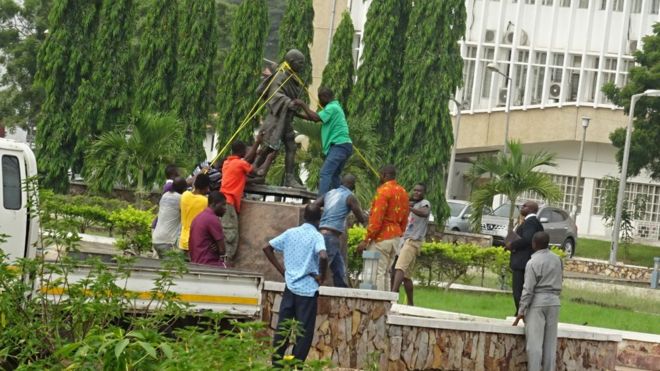
Racist Gandhi statue removed from University of Ghana [BBC]
Posted: 13 Jun 2020, 15:55

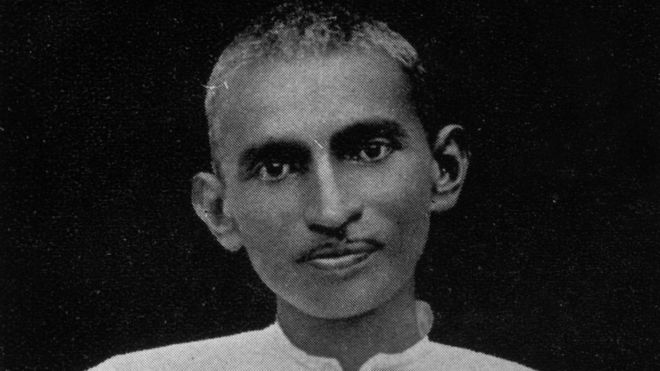
In his early writings he referred to black South Africans as "kaffirs" - a highly offensive racist slur. He also said that Indians were "infinitely superior" to black people.
https://www.bbc.com/news/world-asia-india-34265882
The authors of a controversial new book on Gandhi's life and work in South Africa certainly believe so. South African academics Ashwin Desai and Goolam Vahed spent seven years exploring the complex story of a man who lived in their country for more than two decades - 1893 to 1914 - and campaigned for the rights of Indian people there.
In The South African Gandhi: Stretcher-Bearer of Empire, Desai and Vahed write that during his stay in Africa, Gandhi kept the Indian struggle "separate from that of Africans and coloureds even though the latter were also denied political rights on the basis of colour and could also lay claim to being British subjects".
They write that Gandhi's political strategies - fighting to repeal unjust laws or freedom of movement or trade - carved out an exclusivist Indian identity "that relied on him taking up 'Indian' issues in ways that cut Indians off from Africans, while his attitudes paralleled those of whites in the early years". Gandhi, the authors write, was indifferent to the plight of the indentured, and believed that state power should remain in white hands, and called black Africans Kaffirs, a derogatory term, for a larger part of his stay in the country.
Racial segregation
In 1893, Gandhi wrote to the Natal parliament saying that a "general belief seems to prevail in the Colony that the Indians are a little better, if at all, than savages or the Natives of Africa".
In 1904, he wrote to a health officer in Johannesburg that the council "must withdraw Kaffirs" from an unsanitary slum called the "Coolie Location" where a large number of Africans lived alongside Indians. "About the mixing of the Kaffirs with the Indians, I must confess I feel most strongly."
The same year he wrote that unlike the African, the Indian had no "war-dances, nor does he drink Kaffir beer". When Durban was hit by a plague in 1905, Gandhi wrote that the problem would persist as long as Indians and Africans were being "herded together indiscriminately at the hospital".
This, in itself, say historians, is not entirely new and revelatory. Also, some South Africans have always accused the man who led India to independence of working with the British colonial government to promote racial segregation. In April, a man was arrested in connection with vandalising a statue of Gandhi. A hashtag #Ghandimustfall (sic) has gained circulation on social media.

Kerri Pangulier, who started the petition, wrote on the change.org page: "I have received an update from Leicester City Council requesting me to close the petition and formally submit it with presenting arguments."
A city council spokeswoman said: "Although this petition has not yet been submitted to us, these representations will be considered as part of a wider conversation about the context, relevance and appropriateness of street names, statues and monuments in the city.
"In such a culturally-diverse city as Leicester, it's important that we respect the histories of all our communities and understand the context for the historical references that are part of our streetscape and built environment."
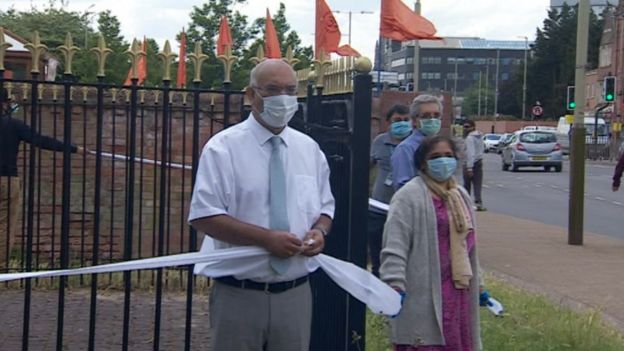
Former MP Keith Vaz said the sculpture was "going nowhere".
The former politician, who attended an unveiling ceremony in 2009, said: "This is the way we honour Mahatma Gandhi who wanted peaceful protest and peaceful activity.
"He was never someone who believed in violence and he did not believe people should act as a mob to remove things.
"We hope very much Leicester City Council and others will realise this statue stays.
"It is going nowhere. All of us are here symbolically to protect it."
 on job application forms when the employer,mostly government Dept,specifically invites applicants from minority backgrounds,they consider blacks as the lowest of the low.
https://www.theguardian.com/world/2019/ ... tue-racismProf Meena Dhanda from the University of Wolverhampton said it was unsurprising that “the more people have begun reading Gandhi rather than merely idolising him, the more they are finding out about his racism”.
She added: “As scholars have shown, he was terrified of intermixing, he upheld caste rules that restricted marriage outside one’s caste. He stereotyped people, for instance, he wrote – ‘Mussalman as a rule is a bully and a Hindu a coward’ and ‘Kaffirs are as a rule uncivilised’.
“Despite his political actions harnessing the force of ‘non-violence’, his underlying metaphysical views were deeply at odds with modern sensibilities. To use him as an apostle of peace whilst ignoring the very beliefs that cause ruptures within modern diverse communities is ill-advised.”
We are now doubting who revelation is..... the same bbc writer, blaming Ghandi as source? Yes, the world will believe thatRevelations wrote: ↑13 Jun 2020, 16:55Was Mahatma Gandhi a racist?
https://www.bbc.com/news/world-asia-india-34265882
The authors of a controversial new book on Gandhi's life and work in South Africa certainly believe so. South African academics Ashwin Desai and Goolam Vahed spent seven years exploring the complex story of a man who lived in their country for more than two decades - 1893 to 1914 - and campaigned for the rights of Indian people there.
In The South African Gandhi: Stretcher-Bearer of Empire, Desai and Vahed write that during his stay in Africa, Gandhi kept the Indian struggle "separate from that of Africans and coloureds even though the latter were also denied political rights on the basis of colour and could also lay claim to being British subjects".
They write that Gandhi's political strategies - fighting to repeal unjust laws or freedom of movement or trade - carved out an exclusivist Indian identity "that relied on him taking up 'Indian' issues in ways that cut Indians off from Africans, while his attitudes paralleled those of whites in the early years". Gandhi, the authors write, was indifferent to the plight of the indentured, and believed that state power should remain in white hands, and called black Africans Kaffirs, a derogatory term, for a larger part of his stay in the country.
Racial segregation
In 1893, Gandhi wrote to the Natal parliament saying that a "general belief seems to prevail in the Colony that the Indians are a little better, if at all, than savages or the Natives of Africa".
In 1904, he wrote to a health officer in Johannesburg that the council "must withdraw Kaffirs" from an unsanitary slum called the "Coolie Location" where a large number of Africans lived alongside Indians. "About the mixing of the Kaffirs with the Indians, I must confess I feel most strongly."
The same year he wrote that unlike the African, the Indian had no "war-dances, nor does he drink Kaffir beer". When Durban was hit by a plague in 1905, Gandhi wrote that the problem would persist as long as Indians and Africans were being "herded together indiscriminately at the hospital".
This, in itself, say historians, is not entirely new and revelatory. Also, some South Africans have always accused the man who led India to independence of working with the British colonial government to promote racial segregation. In April, a man was arrested in connection with vandalising a statue of Gandhi. A hashtag #Ghandimustfall (sic) has gained circulation on social media.


