Colonial amnesia and Germany’s efforts to achieve ‘internal liberation’
Posted: 21 May 2020, 08:03

Colonial amnesia and Germany’s efforts to achieve ‘internal liberation’
May 19, 2020
Henning Melber, University of Pretoria, Reinhart Kössler, University of Freiburg
https://theconversation.com/colonial-am ... liberation
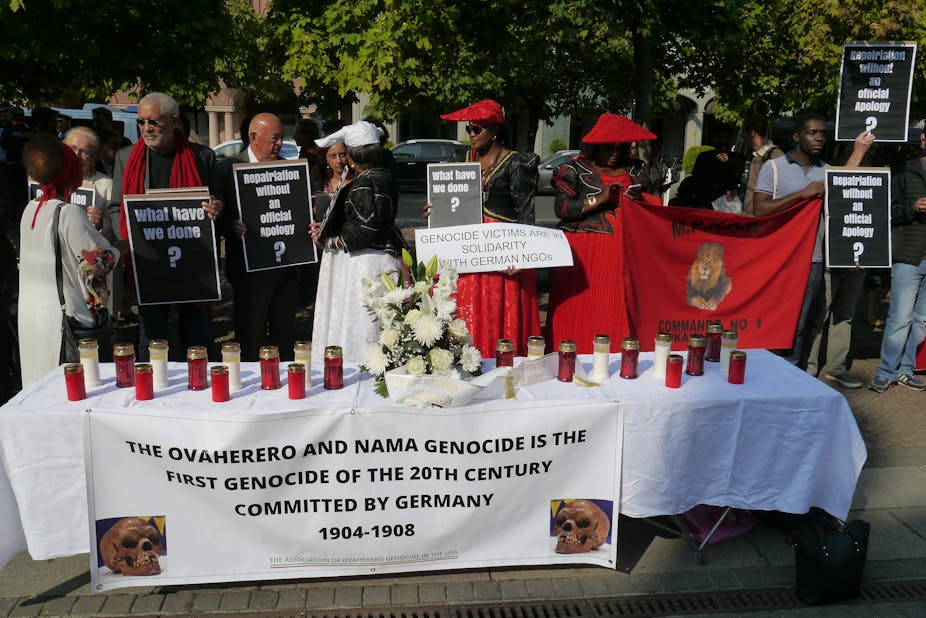
Protesters in Berlin demand that the 1904-1908 mass killings in Namibia be recognised as the first genocide committed by Germany. Supplied/Courtesy of Joachim Zeller
Speaking at the 75th commemoration of VE (Victory in Europe) Day, https://www.theguardian.com/world/2020/ ... r-75-years German president Frank-Walter Steinmeier said https://www.bundespraesident.de/SharedD ... cationFile it was a day of liberation “imposed from outside”, by Allied military forces, including the Soviets. But as he stated, “internal liberation”, the coming to terms with the heritage of dictatorship and above all the horrific mass crimes, remained “a long and painful process”.
In 1985 the West German head of state, Richard von Weizsäcker, for the first time used the term “liberation” for the unconditional surrender of German troops https://www.bundespraesident.de/SharedD ... cationFile that marked the end of the second world war in Europe. This sparked considerable protest and controversy, a sign that even as late as the mid-1980s, Germany was having difficulty coming to terms with its past.
Steinmeier’s more consistent plea to “accept our historic responsibility” met broad consensus. “Internal liberation” had come some way – leaving aside comparatively weak statements by the right-wing Alternative für Deutschland. https://www.dw.com/en/afd-what-you-need ... a-37208199
The culture of remembrance, concerning also dire aspects of the past, that’s been engendered in Germany is viewed by many as exemplary. But it nevertheless has some grave shortcomings. Notably, the remembrance of Auschwitz https://encyclopedia.ushmm.org/content/ ... /auschwitz as a substantial part of German state rationale has come about through a halting and conflicting process. For all its merits, still, by virtually singling out the Shoah (the genocide of the Jews in Europe), it marginalises and disregards other mass crimes of the Nazi period.
As recalled during the VE-Day anniversary, such elision from memory includes over 30 million victims of the war against the Soviet Union and the occupation of eastern territories in what are today Russia, Ukraine, Belorussia, Moldavia, Poland and the Baltic states. This blank spot relates to an ingrained culture in Germany of discrimination against Slavic people and refuses to acknowledge the crimes perpetrated by the millions of ordinary German soldiers. https://www.neues-deutschland.de/artike ... nes%7CHeer
Another glaring lacuna concerns Germany’s past as a colonial power. This period lasted from 1884 to 1919. https://www.newworldencyclopedia.org/en ... ial_empire Despite the relatively short duration, this experience had a great impact on Germany’s violent trajectory during the first half of the 20th century. Since 1945, however, this history has been largely forgotten.
Today many Germans are not even aware that their country once ruled colonies in Africa, Oceania and China. Such public amnesia about Germany’s colonial past https://www.rosalux.de/fileadmin/rls_up ... 9-2018.pdf does not imply only a lack of knowledge. Rather it manifests in the refusal to acknowledge the practice of German colonialism and countenance the consequences.
A prominent case is the genocide of 1904-1908 in then South West Africa. https://theconversation.com/has-the-rel ... low-121329 Germany admitted the fact in 2015. But bilateral negotiations with Namibia have not yet reached any result. https://www.tandfonline.com/doi/pdf/10. ... 20.1750823
Selective amnesia
Complacency about German culture of remembrance tends to isolate the Shoah as the mainstay of canonised public memory. There was a period when the entire field of comparative genocide studies was scrutinised as undermining the singularity of the Shoah. American political scientist and historian Henry Huttenbach https://www.sciencespo.fr/mass-violence ... aning.html pointed to the imbalance
This also eroded the vital call of “Never Again” by the survivors of the Buchenwald concentration camp in 1945. https://www.blurb.com/b/828859-never-again-buchenwald If comparison is tabooed, the Holocaust cannot stand as a warning that organised mass extinction might yet be repeated.that the Holocaust became the paradigm for all genocides by default.
But, unfortunately, we have to stand guard against the very real possibility of current and future cases of genocide, ethnic cleansing and crimes against humanity.
The persistent lack of awareness was shown once again in a mid-2019 foreign ministry position paper on transitional justice. https://www.auswaertiges-amt.de/blob/22 ... e-data.pdf It
and refers toadvocates a comprehensive understanding of confronting past injustices
It suggests thatreparations and compensation for National Socialist injustices.
Strikingly, however, the term “colonialism” does not feature even once in the 32 pages.Germany can provide information about basic requirements, problems and mechanisms for the development of state and civil-society reparation efforts.
Rather, German diplomacy is seen as aggressively keeping things apart. This attitude is self-congratulatory and discriminating at one and the same time.
Namibian genocide
The issue was epitomised when Ruprecht Polenz, the German special envoy in the negotiations with the Namibian government about the consequences of the genocide, met a delegation of Namibian descendants of genocide survivors in 2016. They challenged him for not being part of the negotiations. They pointed out that Germany had negotiated with other non-state agencies, such as the Jewish Claims Conference. https://www.bpb.de/apuz/162883/wiedergu ... [deleted]?p=all

Graves of forced labourers from a concentration in Lüderitz, Namibia. Reinhart Kössler
Polenz stressed that it was inappropriate to draw comparisons in cases such as genocide. But at the same time he pointed out that the Holocaust was qualitatively different from the genocide in Namibia. The meeting exploded in protest by the Namibian delegates – and a walkout. http://genocide-namibia.net/wp-content/ ... V-2016.pdf They saw disrespect in belittling what happened to their ancestors as well as discriminating against them as Africans.
Already in 2001, Namibia’s foreign minister, Theo-Ben Gurirab, commented at the World Conference Against Racism https://nhri.ohchr.org/EN/Themes/Racial ... acism.aspx on the lack of a German apology to Namibians in contradistinction to Europeans. He concluded that if there was a problem in apologising because Namibians were black, that would be racist. http://www.freiburg-postkolonial.de/Sei ... on2006.htm
The challenges of ‘internal liberation’
German memory politics and practices are not quite as exemplary as the Foreign Office would like to make us believe. In fact, the engagement with the violent past particularly of the first half of the 20th century is an ongoing and painful as well as conflictual process. Inasmuch as this process has been seen to consecutively encompass crimes and victim groups that had been silenced before, such an observation can only underline the magnitude of the task.
The urgency of addressing such challenge emerges from revisionist efforts, spearheaded by the Alternative für Deutschland. The group’s honorary chairman, Alexander Gauland, infamously termed Nazi rule as “bird’s [deleted]” in comparison to Germany’s “successful” history. https://www.afdbundestag.de/wortlaut-de ... r-gauland/
The party has drawn up a parliamentary draft resolution calling for a positive reassessment of colonialism’s modernising achievements. https://dipbt.bundestag.de/dip21/btd/19/157/1915784.pdf It makes explicit reference to a 2018 statement by the personal representative of the German Chancellor for Africa. https://africasacountry.com/2019/01/a-t ... olonialism He maintained that German colonialism contributed to liberate the African continent from archaic structures.
These developments show that there are limits to Germany’s accomplishment of coming to terms with its violent past. This was also reflected in the vigorous objection by German officials to Achille Mbembe, https://wiser.wits.ac.za/users/achille-mbembe the Cameroonian philosopher and political theorist, being invited as keynote speaker at this year’s Ruhrtriennale, a renowned cultural festival. He had been asked to address the issue of “Reparation”. https://presse.ruhrtriennale.de/pressre ... mm-2983369
A deputy of the Liberal Party in the North Rhine Westphalia Diet https://fdp.fraktion.nrw/sites/default/ ... le2020.pdf alleged that Mbembe had refuted Israel’s right to exist as a state, and had “relativised” the Holocaust by comparing the practices of separation under apartheid with the Palestinian situation. The federal government’s antisemitism commissioner joined this protest. https://www.jpost.com/diaspora/antisemi ... val-624577
This intervention sparked a controversy that stands as a warning that the postcolonial situation of Germany is very much at stake. By reducing the conflict to issues of antisemitism, it has been trapped in the pitfalls of colonial amnesia. But inner liberation remains hard work. It means conflict and pain, and it must never end.