Ethiopian News, Current Affairs and Opinion Forum
Zmeselo
Senior Member+
Posts: 36763
Joined: 30 Jul 2010, 20:43

Somalia’s Foreign Policy, needs Re-adjustment.

Post by Zmeselo » 01 Sep 2019, 12:14


Somalia’s Foreign Policy, needs Re-adjustment

By Naima Osman

https://www.hiiraan.com/op4/2019/aug/16 ... tment.aspx

August 31, 2019


The world order has become more volatile subsequent to the election of Donald Trump as President of the United States. Since his election he is running a foreign policy that is inconsistent, incoherent and unpredictable. He is hostile to America’s most important alliance, the EU, and is highly sympathetic of Brexit. His trade war with China is affecting the world economy.

In the Middle East, the Arab league is barely functional. A coalition led by Saudi Arabia and its arch enemy Iran are fighting a proxy war in Yemen and elsewhere in the region. Palestinian cause is up in the air as countries in the Gulf have chosen to pursue their national interest over that of Palestine, and are certainly forging strategic partnership with Israel.

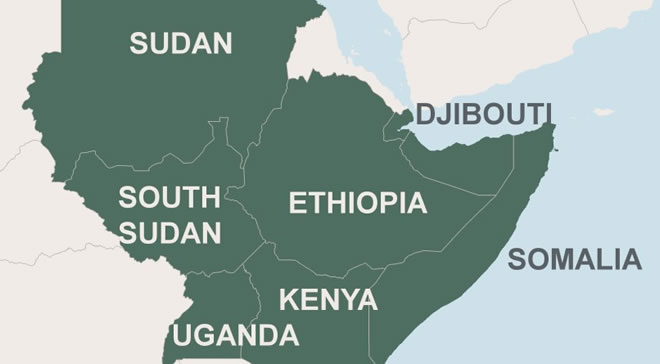
In the Horn of Africa, some positive changes have emerged. Ethiopia and Eritrea have signed a peace agreement. Also Somalia, Eritrea and Ethiopia have forged a trilateral agreement that entails security, defense and economic cooperation. The era of TPLF and its divisive policy is over. In the meantime, Hassan Al-Bashir is overthrown and is in jail for corruption charges.

On the other hand Kenya is nervous about the new developments because its role in the region is shrinking, as Ethiopia’s interest has shifted. More importantly, the looming instability in Ethiopia is of prime concern to the Horn of Africa and to the wider East African communities.

Anarchy and disarray, has always dominated international politics. Somalia has to be on guard, to secure its survival. It needs a proactive diplomacy, that could devise a strategy to sustain its national interest.

What Somalia should do?

Two foreign policy matters, require immediate attention and overhaul. Commitment to the regional peace and development, should be a priority for Somalia. But this should be done, by either demanding IGAD to reform or quit from the organization. Somalia cannot survive with IGAD, as is now. Just recently, the Secretary General of IGAD elevated the status of Mr. Mohamed Ali Guyo- a Kenyan national- not only as the Special Envoy for Somalia but also for the Red Sea and the Gulf of Aden, while there is no single Somali national serving at the executive level. Very strategic, indeed! It must be understood that Kenya, though it does not border the Red Sea and the Gulf of Aden, has managed to position itself as the main driver of the new Red Sea and Gulf of Aden initiatives. This is a slap in the face for countries of Djibouti, Eritrea, Somalia and Sudan who hail from the Red sea and the Gulf of Aden.

There is a growing frustration among IGAD member states, regarding the way IGAD is hijacked. Countries like Sudan, South Sudan, Eritrea, Somalia and even the new Ethiopia sees IGAD as a regional institution that failed to deliver its mission. Somalia needs to spearhead a diplomatic campaign, aimed at either reforming IGAD or pushing for the creation of a new regional block; a block of the willing. Obviously, Djibouti will not be part of this change at least at the beginning because it hosts IGAD, therefore, Somalia should remain committed to prioritize its strategic interest without alienating Djibouti.

If reform is denied, it is our national survival to drive the diplomacy for a new regional block that excludes hostile countries. Our differences with Kenya is widening. Somali nationals entertaining Kenya’s divide and rule policy for their personal gain are leaving behind a terrible legacy, a legacy of national treason. Anyone undermining Kenya’s soft occupation in Somalia is in denial. Kenya has partnered with other hostile countries, to dismantle Somali National unity and is devising a political strategy to take over our land and sea. They will use the likes of Madoobe, to destroy the aspiration of the future generations.

Aiding a foreign entity at the expense of Somali national interest, has been the political platform of the past several decades. Unfortunately, the power struggle in Somalia is guided by a personal greed and has had major repercussions to the security, development and survival of this nation. The problem, touches the nature of our deep political division. Somalia’s current leadership, should commit to mobilize the public against external and internal axis of evils that is threatening our great nation.

We ought to pursue a foreign policy, that purely defends Somalia’s national interest. Time has come to call a spade a spade and IGAD, a dysfunctional organization that often serves as a political instrument to meddle in the internal affairs of Somalia and South Sudan.

The new block should focus on establishing closer economic ties, and common security and defense strategies. Keeping in mind, that the region has become a battleground for geopolitical struggle. Our existence is interdependent and only through collective strategy, we can mitigate all threats facing the region.

The second foreign policy change,that is way overdue is what to do with Israel. The notion that Arab countries are friends or brothers with Somalia is a fantasy of the past. Indeed, some Arab countries have pursued policies that are detrimental to the stability of Somalia. The question whether Somalia should establish diplomatic relations with Israel is not a matter of debate, but a matter of time only. Historically, Somalia never had a direct confrontation with Israel, but our policies always remained supportive of the Palestinians because of conviction of their plight. Nevertheless, countries have interest, but no eternal friendship. Considering the current reality in the Middle East, and the fact that Somalia is a victim of the geopolitical infighting between GCC member states, it will be unwise to stick with the same arguments of the past. Relationships are shaped and guided, solely by the interest of the country. As the regional interests diverted, the search of a balanced diplomacy that enhances the status of Somalia internationally should be adapted. Diplomatic pragmatism calls for pragmatic solutions; it is time for Somalia to seriously consider establishing friendly relationship with Israel without compromising its long standing moral position of the two states solution.

Naima Osman

[email protected]

Zmeselo
Senior Member+
Posts: 36763
Joined: 30 Jul 2010, 20:43

Re: Somalia’s Foreign Policy, needs Re-adjustment.

Post by Zmeselo » 01 Sep 2019, 12:19


Zmeselo
Senior Member+
Posts: 36763
Joined: 30 Jul 2010, 20:43

Re: Somalia’s Foreign Policy, needs Re-adjustment.

Post by Zmeselo » 01 Sep 2019, 13:06


A Year After the Ethiopia-Eritrea Peace Deal, What Is the Impact?

Warming ties are part of a tectonic shift in the Horn of Africa, but the end results are far from certain.

Thursday, August 29, 2019 / BY: Susan Stigant; Michael Phelan

https://www.usip.org/publications/2019/ ... hat-impact

Ethiopia and Eritrea signed a peace agreement just over a year ago https://www.usip.org/publications/2018/ ... orn-africa to end two decades of a “frozen war.” The accord, which resolved a seemingly intractable border dispute after Ethiopian Prime Minister Abiy Ahmed took office and accepted an independent commission’s 2002 boundary decision, was greeted with tremendous optimism in both countries and by international observers. Following the first anniversary of the agreement last month, USIP’s Susan Stigant, the director of Africa programs, and Michael Phelan, a senior advisor on Africa, assess the peace deal’s impact on the states’ bilateral relations, Eritrea’s persistent internal policies, Ethiopia’s economic and political development and stability in the Horn of Africa.


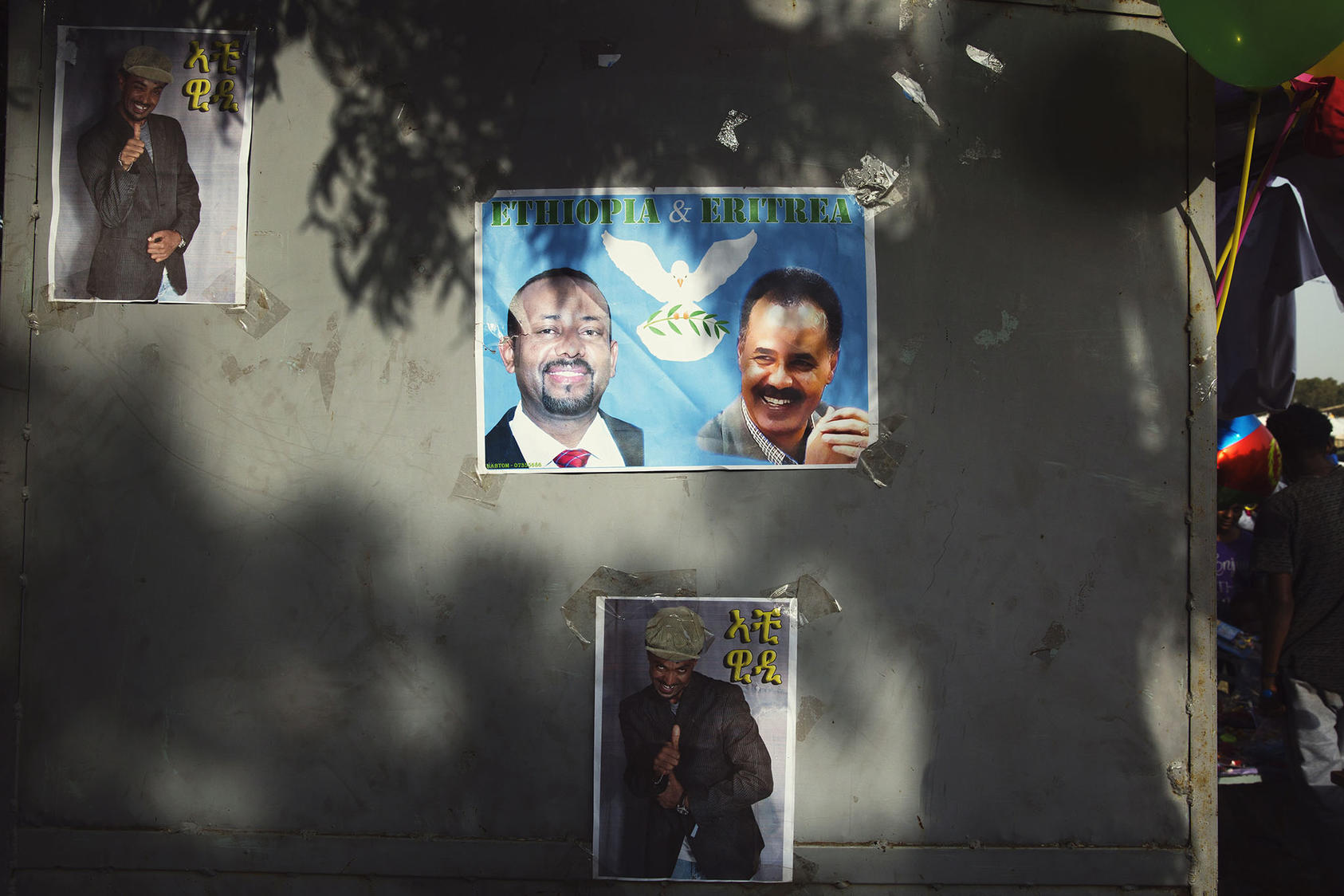
A poster of Prime Minister Abiy Ahmed of Ethiopia, left, and President Isaias Afwerki of Eritrea is displayed during a festival in Asmara, Eritrea, Sept. 7, 2018. (Malin Fezehai/The New York Times)

How has the Ethiopia-Eritrea relationship evolved over the last year?

Phelan: At first it seemed the dynamic and unexpected events in warming relations might break through entrenched resistance. However, this fragile relationship, while improved, has reverted to its norms, minus the looming military threat. While Ethiopia has continued to encourage institutionalizing new trade and travel opportunities with Eritrea, Abiy faces internal politics that have become far more contentious, https://www.usip.org/publications/2019/ ... ews-sidama hampering any further quick advances. Eritrea has reverted to extreme caution around anything that might erode President Isaias Afwerki’s complete control.

In a much-anticipated speech http://www.shabait.com/news/local-news/ ... ias-afwerk on Independence Day in May, Isaias acknowledged “the beginnings of a new era” but then harkened back to the virtue of resilience and “a patient appraisal of the unfolding reality.” While that doesn’t foreclose a positive and productive relationship, the countries’ respective size and economic dynamism will likely govern the pace at which each is willing to move forward. Ultimately, Isaias has acknowledged the
principal aim is to transform the primordial subsistence economy to a modern and developed industrial economy.
Stigant: Ending the “no war, no peace” period between Ethiopia and Eritrea remains a historic milestone. The stories of families reunited after decades highlights the deep personal costs of conflict and the immediate possibilities of peace. However, over the past year, people expected that the peace would result in additional, sustainable improvements. And in some cases, progress has now been stalled or even reversed. For example, Eritrea closed the border crossing between the countries again. To date, the peace has largely remained at elite, political levels—and even personalized between Abiy and Isaias. Individual relationships are important to build peace but insufficient—and even risky, if those relationships sour—to sustain peace and avoid a return to conflict in the medium term. There need to be predictable, agreed upon ways to resolve disputes when they arise.

Eritrean authorities have historically justified their restrictive security state by citing the conflict with Ethiopia. A year after the peace deal, has the government lifted its harsh control?

Phelan: In short, no. The renewal of neighborly relations, including Abiy’s express acceptance of the U.N.-brokered 2000 peace agreement delimiting the contentious border, hasn’t loosened Eritrea’s most restrictive policies. The Ethiopia-Eritrea thaw has enabled progress in Eritrea’s regional disputes with Djibouti and Somalia, but Isaias appears less confident in the internal ramifications of the new environment. He continues to insist on slow going saying, http://www.shabait.com/news/local-news/ ... ias-afwerk
before charting out new and permanent sustainable development programs, it is imperative that we conduct extensive political, economic and security appraisals.


Stigant: Many in the international community hoped that the Ethiopia-Eritrea rapprochement would help to open new channels of engagement and communication with Eritrea and Eritreans. This is still very much a work in progress. Further dialogue—with the government, academics, civil society, and citizens—will be necessary to fully understand the state of play in the country, explore openings for reform, and identify priorities and barriers to progress.

How has the peace deal affected Ethiopia’s political and economic development?

Phelan: It remains to be seen. While it’s certainly possible Ethiopia will continue to lead the continent in GDP growth regardless of Eritrea, growth would be faster with an open and engaged economy to its north. Ethiopia has already made use of other ports across the Horn of Africa (including Djibouti and Somalia) but Eritrea an important outlet as Ethiopia continues to develop. Thus far, there has been more easing of political tensions https://www.usip.org/publications/2019/ ... ise-reform than sustainable progress on the economic front. https://www.usip.org/events/changing-et ... engagement The return to Ethiopia of Ethiopian opposition leaders and their armed groups has removed a painful irritant but also exacerbated political disputes that have long bedeviled governance.

The mutual outreach to resolve regional disputes by Ethiopia and Eritrea with Djibouti and Somalia has settled some of the regional tension that has long disrupted relations and international interest in investment and trade. While facilitating the removal of sanctions, these steps are only a part of the regional dynamic. Gulf states have joined the Chinese, and increasingly Russia, Turkey, and Egypt in aligning and investing with individual governments in the region.

Stigant: We know that peace agreements are more successful and most likely to stick when they are inclusive. That means that the groups who have grievances, conflicts or disputes need to be part of the negotiations and agree to accept the outcomes. In Ethiopia, this means that the Tigray region, which has the longest border with Eritrea, needs to play a constructive, active role. To date, this is not the case. Tensions remain significant between Abiy’s federal government and the leaders in Tigray. Without a political settlement https://addisstandard.com/commentary-af ... -urgently/ first on the roadmap for Ethiopia’s transition—and Tigray’s role in it—it’s hard to guarantee a positive role for Tigray in the Ethiopia-Eritrea accord and lasting peace between the countries.


A year out, has Ethiopia-Eritrea peace had a stabilizing impact on the Horn of Africa?

Phelan: Yes. Eritrea and Ethiopia have been willing to work together toward the resolution of long-standing regional tensions, reportedly agreeing that a more stable Horn of Africa would bolster investor confidence and benefit the region. Eritrea has renewed ties with Djibouti after more than a decade-long border dispute, and with the assistance of Ethiopia, is in talks to resolve additional matters. Eritrea has also renewed diplomatic relations with Somalia, where its support for proxy forces a decade ago resulted in severe U.N. sanctions. After the rapprochement between Asmara and Mogadishu, the U.N. lifted sanctions on Eritrea, although it maintained the arms embargo.

Stigant: The Horn of Africa is experiencing a tectonic transition. https://www.usip.org/publications/2018/ ... ns-red-sea But things are far from settled. The Intergovernmental Authority on Development (IGAD) has welcomed https://www.igad.int/attachments/articl ... omalia.pdf Eritrea’s increased regional engagement—largely through the Ethiopia-Somalia-Eritrea Joint Declaration—but has yet to bring Eritrea back as a regular, active participant in the regional organization after a 12-year absence. An agreement may be reached on a new IGAD chair in the coming months (Ethiopia has held the position for over a decade)—but the delay demonstrates just how sensitive regional politics remain.

Consultations led by the African Union http://www.peaceau.org/en/article/the-8 ... -of-africa and an IGAD Taskforce https://igad.int/programs/66-somalia/20 ... lf-of-aden are animating discussions https://www.newvision.co.ug/new_vision/ ... ome-uganda on priorities and approaches for regional integration, including the relationship with countries on the eastern side of the Red Sea. Eritrea’s willingness to engage constructively and actively is a test of the Ethiopia-Eritrea relationship. While Eritrea has begun to participate in a nascent initiative to establish a “Red Sea Security Council,” championed by Egypt and Saudi Arabia, this notably involves only littoral states and therefore excludes Ethiopia. Ethiopia has been and remains a champion of IGAD, a leader within the African Union, and active participant in global bodies like the United Nations. It’s hard to imagine further consolidation and regional stabilization without Eritrea embracing a more multilateral approach within these bodies.

pastlast
Member
Posts: 2250
Joined: 19 May 2019, 18:02

Re: Somalia’s Foreign Policy, needs Re-adjustment.

Post by pastlast » 01 Sep 2019, 15:30

This PFDJ Junta Clown is already Preparing to JUMP SHIP! HAHAHAHA
Zmeselo wrote:
01 Sep 2019, 12:19
Meanwhile PFDJ FAT-OBESE Clown cadre Sirak Bahlbi just Farted:
Please wait, video is loading...

Zmeselo
Senior Member+
Posts: 36763
Joined: 30 Jul 2010, 20:43

Re: Somalia’s Foreign Policy, needs Re-adjustment.

Post by Zmeselo » 01 Sep 2019, 16:20

The man lives in Japan, so he jumps ship in Somalia?

Yeah right, that makes sense.
:roll:
pastlast wrote:
01 Sep 2019, 15:30
This PFDJ Junta Clown is already Preparing to JUMP SHIP! HAHAHAHA
Zmeselo wrote:
01 Sep 2019, 12:19
Meanwhile PFDJ FAT-OBESE Clown cadre Sirak Bahlbi just Farted:
Please wait, video is loading...

Somaliman
Member+
Posts: 7167
Joined: 09 Nov 2007, 20:12
Location: Heaven

Re: Somalia’s Foreign Policy, needs Re-adjustment.

Post by Somaliman » 02 Sep 2019, 08:29

Zmeselo wrote:
01 Sep 2019, 16:20
The man lives in Japan, so he jumps ship in Somalia?

Yeah right, that makes sense.
:roll:
pastlast wrote:
01 Sep 2019, 15:30
This PFDJ Junta Clown is already Preparing to JUMP SHIP! HAHAHAHA
Zmeselo wrote:
01 Sep 2019, 12:19
Meanwhile PFDJ FAT-OBESE Clown cadre Sirak Bahlbi just Farted:
Please wait, video is loading...


I don't see why he needs to renew his Somali citizenship, since it's not time-limited! Maybe he has lost the relevant papers to prove his Somali citizenship!

From my understanding, this guy is not anyone but the Ambassador of Eritrea in Tokyo!

At least he's genuine as he's asking for his Somali citizenship at a time when Somalia's reputation is not attractive at all due to the protracted chaos that has been reigning in the country. Just look out, foreigners in droves will be applying for Somali citizenship once Somalia recovers and reinvents itself into a better appealing configuration - which is just a matter of time!

pastlast
Member
Posts: 2250
Joined: 19 May 2019, 18:02

Re: Somalia’s Foreign Policy, needs Re-adjustment.

Post by pastlast » 02 Sep 2019, 21:49

Because JAPAN does not want a Ni.gger like this N.igger chimp from ever getting Japanese Citizenship rightfully so, an unprincipled welfare receipent will be useless to Japan and their Country which DOesn't Like NORTH KOREA, a Country which is the model used by your Cult master Isayas Afwrki in Eritrea , De Juche = Self-Reliance mumbojumbo! Only Reason Japan Even Entertains an Embassy from Eritrea is because of the Free Fish they are getting in the Red Sea where they can Fish as they want in Eritrea! Your Junta make sure Yemenis and Eritreans Don't Fish the Red Sea but Allows Japanese Ships to Fish FREELY in the RED SEA!...
Zmeselo wrote:
01 Sep 2019, 16:20
The man lives in Japan, so he jumps ship in Somalia?

Yeah right, that makes sense.
:roll:
pastlast wrote:
01 Sep 2019, 15:30
This PFDJ Junta Clown is already Preparing to JUMP SHIP! HAHAHAHA
Zmeselo wrote:
01 Sep 2019, 12:19
Meanwhile PFDJ FAT-OBESE Clown cadre Sirak Bahlbi just Farted:
Please wait, video is loading...

Post Reply