Ethiopian News, Current Affairs and Opinion Forum
Zmeselo
Senior Member+
Posts: 36921
Joined: 30 Jul 2010, 20:43

His Holiness Abune Petros gives benediction.

Post by Zmeselo » 07 Jan 2020, 09:31


His Holiness Abune Petros gives benediction

http://shabait.com/news/local-news/2991 ... enediction


Asmara, 06 January 2020- His Holiness Abune Petros, Archbishop of the Eritrean Tewahdo Orthodox Church, gave benediction in connection with Christmas.

Abune Petros gave detailed briefing on the background of the Holiday and honored the Eritrean martyrs that paid their precious lives, so that the Eritrean people celebrate their Holidays in unity and joyfulness.

Abune Petros also called on the faithful, to support families of martyrs and extend hands to the disadvantaged nationals.

Finally, His Holiness Abune Petros wished peace and prosperity to the Eritrean people.


_______________
_______________________


New year: new changes??

Saturday, 04 January 2020

Written by Ruth Abraham

http://shabait.com/categoryblog/29910-n ... w-changes-


Happy New Year…!!? But nothing is new; even the day has been there before. So what is new to be glad about when it is similar to any other day? NW (short word for anyway), Bright future 2 u,
was a text message I got from an unknown number on January 1, 2020 at 12:37 after midnight.

Whoever that person was, got me thinking about a lot of things because that person is right and wrong at the same time. Nowadays, planning to change something in the coming year has become a norm. The New Year is an exclusive day, when people shower one another with gifts and blessings. So, I asked myself, why this day in particular? Is it not like every other day?

Have you noticed that even without having to think about it, people introduce many changes of different sorts in a new year? The changes we want to make in New Year tend to depend on our gender, marital status, age, living standard and many others. Married people may want to change their house utensils, or buy something new for the house. Some want to change their physical appearance, hairstyle, for example. People with addiction, wait for this specific day to let go of their habit.
What are your resolutions for the new year?
is a question people frequently ask, few days before and after a new year. No matter how close they are to you, people just ask you that question. Well, you would not want to go around telling people about your plans because, as the saying goes,
big moves are not planned out loud.
So I tell my casual friends,
I'll be working harder and try to remain happy.
But to the people whom I think are in a place to know about my real plan,
dear reader, you don’t expect me to tell you, do you?

The conventional way to change is to do it, when a need for change arises. Our brain responds to such a need, not to a day such as new year. Whenever a person needs to modify something, the person should modify it or get it modified on time when he/she thinks they need it. I think the problem is that we check on ourselves annualy, like a shop inventory. On New Year’s Eve, many people celebrate the fact that a day changes. But talk to yourself every day; check it whenever you are free. You will find something to change or fix, every time you do the cheking.


We all passed the stages of childhood, when we only used pencils to write and then at some point we were allowed to use pens. The first time I got that PRIVILEDGE, I wrote something and canceled it. I scrawled over my mistakes, to make it known that it was a mistake. But as I grew up, I learned to leave the mistakes with a small mark and turn to another page. That way, my exercise books became more neat and attractive than when I scratched over them. This is life! You don’t have to scratch over your mistakes, or try to erase them. You do not like this page? Just put a small mark and turn to the other page, so you still remember your mistake but do not deface the current page, that is today, which will eventually leave a scratch on the next page, tomorrow.

These days, the changes that we introduce are more like the decorated citylights that are put up for a holiday and taken down afterward to be put up the same time next year. If you plan to change something, stick to it, be persistent and work hard to get it. The difference between the old and new generation, begins at this point. People of our generation are not persistent enough, to win a challenge. We let go of our desires for change too early, to give ourselves better chances.

This year, many people went to Massawa to spend the New Year Eve and the day itself in a differ-ent atmosphere. I went out with a friend, on the Eve of 2020. Harnet Avenue was overcrowded with young people, many high school seniors enjoying their last New Year in Asmara before they go to Sawa. Young adults were either at bars and clubs dancing and drinking or down at Massawa washing the misfortunes of the passing year, 2019. Either way, it is a new year and it is okay to make big plans and say your goodbyes to the old one, but they say big things have small beginnings. The culture of giving up and underestimating ourselves, is a horrible epidemic these days. If you believe something needs to change inside or outside of yourself, then go for it. Don’t wait and don’t give up! Let me share an advice I got from someone three years ago when I failed an exam,
an arrow is drawn backward so that it can strike harder.
This is all to say that the beautiful New Year, bears equal chances as the beautiful 365 every days. It is okay to pick the part that needs change off, during any of those days.
I dnt knw (don’t know) who this is, but it’s just all in our mind. Nothin (nothing) maybe new but we set a new journey to create something new, it is every1’s right to aspire great things with a New Year. Everything is possible if you think positive and that’s what people do in New Year, HNY
was the text I wrote back to my unknown friend and, by the way, what the New Year brings you depends a great deal on what you bring to the New Year. (Vern McLellan)

We bring good vibe to the New Year, and it brings back better vibes.

Andertan
Member
Posts: 2259
Joined: 24 Oct 2019, 16:18

Re: His Holiness Abune Petros gives benediction.

Post by Andertan » 07 Jan 2020, 09:38

New Year to Eritrea


Zmeselo
Senior Member+
Posts: 36921
Joined: 30 Jul 2010, 20:43

Re: His Holiness Abune Petros gives benediction.

Post by Zmeselo » 07 Jan 2020, 09:51

New Year’s Gifts from Samrawit

Written by Billion Temesghen

http://shabait.com/articles/q-a-a/29907 ... -samrawit-

Articles - Q & A


When looking for gifts to loved ones, Samrawit and her peers have options for you.

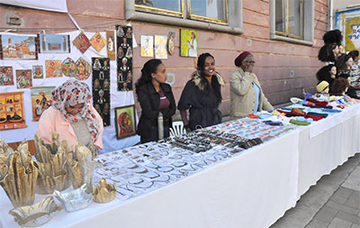
Annually, under the umbrella of the National Union of Eritrean Women, a group of female artisans display their works under the shade of the Ministry of Education building at Harenet Avenue. Whether you buy something or not, the street fair is open for onlookers. Adding glam to the overall New Year’s atmosphere in town this specific fair is there to liven the festive season. Meet Samrawit Anday, 26, and a professional artisan who’s been presenting her works there, undoubtedly elsewhere as well, for the past five years and more. Q&A focuses on her journey as an artisan to give our readers an insight into what it is like to be a young female craftsperson in Eritrea.


Thank you! How long have you been into artistry?

For as long as I can remember; however, I hadn’t come out of my shell until 2013 when I joined the antipollution campaign.

Anti-pollution campaign? What was that?

In 2013, young Eritrean artists came together to paint the world’s longest painting protesting pollution and hoping for a batter space for the young to live in. The painting was more seven kilometers long and the theme was: “pollution free world”. It set a new Guiness Record.

That is, indeed, interesting. How exactly did that put you, “out of your shell”?

I felt encouraged, to put my paintings out for the public to see. Moreover, working with young people of my age specifically for that project made me realize that I wasn’t alone out there, so I had nothing to feel shy about. After that, I worked on enhancing my knowledge by taking courses not only for painting but also for poetry and clay artcrafts. Soon after, I took part in a joint exhibition with other artists, and the results I had there were definite motivations for me to be who I am today as an artist.

Speaking about education, you did widen your exposure by taking courses in India as well, didn’t you?

I did! In Eritrea when you join either the youth union or the women’s union, it is a lot easier in terms of exposure, legal matters and support of different kinds. The artist you become is something that you’ll have to work for; but there do exist different schemes planned at assisting talents. That being said, I am a member of a group of women artists that work under the umbrella of the National Union of Eritrean Women. I have done quite a lot along with that group, organizing exhibitions on different occasions and attending training courses and other platforms where we exchange ideas. My scholarship was part and parcel of the group’s mission to encourage us, women artists. The irony is that I went to India to learn about artistry, related to bamboo. However, I was mesmerized by the hundreds of other crafts particular to India. Arts, colors, linens and more make India so beautiful when talking about the artistic culture people have. I couldn’t help but be mesmerized, so much so I took note of a big part of what I saw, one of which was paper quelling. Once I came back home, I didn’t do much with bamboo but practised paper quelling. Luckily, one of my favorite colleagues in the team, and also the team leader, Nigsti Ghebremeskel, was aquatinted with an artist from Norway and was lucky enough to have learned some skills from him. Later on, with a little bit of imagination and a touch of art, I developed that into something I can call my own.


In fact, I wanted to come to this point; to the exact point that makes you different from a big part of the local artists. You dropped painting and now you are mainly known for handcrafts that are branded by your palate. Tell us a bit more please.

I can’t say I completely dropped painting but it is, indeed, true that I haven’t been as active as I used to be. Nowadays I am vigorously working on handcrafts of different kinds and purposes. I make key chains, jewelries, fridge magnets and other handcrafts. I dedicate my time to it and it is a very demanding job but also very rewarding, when I see the final products being loved by people of all ages.

Who are your customers?

I can say people of all ages, but normally young ones as they fancy accessories a lot.

And your inspirations would be…

Trends. I am inspired by trends. I look at people: what they wear and what they carry and then I think of accentuating their look. I love to accessorize, typical and trendy looks. So my works are a representation of our tradition and our society, in present day. During exhibitions and fairs, people approach me with their own designs and ideas as well. That is also something, I get inspiration from.

You say handcraft is not easy and, rightfully so, it does take time and needs ample intuition. Does the public appreciate your efforts?

Some do, some don’t. People enjoy widow shopping, handcrafts. Like the good art, people are captivated by the details that are poured to our works. But generally speaking, people tend to buy industrial goods. They come in plastic and they are a lot cheaper. Therefore, I’d like to ask the public to give credit to our handcrafts. They are unique and of good quality. You won’t see hundreds of the same key chains, or whatever product. Uniqueness, has a beauty of its own. Moreover, the raw material we normally use is recycled. That by itself is more than a good reason to acquire homemade handcrafts, rather than buying imported goods.

What are the challenges you face besides being occasionally out-marketed by imported goods?

The issue of patent law, is quite hindering. It is hard to label your own product and keep it intact, for long. You’ll see imitations being produced, in no time. Still, that is not a threat to me personally as those who copy can’t keep producing the product for long. That being said, if I were to put myself in the shoes of a customer I would hate to see the same handcraft in different shops. The feeling of redundancy is rather exasperating, especially when talking about handcrafts. If they are recurrent, they are not unique anymore and have the industrial appearance and that is absolutely not good. This is the biggest challenge I face, regularly.

Do you have any idea, about how to tackle this challenge?

I wish I did, but I don’t. This is something that needs to be regulated by legal instruments and on top of that, I wish people could abide by values and refrain from stealing other’s ideas.

Care to share your future plans?

Yes. The plan is to hold a solo exhibition and if things go well, I’d like to open a shop so that people can reach me easily.

Anything you’d like to say, at the end?

Happy New Year to us all!

Thank you!

YOU CAN REACH SAMRAWIT ANDAY at [email protected], facebook/samriAcraft, instagram/samriAcraft

Zmeselo
Senior Member+
Posts: 36921
Joined: 30 Jul 2010, 20:43

Re: His Holiness Abune Petros gives benediction.

Post by Zmeselo » 07 Jan 2020, 10:06

Developing Tourism in Eritrea

Written by Simon Weldemichael

http://shabait.com/articles/nation-buil ... n-eritrea-

Articles


Tourism is one of the most dynamic socioeconomic sectors in the world today, and continues to grow in the global market.

United Nations World Tourism Organization defines tourism as:
Social-economic aspects which allow the movement of people to countries or places outside their usual environment for personal, business and professional purposes.
Tourism has long been regarded as the largest smokeless industry, to impact the overall growth of national economies. With the increase in the rate of globalization, tourism has become one of the largest and fastest growing sectors in the world.

The Government of Eritrea is taking important steps to develop the tourism industry, to ensure the contribution of tourism toward the overall development programs. In the past twenty seven years, Eritrea has taken a modest initiative at renovation and construction of transport infrastructures and hospitality facilities on the tourist attraction sites. In addition to that, important measures have been taken to protect Eritrea’s natural environment and cultural heritage. The development of the service sector, holds a central place in the development of tourism.

The infrastructure of Eritrea was severely affected, during the wars for Eritrea’s independence and to protect its sovereignty. As of 2002, immediately after the end of the TPLF-instigated war of aggression, the government launched a development and rehabilitation program. Overall government expenditures on infrastructure accounted for 13% of the total government expenditure for that period (IPRSP, 2004, p18). The Government is undertaking major infrastructure rehabilitation and development programmes. In addition to Asmara international airport, a modern and competitive international airport was constructed in Massawa. Tourist centers were constructed, in Dahlak islands. Asmara – Massawa railway, was renovated. A new vein of tourist road was constructed, through the green belt of Semenawi Bahri. Large water dam projects and electric power generation, are underway.

According to Eritrea’s Tourism Proclamation No.152/2006, "tourism” means the business of providing travel, accommodation, hospitality and information services to tourists on a commercial basis and other ancillary services, which facilitate the requirements of tourists. A tourist is a person who stays at least one night in Eritrea, in either private or commercial accommodation, but whose stay does not exceed twelve months and whose main purpose of visit is not to work. Eritrea has significant potential, for the development of tourism. Climate is an influential factor, in determining the destination areas to which recreational tourists travel. In addition to the scenic views enjoyed in the journey from highland Asmara to the coastal town of Massawa, one can also experience three seasons in a two-hour drive. Eritrea has pleasant climate and warm and clean waters of the Red Sea. The country has a coastline of more than 1,000 kilometers and about 350 offshore islands. The clean beaches and offshore islands, with the diversity of terrestrial and marine animals is another potential resource. Such an endowment gives Eritrea a great potential, in beach and marine resort tourism. Eritrea has attractive physical structure, with scenic beauty ranging from high ground of above 3000 meters to low-lying areas of 100 meters below sea level. Aided by the physical structure and diversity, Eritrea has a viable potential for adventure tourism. Expeditions to the Danakil Depression and mountain climbing in Soira and Kohaito and other personally challenging activities, can attract tourists.

The mosaic, peaceful and hospitable people is an additional resource that could make the tourists stay enjoyable. Eritrea can also be the center of health tourism, with its hot springs. Its geographic location makes it ‘the gate way to Africa’, and the peace and safety that is prevalent in the country gives it a comparative advantage over the rest of Africa.

Tourism, has become a vital source of income for many countries. Tourism generates income, through the consumption of goods and services by tourists and the taxes levied on businesses in the tourism industry. Tourism also creates, wide employment opportunities. Besides that it plays an important role, in the promotion of mutual understanding among people of various countries and cultures.

Taking all the natural and human conditions of Eritrea into consideration, tourism should hold the lion’s share in the country’s income. In many countries, tourism is playing an increasingly important role in the national economy. For example, it has been said that the income generated from travel and tourism is larger than the GDP of the automotive manufacturing sector in China. Therefore, in order to fully gain the benefits of tourism, the government and the private sector should work in collaboration. Eritrea’s tourism industry is in its embryonic stage, waiting for the government and the private sector to invest. The natural and cultural elements of Eritrea are conducive, for the development of successful tourism industry.

The economy of Eritrea is primarily based on agriculture, small-scale industry, fisheries and a service sector including tourism. Poverty reduction and economic growth have been the central objectives of the Eritrean government, since independence. Poverty reduction is Eritrea’s major challenge, and is placed at the top of the development agenda. To use tourism, as one of the means to improve the living standards of Eritreans is an option on the table. With its abundant archaeological and cultural attractions and natural endowments, Eritrea has the potential to become the most sought tourist destination.

The development of tourism, will definitely facilitate the nation building process of Eritrea. Besides, tourism could aid the country’s diplomatic venture. In the past, Eritrea was made a victim of erroneous political agendas. Various diplomatic and political machinations were attempted, to isolate the country. The development of tourism can greatly help introduce, the true essence of the country to the world. Therefore, Eritrea has to use tourism as a vehicle for introducing its own history, nature and culture to the wider international community.


The Eritrea 2020 Tourism Development Plan, states that Eritrea has significant opportunities for developing tourism. The opportunities for developing tourism in Eritrea include natural environment, especially good beaches and marine areas suitable for diving, scenic and wildlife in national parks and some hot springs. There are also cultural heritage resources including archaeological and historic sites, the architectural riches of the towns, and cultural patterns of various ethnic groups.

Heritage is a fundamental resource, and has always been a major tourist attraction. Heritage can supply genuine attractions for tourism, but excessive tourism may threaten heritage preservation. Eritrea is signatory to three major international conventions, that have relevance to tourism and the preservation of heritage. Eritrea is a signatory to the World Heritage Convention of 1972, the 2003 Convention on the Safeguarding of the Intangible Cultural Heritage and the 1954 Convention for the Protection of Cultural Property in the Event of Armed Conflict. In addition to these international conventions Eritrea enacted its own national heritage protection laws, titled
proclamation no. 177/2015 Cultural and Natural Heritage Proclamation.
According to this proclamation, Cultural Heritage means any tangible or intangible resource which is the product of human creativity and labor in the discernible historical times describing and witnessing to such creativity and labor because of its scientific, archeological, historical, cultural, artistic, architectural or aesthetic value or content ultimately bearing the identity and/or collective memory of peoples or communities. As cited in the proclamation, one objective of the proclamation is to establish an integrated and interactive system at all levels and lay down the general principles for the identification, assessment, registration, preservation, protection and development of Cultural and Natural Heritage of Eritrea for the present and future generations.

Sustainable development, should be the fundamental basis of development plans. The natural and cultural resources for tourism must be conserved for continuous use in the future, while still bringing benefits to the present society. On top of that, the benefits of tourism should be distributed widely throughout the society.

Asmara, the capital of Eritrea, is not only the political center but also a cultural, and tourist center of Eritrea. The city has many places of historic interest and scenic architectural beauty. Eritrea has great potential of urban tourism which is based on architectural magnificence especially in Asmara, Massawa and Keren. It has also amusing historical sites, associated with the struggle for independence. The war museum in Nakfa, war cemetery in Asmara, the trenches of Sahel and the materials available in Massawa museum are some of the prominent areas with tourist attraction potentials.

Zmeselo
Senior Member+
Posts: 36921
Joined: 30 Jul 2010, 20:43

Re: His Holiness Abune Petros gives benediction.

Post by Zmeselo » 07 Jan 2020, 10:16

A gift offers a gift

Written by Milka Teklom

http://shabait.com/about-eritrea/art-a- ... ers-a-gift

About Eritrea - Art & Sport


As a kid I grew up hearing the word empowerment mentioned with the word women, which made me wonder if women are so powerless that they are in need of perpetual empowerment.

But for so many centuries, females all over the world have been suppressed and degraded. Religions and cultural beliefs have greatly contributed to the ill treatments of women and since societies rely on their culture and religion as a guide in their lives, gender inequality has survived a long span of time.

In Eritrea, the thirty-year war for independence helped women to achieve partial emancipation. The creation of the National Union for Eritrean Women (UNEW) during the struggle, was the beginning of the journey towards the road of equality and empowerment. Since its creation in 1979, the organization has strived to launch platforms and opportunities that allow talented women to emerge. One of these platforms is the art fair that is organized twice a year, one at the Eritrean Festival in expo and another during the holiday season of Christmas and New Year in front of the Ministry of Education building.

Although women are the main players in the Eritrean cultural and arts in particular, their role has been historically unacknowledged. They decorate “hidmo”, craft ornaments, embroider their cloths and hairs and make traditional cuisines.

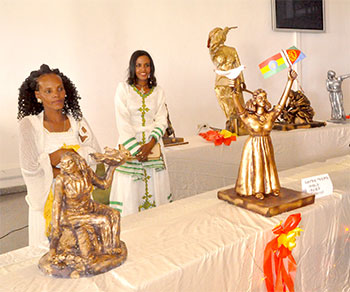
Seven years ago, the NUEW assembled artists in a group of fifteen members with Mrs. Negisti Gebremeskel as their coordinator. Since thenz the group members have increased to thirty and have been hosting the art fairs. Annually handcrafts made of palm leaf, wood, hide, pottery, ornaments and clothing lines made out of cotton are put on display. This year’s exhibition was different, as many new inventions were seen.

In an interview at the exhibition, Mrs. Akberet Bahta said that she always looks forward to the events, especially the fair on the holiday season because she is able to give gifts that represent our culture.
What attracted me this year was the washable diaper; I have two kids, one and three years old. The expense of the disposable diaper was getting unbearable but now I could save up by washing and reusing.
Another attendant, Nebil Haji, a high school student, said,
I admire their talents and every single product in the exhibition is useful, but the prices are absurd.
A lot of people agreed with him; most of them said they love the products but the prices scared them off. We talked to three of the artists, to help explain the reason behind the prices and for us to explore their work.


Nejat Sulieman, one of the artists who founded the group, has been an artist for almost ten years crafting hide and pearls. She said being a female, gave her an insight of what women want. Most of her products this year are earrings, necklaces made of pearl and bracelets for men made of hide. The other artist is Helen Gebru, whose paintings are self-explanatory; they immensely represent our culture and our heroic figures. She started painting in 2005, and then joined the group in 2013. Eventhough she does all sorts of paintings, this year she focused on wood by burning figures.

Finally, we talked to Sewrawit Anday, the youngest member at the exhibition. It was really difficult to interview her, because the number of people inspecting her products was so big. Her artistic works are traditional and abstract ceramic, flower vases made using cement, fridge magnets, and earrings made of paper.

The artists use imported material for their handcrafts, which makes their products expensive. They claim, that the prices do not even cover their initial costs. They also said that hand-crafted artistic works are hard and take a long time to make, and all over the world this makes them more expensive than industrially produced ones. The artisans massively thanked the NUEW, for letting them express their inner talents and they called on other female artists to join the group.

Hearing all that as a woman, I think we are a gift sent to the world and ever since we arrived we have been contributing the precious gifts of being a mother, a wife, a sister, and an artist.

Zmeselo
Senior Member+
Posts: 36921
Joined: 30 Jul 2010, 20:43

Re: His Holiness Abune Petros gives benediction.

Post by Zmeselo » 07 Jan 2020, 10:21

Conservation process of archaeological materials

Written by Abel Grmai

http://shabait.com/about-eritrea/histor ... materials-

About Eritrea - History & Culture


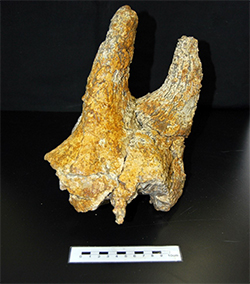
Paleontological laboratory studies play a key role in preparing fossil materials for the purpose of identifying and determining mammal’s evolution and chronology, as well as understanding the interactions with their environment.

Therefore, securing the conservation of fossil materials before analysis is crucial for better understanding and interpretation of the anatomy and morphology of the bones. However, considering the fragile nature of most fossil specimens, a proper conservation work is often a pre-requisite to avoid shock resilience.

During excavations, both from historical and prehistoric sites, bones or faunal remains can be found especially from burial sites, kitchen areas and naturally buried at stratigraphic levels. In Eritrea, several prehistoric sites are known mainly from the Danakil Depression of the Northern Red Sea Region. Since the inception of the projects in this region, in this locality, ample collection of faunal remains has been collected. One example of the collections is the almost complete cranium of the Buia women, dated to about one million years. Among the faunal collections from this region (mainly from the Engel Ella – Ramud Basin) include the remains of hippos, elephants, pigs, horses, rhinos, giraffes and hyenas. These fossil remains are collected during field seasons and at this time they are housed at the Archaeological Heritage Research Branch’s laboratory of the Commission of Culture and Sports. This year, practical programs concerning careful cleaning, restoration, preservation process and analysis have started. Following, are the technical procedures that we use at the AHRB laboratory.


When a fossil is found exposed at a surface, the general space should be properly delimited with a small trowel and a brush. Then, after the bones are carefully excavated and separated from the sediment, they are gently cleaned using wooden and/or metallic instruments. Fragile bones, have to be consolidated with Paraloid B-72 at 5 to 10% in acetone.

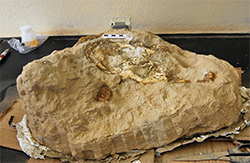
In order to ensure the safety of the fossil materials collected from fieldworks, they should be extracted very carefully, and placed temporarily on a support using a sediment block. After these, the surface of the material can be slowly re-sized using point iron bars, and when the material is ready it can be covered using aluminum foil. Then after, the material’s condition, measurements and photos can be taken for the purpose of documentation and analysis.

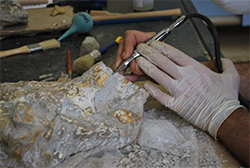
Archaeological remains are generally found covered with sediments, and are often penetrated by the roots of small plants. Sometimes, in order to remove sediment from the surface of an artifact, you can simply rinse the object in water. Well preserved bones can also be cleaned by brush, engraver machine, metal and wood engravers, small pieces of wet clothes or cotton. In our cleaning process we do not use detergents, as they may contain colorants, perfumes, and other additives that may contaminate the bone, rendering it useless for chemical analysis or dating. Stubborn dirt deposits can be gently dislodged with a paint brush or wooden probe, but this is done cautiously as wet bone can be soft and easily abraded. Rootlets growing in the bone can sometimes be removed with tweezers. But careful procedures are taken not to pull fragments of bone off with the rootlets, which are often branched beneath the surface. Some of the dirt and rootlets are removed in the field under the supervision of an archaeologist who decides on the degree of cleaning required.

Faunal (animal) remains are often damp or wet when first excavated and must be dried before they can be studied or stored in a research collection. Undeteriorated specimens of bone, antler, and ivory can be treated by a non-specialist, but deteriorated specimens may require the advice of conservator. To test hardness of the surface, we press the surface of the bone in several areas. If it compresses or feels spongy, the material has deteriorated.


First, assess the condition of the bone to determine whether the material is bone, antler, or ivory. Ivory, which has multiple layers is denser than bone or antler and is more likely to crack or delaminate while drying. Next, determine the condition of the material. One good indication of condition is the hardness, so gently press the surface of the bone in several areas. If it compresses or feels spongy, the material has deteriorated. Deterioration can be roughly divided into three categories: a hard surface indicates little or no deterioration; a soft surface with a hard bone beneath indicates slight to moderate deterioration; and an extremely soft surface indicates a high degree of deterioration. In the latter case, it may be necessary to consolidate the material.

Bone that is hard or has only a slight softening of the surface can probably be air dried safely, but bone that is soft is likely to be sensitive to water loss. However, hardness is only one indication of its condition. Some burial conditions selectively damage one or more components of the bone, leaving objects that are hard but still susceptible to damage (e.g. shrinkage, twisting, cracking, or delamination) when air dried. Therefore, even if a bone is hard and apparently durable, test dry a few pieces. If any problems are noted, a decision can then be made about consolidating the other pieces. After cleaning using paint brush, pneumatic engraver if needed, scalpel, wood materials, gauze, we consolidate the bone. The decision to consolidate must be considered carefully as consolidants can interfere with the chemical analysis or dating of the bone. The consolidation process is done by mixing acetone with Paraloid B-72, and the proportion differs with the type and condition of the bone. After applying acetone, the material needs time to dry. Drying should be slow and controlled. The simplest method is to lay the clean wet bone on a table or open mesh rack and allow it to dry slowly. Turn bones frequently to ensure even drying, and monitor all pieces for cracks, delamination, or other physical changes.

Bone should be dried at a moderate humidity and cool temperature, out of sunlight and away from any heat sources. The rate at which the bone dries can be slowed by increasing the relative humidity. If cracking occurs while drying more consolidation is needed.

Finally, throughout the lab process and after packing and storage, the bone is accompanied by a detailed and proper documentation system. All the steps of laboratory processes are properly recorded and documented. For example, all the solvents applied during the laboratory processes have to be recorded thoroughly. These documentation strategies can inform and alert researchers about the possible interference of the materials during future testing.

Zmeselo
Senior Member+
Posts: 36921
Joined: 30 Jul 2010, 20:43

Re: His Holiness Abune Petros gives benediction.

Post by Zmeselo » 07 Jan 2020, 10:26


Post Reply