Congratulations, President "Farmaajo"!
Last edited by Zmeselo on 24 Sep 2019, 13:18, edited 1 time in total.
Re: Congratulations, President "Farmaajo"!
Amb. Sophia Tesfamariam (@stesfamariam) Tweeted:
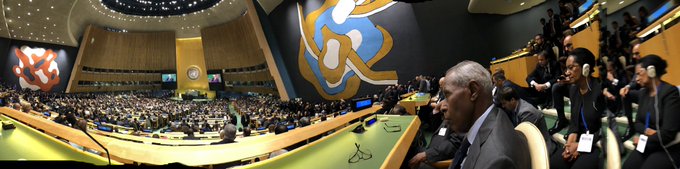
#UNGA74 debates underway. Eritrea's delegation is led by H.E. Osman Saleh, Minister of Foreign Affairs & Mr. Yemane Ghebreab, Advisor to the President & Head of Political Affairs at PFDJ.
_______________________
________________________
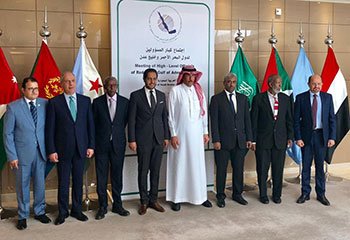
Eritrea's Statement at the Meeting of High - Level Officials of Red Sea and Gulf of Aden
Monday, 22 April 2019
Written by Shabait Administrator
http://www.shabait.com/categoryblog/283 ... lf-of-aden
Eritrea's delegation, composed of Presidential Adviser Yemane Ghebreab and Hagos Ghebrehiwet, Head of PFDJ Economic Affairs participated at the Meeting of High - Level Officials of Red Sea and Gulf of Aden that was convened in Riyadh from 21-22 April, 2019. Eight Red Sea and Gulf of Aden states, namely: Egypt, Eritrea, Djibouti, Jordan, Saudi Arabia, Somalia, Sudan and Yemen participated in the Conference.
(Eritrea's full Statement attached)
___________________
Mr. Chairman
Distinguished Participants
Ladies and Gentlemen,
Allow me first to express our profound gratitude for the kind invitation extended to us to participate in this important conference.
The geo-strategic and geo-political importance as well as complexity and sensitivity of the Red Sea are too evident to merit extended discourse here. Furthermore, the vital importance of this international water way; its intrinsic regional and global significance, will not diminish but rather augment with time.
This will remain true irrespective of the turns and twists of history or changing circumstances. In the event, the attention that must be accorded to safeguard the security of the Red Sea must be high and fully consonant with its paramount importance.
Dear Participants,
As we all agree, this important maritime route had sadly become a theatre for reckless regional and international interferences in the past thirty years largely due to misguided exogenous agendas. This somber state of affairs in turn entailed a perplexing reality of stampede and unnecessary complications. This was in addition to the legacy of the Cold War.
It must be noted here that the interferences that stem from regional and international agendas could not have materialized without the complicity and connivance of local players. In this perspective, the whole affair warrants a sober and comprehensive review that is not dented by emotional or presumptive approaches.
In these times, the proliferation of institutions is increasingly becoming the norm all over the world. This is also true in our region. The various initiatives usually emanate from a reservoir of political goodwill. Indeed, they are launched to advance lofty objectives. Unfortunately, the institutions that stay the course, gain traction and consolidation over time to deliver the desired results are few.
By the same token, initiatives undertaken in the past years to foster appropriate institutional frameworks and ties of cooperation in the Red Sea, or to launch conferences for submission of research papers, have been considerable indeed. Here again, those that have produced impacting results are few.
The formulation of a viable framework of cooperation and attendant functional institution on the basis of consensus and mutual understanding will therefore require a patient and methodological approach. Continuous and serious consultations will thus remain a matter of necessity rather than choice.
In our modest view, the requisite consultations should incorporate the following cardinal procedural and substantive issues. They must also be conducted in a manner that will avoid wastage of time or opportunity loss. The key parameters are:
1. Comprehensive and unbiased assessment of the current realities of the Red Sea and associated matters, in all their dimensions and perspectives in a realistic manner;
2. Full clarity on the desired objectives and goals;
3. Detailed mapping of the threats to the peace and security of the Red Sea; and, categorization and specification of these parameters;
4. Formulation of a viable strategy that will ensure achievement of constructive objectives and goals;
5. Formulation of strategies to contain and eliminate the threats in tandem with the positive policies of cooperation;
6. Mapping out detailed schemes and plans that will ensure holistic implementation of the twin strategies;
7. Stipulation of the implementation mechanisms, associated structures and mobilization of the requisite resources;
8. Ensuring that all the organizational configurations and frameworks that are developed are anchored on respect of sovereignty and international law;
9. Ensuring that all littoral States build and possess their own effective defense capabilities and naval forces (without delegation to others);
10. Supplementing, through collective efforts and synergy, those specific tasks that cannot be met through individual domestic capabilities and resources;
11. All relevant States will create appropriate modalities of cooperation with “external forces” for tasks or missions that are beyond their collective capability on the basis of a consensual framework;
12. Creation of competent committees to address all these issues in a comprehensive and professional manner.
Dear Participants,
Let me conclude by expressing our sincere hope that the modest views we have outlined above will enrich the deliberations of this Conference.
I thank you!
#UNGA74 debates underway. Eritrea's delegation is led by H.E. Osman Saleh, Minister of Foreign Affairs & Mr. Yemane Ghebreab, Advisor to the President & Head of Political Affairs at PFDJ.
_______________________
________________________
Eritrea's Statement at the Meeting of High - Level Officials of Red Sea and Gulf of Aden
Monday, 22 April 2019
Written by Shabait Administrator
http://www.shabait.com/categoryblog/283 ... lf-of-aden
Eritrea's delegation, composed of Presidential Adviser Yemane Ghebreab and Hagos Ghebrehiwet, Head of PFDJ Economic Affairs participated at the Meeting of High - Level Officials of Red Sea and Gulf of Aden that was convened in Riyadh from 21-22 April, 2019. Eight Red Sea and Gulf of Aden states, namely: Egypt, Eritrea, Djibouti, Jordan, Saudi Arabia, Somalia, Sudan and Yemen participated in the Conference.
(Eritrea's full Statement attached)
___________________
Mr. Chairman
Distinguished Participants
Ladies and Gentlemen,
Allow me first to express our profound gratitude for the kind invitation extended to us to participate in this important conference.
The geo-strategic and geo-political importance as well as complexity and sensitivity of the Red Sea are too evident to merit extended discourse here. Furthermore, the vital importance of this international water way; its intrinsic regional and global significance, will not diminish but rather augment with time.
This will remain true irrespective of the turns and twists of history or changing circumstances. In the event, the attention that must be accorded to safeguard the security of the Red Sea must be high and fully consonant with its paramount importance.
Dear Participants,
As we all agree, this important maritime route had sadly become a theatre for reckless regional and international interferences in the past thirty years largely due to misguided exogenous agendas. This somber state of affairs in turn entailed a perplexing reality of stampede and unnecessary complications. This was in addition to the legacy of the Cold War.
It must be noted here that the interferences that stem from regional and international agendas could not have materialized without the complicity and connivance of local players. In this perspective, the whole affair warrants a sober and comprehensive review that is not dented by emotional or presumptive approaches.
In these times, the proliferation of institutions is increasingly becoming the norm all over the world. This is also true in our region. The various initiatives usually emanate from a reservoir of political goodwill. Indeed, they are launched to advance lofty objectives. Unfortunately, the institutions that stay the course, gain traction and consolidation over time to deliver the desired results are few.
By the same token, initiatives undertaken in the past years to foster appropriate institutional frameworks and ties of cooperation in the Red Sea, or to launch conferences for submission of research papers, have been considerable indeed. Here again, those that have produced impacting results are few.
The formulation of a viable framework of cooperation and attendant functional institution on the basis of consensus and mutual understanding will therefore require a patient and methodological approach. Continuous and serious consultations will thus remain a matter of necessity rather than choice.
In our modest view, the requisite consultations should incorporate the following cardinal procedural and substantive issues. They must also be conducted in a manner that will avoid wastage of time or opportunity loss. The key parameters are:
1. Comprehensive and unbiased assessment of the current realities of the Red Sea and associated matters, in all their dimensions and perspectives in a realistic manner;
2. Full clarity on the desired objectives and goals;
3. Detailed mapping of the threats to the peace and security of the Red Sea; and, categorization and specification of these parameters;
4. Formulation of a viable strategy that will ensure achievement of constructive objectives and goals;
5. Formulation of strategies to contain and eliminate the threats in tandem with the positive policies of cooperation;
6. Mapping out detailed schemes and plans that will ensure holistic implementation of the twin strategies;
7. Stipulation of the implementation mechanisms, associated structures and mobilization of the requisite resources;
8. Ensuring that all the organizational configurations and frameworks that are developed are anchored on respect of sovereignty and international law;
9. Ensuring that all littoral States build and possess their own effective defense capabilities and naval forces (without delegation to others);
10. Supplementing, through collective efforts and synergy, those specific tasks that cannot be met through individual domestic capabilities and resources;
11. All relevant States will create appropriate modalities of cooperation with “external forces” for tasks or missions that are beyond their collective capability on the basis of a consensual framework;
12. Creation of competent committees to address all these issues in a comprehensive and professional manner.
Dear Participants,
Let me conclude by expressing our sincere hope that the modest views we have outlined above will enrich the deliberations of this Conference.
I thank you!
Last edited by Zmeselo on 24 Sep 2019, 13:37, edited 1 time in total.
Re: Congratulations, President "Farmaajo"!
“Our Heritage is Our Identity, Director of RDC Mrs. Azieb Tewolde
Written by Billion Temesghen
http://www.shabait.com/articles/q-a-a/2 ... ebtewolde-
Articles - Q & A
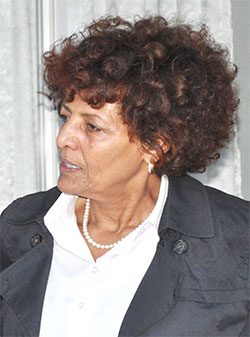
Knowledge, sharing is something Eritreans strongly believe in and work for. Because growth depends on shared vision and work, the Eritrean Research and Documentation Center (RDC) keeps its archives’ doors open to researches, scientists and students from the country and abroad. The ultimate goal is to make Eritrean heritage known to the world, as a contribution to the larger chronicle of humanity. The intertwined history of human beings, is a mosaic of so many pieces. We look in today’s Q&A, at how RDC is making ancient manuscripts found in Eritrean monasteries gems of humanity.
Thank you for your time, Mrs. Azieb!
Let me first give you a chance, to pass on your greetings to our readers.
Pleasure!
I am Azieb Tewolde, and I am the Director of the Eritrean Research and Documentation Center. Since its establishment in 1996 the center has been an independent office that works to ensure the preservation, cataloging and digitalizing of Eritrea’s historical gems in collaboration with local and international organizations. RDC is also a gigantic archive which serves as reference for students, researchers, historians and other interested people who want to go back in time and study past civilizations in our region.
RDC has worked closely with local monasteries for almost twenty years now, with an aim to preserve manuscripts. It has made the preservation of manuscripts, its top priority. It also works, to fortify the Eritrean identity.
RDC is known to have carried out several workshops, in collaboration with international organizations and research centers. For example, in the last week of August, RDC held a workshop in collaboration with the Research Center of Hamburg University of Germany.
Can you tell us about it, please?
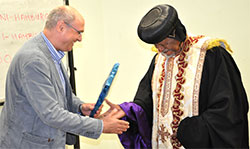
The recent workshop, RDC coordinated alongside the Research Center of Hamburg University was attended by 25 experts from the Adi- Keih College of Business and Social Science, the newly established Debre Sina Theology College, the Eritrean Orthodox Tewahdo Church as well as from RDC itself. A renowned Professor in the field, Alessandro Bausi, Director of the Research Center at Hamburg University, came, along with a group of experts he led, here to give training.
The training had two phases. In 1996, amongst other ventures, RDC started its mission with manuscripts, which, fortunately, are found in a big number scattered across numerous monasteries of our country. We have conducted many workshops and have carried out successful training and research sessions, which have certainly encouraged us and other parties to further enhance our endeavors every time. Most of our projects were initially conducted, using our local capacities. Our work began to make greater impact, soon after we opened up to international expertise. And, of course, the recent collaboration with the University of Hamburg demonstrated an intensive participation, with a good outcome.
We have had surveys regarding our workshops, and how well they have been and are being carried out. We wanted our approach to be scientific. Therefore, being updated with related advancements in the field has been a focus of our interest. I can say that the work carried out so far has been conducted with diligence and will certainly be a solid foundation, for future research undertakings.
The second phase was: encouraging local expertise. It is an important factor, as a matter of fact. We’ve worked on it, and are still working on it. Cataloguing, safeguarding and digitalizing manuscripts are proficiencies that need to be constantly appraised. To this end, what pleases me most is that this specific workshop has been vibrant thanks to the participation of young graduates from different colleges. They have grasped the instruction provided by the experts in a meticulous way, and have made us extremely proud.
What stage has this specific venture reached?
It is only the beginning. Raising a wareness and earning the trust of the monks at the monasteries, with their long-kept treasures, was not an easy task. The time to educate and build up an Eritrean expertise, will take time. Which is why, I’d rather not boast about what we’ve done so far. We need to educate our young graduates, further. We need to provide them with opportunities, to study for their MA degrees and PhDs. We need to invigorate their passion, as well as reward their education. Eritrea will definitely benefit one day from its own doctors and professors, considering that what is waiting to be unveiled is immense. So far we have done well but the coming deeds won’t be easy.
What criteria does your office use in inviting international experts to work with?
We have our own standards but they are not fixed, as the field is immense and has a wide spectrum of internal fields within. But we certainly look in to their past experiences and their genuine interest, to shed light on a heritage that is of common interest to the local and international community.
To what extent do you believe the importance of manuscripts stretch to, not only for the country but also as a heritage for the global community?
It is a heritage of paramount importance. According to our survey, the latest one dates back to 1896. This one is linked, to the advent of Christianity in our region. Not all manuscripts contain religious texts. Some manuscripts are on literature, some on law, some others on economics. Therefore, they are mirrors of a whole civilization covering the society’s customs, education and scientific advancements. They are, indeed, an amazing inheritance that will serve local communities and beyond. These are gems of humanity and we will strive to safeguard them, while sharing them with the rest of the world.
As the common saying of the Eritrean people goes: “Our Heritages are Our Identity.”
We can assure you that we are working not only to explore and enrich our archives but also working hard, to add further vigor to the Eritrean Identity.
Thank you again!
Written by Billion Temesghen
http://www.shabait.com/articles/q-a-a/2 ... ebtewolde-
Articles - Q & A
Says Mrs. Azieb.Discoveries of the past found in Eritrea are “gems of humanity and Eritrea will strive to safeguard them while sharing them with the rest of the world,
Knowledge, sharing is something Eritreans strongly believe in and work for. Because growth depends on shared vision and work, the Eritrean Research and Documentation Center (RDC) keeps its archives’ doors open to researches, scientists and students from the country and abroad. The ultimate goal is to make Eritrean heritage known to the world, as a contribution to the larger chronicle of humanity. The intertwined history of human beings, is a mosaic of so many pieces. We look in today’s Q&A, at how RDC is making ancient manuscripts found in Eritrean monasteries gems of humanity.
Thank you for your time, Mrs. Azieb!
Let me first give you a chance, to pass on your greetings to our readers.
Pleasure!
I am Azieb Tewolde, and I am the Director of the Eritrean Research and Documentation Center. Since its establishment in 1996 the center has been an independent office that works to ensure the preservation, cataloging and digitalizing of Eritrea’s historical gems in collaboration with local and international organizations. RDC is also a gigantic archive which serves as reference for students, researchers, historians and other interested people who want to go back in time and study past civilizations in our region.
RDC has worked closely with local monasteries for almost twenty years now, with an aim to preserve manuscripts. It has made the preservation of manuscripts, its top priority. It also works, to fortify the Eritrean identity.
RDC is known to have carried out several workshops, in collaboration with international organizations and research centers. For example, in the last week of August, RDC held a workshop in collaboration with the Research Center of Hamburg University of Germany.
Can you tell us about it, please?
The recent workshop, RDC coordinated alongside the Research Center of Hamburg University was attended by 25 experts from the Adi- Keih College of Business and Social Science, the newly established Debre Sina Theology College, the Eritrean Orthodox Tewahdo Church as well as from RDC itself. A renowned Professor in the field, Alessandro Bausi, Director of the Research Center at Hamburg University, came, along with a group of experts he led, here to give training.
The training had two phases. In 1996, amongst other ventures, RDC started its mission with manuscripts, which, fortunately, are found in a big number scattered across numerous monasteries of our country. We have conducted many workshops and have carried out successful training and research sessions, which have certainly encouraged us and other parties to further enhance our endeavors every time. Most of our projects were initially conducted, using our local capacities. Our work began to make greater impact, soon after we opened up to international expertise. And, of course, the recent collaboration with the University of Hamburg demonstrated an intensive participation, with a good outcome.
We have had surveys regarding our workshops, and how well they have been and are being carried out. We wanted our approach to be scientific. Therefore, being updated with related advancements in the field has been a focus of our interest. I can say that the work carried out so far has been conducted with diligence and will certainly be a solid foundation, for future research undertakings.
The second phase was: encouraging local expertise. It is an important factor, as a matter of fact. We’ve worked on it, and are still working on it. Cataloguing, safeguarding and digitalizing manuscripts are proficiencies that need to be constantly appraised. To this end, what pleases me most is that this specific workshop has been vibrant thanks to the participation of young graduates from different colleges. They have grasped the instruction provided by the experts in a meticulous way, and have made us extremely proud.
What stage has this specific venture reached?
It is only the beginning. Raising a wareness and earning the trust of the monks at the monasteries, with their long-kept treasures, was not an easy task. The time to educate and build up an Eritrean expertise, will take time. Which is why, I’d rather not boast about what we’ve done so far. We need to educate our young graduates, further. We need to provide them with opportunities, to study for their MA degrees and PhDs. We need to invigorate their passion, as well as reward their education. Eritrea will definitely benefit one day from its own doctors and professors, considering that what is waiting to be unveiled is immense. So far we have done well but the coming deeds won’t be easy.
What criteria does your office use in inviting international experts to work with?
We have our own standards but they are not fixed, as the field is immense and has a wide spectrum of internal fields within. But we certainly look in to their past experiences and their genuine interest, to shed light on a heritage that is of common interest to the local and international community.
To what extent do you believe the importance of manuscripts stretch to, not only for the country but also as a heritage for the global community?
It is a heritage of paramount importance. According to our survey, the latest one dates back to 1896. This one is linked, to the advent of Christianity in our region. Not all manuscripts contain religious texts. Some manuscripts are on literature, some on law, some others on economics. Therefore, they are mirrors of a whole civilization covering the society’s customs, education and scientific advancements. They are, indeed, an amazing inheritance that will serve local communities and beyond. These are gems of humanity and we will strive to safeguard them, while sharing them with the rest of the world.
As the common saying of the Eritrean people goes: “Our Heritages are Our Identity.”
We can assure you that we are working not only to explore and enrich our archives but also working hard, to add further vigor to the Eritrean Identity.
Thank you again!
Re: Congratulations, President "Farmaajo"!
(Courtesy: https://twitter.com/Amanuelande)

Sign the Petition!
Peace loving Eritreans in the UK, are sending a message to BBC Tigrigna, to stop with the fake news.
Sign the Petition here....
https://www.change.org/p/bbc-peace-lovi ... dit_var=v2
Sign the Petition!
Peace loving Eritreans in the UK, are sending a message to BBC Tigrigna, to stop with the fake news.
Sign the Petition here....
https://www.change.org/p/bbc-peace-lovi ... dit_var=v2
Re: Congratulations, President "Farmaajo"!

https://photos.app.goo.gl/E1fqNEbrZTtM65DS9
_________________
____________________________

Wins and conquests of Eritrean women

By Guido Talarico
http://www.worldmedias.net/wins-and-con ... ean-women/
The history of the Eritrean feminist movement is very fascinating because it was born in the folds of a long civil war, but it is also an event that has added substance to the revolutionary epic, that is to say, many concrete results obtained in favor of women. It is no coincidence that the movement has the legal formula of the union, the National Union of Eritrean Women (NUEW). To celebrate 40 years of life and activity, meeting both Eritrean women living in their homeland and those of the diaspora, the NUEW organized a major international meeting in Rimini, the outcome of which was told to us by President Tekea Tesfamicael, who came to us in the editorial office to take stock of the celebrations but especially of forty years of activity.
– Tesmicael told us –Ours is a liberation movement that was born at the front
the Eritrean women were in the front line against the enemy. In all, we represented almost 30% of the fighters, we did everything for our country, then, after that bloody experience, difficult but victorious, it became almost natural to have more equal treatment, gender equality as before did not exist.

Tekea Tesfamicael is understandably very happy with the path that has been done and you can see it. The Eritrean one for gender equality is a model not only for Africa. She, who was on the mountains fighting for the independence of her land and her people, when she speaks of those years and the work done for women she lights up, shows a passion and a pride that have deep roots.We came from a patriarchal management of society – continues the president of NUEW – women were subjected to fathers and husbands. War and revolution have changed everything. We demonstrated on the ground and in fact that equality was an irresistible obligation, so things began to change. Before 1979, women had no education, no homes or land, no choice or decision. After the war, an uninterrupted process of equalisation began, which today makes Eritrea one of the world’s most feminine nations, demonstrating a high concept of women and protecting their rights.
she explains.Our government, led by our President Isaias Afewerki, has done a great deal in recent years,
And here, this woman full of grit and energy, begins to talk about the rights that the women’s union has achieved. An analytical narrative, point by point, result by result, which demonstrates all the importance of the path taken.He has defended his territory, his people, but he has also dealt with fundamental social issues. Land and water for all, hospital facilities throughout the country, infrastructures that have allowed mobility. It has not been easy for years because we have always remained at war to defend our borders, but great work has been done for all and women have benefited greatly.
says Tesfamicael, who then gives concrete examples –All the physical mutilations that Eritrean women had been suffering for centuries have been abolished, gender bans have been eliminated, prejudices have been defeated –
before the revolution only men could possess lands. Now, no, women can have land, cultivate it, have money, be autonomous, have the right to school and university education. This kind of thing has filled gaps, but on certain fronts we have also gone ahead with realities such as the European one. Today in our country equal pay is guaranteed while, as we know, in many Western countries women still earn less for equal work.

Tesfamicael is a concrete woman, she knows that the path of her country is still long, and in fact she says that after the peace with Ethiopia
but she emphasizes with joy that in Eritrea, unlike many other African countries, even though there are at least nine different ethnic groups people live in harmony with the aim of keeping the country united and improving it.now our priority is to create development and economic growth,
concludes the interview with a big smile –Our union –
She doesn’t say it, but you can feel that she thinks it. So we say it: even with women Eritrea has done a little miracle.has 340,000 members. In every single village there is one of our representatives. In the government we have five ministries, Fozia Mashim for Justice and Amina Nurhisen for Health, as well as the Ministries of Tourism, Labour and Welfare. In Rimini we were 1,500 of us.
Re: Congratulations, President "Farmaajo"!
Yemane G. Meskel (@hawelti) Tweeted:
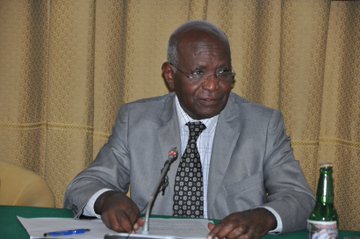
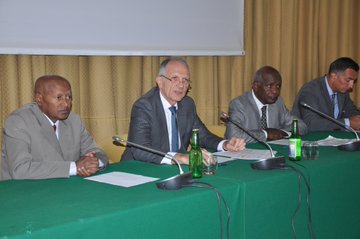
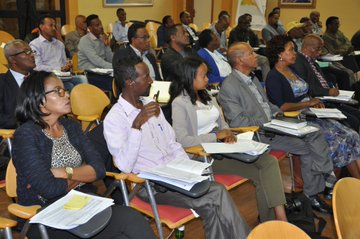
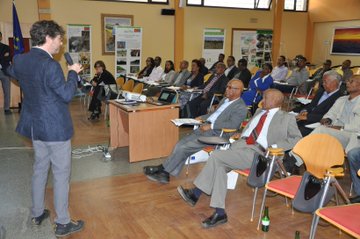
Ministry of Land, Water & Environment has organised, in conjunction with the EU Delegation to Eritrea, a four day workshop at Asmara Palace on the nexus between environment & national development. Participants in the workshop include: officials/experts from all relevant Ministries.
_______________
Rediet Kifle (@AsmaraGemel) Tweeted:
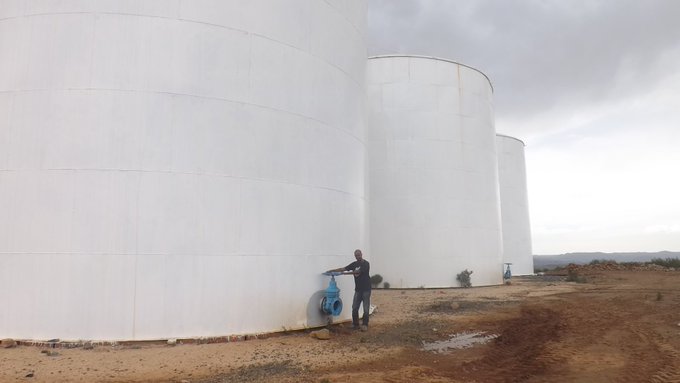
#harvestEritrea Huge water storage system in our neighborhood, in the outskirts of Asmara.
This city, situated on the highest elevation from the region, requires huge investment to catch, pump, and store water for its population... Because water is life.
_______________________
Ghideon Musa (@GhideonMusa) Tweeted:
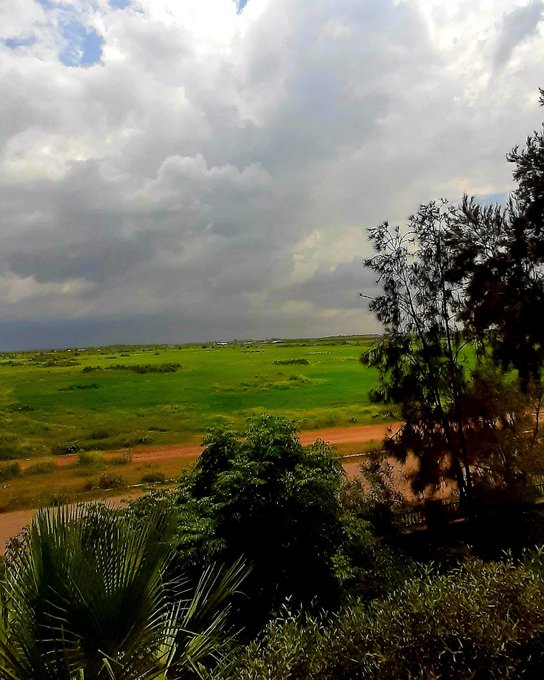
Blessed land of Eritrea!
View around Sembel.
Ministry of Land, Water & Environment has organised, in conjunction with the EU Delegation to Eritrea, a four day workshop at Asmara Palace on the nexus between environment & national development. Participants in the workshop include: officials/experts from all relevant Ministries.
_______________
Rediet Kifle (@AsmaraGemel) Tweeted:
#harvestEritrea Huge water storage system in our neighborhood, in the outskirts of Asmara.
This city, situated on the highest elevation from the region, requires huge investment to catch, pump, and store water for its population... Because water is life.
_______________________
Ghideon Musa (@GhideonMusa) Tweeted:
Blessed land of Eritrea!
View around Sembel.
Re: Congratulations, President "Farmaajo"!
Africa Rising Cycling (@CyclingAfrica) Tweeted:
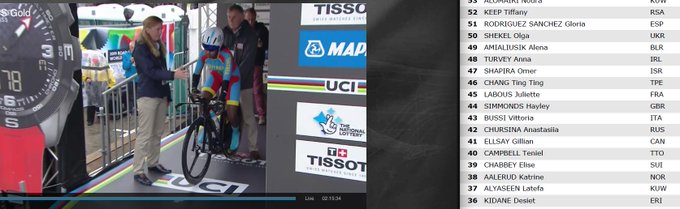
So great to see Desiet Kidane from Eritrea, representing the amazing women of African cycling. #thisgirlrides #africarising @CyclingAfricaEU @WeAreEritreans @Yorkshire2019
Africa Rising Cycling (Europe) (@CyclingAfricaEU) Tweeted:
Great to see #TeamEritrea out training on the @Welcome2Yorks Yorkshire roads ahead of this week’s @Yorkshire2019 World Champs with strong male and female riders. Mighty Daniel Teklehaimanot, leads the team

 ♀️♂️
♀️♂️ #africarising

So great to see Desiet Kidane from Eritrea,
 representing the amazing women of African cycling. #thisgirlrides #africarising @CyclingAfricaEU @WeAreEritreans @Yorkshire2019
 Africa Rising Cycling (Europe) (@CyclingAfricaEU) Tweeted:
Great to see #TeamEritrea out training on the @Welcome2Yorks Yorkshire roads ahead of this week’s @Yorkshire2019 World Champs with strong male and female riders. Mighty Daniel Teklehaimanot, leads the team


 ♀️♂️
♀️♂️ #africarising
 Re: Congratulations, President "Farmaajo"!


Istituto Italiano di Cultura
Stoccolma

Seminar "The World Heritage Asmara"
26/10/2019
Seminar Maeci
https://iicstoccolma.esteri.it/iic_stoc ... er#Eritrea
Half day seminar at Istituto Italiano di Cultura in Stockholm
This seminar will present and discuss a research project related to Asmara, the architecturally expressive capital of Eritrea. The architecture, belonging to the first half of the 20th century, is a product of Italian colonialism, but also reaches back to Asmara’s predecessor with Ottoman roots, Massawa. The project considers aspects of regional, classical, Italian, Ottoman and ”international style” identities, in perspectives ranging from the urban scale to architectural details. The presentation will focus on specific architectural cases in Asmara and Massawa, explored by the project team in study visits during 2018, but also consider the position of the Eritrean cities in a globalized historiography.
In 2017 Asmara was included in the Unesco World Heritage List. The criteria fulfilled were thus summarized:
The project is a collaboration between the Swedish Institutes in Rome and the Swedish Research Institute in Istanbul.The authenticity of local intangible attributes manifested in language, cultural practices, identity, and sense of place have been retained through Asmara’s evolution from an indigenous centre of economy and administration, through a colonial capital, to a modern African capital.
Invited lecturer: Antonello Alici, PhD, assistant professor at Università Politecnica delle Marche, Ancona
The project members:
Kristian Göransson, PhD, Classical Archaeology, scholar at the Swedish Institute in Rome
Maria Mellgren, MSc, Conservation of Built Environment
Johan Mårtelius, Professor, KTH Architecture, scholar at SRII
Gertrud Olsson, PhD, senior lecturer HDK Steneby/Göteborgs universitet, scholar at SRII
Greger Widgren, Former ambassador, member of the Research Collegium at SRII
Informazioni
Data: Sab 26 Ott 2019
Orario: Dalle 13:00 alle 16:30
Organizzato da : IIC Stoccolma
In collaborazione con : Svenska Institutet i Rom, Svenska Forskningsinstit
Ingresso : Libero
________________
________________________
Rahel A. (@haiyab) Tweeted:
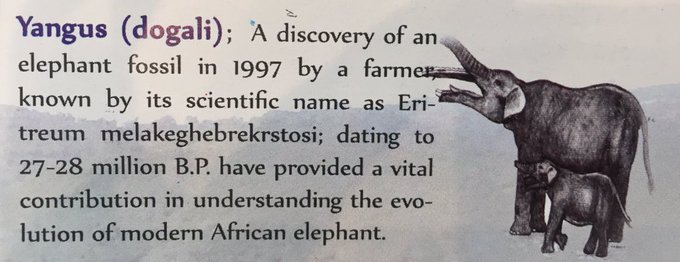
@GhideonMusa A small discovery we made, while visiting the Northern Red Sea region museum. I guess, the elephants are just getting back home.
Re: Congratulations, President "Farmaajo"!
Eritrea is Not Moving Forward with the PFDJ/PIA regime as the Main Obstacle to Eritrea's Bright Future!
You can congratulate Farmaajo! Somalia is Doing Better than Eritrea in All Indicators without the Need for an Authoritarian Regime like your PIA!
You can congratulate Farmaajo! Somalia is Doing Better than Eritrea in All Indicators without the Need for an Authoritarian Regime like your PIA!
Re: Congratulations, President "Farmaajo"!
https://www.indexmundi.com/factbook/com ... ea.somalia
Net migration rate
ERITREA -13.9 migrant(s)/1,000 population (2017 est.)
SOMALIA -6.5 migrant(s)/1,000 population (2017 est.)
Looking at Somalia has a Functioning Democratic Government, has problems with Al Shabaab (which PIA personally Supported), Has Break away provinces (Somaliland, Puntland)...Still SOMALIA has a Lower Exit Migration rate than ERITREA (the Supposedly Stable Country)!
Hahaha PFDJ members on here are a Bunch of Liars and Selfish Hypocrits (NONE of them Go Back to Eritrea)...Take the author of this Propaganda mereja topic "Congratulations, President "Farmaajo"!". This Author of Propaganda copy and pastes Unconnected CRAP and trys to Portray a NARRATIVE which Is NOT REAL:
His Narrative is that "ERITREA is Doing Well Under the DIctatorship of PIA/PFDJ", yet he is a COWARD for Not MOVING there and Doing his national service!
Net migration rate
ERITREA -13.9 migrant(s)/1,000 population (2017 est.)
SOMALIA -6.5 migrant(s)/1,000 population (2017 est.)
Looking at Somalia has a Functioning Democratic Government, has problems with Al Shabaab (which PIA personally Supported), Has Break away provinces (Somaliland, Puntland)...Still SOMALIA has a Lower Exit Migration rate than ERITREA (the Supposedly Stable Country)!
Hahaha PFDJ members on here are a Bunch of Liars and Selfish Hypocrits (NONE of them Go Back to Eritrea)...Take the author of this Propaganda mereja topic "Congratulations, President "Farmaajo"!". This Author of Propaganda copy and pastes Unconnected CRAP and trys to Portray a NARRATIVE which Is NOT REAL:
His Narrative is that "ERITREA is Doing Well Under the DIctatorship of PIA/PFDJ", yet he is a COWARD for Not MOVING there and Doing his national service!
