Post
by tarik » 22 Feb 2026, 10:18
Here is more proof that ኣቡነ ኣረጋዊ was a white guy from syria.
Fact-checked by Grok last month
Abuna Aregawi
Abuna Aregawi, also known as Abuna Ze-Mikael Aregawi, was a sixth-century monk venerated as a saint and one of the Nine Saints in the Ethiopian and Eritrean Orthodox Tewahedo Churches.[1][2] He played a pivotal role in spreading Christianity and establishing monasticism in the Aksumite Kingdom, particularly through founding the ancient Debre Damo monastery in northern Ethiopia. Renowned for his ascetic life and miraculous deeds, Aregawi is celebrated as a foundational figure in Ethiopian Orthodox tradition.[1][2]
According to hagiographic tradition, Aregawi was born around 455 AD, with accounts varying between Constantinople, Rome, or Syria as his place of origin.[2][3] He entered monastic life at the age of 14, receiving his habit from a priest named Pachomius and embracing a life of renunciation inspired by scriptural teachings such as Matthew 10:37-39. He later joined eight other monks from Syria and Egypt—collectively known as the Nine Saints—in a mission to evangelize the Agau people in the region spanning modern-day Eritrea and northern Ethiopia, fleeing persecution after the Council of Chalcedon (451 AD), where he learned the Ge'ez language to facilitate his preaching.[2][1][4] This group arrived during a period of religious expansion following the conversion of the Aksumite Empire to Christianity in the fourth century, contributing to the consolidation of Orthodox faith and monastic communities amid post-persecution revival.[2][1]
Aregawi's most notable legacy is the establishment of Debre Damo, one of Ethiopia's oldest monasteries, located on an isolated mountaintop accessible only by a traditional rope system. According to hagiographic tradition, he miraculously ascended the sheer cliffs with the aid of a large serpent dispatched by the Archangel Michael, symbolizing divine protection and his role as a miracle-worker. The monastery became a center for Coptic monasticism, preserving ancient manuscripts and liturgical practices that influenced Ethiopian Christianity for centuries. Aregawi is said to have evaded death through God's grace, akin to biblical figures like Enoch and Elijah, underscoring his enduring spiritual intercessory status. His feast day is observed on October 14, drawing pilgrims to Debre Damo for commemorations that highlight his contributions to the church's theological and communal foundations.[1][2][3]
Early Life
Birth and Family
Abuna Aregawi, also known as Za-Mika'el Aregawi, was born around 455 AD in Constantinople, the capital of the Byzantine Empire, to devout Christian parents named Isaac and Edena.[5] His father Isaac and mother Edena were wealthy believers who humbly served God and supported the poor, instilling in their son a deep commitment to the faith from an early age.[5]
Raised in a pious household, Aregawi received a foundational education in Christian scripture and doctrine under his parents' guidance, studying both the Old and New Testaments as a child.[5] Hagiographic traditions portray his family as part of the Byzantine royal house, suggesting possible ties to imperial or ecclesiastical circles in Constantinople that facilitated his early exposure to religious learning.[6] This environment nurtured his spiritual inclinations, leading him toward a monastic path in his youth.[6]
Monastic Formation
Abuna Aregawi, born into a devout Christian family in Constantinople around 455 AD, received early instruction in the Holy Scriptures from his parents Isaac and Edena, fostering his spiritual inclinations from youth.[5]
At the age of 14, driven by a profound commitment to divine service and inspired by the Gospel exhortation in Matthew 10:37–39 to prioritize faith over familial ties, he fled home to enter a monastery in the Roman Empire.[5]
According to hagiographic tradition, upon arrival, he was tonsured as a monk by the esteemed Father Pachomius the Great, the pioneer of cenobitic monasticism, and adopted the name Za-Mika'el, signifying "Michael of God" in Ge'ez and reflecting his particular veneration for the Archangel Michael as protector and intercessor.[5]
Under Pachomius's mentorship, Aregawi engaged in intensive spiritual formation, embracing the rigorous ascetic practices of communal monastic life, including prayer, manual labor, and scriptural study, which drew from broader Eastern Christian traditions, notably the Syriac influences that shaped early monastic discipline in the region.[5][7]
This period solidified his mastery of monastic rules, later earning him the epithet Aregawi ("the elder") among his contemporaries for his precocious wisdom and piety.[5]
Journey to Ethiopia
Persecution and Exile
Following the Council of Chalcedon in 451 AD, which affirmed the dyophysite Christology and condemned Miaphysitism as heretical, non-Chalcedonian monks throughout the Byzantine Empire faced severe persecution, including exile, imprisonment, and execution under emperors such as Marcian and later Justinian I.[6] Abuna Aregawi, a Miaphysite adherent trained in monastic traditions, was among those compelled to flee to safeguard his faith and the doctrine emphasizing the unified divine-human nature of Christ.[8] This theological schism prompted a wave of exiles from regions like Syria and Egypt, where Miaphysite communities had flourished under figures like Severus of Antioch, but imperial edicts increasingly targeted their monasteries and teachings.[9]
Aregawi, born into a prominent Byzantine family, departed from the empire's heartland—likely Constantinople—with a group of disciples to evade Byzantine authorities enforcing Chalcedonian orthodoxy.[6] His journey westward and southward traversed perilous routes through Syria, where Miaphysite strongholds offered temporary refuge amid ongoing crackdowns, and possibly extended to Rome before turning toward the Red Sea ports for passage to Africa.[8] Joining other exiles, including fellow future saints, Aregawi's flight was driven by a commitment to preserve Miaphysite doctrine untainted by imperial compromise, viewing Ethiopia as a haven where the faith could be propagated without coercion.[6]
Hagiographical traditions recount divine interventions safeguarding Aregawi during this odyssey, such as miraculous provisions of food and shelter in hostile terrains and visions guiding his path away from pursuers, underscoring his role as a vessel of God's protection for the true faith.[9] These accounts, rooted in Ethiopian Gadl (vita) literature, emphasize his unyielding devotion amid trials, portraying the exile not merely as escape but as a providential mission to transplant Miaphysite Christianity beyond imperial reach.[6]
Role Among the Nine Saints
Abuna Aregawi, also known as Za-Mika'el Aragawi or Abba Aragawi, was recognized as one of the Nine Saints in Ethiopian Orthodox tradition, a group of missionary monks who fled persecution following the Council of Chalcedon in 451 AD and arrived in Axum around 480 AD (late 5th century). Prior to their arrival, the group had resided in Egypt, learning the Ge'ez language and local customs to aid their mission. The Nine Saints comprised Abba Afse, Abba Alef, Abba Garima, Abba Guba'e, Abba Likanos, Abba Pantaleon, Abba Sehma, and Abba Yam'ata, along with Aregawi himself; they originated from various regions of the Eastern Roman Empire, including Syria and Rome, and collectively aimed to strengthen Christianity in Ethiopia.[10][11]
Upon their arrival in Axum, the ancient capital of the Aksumite Kingdom, the Nine Saints were warmly received at the royal court of King Ella Amida (reigned late 5th century), who ruled during a period of expanding Christian influence. They spent approximately 12 years at the court, providing counsel on matters of faith and governance, including the consolidation of Christian doctrine amid regional tensions. This advisory role helped integrate monastic ideals into the kingdom's administration, laying foundational support for the broader evangelization efforts across northern Ethiopia.[12][13][10]
As a prominent figure among the group, Aregawi assumed a leadership position in their collaborative mission to propagate Miaphysite Christianity—the non-Chalcedonian doctrine emphasizing the unified nature of Christ—which aligned with Ethiopia's rejection of Chalcedonian orthodoxy and reinforced its ties to Coptic and Syriac traditions. The Nine Saints worked together to establish monastic communities and translate sacred texts, including parts of the New Testament, from Greek and Syriac into Ge'ez, thereby enculturating Orthodox faith in local contexts. Aregawi's influence was particularly notable in introducing Syriac liturgical elements, such as hymnody and ascetic practices derived from Eastern monasticism, which profoundly shaped the Ethiopian Orthodox Tewahedo Church's rituals and spiritual life.[10][14][15]
Monastic Career
Founding Debre Damo
Abuna Aregawi, one of the Nine Saints who arrived in Ethiopia in the fifth century, established the Debre Damo monastery on an isolated amba (flat-topped mountain) in the Tigray Region, selected for its seclusion ideal for ascetic life.[16] According to hagiographical accounts, after praying for two weeks at the base of the inaccessible plateau north of Axum, Aregawi was divinely assisted in ascending to the summit.[16]
The legendary ascent involved a massive serpent, approximately 60 feet long, sent by God and guided by the Archangel Michael.[16][5] Aregawi grasped the serpent's tail, allowing it to carry him safely to the top, where he praised God and began constructing the monastic community.[16] This miraculous event underscores the divine endorsement of the site's isolation, accessible only by a leather rope in later times.[5]
Emperor Gebre Meskel (also known as Kaleb), ruler of the Aksumite Empire, commissioned the construction of a church within the monastery, providing royal support that solidified its status as a center of Orthodox monasticism.[16][5] Tradition also relates that when Gebre Meskel built stairs to the summit for easier access, Aregawi ordered their destruction ("Dahmemo") to preserve the monastery's isolation.[16][5] Tradition holds that Aregawi's mother, the nun Edna, accompanied him to the area but remained at the base of the mountain, as he established the monastery as exclusively male-only with strict ascetic rules that prohibited women from entering and emphasized communal prayer, fasting, and manual labor.[5][16] This marked the early phase of development into an exclusively monastic brotherhood.
Missionary Activities
Abuna Aregawi, operating from his base at Debre Damo monastery, played a pivotal role in the evangelization of northern Ethiopia as part of the collective efforts of the Nine Saints, focusing on the Tigray region and its diverse populations. His missionary work emphasized the spread of Syriac-influenced Orthodox Christianity among local communities, including the Agaw and Semitic-speaking groups, through teaching, community building, and demonstrative acts of faith.[6][17]
A key aspect of Aregawi's contributions involved the translation and dissemination of Syriac religious texts into Ge'ez, the emerging liturgical language of Ethiopia, which facilitated the enculturation and deeper integration of Orthodox doctrines among indigenous peoples. As one of the Nine Saints, he participated in completing the translation of the Bible and other foundational works, adapting them from the Antiochene tradition to resonate with local linguistic and cultural contexts, thereby making Christian teachings more accessible and aiding widespread adoption.[6][4]
From Debre Damo, Aregawi supported the Nine Saints' broader network of ascetic centers that served as hubs for education, worship, and conversion across Tigray and adjacent areas. These foundations, including satellite hermitages and chapels linked to the main monasteries, helped consolidate Christian presence in rural and mountainous terrains, fostering monastic expansion and spiritual guidance for converts from Agaw and Semitic ethnic groups.[13][17]
Tradition attributes several miracles to Aregawi that underscored his evangelistic impact, such as healings and miraculous interventions that drew Agaw and Semitic peoples to Christianity, reinforcing the faith's supernatural credibility and leading to communal embrace of Orthodox practices in Tigray.[6][13][17]
Later Years
Royal Advisorship
Abuna Aregawi, also known as Za-Mika'el Aragawi, maintained close ties with the Aksumite royal court following his arrival in Ethiopia as one of the Nine Saints, extending his influence into advisory roles during the early sixth century. After spending twelve years at the court of King Ella Amida II, he continued to engage with subsequent rulers, including King Kaleb (also called Ella Asbeha, r. c. 514–530 CE), whose reign marked a pivotal period of Aksumite expansion and Christian consolidation.[6][18]
According to the fifteenth-century Gadla (hagiography) of Za-Mika'el Aragawi, King Kaleb specifically consulted the saint before embarking on his military campaign against the Himyarite Kingdom in South Arabia around 525 CE, an expedition aimed at protecting persecuted Christians under the Jewish ruler Dhu Nuwas. This counsel is depicted as pivotal, with Aregawi providing spiritual guidance that aligned the king's actions with the promotion of Orthodox Christianity across the region. The tradition underscores Aregawi's role in advising on matters of faith and state, ensuring the campaign's alignment with ecclesiastical objectives.[6][18]
Aregawi's interactions with Kaleb also influenced broader royal policies favoring monastic expansion, as his foundational work at Debre Damo monastery—established during this era—received implicit support from the court, fostering the growth of ascetic communities that bolstered Christian institutional development in Aksum. Hagiographical narratives portray these engagements as instances of prophetic blessing, where Aregawi's intercessions ensured divine favor for the king's military and evangelistic efforts, thereby strengthening the symbiosis between monarchy and church. Following the campaign, Kaleb's own abdication and monastic retirement reflected the enduring impact of such advisory ties on royal spirituality.[6][18]
Death and Burial
Abuna Aregawi is traditionally believed to have met his end in the 6th century at the Debre Damo monastery, late in his life at the age of 92, during the reign of King Gabra Masqal. According to the hagiographical account in the Gadla Abuna Aregawi, he did not experience physical death but was miraculously assumed into heaven, vanishing from a cave on the monastery grounds on the 14th day of the month of Tequemt (corresponding to October in the Gregorian calendar). This event is described as akin to the biblical assumptions of Enoch and Elijah, with his body disappearing without trace, leaving behind only his cross and staff as relics.
No conventional tomb exists for Abuna Aregawi, as per monastic tradition, since his assumption precluded burial; instead, his relics are preserved within a dedicated chapel constructed at the entrance to the cave where he vanished. The cross and staff are kept inside the cave, accessible only to select monks, while dust collected from the spot of his disappearance is venerated for its purported healing properties. This site within Debre Damo serves as the focal point for his commemoration, emphasizing the monastery's role in safeguarding his legacy.
Immediately following his assumption, Abuna Aregawi's disciples at Debre Damo began venerating the cave as a holy site, reporting miracles attributed to his intercession. Accounts in the Gadla describe instances where the dust from the cave cured ailments such as plague when applied with faith, and prayers offered at the location were said to be swiftly answered, fostering a tradition of pilgrimage and devotion among the monastic community. These early posthumous honors underscored his status as a saintly figure, with the relics becoming central to the spiritual life of the monastery.
Legacy
Theological Influence
Abuna Aregawi, as one of the Nine Saints, played a pivotal role in reinforcing Miaphysite Christology within the Ethiopian Orthodox Tewahedo Church, having fled the Chalcedonian persecutions in the Roman Empire during the late fifth century. These Syrian monks, committed to the non-Chalcedonian doctrine of Christ's single united nature, helped solidify Ethiopia's alignment with Oriental Orthodox theology against dyophysite interpretations. Their arrival ensured the doctrinal purity of Miaphysitism in Aksumite Christianity, countering potential Chalcedonian influences from Byzantine sources.
Aregawi and his fellow saints introduced Syriac monastic rules to Ethiopia, adapting the cenobitic traditions of St. Pachomius to the local highland context, which emphasized communal living, ascetic discipline, and scriptural study. These rules, translated from Syriac into Ge'ez, formed the foundation of Ethiopian monasticism, blending Eastern Syrian practices with indigenous communal structures to foster spiritual formation amid rugged terrains. This adaptation not only preserved Syriac liturgical elements but also integrated Ethiopian customs, such as agricultural self-sufficiency and oral teaching traditions, enhancing the resilience of monastic life.[7][12]
At Debre Damo, the monastery Aregawi founded around 500 CE, he oversaw the preservation of early Christian manuscripts, safeguarding Syriac and Greek texts that informed Ethiopian theology. These efforts contributed to the development of Ge'ez as a liturgical language, with the saints' translations of scriptures and hagiographies enabling the integration of Orthodox doctrines with local Agaw and Semitic customs, thus enriching the church's ritual and exegetical traditions.[19][20]
Veneration and Feast Days
Abuna Aregawi is recognized as a saint and canonized by the [Ethiopian Orthodox Tewahedo Church](/page/Ethiopian_Orthodox_Tewahedo Church) and the Eritrean Orthodox Tewahdo Church, where he is venerated as one of the Nine Saints who contributed to the spread of Orthodox Christianity in the region.[13][5]
His primary feast day is observed on 24–25 October in the Gregorian calendar, corresponding to Ṭəqəmt (Tikimt) 14 in the Ethiopian calendar, commemorating his death and ascension to heaven, often culminating in pilgrimages to Debre Damo monastery, his burial site.[13][5] This annual commemoration is supplemented by monthly remembrances on the 14th of each Ethiopian month, during which devotees invoke his intercession through specific prayers such as "Salutation to Ze'Mika'el, righteous art thou, doer of miracles, O our Father Aregawi, intercede on our behalf."[5]
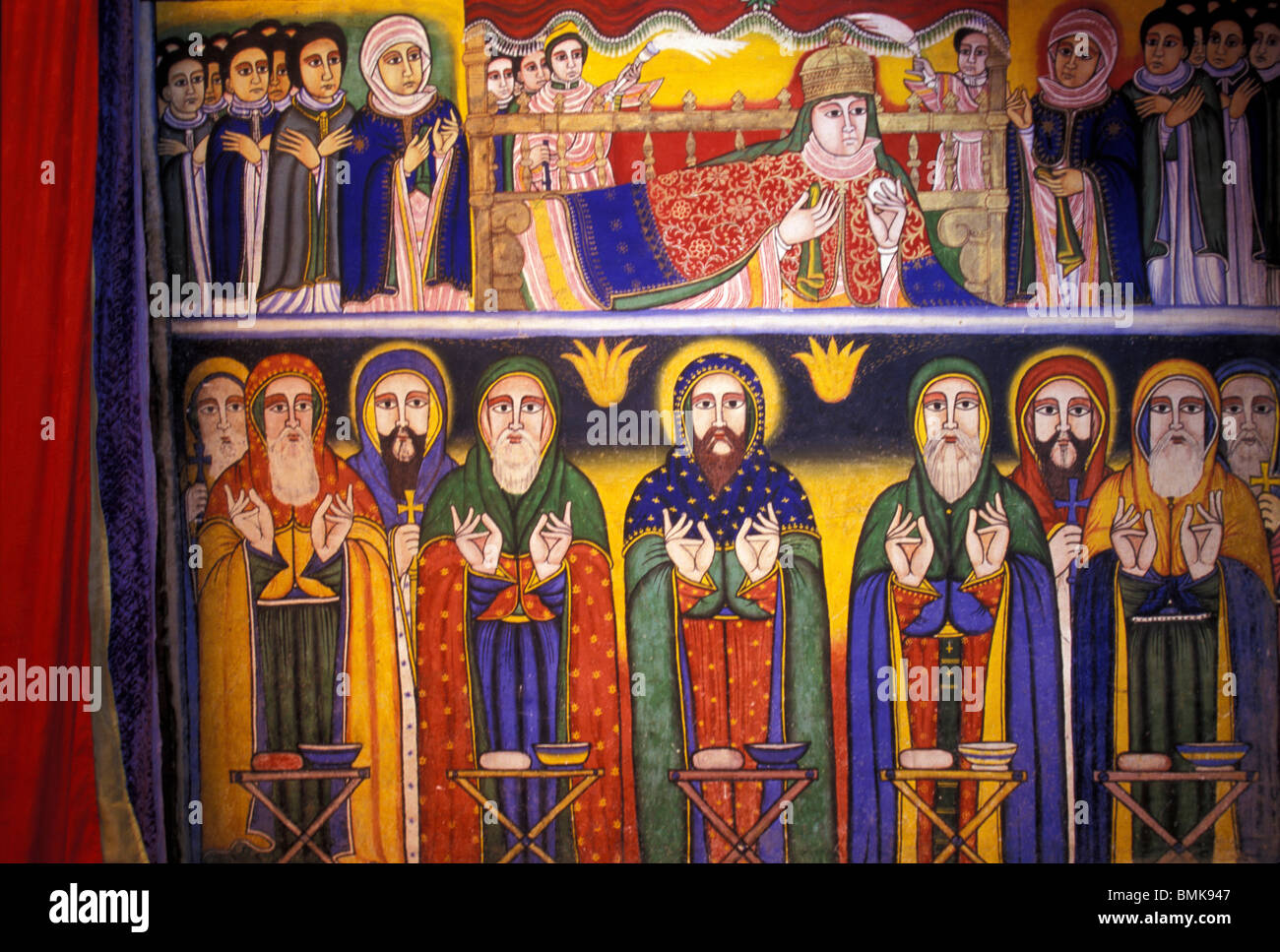
Secondary veneration highlights his role among the Nine Saints, with devotional practices including collective liturgical honors and icons that frequently depict him alongside Archangel Michael, reflecting the archangel's role in his legendary ascent to Debre Damo.[13][5]
=================================================================================================================================
British Museum
Main navigation
Saint Aregawi
Saint Aregawi
primary name: Aregawi
other name: Abuna Aregawi
other name: Za-Mikael Aragawi
Details
individual; saint/martyr; Ethiopian; Male
Biography
A Syrian monk who travelled to Ethiopia in the sixth century to spread Christianity and establish monasticism. He is one of the nine saints, the founding fathers of Ethiopian Christianity. Seeing Debre Damo the saint was astonished at how remote and impenetrable the mountain was. Before him appeared a large serpent, who directed by Saint Michael, wound itself around the saint and carefully lifted him to the mountain top. Here Saint Aregawi founded one of Ethiopia’s oldest monasteries. His feast day on the 14th October attracts many pilgrims to Debre Damo.
View lessabout biography