Ethiopian News, Current Affairs and Opinion Forum
-
fasil1235
- Member
- Posts: 2280
- Joined: 01 Jul 2018, 08:58
- Location: Sululta
Post
by fasil1235 » 07 Feb 2026, 06:26
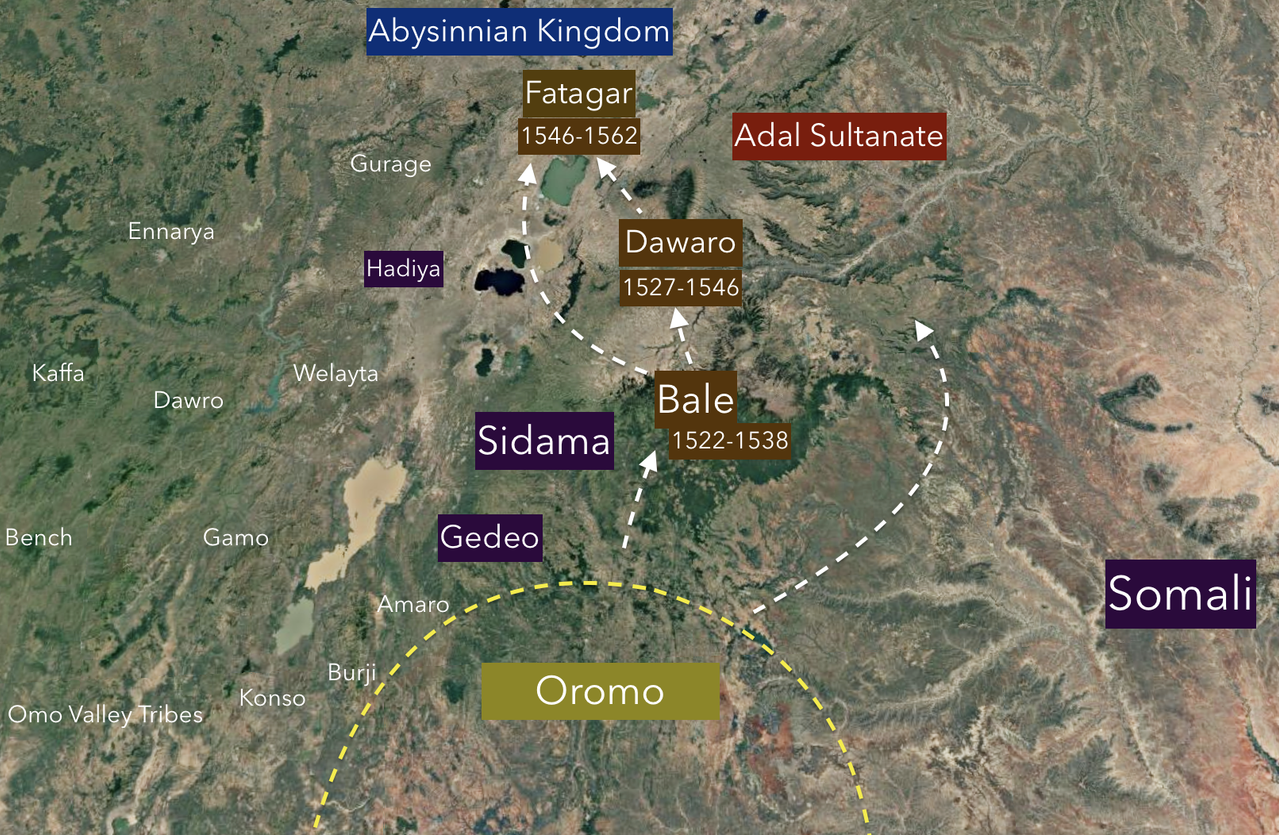
 Conquest of Bale
1522-1538 - 16 years
According to the monk Bahrey, Bali was the first major province to be permanently settled by the Oromo during the Great Migrations.
The Early Raids (1522–1530): Under the Luba of Melbah, the Oromo began raiding the borders of Bali.
The Permanent Occupation (1530–1538): Under the Luba of Mudana, the Oromo moved past the Wabi Shebelle river and began staying in the territory rather than returning to their southern homelands.

Historians note that Bali's flat, fertile lowland plains were "ideal" for the Oromo's cattle-centric, nomadic lifestyle. The Muslim governor at the time, Umar, reportedly retreated to the northern mountains to avoid confrontation, effectively handing the central and southern plains to the Oromo
Umar realized that his forces—which were already exhausted from years of fighting the Abyssinian Warriors ✠ —could not stop this new, Oromo nomadic threat. To avoid a bloody and losing confrontation, he retreated to the northern, more mountainous parts of the provinc
-
fasil1235
- Member
- Posts: 2280
- Joined: 01 Jul 2018, 08:58
- Location: Sululta
Post
by fasil1235 » 07 Feb 2026, 06:56
Conquest of Dawaro - Arsi
1527-1562 - 19 years
The Oromo Conquest of Dawaro began with 3 initial waves
1522–1530 (Luba Melbah): Initial "hit-and-run" raids. The Oromo began testing the southern defenses of Dawaro while the Ethiopian Christian Empire was distracted by the rising power of Imam Ahmad (Gran).
1530–1546 (Luba Mudana and Robale): Following the massive Battle of Shimbra Kure (1529), which devastated the Christian ✠ Ethiopian army, Dawaro became a vacuum. The Oromo began staying in the territory permanently.
1554–1562 (Luba Meslé): This is the definitive period of conquest. Under the leadership of the Meslé Gadaa, the Oromo military transitioned from infantry to cavalry, making them unstoppable in the flat plains of Dawaro.


Before Luba Mesle time, Oromo warriors often returned to their ancestral lands after a campaign. The Luba Mesle changed the strategy:
• Territorial Consolidation: They moved into Dawaro with their families and cattle, not just as a military force.
• Infrastructure of Power: They established permanent Caffee (assembly grounds) in the newly acquired territories, making the Oromo presence a permanent administrative reality rather than a passing threat.
2. The Mogasa (Ritual Adoption)
The Luba Mesle era is famous for the widespread application of Mogasa. This was the "secret sauce" of Oromization.
• Contractual Kinship: Instead of keeping the Hadiya and Harla as a permanent underclass, Mesle’s Luba invited them to become "Oromo" through a formal oath.
• The Ritual: The non-Oromo person or clan would sit under a tree and be ritually adopted into an Oromo clan (like the Arsi or Itu). From that moment on, they were legally Oromo, gaining access to land rights and protection under the Gadaa laws.
3. The Power of Afaan Oromo
Linguistic shift followed political power. Because the Gadaa system was an oral-legal culture, anyone who wanted to participate in the local government, dispute resolution, or trade had to speak Afaan Oromo.
• Under Mesle, the Oromo language became the lingua franca of Dawaro.
• Within a few generations, the original languages of the Harla and Hadiya in that specific region began to fade, replaced by the language of the ruling Luba.
4. Military Superiority: The Cavalry
Mesle is credited with significantly enhancing the Oromo military tactics in the highlands.
• By utilizing the open plains of Dawaro, the Oromo developed a highly mobile cavalry.
• The disorganized remnants of the Dawaro kingdom (which had been shattered by the earlier conflicts between the Adal Sultanate and the Christian Ethiopian Empire) could not withstand the coordinated, horse-mounted charges of the Luba Mesle warriors.
-
fasil1235
- Member
- Posts: 2280
- Joined: 01 Jul 2018, 08:58
- Location: Sululta
Post
by fasil1235 » 07 Feb 2026, 15:34
Conquest of Fatagar
1546-1562 - 16 years
According to the Abba Bahrey: The Michille Luba (1554–1562): This period is often cited as the definitive era when the Oromo consolidated control over Fatagar. They began to transition from seasonal raiding to permanent settlement, effectively severing the link between the Christian ✠ highlands and the southern provinces.

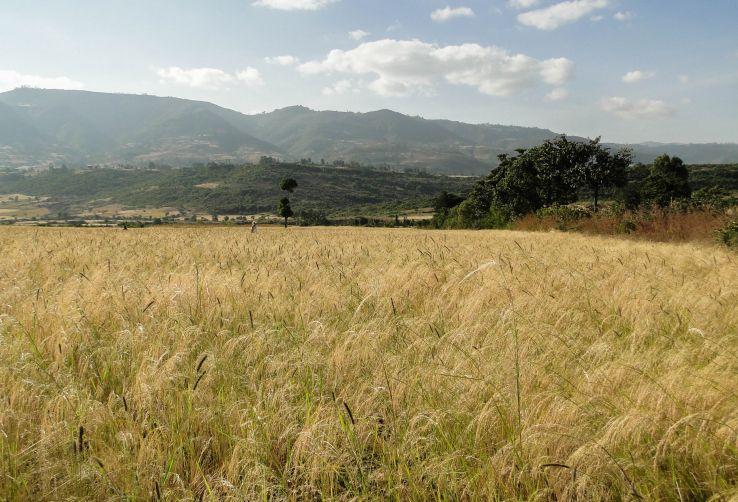
The Battle of Fatagar (March 23, 1559) was the most significant battle in the region's history, though it was primarily fought between the Christian ✠ Abysinnian Empire and the Adal Sultanate, which inadvertently left the door open for Oromo settlement. The Abysinnian King Gelawdewos was killed in battle. With the Christian Emperor dead and Nur ibn Mujahid’s forces severely weakened and retreating to Harar, a power vacuum was created.
The Battle of Hazalo (July 1559)
Shortly after ✠ Emperor Gelawdewos was killed in Fatagar (March 1559), the victorious Adalite leader, Nur ibn Mujahid, was returning to Harar.As Nur’s forces marched through the plains of Hazalo (in or near Fatagar), they were ambushed by Oromo warriors.: It was a slaughter. The Oromo utilized their superior mobility and the fact that the Adalite soldiers were depleted from their previous campaign against the Christians.
Nur ibn Mujahid survived and reached Harar, but his army was so devastated that he famously donned mourning clothes and withdrew behind the walls of Harar (building the famous Jugol Wall to protect the city from the very Oromo forces that had just crushed him at Hazalo).
The Battle of Mount Azalo (1577–1578) - this battle saw King ✠ Sarsa Dengel engage the Oromo forces. While the Emperor claimed victory, the "victory" was tactical rather than strategic; he was forced to retreat northward, leaving Fatagar permanently under Oromo control.
 Conquest of Bale