What really happened in Axum?
Besides, November 30th was Hidar 21, St. Mary's day and it was reported that the church was busy with priests and congregants. How could that happen, if massacre took place on Nov 28 & 29?
Last edited by Zmeselo on 30 Nov 2025, 17:41, edited 1 time in total.
Re: What really happened in Axum?

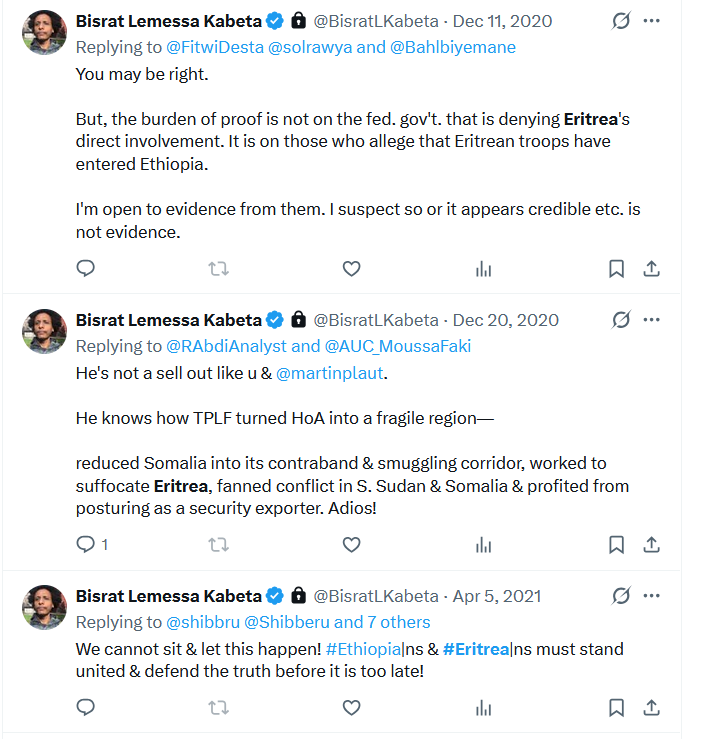
This character, Bisrat Lemmesa — a PhD holder and owner of the Nexus “independent” think tank — went on @AJHeadtoHead with @mehdirhasan to lecture the world about Eritrea, claiming it has failed to build functional institutions and cannot operate as a reliable state. Even more astonishingly, this same “expert” declared that Abiy merely “signed” to recognize the borders per the Algiers Agreement and at the same time failed to correct the historical “blunder” of Ethiopia’s lack of sea access.
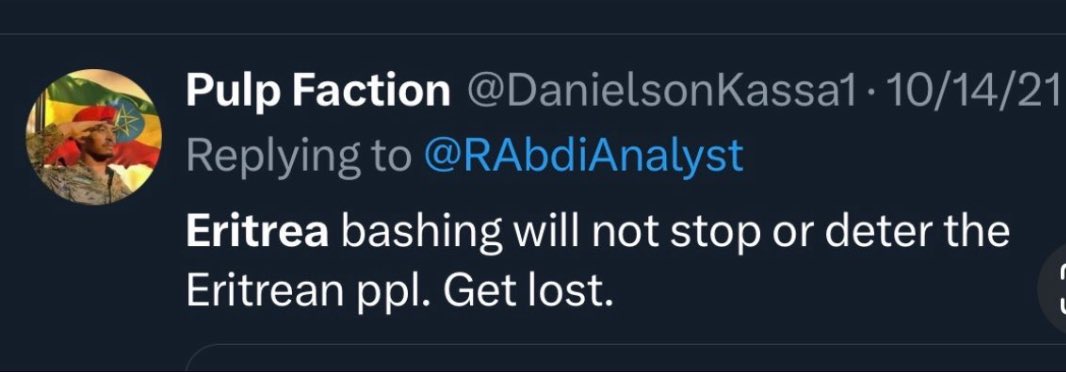
Rather than wasting time debating these laughable assertions, I’ll simply let Bisrat Lemmesa’s own posts from the last five years expose the contradictions. I’ve compiled screenshots of his most telling statements:

He argued that Eritrean territories — including Badme — must be returned to Eritrea based on the Algiers Agreement. Conveniently, the very same Algiers Agreement clearly affirms the Eritrea–Ethiopia border and places Assab firmly within Eritrea, making Ethiopia a landlocked state. He seems to be oblivious to that part.
Some expert!
He has also posted countless messages thanking Eritrea for “saving” Abiy and preventing Ethiopia’s collapse, including direct replies to Eritrea’s Minister of Information.

When the EU imposed unilateral sanctions on Eritrea, Bisrat wrote:
Eritrea has shown its commitment to regional integration & stability. So, why now?The Eritrean state is resilient despite concerted aggression. The EU has failed to recognize that the 2009 UN sanction was a ploy staged by TPLFites & sponsored by @AmbassadorRice.
 The Eritrean state is resilient despite concerted aggression. The EU has failed to recognize that the 2009 UN sanction was a ploy staged by TPLFites & sponsored by @
By his own words, then, Eritrea is not the dysfunctional state he now portrays on international media. According to Bisrat himself, Eritrea is a resilient country, a stabilizing force in the region, a state Ethiopia depends on in moments of existential crisis, and — as per the Algiers Agreement he once championed — the lawful sovereign of the territories in question.
His recent claims, collapse under the weight of his own documented praise.
_________
Ghidewon Abay: @GhidewonSicko, for far too many “politicians” and “analysts” south of the Eritrea–Ethiopia border, discourse and engagement has never been about truth or facts; it is about temperature. What some of us did not fully appreciate, is how deeply this ailment runs further south as well. The same pattern defines whether he is @reda_getachew, @AbiyAhmedAli, Lemmessa, Angaffa or many others.
You encounter them at 12:00 PM roaring with certainty about one position, only to find them at 6:00 in the evening calmly defending its opposite, as though the afternoon has erased their own words. They act as if the public has the memory of a goldfish. They have no compass, only a thermometer: whatever burns hottest in the moment becomes their latest “principle.” Yesterday’s sacred “red line” becomes today’s “misquote,” and by tomorrow it will be repackaged as a “complex issue.”
Press them on what they truly believe and you quickly discover there is no core principle, no consistent ethic, only vapor, slogans, and opportunistic improvisation dressed up as conviction.
It is a political culture utterly unlike the Shaebia tradition we know:
be patient, speak little, don’t be shortsighted, look far beyond the immediate horizon, anchor yourself in unshakable principles, and hold to them even when the ground trembles beneath your feet.
And as we witness this contrast, we cannot help but recall Fihira’s (Tesfay Mehari) iconic words:
መትከል፡ መትከል፡ መትከል ዝረገጸ ኣይስሕትን ሾቱኡ፣ ንዝመጽእ ጎነጽ የትሕዞ ቦትኡ።
Paraphrasing the words are saying: Those anchored in principles will not miss their goal, they will achieve their vision. They can endure storms, pressure, and hostility, because conviction, not convenience, guides their path.
Last edited by Zmeselo on 30 Nov 2025, 17:45, edited 3 times in total.
Re: What really happened in Axum?
The desperation is palpable! Look, how they spelled "coup".

Grok's response:
Grok's response:
Just 4 years ago, he was saying this:No, the claims in this X post are not true. The attached image is a poorly photoshopped fabrication mimicking an Al Jazeera article, complete with obvious spelling errors (e.g., "Attempetpt," "Simultananeous," "Agenciesies") and an impossible publication date of "30 Nov 2025" (which aligns with today but predates any real reporting). The purported article URL—https://www.aljazeera.com/news/2025/11/ ... an—returns a 404 error and does not exist.
There are no credible reports of a coup attempt in Eritrea's capital of Asmara today or in recent weeks. Eritrea has a history of rumored or failed coup attempts (e.g., a 2013 military mutiny and unconfirmed 2016 rumors), but nothing matches this description in November 2025.
Current news from the region focuses on simmering tensions between Ethiopia and Eritrea over Red Sea access, but no active coup or internal unrest in Asmara.
Drone strikes by Sudan's Rapid Support Forces (RSF) on Port Sudan did occur earlier this year (notably in May 2025, targeting fuel depots, an airport, and military sites), but there are no reports of new strikes today or this month.
The RSF-Sudanese Armed Forces conflict remains active, with drone warfare escalating overall, but no linkage to events in Eritrea.
The post itself acknowledges "urgently trying to verify," but replies in the thread quickly call it out as fake news with bad editing.
This fits a pattern of misinformation around Sudan-Eritrea border tensions, including prior false claims in May 2025 about RSF attacks on Eritrean assets (which were debunked).
Always cross-check viral claims with primary sources like Al Jazeera's actual Eritrea or Sudan pages, which show no such story.
Last edited by Zmeselo on 30 Nov 2025, 17:50, edited 1 time in total.
Re: What really happened in Axum?
The Potemkin Party leader, Abiy Ahmed, has once again been publicly exposed as a pathological liar - and Endagachew Tsige was used as his messenger between Eritrea and Ethiopia back in 2018. But in that interview, Endagachew ended up revealing the truth: Abiy is not trustworthy. He lies to every side, shifts narratives just to survive politically, and his behavior keeps getting worse.
Last edited by Zmeselo on 30 Nov 2025, 17:47, edited 1 time in total.
Re: What really happened in Axum?

Opinion
Ethiopia’s Red Sea Pretensions: The Ambition is Grand. The Reality is Not.
By Ghidewon Abay Asmerom
https://redseabeacon.com/ethiopias-red- ... ty-is-not/
November 30, 2025
Ethiopia’s claim that it is destined to “secure the Red Sea” would be audacious, if it were not so astonishingly detached from reality. A landlocked state that cannot hold the center, that commands no coastline, no navy, and increasingly little authority beyond its own capital, now imagines itself a maritime guardian. It is a classic case of political overreach: a frog that insists it roars like a lion. Its leaders speak as though the salty waters of the Red Sea possess a kind of holy cure for Ethiopia’s internal breakdown, as if geography might redeem governance. The result is not strategy, but spectacle. A government struggling to manage its own districts, is now claiming stewardship over one of the world’s most strategic waterways. It is a delusion at best, and an absurdity that borders on the laughable.
The claim that the Red Sea only became unstable
is not merely false; it is a deliberate inversion of the historical record.after Ethiopia left
The region’s volatility today, is overwhelmingly a product of the war in Yemen and intensifying great-power competition. Long before that, however, Ethiopia played a central role in destabilizing the Horn. Its 2006 invasion of Somalia collapsed an emerging political order and, as a UN investigation later affirmed, the arms flows and upheaval that enabled extremist militancy were directly tied to Ethiopia’s intervention; even as Addis Ababa fabricated evidence to justify its actions. Ethiopia’s prime minister has also admitted in parliament, that Ethiopia’s government helped ignite the crisis in South Sudan. Recent reports have also made it clear Ethiopia, working as a proxy, is responsible for the civil war in Sudan. A state that has repeatedly been a catalyst for regional disorder, cannot now credibly claim the mantle of regional savior.
That makes Ethiopia’s new claim, that it is
not a foreign-policy doctrine but political theater.best suited to secure the Red Sea,
A landlocked country cannot secure a maritime corridor it does not border, does not administer, and has never lawfully possessed. Yet Ethiopia’s leadership continues to repeat this narrative, as if repetition could transform fantasy into jurisdiction. It cannot!
The domestic context explains the performance. Ethiopia today struggles to govern itself. Insurgencies rage in Oromia. Amhara defies federal authority. Tigray remains fractures and in limbo. Beyond Addis Ababa, state authority is thin, inconsistent, or absent. In such circumstances, sweeping declarations about Red Sea stewardship are not strategy but escapism. A state losing cohesion seeks symbolic victories abroad to mask fractures at home.
The military realities are even harsher. Ethiopia’s last naval encounter ended when the young EPLF navy swept aside Ethiopian naval installations, in 1990 and 1991. Now, with no coastline, Ethiopia proposes to build a navy on Lake Tana and deploy it onto one of the world’s most contested maritime corridors. This is not ambition; it is fantasy dressed as policy.
Diplomatic consultations with France or the United States offer no validation for Ethiopia’s territorial desires. They are routine exchanges and in France’s case often motivated by commercial need. Paris has been scrambling for defense clients, since losing the enormous AUKUS Australian submarine contract to the United States and has been pushed out of several West African states. If France entertains naval cooperation with Ethiopia, it is chasing business, not endorsing redrawn borders.
Ethiopia’s claim to moral authority is equally hollow. The state played a documented role in the CIA’s extraordinary rendition program, acting as a venue for “enhanced interrogations,” or torture that Western governments preferred not to conduct themselves. Ethiopia has also aligned with terrorist groups, whenever convenient. A government with such a record, cannot credibly cast itself as a guardian of maritime peace.
Ultimately, Ethiopia’s maritime rhetoric arises from internal fragility rather than external necessity. The country is strained by political polarization, armed uprisings, severe economic deterioration, and a crisis of legitimacy. The Red Sea provides an easy distraction, a distant horizon onto which the government can project grandeur while avoiding its own failures. The sea becomes a symbol, not a strategy.
No Red Sea state, African institution, or global power supports Ethiopia’s claim to sovereign coastal territory. The security of the Red Sea belongs to the states that actually border it, whose coastlines are protected by the UN Charter and the principles of territorial integrity. Eritrea’s coastline is legally defined and cannot be seized or negotiated away by pressure or desperation.
As always, Ethiopia’s talk of “Red Sea security” is less about regional stability than about advertising itself as a willing subcontractor for foreign powers. Its own prime minister has said openly, that he is
and that Ethiopia could fight the wars Western countries are unwilling to send their children to.ready to fight and die for America
The message is unmistakable: Ethiopia is positioning itself as an errand state and a supplier of expendable manpower for great-power agendas.
This is not theoretical. Ethiopia is already operating as a mercenary force for the UAE in the destabilization of Sudan and has become a key transit route for ferrying Colombian narco-trafficker paramilitaries to fight alongside the RSF. A state that rents out violence and facilitates foreign militias, cannot credibly present itself as a guardian of security in one of the world’s most sensitive maritime corridors.
In the end, Ethiopia’s Red Sea pretensions collapse under the weight of their own impossibility. A government that cannot secure the road from Addis Ababa to Ambo, now claims it will secure the shipping lanes from Suez to Bab-el-Mandeb. A state that loses territory to its own insurgents, imagines it will police global chokepoints. A leadership that treats geography as a suggestion and history as a prop demands a role that neither law, nor capacity, nor neighbors will ever grant it.
The truth is simple. The Red Sea does not need Ethiopia’s protection. Ethiopia needs the Red Sea as a political distraction. Its leaders are chasing saltwater, not because it strengthens the nation but because it masks its unraveling. They try reaching for a coastline they cannot touch, in the hope that no one notices the ground collapsing beneath their feet.
But illusions do not make borders. Fantasies do not create navies. And desperation does not confer sovereignty.
The Red Sea will remain secure, through the states that actually border it and through the international laws that govern it. Ethiopia is not on that list. No amount of rhetoric, repetition, or theatrical ambition will place it there.
Pretension is not power. Geography is not optional. And the Red Sea is not Ethiopia’s to claim, to police, or to dream into reality.
Re: What really happened in Axum?
The false story of a "massacre" at Axum was concocted by none other than Martin Plaut, Kjetil Tronvoll, etc.... who have been using the people of Tigray as pawns to advance their Neo-colonial agendas in the Horn region. It was the white south African Martin Plaut who once tweeted: "Yes, I lie sometimes to push my own agenda. So what? The end justifies the means."
