
 Newcastle United’s Alexander Isak and the ‘explosion’ that set him on course for the top
Jacob Whitehead
https://theathletic.com/4531978/2023/08 ... newcastle/
Aug 8, 2023
Newcastle United’s Alexander Isak and the ‘explosion’ that set him on course for the top
Jacob Whitehead
https://theathletic.com/4531978/2023/08 ... newcastle/
Aug 8, 2023
This is not a fairytale,
warns technical director
Peter Wennberg from the coaches’ office of the AIK academy.
That may be true. When Isak was a teenager, he had a period when he struggled with a growth spurt, had his mentality questioned by coaches, and considered joining his team’s hated rivals, Djurgarden. Then came what team-mates call “
the explosion”, and everything changed.
Yes, it is a comeback story in a way. But in some parts, it is still a fairytale.
Take the 17-year-old who received a
FaceTime call from an unrecognised number. He picked it up. On the other end was another striker:
Ronaldo,
O Fenomeno, imploring Isak to sign for Real Madrid.
https://theathletic.com/football/team/real-madrid/
Ronaldo was not alone. Less than six months after making his debut for AIK, one of Sweden’s big three clubs, there were calls from Borussia Dortmund, RB Leipzig,
https://theathletic.com/football/team/leipzig/ Liverpool
https://theathletic.com/football/team/liverpool/ and Barcelona.
https://theathletic.com/football/team/fc-barcelona/
 Ronaldo O Fenomeno Credit: Bongarts/Getty Images/Andreas Rentz
Now, it is Newcastle United’s Alexander Isak. This is the making of him told from the streets where he grew up, the roads that led him to the north east of England and, this season, the Champions League.
https://theathletic.com/football/champions-league/
1. ‘Always ambitious’
This is not the Stockholm of spires — these are the Stockholm suburbs, a Stockholm of 1960s tower blocks, malls and three-lane roads. Five kilometres north west of the city centre, the sprawling neighbourhood of Solna is one of the most diverse areas of Sweden — and where
Teame Isak, Alex’s father, moved in the 1980s, uprooted by the civil war in his home country of Eritrea.
The estate of Bagartorp is literally on the other side of the tracks, separated from the torso of Solna by a giant train repair depot. The Friends Arena, home to both AIK and the Sweden national team, is just a 10-minute walk away. The same distance in the other direction is Jarva, one of Stockholm’s most infamous neighbourhoods, where in the past decade, deprivation has brought riots against government policy.
 The block in Bagartorp where Isak grew up (Photo: Jacob Whitehead)
But Isak was only ever going in one direction. Bagartorp is ensnared by a circular service road and, in the mid-2000s, its iris was a small pitch, since razed in a redevelopment and never replaced, surviving only in a picture on the area’s
Wikipedia page.
After lessons or during school holidays, Isak would leave his block of flats — one of four identical buildings — and head straight there. Invite-only. Five-year-old Isak took some persuading to attend formal training, but after being included in AIK’s youth teams within a year, that would soon change.
Presumably, those who play on the main pitch at Skytteholms, in central Solna, tend to feel like they’ve made it, watched by fans on worn red seats. When The Athletic visits, AIK’s women’s team are training there, managed by
Jesper Bjork, Isak’s coach as a young teenager. The days of a decade ago do not feel far away.
 Jesper Bjork at the Skytteholms training ground (Photo: Jacob Whitehead)
Back then, there was also another Alexander:
Alex Snacke, who captained Isak’s age group from six to 16 and made it to the first team at the same time as Isak. A centre-back, Snacke had a passing range still talked about by coaches, but he tore his ACL on his first loan away, then tore it again the day after returning from the injury. Now retired, he coaches AIK’s Under-13s.
Always ambitious,
Snacke remembers of the six-year-old Isak.
 The two Alexanders, Isak, far left, and Snacke, front, at AIK youth training (Photo: Alexander Snacke)
He was smart,
says Bjork of Isak.
He wants to try to trick defenders into doing stupid things, then move the ball in another direction. But the hardest thing was getting him going in training sessions.
It was the best Bjork could do to get his charges to the pitch. Skytteholms is bordered by Solna Centrum, a giant mall. A Max Burger, the popular Swedish chain, backs on to the training pitch. Without changing facilities back then, the team would use the franchise as a dressing room.
 The AIK academy’s unofficial changing rooms (Photo: Jacob Whitehead)
They wouldn’t be eating, they’d just be chatting,
laughs Bjork.
If I ever wondered where they were — I’d go to Max.
Other options were available.
We always used to eat this all-you-can-eat Chinese buffet,
remembers
Oscar Krusnell, a left-back in that age group who later made it on to the books at Sunderland.
I remember sitting there, playing football, then going back to eat again, always with Alex.
Coaches encouraged the buffet — chicken and rice was preferable, nutritionally speaking, to burgers.
He was always kind,
says
Gabriel Aphrem, a fellow AIK academy player and Sweden Under-17 international.
One time, we were maybe 14 or 15, my lunch was 100 Swedish krona. I didn’t have it and he paid. Not everyone would have done that and he wasn’t from the wealthiest family.
Isak’s group, schooled together, were notably close. During holidays, they spent up to 10 hours a day at Skytteholms, eating, training, or playing at another nearby cage. Isak’s first senior number at AIK was 36 — a nod to the fact his friends always organised their own game at six o’clock on pitch three.
Afterwards, they would often go to the house of a coach whose son was in the side. Isak and his team-mates were obsessed with an automatic ice dispenser. They’d mess around with the ice cubes, putting them down each other’s necks. It played to Isak’s instincts as a joker.
Well played guys!
Bjork remembers the relentlessly sarcastic Isak shouting at half-time whenever his team trailed.
We’re playing really well. Brilliant.
It showed some strength of character. Back then, Isak was not seen as the standout player.
That was the only problem he had,
Aphrem remembers.
He liked to joke, sometimes too much. His only enemy was himself.
 The AIK squad in 2012, featuring Isak, middle row, centre; Bjork, front row, second from the left; Snacke, front row, fifth from left; and future international Isak Hien, middle row, far left (Photo: AIK)
2. ‘I didn’t work hard enough and they were right’
The AIK squad in 2012, featuring Isak, middle row, centre; Bjork, front row, second from the left; Snacke, front row, fifth from left; and future international Isak Hien, middle row, far left (Photo: AIK)
2. ‘I didn’t work hard enough and they were right’
From above, the AIK academy site at Rasunda in central Solna looks like a bungalow built from cinder blocks. A school and children’s park overlooks the single 4G pitch, the hopefuls arriving for training making their way through gaps in the wire fencing.
There is nothing to suggest the original Rasunda Stadium, one block over, hosted the 1958 World Cup final; the one where a 17-year-old
Pele flicked the ball over a Swedish defender before side-footing into the net, the first of his two goals in a 5-2 win. Torn down in 2013, only a single tower block remains from the old site.
Appearances can be deceiving. Look at Isak, a player whose gangly build suggests awkwardness, yet he flows like a sail catching wind. At Rasunda, the unprepossessing exterior hides its depths. Stretching underground like a bunker, heavy doors lead to a corridor decorated with photos of every academy graduate since it opened.
You’re speaking to a man who should be on that wall,
says Wennberg, who manages the academy, pointing to Snacke.
 Inside Rasunda (Photo: Jacob Whitehead)
Bashfully, Snacke explains Isak was not initially the star player. There was
Isak Hien, now a centre-back for Verona and Sweden, who led the line back then.
Nebiyou Perry, an American-Swedish winger, was the most skilful. Krusnell and Aphrem played for national age-group teams. It takes some prodding and the intervention of the bear-like Wennberg for Snacke to admit he was also among the standouts.
I have one memory, which I tell my players now,
says Snacke.
When we were 13, we went away to this national tournament. Out of the whole squad, only three or four weren’t picked. He was one of them.
 Snacke in the changing rooms at Rasunda (Photo: Jacob Whitehead)
At that age, I don’t think he realised he had to work hard for it,
explains Bjork.
He played like it was fun, but he didn’t play for his life.
When we had the toughest games, against Hammarby and Brommapojkarna, he’d score. But against the smaller teams, we couldn’t get him going. Against Bollstanas, we won 10-0 and couldn’t tell if Isak was playing or not.
Bjork spoke to his parents — praised by AIK for never questioning their coaching or pressurising Isak — explaining what needed to change.
It was not that he was unprofessional,
says Wennberg.
It was just that there were kids’ habits which needed to transform into professional habits.
 Isak and Krusnell (on Isak’s back) during their time with Sweden Under-17s (Credit: Oscar Krusnell)
At that age, transformation was part of the problem. Isak had always been tall for his age —
My first impression was of a big guy,
remembers Krusnell — but he was rapidly shooting up towards his current height of 6ft 4in (193cm).
Growing almost a foot in two years, his play began to suffer as his body changed.
Though he would not share his frustration publicly, not being in the starting XI was gnawing away at him. Isak began to look at other options, including Djurgarden, in wealthier central Stockholm. Djurgardens are AIK’s arch-rivals in the
Tvillingderbyt (The Twin Derby), so named due to both being founded within three weeks of each other.
Sean Longstaff’s father
David, a professional ice-hockey player, played for Djurgardens’ ice-hockey team when Longstaff was young, with the family living in Sweden. Now, the Newcastle pair tease each other about holding allegiances from different sides of the divide. What could have been.
That thought was a fleeting one and Isak was persuaded against moving by family and close acquaintances. Coaches say he behaved impeccably throughout this period.
I had no idea he considered moving,
says Snacke.
Of course, I have had tough periods before,
Isak told Swedish newspaper
Aftonbladet in 2017.
I was dropped to the bench. They thought I didn’t work hard enough and they were right. It was then that I realised this was serious. So that’s when I sorted myself out.
Determined to reacclimatise to his frame and transform his habits, Isak also began to train with local coaches from the Eritrean community, organised by his elder brother
Binyam. Improvements, gradually, incrementally, made in the dark evenings of a Swedish winter, began to show.
Within the AIK academy, coaches noticed these changes. Recognising the improving Isak was relying on his speed when playing up front, the decision was made to pull him deeper, just temporarily, to make him more press-resistant.
 Wennberg and AIK assistant Henok Goitom at Rasunda (Photo: Jacob Whitehead)
We wanted him to gain 360-degree awareness,
explains Wennberg.
It meant he became more involved in the game, put pressure on his first touch, made him contend with more traffic. We saw how he could affect the game in the build-up.
Occasionally utilising Isak as a No 10 for Newcastle this season,
Eddie Howe has been a beneficiary.
Another conversation was also deemed pivotal.
We began to realise that we had a special one,
says Wennberg.
The coaches’ office was at the entrance, at the top of the stairs. Every time he’d pass it and just say: ‘Hi’. There were four or five of us, planning his future, taking care of individual analysis, just for him.
So one morning I said: ‘Hey, Isak, come and sit down’. Every coach was sitting there, by the whiteboard. ‘Everyone here is working 24/7 for you’, I said. ‘And you just pass us and say: ‘Hi’. Next morning, I want you to come in here and ask: ‘What do I need to do to improve today? What is the mission?’.
We had the training and the very next morning, there he was, straight into the coaching room. ‘Hey coach’, he said. ‘What is the plan for me today?’. If you really want to be great, you need to be the main star in your own life, to drive it. That’s when I knew he was ready.
3. ‘I call it the explosion’
The Friends Arena sits in Solna like a spaceship on the street. Cavernous, luminous, flashing neon across the skyline. On the day The Athletic visits, security for
Beyonce, playing two nights in Stockholm, includes a wide perimeter. Isak had to pass the stadium every day to get from Bagartorp to his secondary school.
 Stockholm’s Friends Arena (Photo: Jacob Whitehead)
But playing there? That was all to do with a pair of boots.
Andreas Alm managed AIK from 2011 to 2016 and had been an assistant for three years before that. Entering his last season at the club, Alm had not planned to compete for the Allsvenskan, Sweden’s top divison, with a 16-year-old as his starting striker.
We’d bought a guy that was expected to be the top scorer in the league — an experienced guy who had played in another Swedish side before that,
Alm tells The Athletic after training with his current club, Danish first-division side
Odense Boldklub.
But then there began to be some issues with that player.
He was injured — he couldn’t play with the right boots,
Wennberg explains.
We had Adidas during that time, but he needed to play with Nike boots or he would struggle with his foot.
Wanting to trial his academy players, Alm brought the teenager, Isak, into first-team training. Alm was instantly impressed.
I still have clips of his first sessions because he understood our patterns of play so quickly,
says Alm.
There had been this explosion,
remembers Snacke.
He was always decent. But at 15 or 16, he just became the fastest, the strongest, the player with the best technique. I’ve never seen everything click at the same time before.
AIK’s youth side began to qualify for tournaments involving Europe’s top youth sides. Barcelona and Ajax — the latter featuring
Matthijs de Ligt and
Frenkie de Jong — visited Skytteholms.
I remember one game in the middle of this period when he kicked off and knocked the ball in front of him,
Snacke says.
He just chipped the goalkeeper from halfway. That was when the attention really ramped up.
On one occasion, playing in Italy, he was racially abused by the crowd during a standout performance.
It’s obviously not OK,
says Krusnell, playing left-back in that game.
But he was chilled out; he didn’t let them get a reaction out of him. He just played, so didn’t let them win.
He was succeeding internationally, too. Despite being benched for a crucial qualifier against Wales — much to the surprise of his team-mates — he came off the bench to send Sweden to the finals of the 2016 Under-17 European Championships, the first time they had reached the tournament in three years.
Back at AIK, coaches were searching for ways to challenge him. Aside from playing in midfield, they took him to Bologna to expose him to another way of playing. Despite his success, Wennberg was occasionally reminded that their prodigy was only 16 years old.
He was called up for a national team camp, which started on the Monday, but we had a game against a really local under-19 team the day before. It was an away game, not so fancy, on a suspect pitch south of Stockholm.
So I spoke to the national coach and we agreed to play Alex for the first 45 minutes — he was not going to start the first national team game anyway. But when I told him, he said: ‘I don’t want to be a part of it’. I told him to trust me and he played — but he didn’t leave the centre circle for the entire half.
He’d checked out and we were really angry with him. But then, as soon as he came back, he apologised for not seeing the bigger picture.
Isak did not have to wait long for his senior AIK debut. He came off the bench in the Swedish Cup against Tenhults IF in February 2016, aged 16 years and 160 days. He scored. Just over a month later came his first league appearance, a start against Ostersund, then managed by
Graham Potter. He scored again.
There had been scepticism, much of it around his still skinny frame.
I’d told the assistant coach: ‘At the end of the year, the best player at AIK will be Alexander Isak’,
Wennberg remembers.
He told me: ‘If we play him, we’ll end up 10th in the league’.
He didn’t put himself in positions where his physicality was an issue,
says Alm.
He’s so smooth. Think about how he doesn’t touch the ball but lets it run. That puts a whole back four on their heels, it opens up so many angles. He did that straight away.
The first-team squad discovered Isak’s intelligence as soon as he entered training.
Henok Goitom made over 250 appearances for AIK and was finishing his first spell at the club when Isak broke on to the scene. Also from an Eritrean background, Isak’s father Teame had taught Goitom the language, Tigrinya, as a child.
Now assistant coach of AIK’s first team, Goitom remembers Isak’s immediate impact.
In the summer, he was one of two or three that came to train with us. We were doing a drill and I wanted the ball. I was the starting striker and I really wanted it. But he didn’t pass, he gave it to someone else.
Then I looked behind me and there was an opponent right there. His intelligence shone through. He was — not sneaky, that sounds like a negative — but always looking for an opportunity.
Graduating into the first team could be intimidating. But not for Isak, who immediately gravitated to the most experienced players.
He was just exactly the same person,
says Snacke.
That was the big difference between us. He settled really well into the group. I found it too big for me.
Legendary Swedish striker
Henrik Larsson, then managing Helsingborgs in the Allsvenskan, noticed Isak.
I thought he looked like an interesting talent,
he tells The Athletic.
That relaxed attitude helps. You can’t afford to get stressed when you’re playing or training. Everything is not always going to go your way. There’s always going to be heated situations in games and if you’re able to handle emotions, you’re always going to have a headstart.
Situations do not come much hotter than what Isak faced on his 17th birthday when he started in the Tvillingderbyt against Djurgardens for the first time.
The towers tell the story of who defends the city,
read AIK’s tifo, barely readable among flares and smoke, which resulted in players having to leave the pitch.
No matter.
Isak scored the first two goals in a 3-0 win, the first after just 15 minutes, a near facsimile of his debut goal for Newcastle against Liverpool, taking the ball on his back foot before smashing it home. Stockholm had a new prince.
When the smoke had cleared, all Isak wanted to talk about was whether he would have time to buy ingredients before the shops closed, tasked with bringing a birthday cake into training the next day.
4. ‘He just thinks it’s freaking cool’
Bjorn Wesstrom’s phone began to buzz and did not stop until January. AIK’s sporting director knew they had a star on their hands. Given the club’s model, the question was not if they would sell — but when.
The club knew the January window was the time to cash in, having resisted in the summer.
Those offers were for only half the money we eventually got,
Wesstrom explains.
So I think we made the right choice.
AIK had a figure in mind. In their sights was
Zlatan Ibrahimovic’s record fee for a player from the Swedish league after leaving Malmo for Ajax — €8.7million (£7.6m; $9.4m). Isak had changed agents during that period, moving from fellow Swede
Patrick Mork to
Vladica Lemic, who also represents Croatia internationals
Luka Modric and
Mateo Kovacic. With AIK open about their price and several teams willing to meet it, most approaches came through Isak’s agent. It was to be his decision.
There was a couple of months until the window,
Wesstrom remembers.
So there was no need to rush into things, the family didn’t want to either. Everyone was calm. I think he just thought it was freaking cool.
Real Madrid were the first side interested and led the race for the majority of the autumn. As well as Ronaldo’s charm offensive, they detailed their plan to the family, who even had hotel rooms booked in Madrid.
Liverpool and RB Leipzig were interested, sending their most senior scouts to Stockholm on several occasions, along with a couple of Serie A sides.
Ralf Rangnick, then Leipzig’s coach, let his interest slip after conversationally telling journalists about a recent trip to Stockholm. He confessed it was to watch Isak soon after.
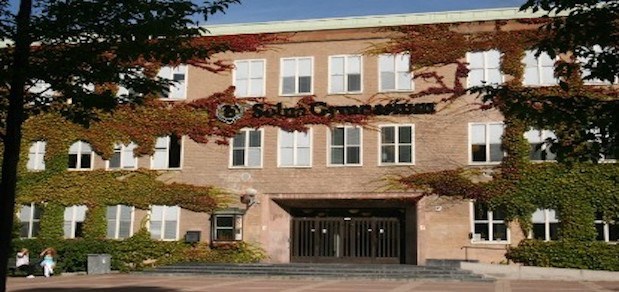 Entrance to Isak's school in Solna (Photo: Jacob Whitehead)
Barcelona also contacted me quite late in the process,
says Wesstrom.
But when they heard Real Madrid were involved, they were honest and said, ‘OK, we know we aren’t going to win this’, and withdrew.
Though city rivals Madrid looked in pole position, they too would be usurped. Borussia Dortmund — with a reputation for signing and developing Europe’s most talented teenagers — swooped in.
He wanted that development plan,
says Wesstrom.
And Dortmund was seen as the best place for that. The family were all in agreement.
The deal was done.
Isak joined Dortmund for €10million.
I remember the day he left,
says Snacke.
We were on the training ground and he just came to pick up his boots. He left almost instantly.
That spell was difficult. Living alone in Germany as a 17-year-old, Isak spent evenings playing Call of Duty with his former AIK team-mates. Though he trained well in the day, Isak felt the competition was simply too good at that stage in his career — and Dortmund’s B-team not good enough. Dortmund was replete with wide talent, including
Ousmane Dembele, Christian Pulisic and
Jadon Sancho. Isak barely played.
People think that spell was a failure,
says Goitom, who mentored the young Isak.
But he was 17. He’d played just one season in the Allsvenskan. It was like playing games even when just training with Dortmund. It was the right step.
5. ‘Will you be next?’
Soon after Isak had left AIK, a green Audi came through Solna. Skimming through the streets, it slowed as it approached the torn wire fencing of Rasunda and turned through the gate, riding the potholes. It kept on going, forgoing the parking spaces before coming to a stop right next to the pitch.
Isak climbed out of the car and walked into the redeveloped academy building, sporting a new floor.
Good,
he said.
This is what I’ve financed.
From the outside, it might have seemed a statement.
I’ve arrived.
Those inside knew differently.
That’s not Alex!
Wesstrom insists.
He’s always been humble. Let me tell you a story. He was 16 and training with the AIK first team, but in school, he still had to take part in PE. Even though he was a professional player.
There was a girl in his team, nobody was passing her the ball. Isak created this chance for himself, he was about to nail it. But then he stopped and gave the ball to the girl — and she scored. The role model, the star of the school — he wanted to give that girl the best day of her life.
It runs in the family.
Saba, his mother, still works in Solna as a carer. This winter, while injured, Isak returned to Stockholm to do his rehab, training at the first team’s Karlberg base and spending time at the academy.
If he went downstairs, this is what he would have seen: Rasunda still being developed — spending the last of the Isak money, one would like to think — with a large gym at its heart, daubed in AIK’s black and yellow.
This is where players begin their conditioning, start to lift weights, and accelerate their journey to the AIK first team. They will be staring at one wall, which the club’s ultras are halfway through painting.
 The Isak mural (Photo: Jacob Whitehead)
Run fast, jump high,
the banner reads.
Above are a series of faces; one is the most prominent, a reminder of what happens if those instructions are followed. Isak’s face casts its smile over the gym, next to a blank outline.
Will you be next?
it asks.
On the way out, amid the deafening clack of 40 pairs of studs, Wesstrom grabs a midfielder from the under-15 squad, combative, a ball-winner.
We think it could be him,
he says.
Remember, though, there’s a long way to go. Solna does not do fairytales.
(Top photo: Clive Brunskill via Getty Images)

 Weekly forecast 08 - 15 August: