AFRICA,
Competing factions in Ethiopia’s interim Tigray administration
https://www.nefasitpost.com/competing-f ... istration/
Aug 4, 2023
Interim governor of Tigray, Getachew Reda, meets Tigray diaspora in Denver. Struggles within TPLF increase; visit seeks to reassure the diaspora.
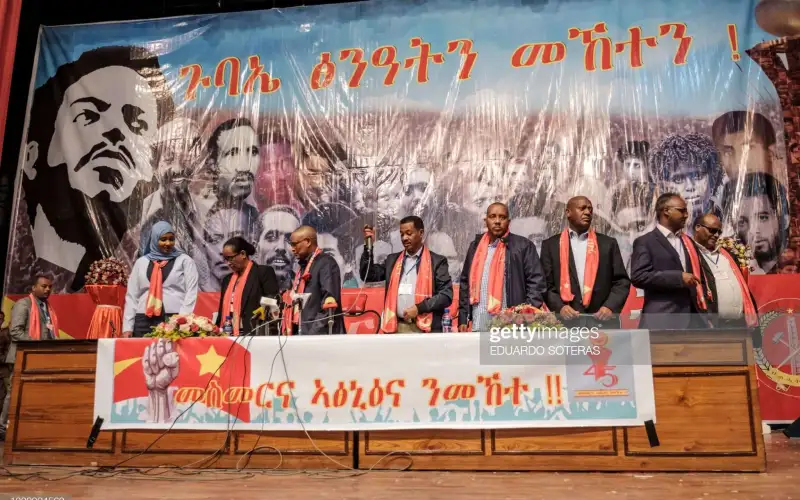
(FLTR) Keria Ibrahim, Fetlework Gebregzabher, Debretsion Gebremichael, Alem Gebrewahid, Getachew Reda, Addis-Alem Balema, Asmelash Woldeselassie, leaders of the Tigray People’s Liberation Front (TPLF), stand in front of the public during the TPLF First Emergency General Congress in the city of Mekelle, Ethiopia, on January 04, 2020. (Photo by EDUARDO SOTERAS / AFP) (Photo by EDUARDO SOTERAS/AFP via Getty Images)
On July 22, 2023, Interim governor of northern Ethiopia’s Tigray region, Getachew Reda arrived in Denver, Colorado for a series of meetings with diaspora-based Tigray nationalists in the U.S. Addressing conference participants, Getachew assuaged members of the Tigray diaspora about recent events in Ethiopia that have largely sidelined the once dominant Tigray People’s Liberation Front (TPLF). Getachew’s visit, coincided with increased internal divisions between hardliners and reformists. Considering this, the visit can be largely seen as an attempt to reassure increasingly irritated members of the diaspora.
In May 2023, the National Electoral Board of Ethiopia (NEBE) announced its plans to hold a vote for a new regional government in the Tigray region during the upcoming Ethiopian calendar year. However, the once vanguard of the old ruling party in Ethiopia, the Tigray People’s Liberation Front (TPLF), was effectively disqualified from participating in remedial elections. This decision, sparked fresh negotiations between Addis Ababa and Mekelle. Within the TPLF camp, this was widely interpreted as an attempt to create disunity in the region and weaken the once dominant TPLF on the national stage. Some have attributed NEBE commissioner Birtukan Mideksa’s resignation https://abren.org/the-challenge-of-repl ... itpost.com to this row, although she states personal health reasons.
Nine months after the Government of Ethiopia (GoE) and the TPLF signed the Cessation of Hostilities Agreement (CoHA) https://abren.org/ethiopia-breakthrough ... itpost.com in Pretoria, leaders of Tigray region are facing new challenges, both economically and politically. A key concern, is whether their political organizations can maintain unity. Having failed military, hardliner opposition figures are accusing the interim regional government of softness; even pushing for an early referendum to secede from Ethiopia, a move that will require the near impossible task of gaining consent from all representatives of Ethiopia’s house of the people’s federation. This makes the secessionist push a mere political stunt, ungrounded in real politics, unless of course there are still remaining plans to achieve this by force.
Following the NEBE announcement, TPLF chairman Debretsion Gebremichael expressed support for an accelerated regional election within a year. Hardliners supported this stance, fearing further delaying the vote will empower the federal government in regional affairs and lead to further weakening of the TPLF. However, officials in the interim regional government raised doubts about the feasibility of such a rapid poll due to the ongoing post-war turmoil; including the presence of Amhara and Eritrean soldiers in the north and west.
In March 2023, the interim government was formed with around half of its top officials coming from the TPLF. However, due to the peace agreement reached in November 2023, the TPLF, owing to its military weakness had to give up some of its power and make significant concessions to Prime Minister Abiy Ahmed’s federal government. It was based on federal government guidance, the rest of the regional interim government consisted of opposition leaders, senior military officers, and a few academics.
The TPLF and the interim government hold differing positions, indicating tensions between the party and an interim administration under the federal government’s influence. Many Tigray nationalists are concerned that their rivals in Asmara, Addis Ababa, and Amhara leaders in Bahir Dar are exploiting these internal divisions to further weaken the region’s clout.
Initially, the TPLF’s attempt to appoint Debretsion as the head of the interim government was rejected by Prime Minster Abiy, who most likely wanted to avoid having the wartime leader of Tigray continue in power; in particular after portraying the peace agreement as victory for the GoE. As a compromise, Getachew was eventually chosen to lead the interim government; partly due to a last minute protest vote against TPLF politburo favorite candidate, Fisseha Habtetsion.
Getachew represents the reformist camp, within the TPLF. To dispel accusations of disloyalty to the party however, he has gone to great lengths to assure the party hierarchy that he intends to implement TPLF policies and mentioned that his cabinet was largely approved by Debretsion himself.
As the new leader of Tigray, Getachew tried to form close alliance with TPLF general, Tadesse Worede and Tsadkan Gebretensae; a non-TPLF military strategist who has proposed reforms to gain public acceptance after painful military setbacks. Tsadkan’s proposal for an all-inclusive process in forming the interim government was supported by oppositions groups, who often take extreme positions, but rejected by the TPLF-dominated general assembly. This led to the current TPLF-dominated interim government, where reformist ideas advocated by Tsadkan continue to influence decision-making.
Getachew, general Tadesse, and Tsadkan pronounce their commitment to the separation of party and state; which would realistically involve excluding the TPLF from the process of appointing local officials and allowing opposition parties to participate in elections without harassment from the government or media. However, this is seen as mare posturing, as party control of the Tigray regional governance structure has been a long feature.
Initially, hardliners found themselves on the defensive as reformist and reactionary factions emerge and the electoral board excludes the party from elections, which they perceive as Abiy’s strategy to create divisions among Tigrayan elites.
Some TPLF veterans and their allies perceive any liberalizing measures, as a threat to their party power. The TPLF has historically maintained its regional dominance, through centralized control of the regional state apparatus. Additionally, there are concerns about the potential consequences of an internal inquiry into pre-war and wartime conduct.
Debretsion is eager for a speedy election to restore the TPLF’s pre-eminence as the interim government’s prolonged presence poses a risk to the TPLF’s bureaucratic control, which has been a reliable tool of reenforcing TPLF’s continued dominance within the region. Some TPLF leaders fear that democratic reforms could be exploited by their adversaries to weaken Tigrayan resistance, recalling how Prime Minister Abiy and his allies used similar tactics to remove them from national power during his ascent to dominance in 2018.
This situation adds further pressure on Getachew, who no longer has the military option as leverage against Addis Ababa. Instead, he is attempting to convince federal authorities to safeguard Tigray’s crucial interests; which include reclaiming territories lost to Amhara during the conflict, while simultaneously showing strength to assuage Tigray nationalist hardliners.
The unresolved boundary issue, has become a significant point of criticism against Getachew by his opponents; whether they are within or outside the TPLF, even if they lack a practical plan to restore Tigray’s prewar boundaries. His unfulfilled promise to return lost territories, presents a major liability to his continued political career in the Tigray region. While a tacit federal backing keeps him afloat, this is certainly an uncomfortable position for the interim leader.
TPLF’s attempt to regain its legal status was recently rejected by NEBE, and with that extra funding appropriated for political campaigning was lost. It also means the party’s business empire controlled under shell company, Endowment Fund for the Rehabilitation of Tigray (EFFORT) remains frozen at the behest of the Federal government. This has led to hardliner recalcitrance, as far as engagement with Addis Ababa.
This rejection, has also sparked challenges to the influence of the interim government led by Getachew Reda. To assuage fears of growing factionalism, TPLF chairman, Debretsion has taken steps to present a unified front. He ensured that both the party and the interim government issued simultaneous statements criticizing the electoral board, aiming to dispel reports of a widening rift. According to a senior insider, the disagreements may be personal than ideological, and on major issues, there is still a consensus within the party.
General Tadesse and other leaders acknowledge internal policy differences, but emphasize their commitment to peaceful coexistence. Tadesse’s refusal to engage in the blame game, demonstrates the interim government’s efforts to resolve disputes with any dissatisfied party leaders. With military defeat came a litany of accusations about war aims and strategies, and whether sacrifices made were worth final outcomes. The TPLF has tried its best, to put a damper of this awkward problem.
To quiet the reformists, Debretsion has been advocating the need to separate the party and the state. But given decades of totalitarian control of regional governance, this is unrealistic, at least in the short term. In typical maoist fashion, the party has far reaching tentacles in everything, from schools to religious institutions. Throughout its history, the party functioned as a united front, but after recent losses, maintaining top-down unison has been difficult. Although leaders stress that they are committed to democratic reforms and willing to make concessions, putting these sentiments into practice remains a challenge.
As a result, public unease has been growing, particularly among the ardent diaspora, pointing out concerns about signs of a power struggle. Many Tigray nationalists, after fighting against what they perceived to be a “genocidal aggression”, want their leaders to avoid internal disputes to prevent further losses for the region. It is with this in mind Getachew Reda visits Denver, Colorado.


 community.