Ethiopian News, Current Affairs and Opinion Forum
Zmeselo
Senior Member+
Posts: 37345
Joined: 30 Jul 2010, 20:43

UNDP Memo Echoes Ethiopian Talking Points on Tigray

Post by Zmeselo » 09 Mar 2021, 22:21


EXCLUSIVE
UNDP Memo Echoes Ethiopian Talking Points on Tigray

Agency memo sidesteps questions around government’s role in Tigray.

BY COLUM LYNCH, ROBBIE GRAMER

https://foreignpolicy.com/2021/03/09/et ... legations/

MARCH 9, 2021


Ethiopian army soldiers stand as a child stand next to them at Mai Aini refugee camp, in Ethiopia's Tigray region, on Jan. 30. EDUARDO SOTERAS/AFP VIA GETTY IMAGES

The United Nations’ top development agency said in a memo to U.N. Secretary-General António Guterres that leadership in Ethiopia’s Tigray region deserves much of the blame for provoking the federal government’s bloody offensive against the Tigrayans, appearing to suggest that a military crackdown that has driven half a million people from their homes and fueled allegations of mass atrocities may have been justified.

The confidential memo—signed by Achim Steiner, the administrator of the U.N. Development Program (UNDP)—says that “all sides” in the East African conflict bear a share of responsibility for the bloody government offensive on the northern Ethiopian region of Tigray, with federal forces receiving backing from the Eritrean armed forces and militias from Ethiopia’s Amhara ethnic group.

The four-page memo points to the Tigray People’s Liberation Front, Ethiopia’s former ruling political party, as provoking the Ethiopian government offensive by attacking and seizing Ethiopia’s Northern Command headquarters in Tigray in early November 2020, in what would have been an
act of war everywhere in the world, and one that typically triggers military response in defense of any nation,
according to the Feb. 16 memo, which was obtained by Foreign Policy.

The memo provides a largely sympathetic account of Ethiopia’s role in the crisis, echoing government talking points and repeating the Ethiopian leadership’s says that the international community has failed to address Tigrayan provocations over the past two years, including its opposition to government reforms and refusal to engage in political talks with the government. The memo also urges donor states to focus more on development and humanitarian goals and less on reprimanding the Ethiopian government over its human rights record and especially the excesses committed during the conflict. It recommends that any investigation into human rights abuses be led by Ethiopia’s own national Human Rights Commission, possibly with international participation.
In a context like Ethiopia, this approach is likely to be counter-productive and will yield no results,
the memo states, referring to taking a confrontational tack.

The memo paints a damning portrait of the Tigrayan political leadership, characterizing it as an obstacle to the government’s reform agenda, while faulting foreign governments for failing to call the Tigrayans out over the past two years when their actions challenged the rule of Prime Minister Abiy Ahmed.
The ghosts of a repressive 27-year TPLF regime continue to torment the country—and winning the hearts and minds for social cohesion requires accepting that there is blame on all sides, including the international community,
it states.

It remains unclear what influence, if any, the memo will have on the thinking of the U.N. secretary-general. UNDP’s pro-government stance reflects the fact that any effort to restore peace and basic services in Tigray will require the cooperation of the Ethiopian government. But it also underscores a long-standing concern U.N. observers have held about the development agency: Its dependence on member states’ approval for development programs has made the organization almost reflexively deferential to governments where it operates. The agency’s reluctance in the past to criticize governments from Myanmar to Sri Lanka as they carried out mass atrocities against ethnic minorities inflicted lasting harm on the U.N.’s reputation as a champion of human rights.

Senior U.N. and UNDP officials said that the memo does not reflect the official U.N. position and that is simply one of a number of briefing notes reviewed by senior leaders in the organization seeking to forge a U.N. position on the crisis.
These internal briefing notes provide insight and analysis based on a variety of views and positions of stakeholders on the ground, and do not constitute UNDP’s endorsement or official position on a particular issue,
according to a statement from a UNDP spokesperson.

A senior U.N. official, speaking on condition of anonymity, said that Guterres’s own views on the crisis are reflected in recent statements by the U.N.’s chief relief coordinator, Mark Lowcock, who in a briefing cited claims by fleeing civilians that there
is an orchestrated campaign of ethnic cleansing across parts of Tigray, with large numbers of witnesses reporting that Eritrean soldiers and Amhara militias are responsible.
The senior U.N. official also said that Guterres agrees with a March 4 statement by the U.N. high commissioner for human rights, Michelle Bachelet, who cited credible reports
about serious violations of international human rights law and humanitarian law by all parties to the conflict in Tigray in November last year.
The Ethiopian government has called for “thorough” investigations into the “alleged” massacres, while the Eritrean government has dismissed reports of its troops orchestrating massacres as
outrageous lies.
The Ethiopian Embassy in Washington did not respond to an additional request for comment.

The UNDP memo says that Abiy was initially reluctant to use force in Tigray, despite the risk of appearing weak, and withheld financial support to Tigrayan authorities to get them to back down on holding an election independently from the rest of the country. But it says Tigrayan troops forced his hand with its attack on the Ethiopian army’s Northern Command and armory facilities.

Since the fighting began, the Ethiopian government has not received credit for confidence-building measures it has taken to contain the situation, the memo says. It cites the payment of two months of unpaid salaries to government workers, as well as the restoration of key electrical, banking, and telecommunication services.

It repeats Ethiopian talking points that the Tigrayans released some 10,000 prisoners from the town of Alamata, contributing to insecurity and complicating efforts by an interim administration appointed by the Ethiopian government to govern.

The memo also underscores the urgency of an expanded U.N. role in Tigray, investing in peace-building and recovery efforts.
Our assessment is that the UN is not yet ready for an effective response—a main part of which is explained by insecurity, but also internal preparedness,
the memo says.

Access and communications for relief workers and journalists have been sharply cut off in the battle zone, complicating efforts to penetrate a deluge of misinformation that has emerged from Tigray in recent months.

Ethiopia’s Tigray population accounts for only 6 percent of the country’s population of 110 million people. But the Tigrayans dominated Ethiopian political life for nearly three decades, after Meles Zenawi, an ethnic Tigrayan, came to power in 1991 and ruled as a harsh autocrat.

The Tigrayans’ privileged position came to an end in April 2018, when Abiy Ahmed, a member of the country’s largest ethnic group, the Oromo, came to power. He was awarded the Nobel Peace Prize the following year for ending the country’s 20-year-long war with neighboring Eritrea. But tensions between his government and Tigrayan political leaders have been growing in recent years, culminating in the Tigrayan decision to hold a regional election in September 2020, in defiance of the Ethiopian government, which had postponed elections due to the coronavirus pandemic.

The political dispute escalated into all-out warfare on Nov. 4, when Tigrayan forces launched a surprise attack on the Ethiopian Northern Command’s headquarters in Mekele, and hit several other government bases throughout Tigray. The Tigrayan leadership described the operation as a preventative attack aimed at forestalling an imminent Ethiopian assault.

Ethiopian forces, backed by militias from the Amhara ethnic group, launched an all-out counteroffensive against Tigray, triggering international condemnation and fueling reports of ethnic cleansing and famine. Human rights watchdogs say some of the worst atrocities have been committed by forces from neighboring Eritrea, which entered the war in support of Ethiopia’s offensive, and by other militia groups aligned with the Ethiopian government.

Lowcock, the U.N.’s emergency relief coordinator, told the U.N. Security Council on March 4 that
multiple credible and widely corroborated reports from Tigray … speak of widespread atrocities, involving mass killings, rapes, and abductions of civilians.
He cited reports of
large-scale, organized, and systematic sexual violence,
noting that woman and children are being raped in front of their families.
Eritrean soldiers are alleged to have deliberately killed worshippers inside a historic Christian church in Axum,
he added, referring to a Tigrayan town where reports emerged of a massacre of civilians.
There are multiple reports from many sources of boys and men over the age of 14 being singled out and deliberately killed.
Last week, Human Rights Watch doubled down, accusing Eritrean troops of massacring “scores” of civilians in Axum, and called for the establishment of an independent inquiry into war crimes and possible crimes against humanity.
Eritrean troops committed heinous killings in Axum with wanton disregard for civilian lives,
Laetitia Bader, Human Rights Watch’s Horn of Africa director, said in a statement.
Ethiopian and Eritrean officials can no longer hide behind a curtain of denial.
But the UNDP memo urges engagement with Addis Ababa, not censure. The memo paints a dire portrait of humanitarian conditions in Ethiopia, which was already suffering from locust infestations and drought before the war. Today, around 4.5 million people in Tigray are struggling to find food, health care, water, and other essential services. The health system has all but collapsed, and health workers are largely staying home out of fear that Eritrean soldiers will come to the hospitals to loot and kill, according to the memo. As many as 1.3 million children are out of school, and many of their teachers have fled the rising insecurity.
Everything within the UN rule book tells us it is a moment to engage with the government and people of Ethiopia,
the memo reads.
It is an opportunity to put the humanitarian, development and peace nexus into action. To succeed will require a reassessment of the international community’s current hard talk and posture.
The U.N. agency echoed many of the Ethiopian government’s grievances, citing the “strong sentiment” that the international community is applying “double standards” in its dealings with the Ethiopian government and the renegade Tigrayan political movement.
There is no evidence of any early action taken by the international community to stem what was known to be a 2-year-old cancer in Ethiopia’s body-politic,
the memo stated.

American and European officials have taken a much different tack. U.S. President Joe Biden’s U.N. envoy, Linda Thomas-Greenfield, has voiced concern that the conflict in Ethiopia could spiral into a full-fledged regional crisis, and said preventing further devastation falls squarely on Abiy’s shoulders.
What’s happening in Ethiopia has had, and will continue to have, devastating consequences for thousands of innocent people, and it poses a direct threat to regional peace and security,
Thomas-Greenfield told the U.N. Security Council on March 4.
The onus to prevent further atrocities and human suffering falls squarely on the Ethiopian government’s shoulders.
We urge the Ethiopian government to support an immediate end to the fighting in Tigray. And to that end, the prompt withdrawal of Eritrean forces and Amhara regional forces from Tigray are essential steps,
she added.

The memo—titled “Mission to Ethiopia: Focus on Tigray”—summarizes a “scoping” mission to Ethiopia by Ahunna Eziakonwa, the director of UNDP’s Africa regional bureau, who held meetings with Abiy and Ethiopian President Sahle-Work Zewde. It suggests that Ethiopia’s leadership is open to a broader role by the United Nations.
Initial anger against the international community’s pushback is now waning, as more partners reach out to the federal government and express a higher degree of understanding the current situation,
the memo says.
The PM [Prime Minister Abiy] specifically singled out the Secretary General as among those who extended a hand of friendship and engaged constructively.
It also praises a recent visit by the executive director of the World Food Program that could
open doors for increased humanitarian access.
The memo outlines a series of six “immediate actions” to help resolve the crisis in Ethiopia, including a proposal for the federal government to negotiate the withdrawal of Eritrean troops and the
[f]ull scale acceleration of recovery and development programmes in Ethiopia.
It also counsels Ethiopia’s Amhara militia involved in the attack to resolve its differences with the Tigrayans peacefully, through legal, constitutional means.
This may not be the time to settle old scores however justifiable,
the memo states.

Colum Lynch is a senior staff writer at Foreign Policy. Twitter: @columlynch

Robbie Gramer is a diplomacy and national security reporter at Foreign Policy. Twitter: @RobbieGramer

Zmeselo
Senior Member+
Posts: 37345
Joined: 30 Jul 2010, 20:43

Re: UNDP Memo Echoes Ethiopian Talking Points on Tigray

Post by Zmeselo » 09 Mar 2021, 23:28


Lies by CNN, BBC, Al Jazeera, the NY Times, AP etc don’t have any merit. Ethical & strong people like @staceyabrams need to engage, at the core. Truth is, TPLF started the war & fake Axum massacre proved false. Bullying Ethiopia & Eritrea, may backfire. #EthiopiaPrevails & #EritreaPrevails!
(Araia Ephrem: @agephrem)


Last edited by Zmeselo on 10 Mar 2021, 01:32, edited 1 time in total.

Zmeselo
Senior Member+
Posts: 37345
Joined: 30 Jul 2010, 20:43

Re: UNDP Memo Echoes Ethiopian Talking Points on Tigray

Post by Zmeselo » 10 Mar 2021, 00:40


Ethiopia: The Alex and Mulugeta Comedy Hour! Exciting! Delusional! Now with Mangoes! Sponsored by… Denial!

Jeff Pearce

https://jeffpearce.medium.com/ethiopia- ... 1a5ff022c3

6 hours ago


Alex de Waal is not getting enough fresh fruit in his diet. Neither is his radio sidekick, poor Mulugeta Gebrehiwot.

I guess that requires an explanation. De Waal has been having phone chats with his pal and colleague, Mulugeta, a former TPLF fighter also associated with the World Peace Foundation at Tufts University. Mulugeta has claimed he fled Mekelle and has been up in the mountains, where he also suggested https://eritreahub.org/interview-with-a ... yan-leader what
connects me to the rest of the world
is
an old transistor
which he bought “from a militia [sic],” one with an unreliable battery that can run out and leave him
out of communication for two, three days.
This, of course, begs many questions. Does he mean an old fashioned transistor radio? If so, why bother? Presumably, if he’s using a cell phone to call Alex, he could get data and Internet on the phone, even on an older model. If he’s hiding out with TPLF guerrilla forces, it’s not like he can run to a London-style red phone booth that has a land line. Okay, so presumably mobile —

But wait. Mobiles need cell towers, and since it’s a war, how is he still phoning from up in the mountains, because the TPLF made a point of destroying infrastructure as they retreated, and if you buy the TPLF version, the federal army destroyed it all. So either way, how is he making this call?

Someone clever out there might think, Well, satellite phone. But that would be incredibly stupid, as satellite phones work on radio signals, and with the right tech, you could track the signal and trace the user. And duh, you’d still need to go through a reliable service provider.

So, maybe Mulugeta is simply not up in the mountains. Instead, he’s wandering around some local farmland or in Mekelle, where every so often he likes to check in on current events.

I hereby propose a “Where’s Waldo?” game for Ethiopians with Mulugeta Gebrehiwot. A Where’s Mulugeta? Have you seen this man?


If so, make sure you take a pic and have the surroundings in the background, and date-stamp it, too! Especially since Mekelle has now been retaken by federal forces.

We’ll come back to his current whereabouts in a moment. In the most well known episode of their little radio drama, billed as an “Interview with a Senior Tigrayan Leader” on Eritreahub, Mulugeta talked about 42 divisions, which I’ve pointed out before https://jeffpearce.medium.com/ethiopia- ... bb398c983f is profoundly absurd.

Now Mulugeta is back with another whopper, and it’s the highlight of the latest episode of the Alex and Mulegeta Comedy Hour! But strangely enough, this time we’re not treated to an audio version, nor does de Waal link a transcript to his prominent article about it. https://sites.tufts.edu/reinventingpeac ... ra-tigray/ And unless I’ve missed it, I haven’t found one released elsewhere, such as on Eritreahub, as of my publishing this.

Instead, de Waal writes this:
A few days ago, Eritrean and Ethiopian troops cut down the mango orchards at Adeba and Tseada on the Zamra river in south-central Tigray. It’s not a massacre, a mass rape or torture. But chopping down those fruit trees is evidence for the war aims of the leaders in Asmara and Addis Ababa.
Oh, really? Then he quotes Mulugeta from their phone call of March 1.


After that, de Waal really doesn’t have much to say. He quotes the Bible, and he quotes the Koran about cutting down fruit trees — as if we all need a Greatest Hits from scripture to remind us it’s a dumb idea to practice wanton deforestation. In fact, de Waal buries his main accusation and doesn’t get to it until near the bottom:
Destroying them is a specially egregious form of starvation crime.
Remember that terminology, starvation crime.

There’s a good reason he phrased it that way.

But it feels like something is missing here. They destroyed the town of Samre. Doesn’t that sound kind of significant?

Why is there not an estimated casualty count here? Why isn’t de Waal passing on from Mulugeta more anecdotes about people? Last time, Mulugeta claimed,
Wherever they’re moving, whomever they find, they kill him or her. [It’s] an old man, a child, a nursing woman, or anything.
It’s awfully strange that Mulugeta would boldly declare that Eritrean and Ethiopian forces destroyed an entire town, and then de Waal doesn’t offer from him any quotes with more compelling details on what exactly happened.

Yet de Waal wrote this for an article for Foreign Policy https://foreignpolicy.com/2021/03/03/er ... n-lessons/ published on March 3:
These atrocities are ongoing. On March 1, leading Tigrayan scholar Mulugeta Gebrehiwot, in a rare phone call from the mountains, described how Eritrean troops had razed villages, cut down mango orchards, destroyed irrigation systems, and slaughtered dozens of people from young children to grandparents in the town of Samre and the villages of Gijet, Adeba, and Tseada Sare in recent days. ‘Famine is coming,’ he said. We should heed Mulugeta’s warning: Action now is essential to stop further crimes and a vast humanitarian catastrophe.
Again, why is he not offering specific quotes from Mulugeta about the alleged slaughter?

Unless de Waal somehow made a conscious decision to leave some things out.

I mean it’s a whole town. No refugees fled in a specific direction? No talk of survivors? Instead: fruit.

Just a minor question, too: How do you know victims were grandparents? Children are visually identifiable. Grandparents, you need to know who’s related to who. Mulugeta, according to de Waal, did not say seniors or elderly, he claimed grandparents. The choice of term is revealing, designed to tug at the heartstrings.

Now remember what Mulugeta also told de Waal:
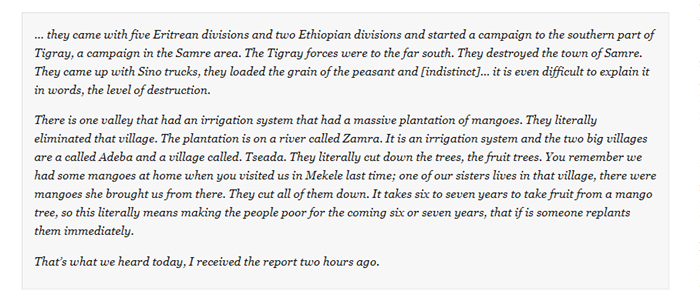
They came up with Sino trucks, they loaded the grain of the peasant and … it is even difficult to explain it in words, the level of destruction.
Well, somebody must have found the words to explain it, and then passed them along to Mulugeta, because he tells us a moment later,
That’s what we heard today, I received the report two hours ago.
In other words, “we” were nowhere near Samre, he was nowhere near Tseada. He can’t tell you what level of destruction happened, if it happened at all, because he didn’t see it for himself. We’re getting the news from a guy (de Waal) who knows a guy (Mulugeta) who knows a guy (anonymous… assuming he exists).

So I do think people should track down our courageous source!
Yoo-hoo, Mulugeta! Where are youuuuu?
We can even use #YoohooMulugeta to share tips and sightings.

On the other hand, as much as we all want to say howdy, maybe we don’t need to ask him after all. Maybe we should be asking someone else, because gawd knows, the Western media won’t bother to.

According to reliable sources on the ground, neither Ethiopian forces nor any other force apart from the TPLF were at the location.

And according to Mulu Nega, the head of the interim Tigray administration who sent a team out to investigate the claims, if the villages were impacted at all, it was from a distance because of fighting between the ENDF and TPLF forces which involved artillery and heavy machine guns.

And as for the mangoes? Well, there never was any plantation — only one farm of a single proprietor with TPLF sympathies who abandoned the land after the fighting.

The trees are still there. For that matter, so are the villagers, and if the mangoes are missing, they were picked by the villagers in the surrounding area.
Alex de Waal knows better than what he purported
says Mulu Nega,
for he has been a close confidante of the TPLF, and Mulugeta Gebrehiwot is a TPLF veteran and is still at large, hiding in the valleys. Therefore he shouldn’t consider and present Mulugeta’s allegations as authentic eyewitness accounts. That’s an utter deception and unbecoming.


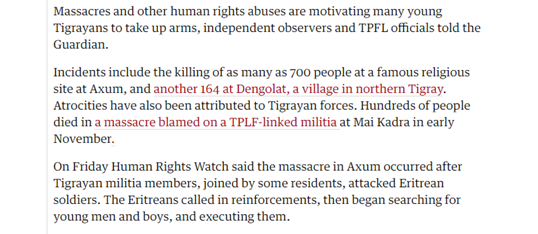
On one level, the latest allegations are outrageous — indeed, they’re ridiculous. But they’re also tragic because we are still seeing reporters for some of the most influential news operations in the world get sucked in and acting as propaganda delivery systems for the TPLF. Here is Jason Burke, a seasoned investigative reporter currently based in Johannesburg for The Guardian, from his report on March 8: https://www.theguardian.com/world/2021/ ... pia-tigray


Notice that the second paragraph attempts some balance. But why is the first paragraph have
independent observers and TPLF officials told the Guardian.
Why is there no comment at all from the government? Except mentioning near the bottom of the story the government’s more general denial statements. Did he even bother to ask for a fresh quote? If so, why is there not even a line addressing specific allegations, if only to say the government didn’t respond or denied them?

Notice that Burke mentions the alleged massacres at Axum and at Dengolat as if they are established fact and hangs this quick summary on the peg of the Human Rights Watch report, one with serious methodological flaws that replicate those of the initial Amnesty report.

As is proved with video footage of Axum taken on one of the days the massacre supposed to happen, along with other contradicting bits of evidence, https://jeffpearce.medium.com/ethiopia- ... 2f471c45ae the “massacre” is a lie.

You can stack up all the phone interviews you want, but you still can’t go back in time and erase people walking around peacefully under bright sunshine outside the very church where you claim celebrations were cancelled.

Now if there were killings around or near Axum on those dates, yes, they require urgent investigation, but this needs to be done properly — in Axum. Not just taking on faith a few phone calls and dubious satellite imagery. And The Guardian story gets worse:
The [Tigrayan] youth are very angry. Until recently, [the TPLF] couldn’t train or arm all of the volunteers that were coming to them … In recent days, they are telling them to come forward again,
said one TPLF administrative official who fled Tigray for a neighbouring province and is in touch with former colleagues there.

William Davison, an Ethiopia analyst with the International Crisis Group, said there were multiple accounts of young men joining the the military wing of the TPLF as news of atrocities spread.
There seems to be almost unanimous outrage … It’s very difficult to say how big the rebel force is now but all indicators suggests that manpower is not a problem,
he said.

Again, why is Burke not counter weighting this perspective of “very angry” Tigrayan youth with any specific response from government or military officials for the federal government? Even if true, why take this TPLF official’s damn word for it? How can you know?

And then… Ugh. Like the toe fungus that refuses to go away, there is William Davison. I guess we’re all supposed to ignore the fact that Davison was deported by Ethiopian authorities, and so has a clear conflict of interest in playing analyst of the situation. I guess we’re supposed to ignore, too, that Davison is infamous in policy circles for bullying those who contradict his analysis in public or that he runs Ethiopia Insight, playing “journalist” while also working as an analyst for Crisis Group.

But besides all that, why are you talking to this guy? When he’s Not. Even. There.

Modern journalism is so wonderful. You just call a guy who pulls assertions out of his àśs about “unanimous outrage” and “indicators.” Maybe it’s
very difficult to say how big the rebel force is now
because you have no genuine hard facts.

And since we’re talking about things pulled out of thin air, let’s circle back to Alex de Waal.

Because we’re left with a couple of other urgent questions: why was de Waal bothering to devote a short article to trees and mangoes instead of the greater horror that an entire town was destroyed? On Twitter, Ethiopians with good common sense already dismissed this nonsense with the hashtag #MangoGenocide.

But I’m wondering… Does he have another agenda?

Well, I have a theory. The UN Security Council is scheduled to have an open debate later this week on Food Security. Alex de Waal’s favorite topic these days when given the chance to talk about it is starvation, and his most recent book, in fact, is titled, Mass Starvation: The History and Future of Famine. But that tome is getting old…

Heyyyy, wouldn’t it be really useful if there was a current example that Alex could bring up to the policy wonks in New York? And that sure would keep his ideas relevant, wouldn’t it? Sure is convenient then that Mulugeta warned him just in time for the meeting, “Famine is coming.

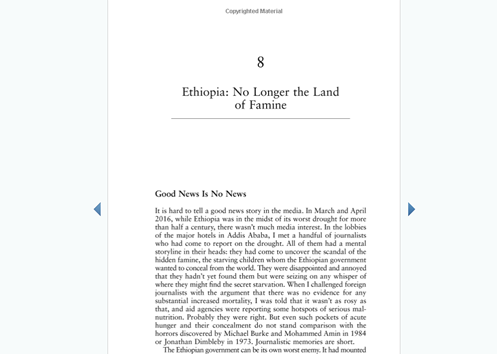
The book by de Waal includes this chapter:


It’s worth pausing here for insight into how de Waal thinks, because these lines leap off the page at me:

When I challenged foreign journalists with the argument that there was no evidence for substantial increased mortality, I was told that it wasn’t as rosy as that, and aid agencies were reporting some hotspots of serious malnutrition. Probably they were right. But even such pockets of acute hunger and their concealment do not stand comparison with the horrors discovered by Michael Burke and Mohammed Amin in 1974 or Jonathan Dimbleby in 1973. Journalistic memories are short.

On his last line, I agree. Heaven knows, I’ve witnessed the goldfish attention span of some reporters. I would even agree he’s right that “pockets” of acute hunger can’t compare with the “horrors” of past decades.

But look at his reasoning. He makes a denial. He’s told what aid agencies report from direct dealing with the populace, which certainly can’t be faked, and he even concedes probably they were right.
But instead of challenging his own assumption and investigating further, he dismisses these instances because “small” hunger isn’t as big a deal as “substantial mortality.” For Mr. de Waal, everything is relative, and he accepts what he likes to see and disregards the rest.

And he’s doing it again. Mulugeta is Scheherazade in the mountains (more likely, Mekelle) spinning tales of impossible army division numbers and fallen mango trees, and the Big Brain of the World Peace Foundation eats it up. And unfortunately, probably shares it all with U.S. intelligence officials and policy makers.

But de Waal’s blind admiration for the TPLF goes way back. In this same book, he reminds us,
In the mid-1980s, the people of Tigray were the epicentre of the great famine.
Okay.

He discusses the TPLF’s strategy, and a little later on come these stunning lines:
In due course, this commitment to the welfare of the people — and its ‘anti-famine policy contract’ — was reciprocated by a solid show of support for the TPLF and readiness to make enormous sacrifices in pursuit of its armed struggle.
These words were published in 2017. They are breathtaking in their display of a lack of integrity.

Because in 2010, the BBC published on its website its story: Ethiopia famine aid ‘spent on weaponshttp://news.bbc.co.uk/2/hi/8535189.stm — written by none other than the Africa editor at the time for the World Service, Martin Plaut.

Many Ethiopians already know this story and link it on social media all the time because it lays bare the truth. A senior TPLF member named Gebremedhin Araya, disguised as a Muslim merchant, swapped useless bags of sand for cash from aid workers, then handed the money off to his leaders, including Meles Zenawi. The theft was confirmed by the TPLF’s Aregawi Berhe, who told Plaut that they ripped off $100 million from the aid workers while leaving their own people hungry, spending the cash mostly on weapons
and building up a hard-line Marxist political party within the rebel movement.
Now there is no way that an experienced analyst like Alex de Waal, who keeps track of current affairs in Africa, could be unfamiliar with this reportage.

And it is not a case of the facts being in dispute. Plaut found two sources formerly with the TPLF itself who provided the details and admitted to the theft.

And yet Alex de Waal chose to ignore this and write what he did.

This is a man who gets quoted and interviewed by major media, whose lines appear in the Irish Times, who has a dangerous influence on the thinking of leaders in the EU, the UN and DC. And he falls for the equivalent of a teenager’s prank phone call, punking the international community in turn.

The hope is that we’re reaching a tipping point, because all the shameless lies are starting to add up that even U.S. and UN officials must soon see what’s been staring them in the face — if only they’d look. We’ve had the “battle-hardened” troops of the TPLF get humiliatingly crushed within a month. We’ve had the phony rape allegations of Mona Lisa Abraha, https://tesfanews.net/ethiopia-al-jazee ... formation/ outed by her own father. Instead of being a target for derision, I think she should be pitied for being manipulated, and her story is ultimately still tragic for her being a pawn and her making life harder for real victims of rape during wartime.

On top of all this, as the house of glass cracks in the alleged “Axum Massacre” narrative, we’re told hyenas ate the corpses on the mountain near the town, and the implication is that this is why investigators won’t find the mass graves promised in lurid witness accounts.

So, Human Rights Watch and the TPLF are now telling the world the dog ate their homework. As the Brits like to say, pull the other one.

And now #MangoGenocide. Like Trump’s final days, the bizarre attempts to deceive increase. But lest we forget — because it wasn’t so long ago — it was in those final days that Trump proved the most dangerous, his rabid goons storming the U.S. Capitol and getting people killed in the process.

Well, here’s why we should really be concerned. This is from the UN’s Office for the Coordination of Humanitarian Affairs: https://reports.unocha.org/en/country/ethiopia/

Following the announcement by the Ethiopian Office of the Prime Minister, on 3 March, that humanitarian agencies will have access to operate in Tigray on the basis of notification to the Ministry of Peace, humanitarian partners are working to increase the presence of staff on the ground as rapidly as possible…

Similarly, the Tigray People’s Liberation Front (TPLF), through a letter sent to the President of the United Nations Security Council, on 3 March, has expressed its readiness to facilitate humanitarian access to relief operations to areas under their control.

This should be setting off alarm bells in a BIG way. History could repeat itself, and we could see once again, aid operations and humanitarian initiatives unwittingly financing the TPLF, playing midwife to the rebirth of a terrorist organization that’s also successfully morphed into a criminal oligarchy.

But we need the UN to listen. Because the brains with the Biden administration aren’t listening, and for better or for worse, as they go, so might go the international community. Those who stand with Ethiopia need to get them to listen.

The world needs to know how flawed and riddled with lies and errors all this coverage is. America’s Secretary of State Antony Blinken needs to know just how badly Western media is failing Ethiopia.

And the world needs to know who Alex de Waal really is. Blinken needs to know who Alex de Waal really is. And once his credibility is shot, and no one at the State Department returns his calls anymore, we’ll see the Alex and Mulugeta Comedy Hour get cancelled. Mulugeta has been using his old colleague as a bullhorn, but when that stops, he’ll also be neutralized.

There will be no more tall, outlandish stories to tell. There will only be hiding. Possibly behind some mango trees.

Last edited by Zmeselo on 10 Mar 2021, 09:20, edited 1 time in total.

Zmeselo
Senior Member+
Posts: 37345
Joined: 30 Jul 2010, 20:43

Re: UNDP Memo Echoes Ethiopian Talking Points on Tigray

Post by Zmeselo » 10 Mar 2021, 01:27


Here is a 17 year old TPLF soldier who was shot and wounded by Amhara militias, after refusing to surrender. She said she refused to surrender, because she was told Amharas were savages and they would execute her. The Amhara militias took her to the hospital, and saved her life!
(Natnael Mekonnen: @NatnaelMekonne7)

_______________________


I received US Amb. to Ethiopia, H.E Geeta Pasi for an exchange of views on bilateral issues of both countries. Discussed on progresses made by the gov't of Ethiopia & additional assistances needed from the international community, regarding the humanitarian support in Tigray.
(Demeke Mekonnen Hassen: @DemekeHasen)

Post Reply