DECEMBER 27, 2020 BY JEAN-PIERRE FILIU
The threat in 2021 of a major Turkish offensive in Iraq
Intoxicated by his successive victories in Syria, Libya and the Caucasus, Erdogan may soon be tempted by a large-scale intervention in Iraqi Kurdistan, where his army is already carrying out occasional raids.
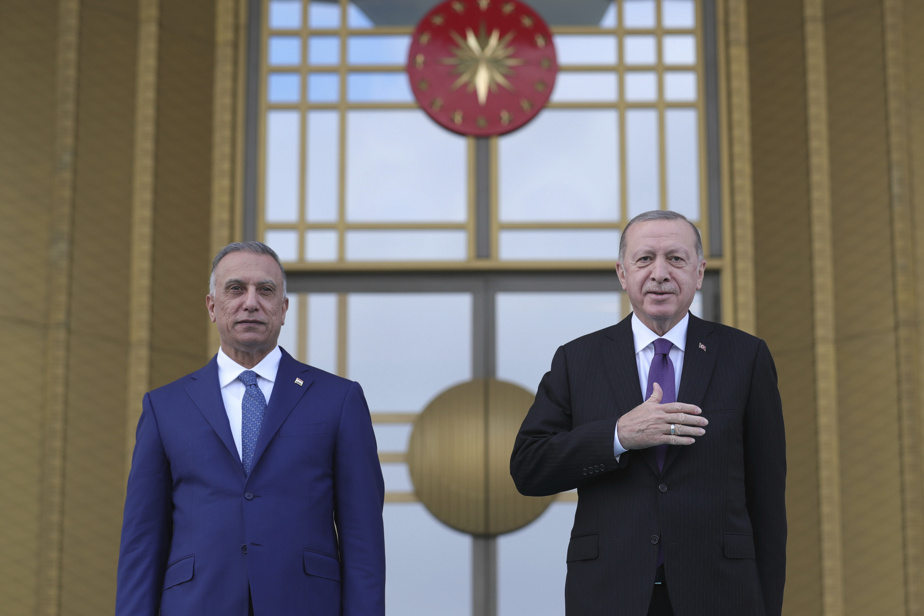
President Erdogan receiving the Iraqi Prime Minister, December 17 in Ankara (Turkish Presidency, via Associated Press)
In just over a year, the Turkish president has recorded three major successes on the regional scene: his October 2019 offensive in northeastern Syria enabled him to drive back Kurdish militias dozens of kilometers from the border Turkish and to break the territorial continuity of such a “ Kurdish belt” ; Ankara's commitment to the Tripoli government in January 2020 helped push back troops loyal to “Marshal” Haftar, forced to fall back to their April 2019 lines; Turkey's military support, by sending drones and Syrian mercenaries,was finally decisive in the victory of Azerbaijan against Armenia in the Nagorno-Karabakh conflict. Undoubtedly intoxicated by such a series of outbursts, Erdogan may be tempted by a new adventure, this time in Iraqi Kurdistan.
A LONG HISTORY OF TURKISH INTERVENTIONS IN IRAQ
The first Turkish raids in the north of Iraq, predominantly Kurdish, date back to 1984, when the Kurdistan Workers' Party (PKK) started a separatist guerrilla on Turkish territory. Saddam Hussein, then at war with Ayatollah Khomeini's Iran, had granted Ankara a right of intervention to a depth of 5 kilometers in Iraqi territory. Such an agreement then enabled the Turkish army to exercise a "droit de suite" against the Kurdish peshmerga, whose bases remained however out of reach. The PKK indeed very early on established its command and its camps in the heart of the Qandil massif,in the far northeast of Iraq, on the Iranian border. It was the beginning of a cycle of regular interventions by the Turkish army in Iraq, suspended only during the ceasefire between Ankara and the PKK, from 1999 to 2004, then during the peace process between the Erdogan government. and the Kurdish guerrillas, from 2013 to 2015.
The year 2020 was marked by a gradual intensification of Turkish raids in Iraq. Operation "Tiger Claws", launched last June, aimed, as in neighboring Syria, to free the border area, in Iraqi territory, of any PKK presence. It was doubled with an aerial component, "Eagle's Talon", which featured Turkish drones, whose effectiveness in the theaters of Libya and the Caucasus was noted. Baghdad's desire to assert its sovereignty in the area did not deter Ankara from continuing its systematic nibbling. In August 2020, three Iraqi soldiers, including two officers, were even killed in the Turkish bombing.of a meeting that these border guards held with PKK cadres. The protests from Baghdad went unanswered, which can only encourage Turkey to push its advantage further. Especially since the Kurdish context, very degraded, encourages it.
FAVORABLE KURDISH DISSENSIONS IN ANKARA
Everything opposes the Democratic Party of Kurdistan (PDK), at the head of the Kurdish autonomy of northern Iraq, and the PKK, linked on the other hand to the Patriotic Union of Kurdistan (PUK), the "enemy brother" of the PDK in Iraqi Kurdistan. The PDK, close to Ankara, is largely based on allegiance to the Barzani family, where the PKK, favorable to Tehran, fights traditional hierarchies. The PDK tolerates the establishment on Iraqi soil of a dozen Turkish military posts and has just concluded an agreement to expel the peshmerga linked to the PKK from Sinjar,who had nevertheless courageously defended there, in 2014, the Yazidis persecuted by Daesh. Never have the tensions between the PDK and the PKK been so strong, the PDK asserting its desire to get rid of the PKK's hold on its soil, and the PKK in return accusing the PDK of playing Ankara's game. In addition, the recent repression of a wave of social protests in Iraqi Kurdistan further weakens the credit of local authorities. As for the Iraqi Prime Minister, recently received by Erdogan in Ankara (photo above), he " condemned any action harming Turkey from Iraqi territory" , while his host undertook to " continue the fight until the eradication of terrorist gangs ” .
Turkey may be tempted to take advantage of Kurdish dissensions and the complacency of Baghdad to strike this time the PKK in the head and target the guerrilla headquarters in its natural fortress in the Qandil Mountains. The operation, whose scale would be unprecedented, would not be without risk in the face of peshmerga very familiar with these difficult to access reliefs. But the Turkish army now has the possibility of sending to the front line the Syrian mercenaries that it has already mobilized in Libya and Azerbaijan (where a tenth of the militiamen thus engaged have been killed).
In addition to this mercilessly exposed “cannon fodder”, the Turkish command, with its high-performance drones, has a weapon that has already proven its worth in the Caucasus mountains. Finally, we must not underestimate the excitement of Erdogan, reinforced in his offensive posture by his succession of external victories.
2021 would then see a new front added to the too many conflict zones already plaguing the Middle East.