Ethiopian News, Current Affairs and Opinion Forum
EthioRedSea
Member
Posts: 4089
Joined: 31 Aug 2019, 11:55

There are 360 miilion Bantu population in sub-sahara Africa( Galla, Amara, Kikiyu of Kenya, rwanda etc are some)

Post by EthioRedSea » 02 Aug 2020, 11:21

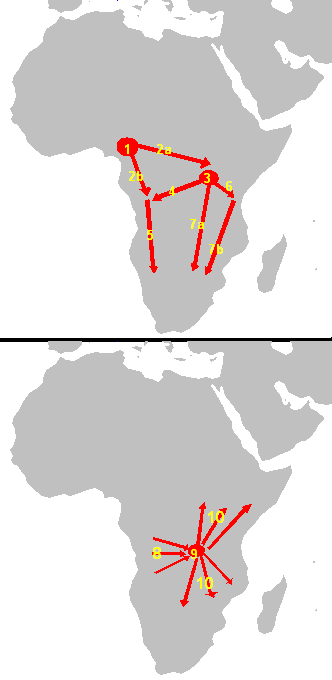
Bantu languages are theorised to derive from the Proto-Bantu reconstructed language, estimated to have been spoken about 4,000 to 3,000 years ago in West/Central Africa (the area of modern-day Cameroon). They were supposedly spread across Central, Eastern and Southern Africa in the so-called Bantu expansion, a rapid dissemination during the 1st millennium BC,[10] in one wave moving across the Congo basin towards East Africa, in another moving south along the African coast and the Congo River system towards Angola.[11] This concept has often been framed as a mass-migration, but Jan Vansina and others have argued that it was actually a cultural spread and not the movement of any specific populations that could be defined as an enormous group simply on the basis of common language traits.

The geographical origin of the Bantu expansion is somewhat open to debate. Two main scenarios are proposed, an early expansion to Central Africa, and a single origin of the dispersal radiating from there, or an early separation into an eastward and a southward wave of dispersal.[12] In terms of migration, genetic analysis shows a significant clustering of genetic traits by region, suggesting admixture from local populations.


EthioRedSea
Member
Posts: 4089
Joined: 31 Aug 2019, 11:55

Re: There are 360 miilion Bantu population in sub-sahara Africa( Galla, Amara, Kikiyu of Kenya, rwanda etc are some)

Post by EthioRedSea » 02 Aug 2020, 11:40

According to the early-split scenario described in the 1990s, the southward dispersal had reached the Central African rain forest by about 1500 BC, and the southern Savannahs by 500 BC, while the eastward dispersal reached the Great Lakes by 1000 BC, expanding further from there, as the rich environment supported a dense population. Possible movements by small groups to the southeast from the Great Lakes region could have been more rapid, with initial settlements widely dispersed near the coast and near rivers, due to comparatively harsh farming conditions in areas farther from water. Under the migration hypothesis, pioneering groups would have had reached modern KwaZulu-Natal in South Africa sometime prior to the 3rd century AD along the coast, and the modern Northern Province (encompassed within the former province of the Transvaal) by AD 500.[13]

Under the Bantu expansion migration hypothesis, the Bantu peoples would have assimilated and/or displaced a number of the presumed earlier inhabitants that they came across, such as Pygmy and Khoisan populations in the centre and south, respectively. They would have also encountered some Afro-Asiatic outlier groups in the southeast (mainly Cushitic),[14][15] as well as Nilotic and Central Sudanic groups. As cattle terminology in use amongst the few modern Bantu pastoralist groups suggests, it is plausible that the acquisition of cattle was from their Cushitic-speaking neighbors. Linguistic evidence also indicates that the custom of milking cattle was also directly from Cushitic cultures in the area.[16] Later interactions between Bantu-speaking and Cushitic-speaking peoples resulted in groups with significant complexity, such as the Tutsi and Hutu of the African Great Lakes region; and culturo-linguistic influences, such as the Herero herdsmen of southern Africa.[

EthioRedSea
Member
Posts: 4089
Joined: 31 Aug 2019, 11:55

Re: There are 360 miilion Bantu population in sub-sahara Africa( Galla, Amara, Kikiyu of Kenya, rwanda etc are some)

Post by EthioRedSea » 02 Aug 2020, 11:40

Between the 9th and 15th centuries, Bantu-speaking states began to emerge in the Great Lakes region and in the savannah south of the Central African rain forest. On the Zambezi river, the Monomatapa kings built the Great Zimbabwe complex, a civilisation ancestral to the Kalanga people.[19] Comparable sites in Southern Africa, include Bumbusi in Zimbabwe and Manyikeni in Mozambique.

From the 12th century onward, the processes of state formation amongst Bantu peoples increased in frequency. This was probably due to denser population (which led to more specialized divisions of labor, including military power, while making emigration more difficult); to technological developments in economic activity; and to new techniques in the political-spiritual ritualization of royalty as the source of national strength and health.[20] Some examples of such Bantu states include: in Central Africa, the Kingdom of Kongo, the Kuba Kingdom, the Lunda Empire, the Luba Empire, Tooro, Bunyoro, Buganda, Busoga, Rwanda, Burundi, Ankole and in Southern Africa, the Mutapa Empire, the Zulu Kingdom, the Ndebele Kingdom, Mapungubwe, the Kingdom of Butua, Maravi, Danamombe, Khami, Naletale, Kingdom of Zimbabwe[21] and the Rozwi Empire.[22]


On the coastal section of East Africa, a mixed Bantu community developed through contact with Muslim Arab and Persian traders, Zanzibar being an important part in the Arab slave trade. The Swahili culture that emerged from these exchanges evinces many Arab and Islamic influences not seen in traditional Bantu culture, as do the many Afro-Arab members of the Bantu Swahili people. With its original speech community centered on the coastal parts of Zanzibar, Kenya, and Tanzania – a seaboard referred to as the Swahili Coast – the Bantu Swahili language contains many Arabic loan-words as a result of these interactions.[23] The Arab slave trade also brought Bantu influence to Madagascar,[24] the Malagasy people showing Bantu admixture, and their Malagasy language Bantu loans.[25] Toward the 18th and 19th centuries, the flow of Zanj (Bantu) slaves from Southeast Africa increased with the rise of the Omani Sultanate of Zanzibar, based in Zanzibar, Tanzania. With the arrival of European colonialists, the Zanzibar Sultanate came into direct trade conflict and competition with Portuguese and other Europeans along the Swahili Coast, leading eventually to the fall of the Sultanate and the end of slave trading on the Swahili Coast in the mid-20th century.
Last edited by EthioRedSea on 02 Aug 2020, 12:08, edited 1 time in total.

EthioRedSea
Member
Posts: 4089
Joined: 31 Aug 2019, 11:55

Re: There are 360 miilion Bantu population in sub-sahara Africa( Galla, Amara, Kikiyu of Kenya, rwanda etc are some)

Post by EthioRedSea » 02 Aug 2020, 11:53

From the above historical analysis, it is clear the Amara are one of the bantu tribal groups that migrated to East Africa. They first settled in Bale and Wellega provinces of todays and were displaced by Galla or Oromo herdsmen. Now Bale and Wollega are inhabited by oromo or Galla speaking Bantus.

The Amara have thus little or no relationship to Aksumite Kingdom or Empire. The Amara were probably slaves of Tigrayans or as some suggest Tigray colonized Amara and used them as foot soldiers in their campaigns.

Post Reply